 USD
USD GBP
GBP  CNY
CNY  EUR
EUR  INR
INR  JPY
JPY  MYR
MYR  ZAR
ZAR  KRW
KRW  THB
THB 


Battery Materials Market, Global, 2025–2032
Supply Chain Localization, Regulatory Compliance, and Battery Performance Enhancement are Driving Transformational Growth
05-Feb-2026
Global
Market Research
PG5L-01-00-00-00
CM_2026_34338
Report Summary: Battery Materials Market
The global Battery Materials Market size was estimated at approximately USD 89.64 billion in 2025 and is projected to reach nearly USD 279.52 billion by 2032, expanding at a CAGR of 17.6% from 2025 to 2032. The rapid expansion of electric mobility, renewable energy storage systems, and advanced consumer electronics is driving significant demand across the lithium-ion battery materials market, positioning the Battery Material Market as a critical enabler of the global energy transition. Increasing investments in localized supply chains and next-generation battery chemistries are accelerating innovation and strengthening long-term market growth.
Key Market Trends & Insights
- Asia-Pacific remains the largest contributor to the Battery Materials Market, supported by strong manufacturing infrastructure and expanding EV production.
- Continuous advancements in cathode and anode technologies are enhancing energy density and performance across the lithium-ion battery materials market.
- Strategic partnerships between material suppliers, battery OEMs, and automotive manufacturers are reshaping the competitive landscape.
- Sustainability initiatives and recycling programs are gaining momentum within the Battery Material Market, driven by regulatory and environmental pressures.
- Emerging technologies such as sodium-ion and solid-state batteries are influencing future innovation strategies.
Market Size & Forecast
- 2025 Market Size: USD 89.64 Billion
- 2032 Projected Market Size: USD 279.52 Billion
- CAGR (2025–2032): 17.6%
- Largest Market: Asia-Pacific
- Growth Opportunity: Electrification and energy storage expansion
The accelerating shift toward electrification, coupled with technological advancements in material engineering, is expected to sustain strong growth across the Battery Materials Market as manufacturers continue to enhance performance, scalability, and sustainability within the evolving lithium-ion battery materials market ecosystem.
Market Overview: Battery Materials Market
The Battery Materials Market is transitioning from a traditional chemical supply model toward an integrated energy ecosystem driven by electrification and decarbonization goals. Rising demand from electric vehicles, renewable energy storage, and consumer electronics is transforming the lithium-ion battery materials market, requiring continuous innovation in material composition and performance optimization. Manufacturers are increasingly investing in high-nickel cathodes, silicon-enhanced anodes, and next-generation electrolyte formulations to enhance battery efficiency and safety.
Structural shifts within the Battery Material Market are also driven by geopolitical considerations and resource security. Governments across North America, Europe, and Asia are implementing incentives to localize production, reduce reliance on imported raw materials, and strengthen domestic battery supply chains. These initiatives are accelerating investment across the Battery Materials Market, encouraging collaboration between mining companies, chemical manufacturers, and battery OEMs.
Technological advancements such as solid-state batteries and sodium-ion chemistries are influencing long-term strategies across the lithium-ion battery materials market. While lithium-ion technology remains dominant, emerging alternatives are pushing suppliers to diversify material portfolios. The Battery Material Market is also seeing increased focus on recycling and circular economy models, as sustainability targets drive innovation in material recovery and reuse.
Overall, the Battery Materials Market is evolving toward a highly integrated ecosystem where material innovation, supply chain resilience, and sustainability initiatives determine competitive positioning.
Scope of Analysis: Battery Materials Market
The global Battery Materials Market analysis covers material innovation trends, supply chain developments, and strategic investments across cathode, anode, electrolyte, separator, and binder technologies. The study evaluates how advancements in the lithium-ion battery materials market influence performance metrics such as energy density, charging speed, and lifecycle durability.
Geographic coverage spans North America, Europe, Asia-Pacific, and other emerging markets, reflecting the global expansion of battery manufacturing capacity. The Battery Material Market assessment focuses on raw material sourcing, processing technologies, and downstream integration strategies that shape supplier competitiveness.
The analysis examines how regional regulations, sustainability mandates, and electrification targets influence the evolution of the Battery Materials Market. Particular attention is given to technological innovation, including next-generation chemistries and recycling initiatives that reduce environmental impact while supporting long-term growth across the lithium-ion battery materials market.
Market Segmentation Analysis: Battery Materials Market
The global Battery Materials Market is structured around multiple segmentation layers that reflect the evolving complexity of battery technologies and end-use applications. By material type, the Battery Material Market encompasses six primary categories, including cathode active materials (CAM), anode active materials (AAM), electrolytes, separators, binders, and adhesives and sealants. These materials collectively determine battery performance, lifecycle durability, and safety standards across the broader lithium-ion battery materials market. Continuous innovation in cathode chemistry and electrolyte composition is reshaping product strategies as manufacturers aim to enhance energy density and reduce overall production costs.
From an application perspective, the Battery Materials Market addresses demand across mobility, stationary energy storage, and consumer electronics. Electric vehicles remain a dominant driver within the lithium-ion battery materials market, while stationary storage applications are expanding rapidly due to renewable energy integration and grid stabilization requirements. Consumer electronics continue to contribute consistent demand, particularly for high-performance and compact battery solutions that rely on advanced material engineering.
Segmentation by battery type highlights lithium-ion batteries (LiB), sodium-ion batteries (SiB), and solid-state batteries (SSB), each representing distinct growth trajectories within the Battery Material Market. While lithium-ion technology currently leads adoption, emerging alternatives are influencing long-term material innovation strategies. Regionally, the Battery Materials Market spans the Americas, Europe, Asia-Pacific (APAC), and the Middle East, Africa, and South Asia (MEASA), reflecting global manufacturing expansion and increasing localization efforts across the lithium-ion battery materials market ecosystem.
Revenue & Spending Forecast: Battery Materials Market
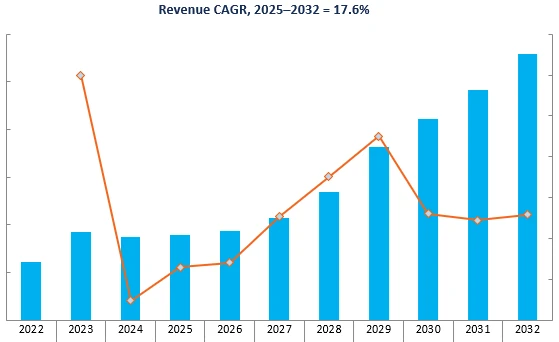
The global Battery Materials Market is projected to experience strong expansion driven by electrification trends, rising battery demand across mobility and stationary energy storage, and continuous innovation in cathode and anode chemistry. According to the revenue forecast chart on page 65, the market generated approximately USD 89.64 billion in 2025 and is expected to reach nearly USD 279.52 billion by 2032, reflecting a robust CAGR of 17.6% during 2025–2032.
Growth momentum in the lithium-ion battery materials market is largely supported by EV adoption, large-scale energy storage deployment, and improvements in battery performance metrics such as energy density and lifecycle durability. The forecast trajectory shows moderate growth between 2025 and 2026 as supply chains stabilize, followed by accelerated expansion from 2027 onward as next-generation battery chemistries and regional manufacturing incentives scale globally.
Revenue expansion within the Battery Material Market is influenced not only by volume growth but also by evolving chemistry mixes, price dynamics, and geopolitical factors shaping raw material sourcing. As highlighted in the revenue forecast analysis section, established lithium-ion technologies continue to dominate short- and mid-term demand, while emerging chemistries such as sodium-ion and solid-state batteries begin contributing toward the latter stages of the forecast period.
Additionally, pricing structures, regional incentives, and advancements in advanced materials—particularly cathode active materials—are expected to significantly influence revenue generation patterns. These factors collectively position the global Battery Materials Market for sustained double-digit growth as manufacturers optimize cost efficiency and performance across evolving battery architectures.
Growth Drivers: Battery Materials Market
The global Battery Materials Market is experiencing strong momentum driven by rising demand for advanced batteries across electric mobility, stationary energy storage, and consumer electronics applications. Increasing electrification across industries is significantly boosting material consumption, strengthening growth across the lithium-ion battery materials market. As EV adoption accelerates globally, manufacturers are scaling production capacity and investing in next-generation chemistries to enhance battery performance and energy density.
Technological innovation remains a key catalyst within the Battery Material Market. Continuous advancements in cathode materials, electrolyte formulations, and anode technologies are improving battery efficiency while enabling higher energy output and longer lifecycle performance. These innovations are also driving premium pricing opportunities, further supporting revenue expansion across the Battery Materials Market. Government incentives, subsidies, and regional funding initiatives are encouraging localization of battery supply chains, reinforcing investment in material development and manufacturing infrastructure.
Additionally, sustainability initiatives and environmental regulations are accelerating innovation in alternative chemistries such as sodium-ion batteries. The growing availability of raw materials like sodium offers cost advantages and enhances supply chain resilience, creating new opportunities within the lithium-ion battery materials market ecosystem. As battery demand expands across multiple industries, higher production volumes continue to strengthen the long-term growth outlook for the Battery Material Market.
Growth Restraints: Battery Materials Market
Despite strong expansion prospects, the Battery Materials Market faces several structural challenges that could moderate growth. One of the primary restraints is the complexity associated with scaling advanced battery technologies, particularly solid-state batteries, where manufacturing processes remain technically demanding and costly. These challenges create uncertainty around commercialization timelines within the lithium-ion battery materials market and emerging alternatives.
Competition from evolving battery chemistries also presents a constraint for traditional lithium-ion materials. Advances in sodium-ion and other alternative technologies are reshaping demand patterns, potentially limiting growth opportunities in certain segments of the Battery Material Market. Material stability and energy density challenges continue to influence adoption rates, particularly for new chemistries entering the commercialization phase.
Safety concerns associated with lithium-based batteries, including thermal management and lifecycle reliability, remain another key restraint across the Battery Materials Market. Additionally, increasing investment in alternative technologies may divert resources away from established lithium-ion materials, creating competitive pressure and pricing challenges within the lithium-ion battery materials market. These factors collectively highlight the need for ongoing innovation and strategic partnerships to sustain long-term market growth.
Competitive Landscape: Battery Materials Market
The global Battery Materials Market is highly competitive, with more than 250 participants operating across cathode, anode, electrolyte, separator, and specialty material segments. Market dynamics are shaped by continuous innovation, supply chain localization strategies, and the development of materials with improved price–performance ratios. Companies competing within the lithium-ion battery materials market are increasingly forming partnerships and joint initiatives to secure long-term supply agreements and accelerate commercialization of advanced battery chemistries.
Key end-user industries driving competition in the Battery Material Market include electric mobility, stationary energy storage systems, and consumer electronics, all of which require high-performance materials capable of supporting energy density and lifecycle improvements. Leading companies such as Sumitomo Metal Mining, XTC New Energy Materials (Xiamen) Co., LTD, Tianjin, and Ronbay maintain strong positions by leveraging advanced research capabilities, scalable manufacturing infrastructure, and strategic collaborations with battery OEMs.
The top four competitors collectively account for approximately 20%–25% of market revenue, highlighting a fragmented yet innovation-driven competitive environment. In addition to market leaders, notable participants such as BTR, Shanghai Shanshan, Resonac, Tinci, Capchem, Guotai Huarong, Solvay, Kureha, Arkema, Zeon, 3M Company, Henkel, Dow, and Sika AG contribute to the evolving ecosystem through specialized material development and niche technology expertise. Distribution strategies across the Battery Materials Market typically combine direct sales with distributor networks, enabling suppliers to expand global reach while maintaining close relationships with OEM customers and battery manufacturers.
Research Coverage
Scope of Analysis
Segmentation
Cell Architectures and Battery Design Trends
Why is it Increasingly Difficult to Grow?
The Strategic Imperative 8™
The Impact of the Top 3 Strategic Imperatives on the Battery Materials Industry
Value Chain Analysis
Raw Material Trends
Key Mergers and Acquisitions
Joint Ventures and Partnerships in the LiB Landscape
Joint Ventures and Partnerships in the SiB Landscape
Joint Ventures and Partnerships in the SSB Landscape
Battery Material Recycling Landscape
Recycling Trends
Competitive Environment
Key Competitors
Growth Metrics
Drivers and Restraints Overview
Growth Drivers
Growth Driver Analysis
Growth Restraints
Growth Restraint Analysis
Opportunities for Materials
Forecast Assumptions
Adoption Levels of Next-Generation Battery Materials
Revenue Forecast
Revenue Forecast by Material Type
Revenue Forecast Analysis
Revenue Forecast by Region
Analysis by Region
Revenue Forecast by End-application
Analysis by End-Application
Revenue Forecast by Battery Type
Analysis by Battery Type
Pricing Analysis
Segment Overview
Cathode Chemistries and Key Application Trends
Growth Metrics
Revenue and Volume Forecast
Revenue and Volume Forecast Analysis
Regional Analysis
Volume Forecast by Chemistry
Volume Forecast Analysis by Chemistry
Average Price Forecast
Average Price Analysis
Competitive Environment
Revenue Share
Segment Overview
Anode Chemistries and Key Application Trends
Growth Metrics
Revenue and Volume Forecast
Revenue and Volume Forecast Analysis
Volume Forecast by Chemistry
Volume Forecast Analysis by Chemistry
Regional Analysis
Average Price Forecast
Average Price Analysis
Competitive Environment
Revenue Share
Segment Overview
Electrolyte Materials Overview
Solid Versus Liquid Electrolytes
Types of Solid-State Electrolytes
Growth Metrics
Revenue and Volume Forecast
Revenue and Volume Forecast Analysis
Solid-State Battery Initiatives
Volume Forecast by Chemistry
Volume Forecast Analysis by Chemistry
Regional Analysis
Average Price Analysis
Competitive Environment
Revenue Share
Segment Overview
Binder Materials Overview
Growth Metrics
Revenue and Volume Forecast
Revenue and Volume Forecast Analysis
Volume Forecast by Chemistry
Volume Forecast Analysis by Chemistry
Regional Analysis
Average Price Forecast
Average Price Analysis
Competitive Environment
Segment Overview
Growth Metrics
Revenue and Volume Forecast
Revenue and Volume Forecast Analysis
Volume Forecast by Chemistry
Analysis by Chemistry
Regional Analysis
Average Price Forecast
Average Price Forecast and Analysis
Competitive Environment
Revenue Share
Segment Overview
Growth Metrics
Revenue and Volume Forecast
Revenue and Volume Forecast Analysis
Volume Forecast by Chemistry
Analysis by Chemistry
Regional Analysis
Average Price Forecast and Trends
Competitive Environment
Revenue Share
Growth Opportunity 1: Developing Repairable and Recyclable Batteries
Growth Opportunity 2: Potential/Upcoming Ban on PFAS to Open Up Opportunities for Alternative Materials/Chemistries
Growth Opportunity 3: Developing Chemistry-agnostic Materials that are Suitable for All Battery Platforms
Growth Opportunity 4: Leverage AI and Machine Learning Tools to Speed Up Material Development
Growth Opportunity 5: Localization of Battery Supply Chains
Growth Opportunity 6: Use of Tapes as Multifunctional Materials
Growth Opportunity 7: Changing Battery Designs Accelerate the Demand for Diverse Material Types
Growth Opportunity 8: Evolving SIB and SSB Designs will Create New Opportunities for Coatings
Growth Opportunity 9: Scaling UV Technologies will Enable Higher Throughput and Reliability in Battery Manufacturing
Benefits and Impacts of Growth Opportunities
Next Steps
List of Exhibits
Legal Disclaimer
Frequently Asked Questions (FAQ) – Battery Materials Market
1. What is the Battery Materials Market?
2. What is driving growth in the lithium-ion battery materials market?
3. What is the expected CAGR of the Battery Material Market?
4. Which regions dominate the Battery Materials Market?
5. What types of materials are included in the Battery Material Market?
6. How do electric vehicles impact the Battery Materials Market?
7. What challenges affect the lithium-ion battery materials market?
8. Who are the major players in the Battery Material Market?
9. What role does sustainability play in the Battery Materials Market?
10. What future trends will shape the Battery Material Market?
Speak directly with our analytics experts for tailored recommendations.
Recent related Specialty Chemicals research
09 Oct 2026 | Global | Technology Research
Innovations in Transparent Ceramics, Biomaterials, Compostable Bioplastics, Graphite, Silica Foam, Aerogels, and Other Advanced Materials for Diverse Applications
This issue of High-Tech Materials Technology Opportunity Engine (TOE) profiles significant advances in high-tech materials for various industrial applications. The featured innovations include Large-sized Transparent and Bonded Ceramics for High-Power Laser Systems, High-Strength Transparent Alumina...
08 Oct 2026 | South Asia, Middle East & North Africa | Market Research
Growth Opportunities for Sulphur Derivatives in MENA, 2025–2030
The MENA region plays a critical role in global sulphur supply; however, a significant share of value creation remains concentrated in exports and commodity derivatives. As global demand evolves and advanced applications for sulphur-based products gain momentum, the region’s competitive advantage li...
02 Oct 2026 | Global | Technology Research
Innovations in Nanotechnology Including Nanocoatings, Nanolithography, Carbon Nanotubes, Nanofluids, Graphene, Ceramic Aerogels, Nanocatalysts, and Nanocomposites
This issue of the Nanotechnology Opportunity Engine profiles significant advances in nanotechnology for various industrial applications. The featured innovations include Sulfate-Free CNCs for Versatile Applications, Contact-Active Antimicrobial Nanocoating With Broad-Spectrum Protection, Nanoimprint...
29 Sep 2026 | Global | Market Research
Electronic Chemical Market, Global, 2025–2032
Electronic chemicals constitute a foundational input to semiconductor, printed circuit board (PCB), and flat panel display (FPD) manufacturing, underpinning the precision, purity, and performance requirements of increasingly sophisticated electronic devices. This study presents a comprehensive analy...
18 Sep 2026 | Global | Technology Research
Innovations in Surface Technologies for Automotive Coatings, Protective Coatings, Oleophobic Coatings, Plasma Coatings, Icephobic Coatings, and Others
This edition of the Advanced Coating & Surface Technology Opportunity Engine profiles significant advances in advanced coatings and surface treatments for various industrial applications. The featured innovations include Ultra-Black Nanocarbon Coatings for Next-Generation Automotive Surface Finishes...
Purchase includes:
- Report download
- Growth Dialog™ with our experts
Growth Dialog™
A tailored session with you where we identify the:- Strategic Imperatives
- Growth Opportunities
- Best Practices
- Companies to Action
Impacting your company's future growth potential.
The study analyzes the above-mentioned materials used in lithium-ion batteries (LIBs), sodium-ion batteries (SIBs), and solid-state batteries (SSBs). These batteries are used across mobility, stationary storage, and consumer electronics applications, and the study analyzes the penetration of the above-mentioned battery types across these key end-applications. The report offers global coverage, with regional analysis focused on the Americas, Europe, Asia-Pacific (APAC), and the Middle East, South Asia, and Africa (MEASA). Each segment provides a detailed analysis of chemistry trends within various battery materials. The analysis also provides a segment-level competitive analysis.
The study concludes by summarizing 9 growth opportunities for stakeholders across the value chain and around the battery materials ecosystem.
Key Questions the Study Aims to Answer: What was the size of the battery materials market in 2025, and what is the expected size by 2032? At what rate is the market growing? What are the key technological and product innovations across different battery materials, and what is their future impact? How will regulations affect the market? Who are the market leaders, and what are the product and technology innovations key participants are targeting across different end applications/regions/chemistries and battery types? How does the value chain work, and what are the important dynamics among the value chain stakeholders?
Author: Soundarya Gowrishankar
| Deliverable Type | Market Research |
|---|---|
| Industries | Chemicals and Materials |
| No Index | No |
| Is Prebook | No |
| Keyword 1 | Battery Materials Market |
| Keyword 2 | Lithium-Ion Battery Materials |
| Keyword 3 | Next-Generation Battery Chemistries |
| Podcast | No |
| Predecessor | PEB2-01-00-00-00 |
| WIP Number | PG5L-01-00-00-00 |