 USD
USD GBP
GBP  CNY
CNY  EUR
EUR  INR
INR  JPY
JPY  MYR
MYR  ZAR
ZAR  KRW
KRW  THB
THB 


Compliance Automation Is Experiencing Transformational Growth Driven by Continuous Compliance, AI Integration, and Evolving Regulatory Complexity
11-Jun-2026
Global
Market Research
PLAA-01-00-00-00
AE_2026_34651
Key Takeaways: Compliance Automation Market
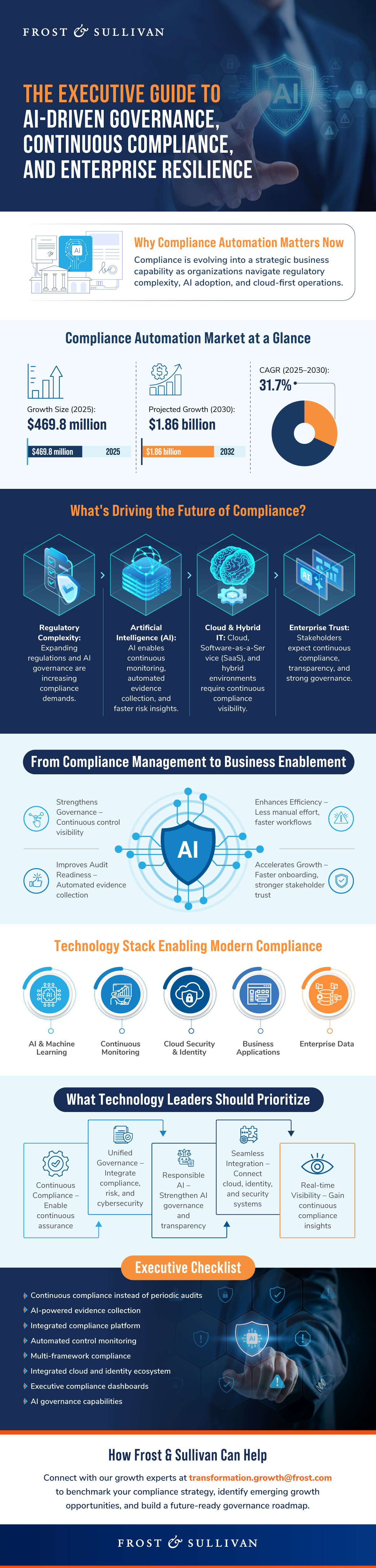
- The global Compliance Automation Market is projected to grow from USD 469.8 million in 2025 to approximately USD 1.86 billion by 2030, registering a robust CAGR of 31.7% during the forecast period.
- Increasing regulatory complexity and the emergence of AI governance requirements are accelerating demand for automated compliance solutions.
- Organizations are shifting from periodic audits to continuous compliance monitoring, creating significant opportunities for compliance automation platforms.
- Growing adoption of cloud computing, SaaS ecosystems, and hybrid IT environments is driving demand for centralized compliance management tools.
- Compliance automation is increasingly viewed as a strategic business enabler that improves audit readiness, customer trust, and operational efficiency.
- Integration of compliance, risk management, governance, and cybersecurity functions is becoming a key market trend.
- AI-powered compliance monitoring, automated evidence collection, and real-time control validation are reshaping compliance operations.
- North America remains the leading market, while Asia-Pacific is emerging as a high-growth region due to digital transformation initiatives.
- Leading vendors include Vanta, Drata, Scytale, Sprinto, and Thoropass.
- Integration complexity, organizational resistance to automation, and implementation challenges remain key market restraints.
- Banking, financial services, technology, manufacturing, retail, and education sectors are among the largest adopters of compliance automation solutions.
Report Summary: Compliance Automation Market
The global Compliance Automation Market is experiencing rapid expansion as organizations face increasing regulatory obligations, cybersecurity requirements, and governance challenges across digital business environments. Traditional compliance programs have historically relied on manual evidence collection, periodic audits, spreadsheets, and labor-intensive processes that struggle to scale within modern cloud-native infrastructures.
Compliance automation platforms address these challenges by automating evidence gathering, control monitoring, risk assessments, policy management, and audit preparation. These solutions provide organizations with real-time visibility into compliance posture while reducing administrative workloads and operational costs.
The market is benefiting from the growing adoption of cloud services, SaaS applications, artificial intelligence technologies, and remote work environments. Organizations increasingly require automated compliance capabilities to manage frameworks such as SOC 2, ISO 27001, GDPR, HIPAA, PCI DSS, NIST, and emerging AI governance regulations.
As regulatory complexity continues to increase, compliance automation is evolving from a back-office function into a strategic capability that supports business growth, accelerates customer onboarding, and improves operational resilience.
Market Overview & Trends: Compliance Automation Market
The global Compliance Automation Market is undergoing a significant transformation driven by the convergence of digital transformation, cybersecurity requirements, and evolving regulatory frameworks. Organizations across industries are seeking scalable solutions that enable continuous compliance rather than relying on periodic assessments and manual audit preparation.
One of the most important trends shaping the market is the shift toward continuous compliance monitoring. Businesses increasingly require real-time visibility into control effectiveness and compliance status across cloud, SaaS, and hybrid environments. Compliance automation platforms provide ongoing monitoring capabilities that reduce risk and improve audit readiness.
Another major trend is the integration of artificial intelligence into compliance workflows. AI-powered platforms can automatically identify compliance gaps, map controls to multiple frameworks, generate audit evidence, and support risk assessments. As AI regulations evolve globally, organizations are also leveraging compliance automation tools to manage AI governance requirements.
The increasing complexity of IT environments is further accelerating market demand. Organizations often operate across multiple cloud providers, software platforms, and cybersecurity tools. Compliance automation solutions help unify data sources and streamline compliance processes through centralized management capabilities.
Customer expectations are also influencing adoption. Enterprise buyers increasingly require vendors to demonstrate compliance certifications before entering into business agreements. As a result, organizations are investing in compliance automation to accelerate security reviews and shorten sales cycles.
Additionally, compliance automation is becoming closely aligned with broader governance, risk, and compliance (GRC) initiatives. Vendors are expanding capabilities beyond compliance management to include risk monitoring, third-party assessments, policy management, and cybersecurity governance.
These trends are expected to support strong market growth throughout the forecast period.
Scope of Analysis: Compliance Automation Market
This analysis evaluates the global Compliance Automation Market, focusing on vendors offering dedicated compliance automation platforms and capabilities integrated within broader governance, risk, and compliance (GRC) solutions.
The study covers technologies that automate evidence collection, control monitoring, risk assessments, compliance reporting, policy management, audit readiness, and continuous compliance monitoring. These platforms typically integrate with cloud infrastructure, SaaS applications, identity systems, cybersecurity tools, and operational workflows.
Geographic coverage includes North America, Europe, the Middle East and Africa (EMEA), Asia-Pacific (APAC), and Latin America (LATAM). The analysis primarily focuses on mature compliance markets while also evaluating emerging opportunities in developing regions.
The report covers the period from 2024 to 2030, with 2025 serving as the base year and 2026–2030 representing the forecast period. Revenue estimates are presented in U.S. dollars.
The scope also includes market drivers, restraints, regional developments, competitive dynamics, technology innovations, and future growth opportunities across the compliance automation ecosystem.
Market Segmentation Analysis: Compliance Automation Market
The global Compliance Automation Market can be segmented by region, industry vertical, and deployment requirements.
By Region
North America leads the global market due to strong regulatory enforcement, advanced cloud adoption, and increasing demand for continuous compliance monitoring. Organizations are actively replacing manual compliance workflows with automated platforms.
Europe, Middle East, and Africa (EMEA) represents one of the most regulation-driven markets. Frameworks such as GDPR, NIS2, DORA, and the EU AI Act are encouraging organizations to invest in automated compliance capabilities.
Asia-Pacific (APAC) is emerging as a high-growth region. Increasing cloud adoption, expanding digital economies, and evolving regulatory requirements are driving demand for scalable compliance solutions across industries.
Latin America (LATAM) remains an emerging market with growing adoption among large enterprises, financial institutions, and multinational organizations seeking compliance with global standards.
By Industry Vertical
Key industry segments include:
- Technology
- Banking, Financial Services, and Insurance (BFSI)
- Manufacturing
- Retail and E-commerce
- Media and Entertainment
- Education
- Healthcare
- Professional Services
Technology companies and BFSI organizations represent the largest adopters due to strict compliance obligations and extensive digital operations.
By Compliance Framework
Organizations utilize automation platforms to manage:
- SOC 2
- ISO 27001
- HIPAA
- GDPR
- PCI DSS
- NIST
- DORA
- AI Governance Frameworks
The ability to support multiple frameworks simultaneously is becoming a key purchasing criterion.
Revenue & Spending Forecast: Compliance Automation Market
The global Compliance Automation Market is forecast to experience exceptional growth through 2030. Market revenue is expected to increase from USD 469.8 million in 2025 to approximately USD 1.86 billion by 2030, representing a CAGR of 31.7%.

Spending will be driven by investments in continuous compliance monitoring, audit automation, AI-powered compliance tools, cloud security governance, and integrated risk management platforms. Demand from technology firms, financial institutions, and regulated industries will account for a significant share of overall market revenue.
Growth Drivers: Compliance Automation Market
Several factors are accelerating growth within the global Compliance Automation Market.
The primary growth driver is the increasing complexity of regulatory requirements. Organizations must comply with a growing number of cybersecurity, privacy, operational resilience, and AI governance regulations, making manual compliance processes unsustainable.
The transition toward continuous compliance monitoring is another major driver. Businesses require real-time visibility into controls and compliance status to reduce risk and improve operational resilience.
Organizations are also seeking ways to improve efficiency without significantly increasing headcount. Compliance automation reduces manual workloads, streamlines audit preparation, and enables compliance teams to manage larger programs with fewer resources.
Additionally, the growing complexity of cloud environments, SaaS ecosystems, and cybersecurity infrastructures is increasing demand for integrated platforms that provide centralized visibility and control.
The rise of AI governance requirements is expected to create new growth opportunities as organizations seek automated tools capable of managing compliance across emerging AI regulations.
Growth Restraints: Compliance Automation Market
Despite strong growth prospects, several challenges may limit market expansion.
Integration complexity remains a significant barrier. Many organizations operate fragmented IT environments that make it difficult to connect systems and establish reliable data flows required for automated compliance.
Limited internal maturity and unclear ownership structures can also hinder implementation efforts. Compliance responsibilities are often distributed across multiple teams, making governance and accountability challenging.
Organizational resistance to change represents another obstacle. Transitioning from manual, audit-driven processes to automated compliance workflows often requires cultural and operational adjustments.
Mid-sized organizations may also face budget constraints and uncertainty regarding return on investment, delaying purchasing decisions and slowing adoption rates.
Addressing these challenges will be critical for vendors seeking to expand market penetration and accelerate customer success.
Competitive Landscape: Compliance Automation Market
The global Compliance Automation Market remains relatively concentrated, with more than 10 major vendors competing across compliance management, audit automation, and governance technology segments.
Competition is based on platform functionality, workflow automation capabilities, ease of implementation, integration flexibility, customer support, compliance framework coverage, pricing, and overall user experience.
Leading competitors include Vanta, Drata, Scytale, Sprinto, and Thoropass, all of which offer comprehensive compliance automation solutions targeting technology companies, financial institutions, and regulated enterprises.
Other notable competitors include Scrut Automation, CyberSaint, Strike Graph, Centraleyes, and SureCloud, each providing specialized capabilities within governance, risk, and compliance ecosystems.
The top three competitors collectively account for approximately 64.1% of market revenue, indicating a relatively concentrated competitive landscape.
Strategic acquisitions are shaping market dynamics. Recent notable transactions include Drata's acquisition of SafeBase, Scytale's acquisition of AudITech, and Vanta's acquisition of Riskey. These acquisitions reflect increasing consolidation and vendor efforts to expand platform capabilities.
Scope of Analysis
Regional Segmentation
Why Is It Increasingly Difficult to Grow?
The Strategic Imperative 8™
The Impact of the Top 3 Strategic Imperatives on the Compliance Automation Industry
Definition
Revenue Estimate Disclaimer
Research Methodology
Inclusion and Exclusion of Vendors
Key Findings: Summary
Key Findings: Evolution of Compliance Automation from Audit Function to Trust Enabler
Key Findings: From Continuous Compliance to Real-Time, AI-Driven Assurance
Key Findings: Rise of Unified Platforms and Integration as a Differentiator
Key Findings: Embedding Compliance into Digital and AI-Driven Operations
Future of Compliance Automation
Customer Preferences
Key Regulations and Frameworks
Competitive Environment
Key Competitors
Growth Metrics
Growth Drivers
Growth Driver Analysis
Growth Restraints
Growth Restraint Analysis
Forecast Considerations
Revenue Forecast
Revenue Forecast by Region
Revenue Forecast Analysis
Revenue Share by Region
Pricing Trends and Forecast Analysis
Revenue Share of Key Vendors
Growth Metrics
Revenue Forecast
Revenue Forecast Analysis
Revenue Share of Key Vendors
Growth Metrics
Revenue Forecast
Revenue Forecast Analysis
Revenue Share of Key Vendors
Compliance Automation: CISO Concerns
Evaluating Compliance Automation: Insights and Recommendations
Growth Opportunity 1: AI-Native Compliance and Governance Platforms
Growth Opportunity 2: Platform Consolidation and Unified Risk-Compliance Solutions
Growth Opportunity 3: Expansion into Mid-Market and Global Adoption
Benefits and Impacts of Growth Opportunities
Next Steps
List of Exhibits
Legal Disclaimer
Frequently Asked Questions (FAQs) – Compliance Automation Market
1. What is the Compliance Automation Market?
The Compliance Automation Market comprises software platforms and solutions that automate compliance management processes, including evidence collection, control monitoring, audit preparation, risk assessments, policy management, and regulatory reporting. These solutions help organizations maintain continuous compliance while reducing manual effort and operational costs.
2. What is driving growth in the Compliance Automation Market?
Key growth drivers include increasing regulatory complexity, rising adoption of cloud and SaaS environments, growing demand for continuous compliance monitoring, expansion of AI governance requirements, and the need to improve operational efficiency through automated compliance workflows.
3. What is the projected growth rate of the Compliance Automation Market?
The Compliance Automation Market is expected to grow at a CAGR of approximately 31.7% between 2025 and 2030, making it one of the fastest-growing segments within governance, risk, and compliance technologies.
4. Which industries are the primary adopters of compliance automation solutions?
Major adopters include technology companies, banking and financial services institutions, insurance providers, manufacturing firms, retail and eCommerce businesses, healthcare organizations, educational institutions, and professional service providers that must comply with various regulatory frameworks.
5. What are the benefits of compliance automation platforms?
Compliance automation platforms improve audit readiness, reduce manual workloads, streamline evidence collection, enhance visibility into compliance posture, support continuous monitoring, accelerate certification processes, and help organizations manage multiple regulatory frameworks more efficiently.
6. Which compliance frameworks are commonly supported by compliance automation solutions?
Most compliance automation platforms support major frameworks such as SOC 2, ISO 27001, GDPR, HIPAA, PCI DSS, NIST, DORA, CIS Controls, and emerging AI governance and cybersecurity regulations.
7. How does artificial intelligence impact the Compliance Automation Market?
Artificial intelligence enhances compliance automation by enabling automated evidence collection, risk analysis, policy mapping, anomaly detection, regulatory change monitoring, and predictive compliance assessments. AI helps organizations improve efficiency and respond more quickly to evolving compliance requirements.
8. What challenges are affecting the Compliance Automation Market?
Key challenges include integration complexity across fragmented IT environments, limited organizational maturity, unclear compliance ownership, resistance to process changes, implementation costs, and difficulties in demonstrating return on investment for smaller organizations.
9. Who are the leading companies in the Compliance Automation Market?
Leading vendors in the Compliance Automation Market include Vanta, Drata, Scytale, Sprinto, Thoropass, Scrut Automation, CyberSaint, Strike Graph, Centraleyes, and SureCloud. These companies provide solutions that support continuous compliance, audit readiness, and governance management.
10. What is the future outlook for the Compliance Automation Market?
The future outlook for the Compliance Automation Market remains highly positive as organizations increasingly adopt continuous compliance models, AI-powered governance tools, and integrated risk management platforms. Growing regulatory scrutiny and expanding digital ecosystems are expected to drive strong market growth through 2030 and beyond.
Speak directly with our analytics experts for tailored recommendations.
Recent related Security research
09 Oct 2026 | Global | Technology Research
Growth Opportunities in SiC MOSFET, Photodiodes, RISC-Vs, and Advanced Memory
The Microelectronics Technology Opportunity Engine covers innovations pertaining to SiC MOSFET, Photodiodes, RISC-Vs, and Advanced Memory.The Microelectronics Technology Opportunity Engine captures global electronics-related innovations and developments on a weekly basis. Developments are centered o...
09 Oct 2026 | Global | Frost Radar
Frost Radar™: Workforce Identity and Access Management, 2026
Hybrid work and software as a service have shifted security enforcement from the network perimeter to identity, transforming it into a control plane. Workforce identity and access management (IAM) now determines whether every user, device, and session should retain access based on context, risk, and...
07 Oct 2026 | Global | Frost Radar
Frost Radar™: Network Detection and Response, 2026
The rapid evolution of enterprise IT environments, driven by cloud adoption, connected devices, and hybrid infrastructure, has rendered legacy perimeter defenses inadequate. Network detection and response (NDR) has become a strategic imperative, providing continuous visibility across network traffi...
05 Oct 2026 | Global | Market Research
Workforce IAM and IGA, Global, 2025–2030
The workforce identity and access management (IAM) and identity governance and administration (IGA) market is a critical component of modern cybersecurity and digital transformation strategies. As organizations continue to adopt cloud services, hybrid work models, artificial intelligence, and increa...
24 Sep 2026 | Global | Market Research
Insights for CISOs: Securing Software Supply Chains in the Age of AI
Software supply chain security (SSCS) is increasingly a strategic business imperative as organizations rely more on open-source software, cloud-native architectures, AI-driven development, and autonomous development workflows. Modern software supply chains now extend beyond traditional code reposito...
Purchase includes:
- Report download
- Growth Dialog™ with our experts
Growth Dialog™
A tailored session with you where we identify the:- Strategic Imperatives
- Growth Opportunities
- Best Practices
- Companies to Action
Impacting your company's future growth potential.
As regulatory requirements expand and organizations operate across cloud, SaaS, and AI-driven environments, compliance automation has become a foundational capability for continuous monitoring and centralized visibility into control effectiveness. This enables organizations to move beyond reactive, audit-driven practices toward more proactive and scalable compliance management.
Organizations are increasingly adopting compliance automation to streamline workflows, reduce duplication, and maintain audit-ready evidence across multiple frameworks and business units. These capabilities improve operational efficiency while supporting more consistent and standardized compliance programs at scale.
Compliance is also increasingly viewed as more than a cost center. It is becoming a strategic business enabler that supports customer trust, accelerates security reviews, and improves organizational agility. Its growing influence on revenue generation stems from faster audit readiness, standardized processes that reduce sales friction and shorten deal cycles, and continuous monitoring that improves responsiveness to customer and auditor requests. As a result, organizations are leveraging compliance automation not only to strengthen governance and efficiency but also to support revenue growth, enhance customer confidence, and create competitive differentiation.
The study period is 2024–2030, with 2025 as the base year and 2026–2030 as the forecast period. Regions covered include North America; Europe, the Middle East, and Africa; Asia-Pacific; and Latin America.
Author: Vivien Pua
| Deliverable Type | Market Research |
|---|---|
| Industries | Aerospace, Defence and Security |
| No Index | No |
| Is Prebook | No |
| Keyword 1 | Compliance Automation Market |
| Keyword 2 | continuous compliance monitoring platforms |
| Keyword 3 | automated evidence collection software |
| Podcast | No |
| Predecessor | PFUZ-01-00-00-00 |
| WIP Number | PLAA-01-00-00-00 |