 USD
USD GBP
GBP  CNY
CNY  EUR
EUR  INR
INR  JPY
JPY  MYR
MYR  ZAR
ZAR  KRW
KRW  THB
THB 


Computed Tomography in Dimensional Metrology Market, Global, 2024–2030
Industrial Adoption is Driving Computed Tomography Scalability in Dimensional Metrology
18-Nov-2025
Global
Market Research
KB3D-01-00-00-00
TM_2025_34105
Report Summary: Computed Tomography in Dimensional Metrology Market
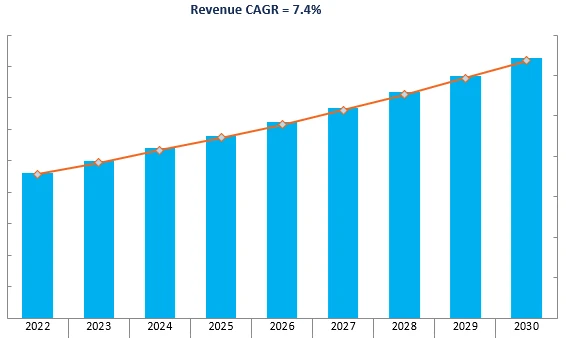
The global CT in dimensional metrology market was valued at USD 269.8 million in 2024 and is projected to reach USD 414.1 million by 2030, expanding at a CAGR of 7.4% from 2025 to 2030. Increasing adoption of non-destructive, volumetric measurement in precision manufacturing, coupled with rapid advancements in electronics, EV components, and medical devices, continues to fuel market growth. The rising shift toward smart factories and digital twins further strengthens demand for metrology-grade CT systems across industrial ecosystems.
Key Market Trends & Insights
- Micro-focus CT systems accounted for the largest revenue share in 2024, driven by widespread use in automotive, electronics, and plastics inspection.
- Nano-focus CT witnessed the fastest growth due to increasing semiconductor miniaturization and MEMS packaging demands.
- Automotive remained the largest end-use segment in 2024, supported by EV battery modules, eDrive components, and gigacasting validation requirements.
- Electronics is the fastest-growing vertical, driven by multilayer PCB inspection, BGA void detection, and 3D IC packaging.
- APAC recorded the highest growth momentum in 2024, led by China, Japan, South Korea, and India.
- Europe remained the most mature market owing to strong OEM presence and advanced aerospace and medical manufacturing clusters.
Market Size & Forecast:
- 2024 Market Size: USD 269.8 Million
- 2030 Market Size Projection: USD 414.1 Million
- CAGR (2025–2030): 7.4%
- Largest Market (2024): Europe
- Fastest-Growing Region: Asia Pacific
Precision manufacturing, EV production scaling, and tighter global quality norms are accelerating the adoption of CT-based dimensional metrology. As industries increasingly rely on internal structural validation, GD&T accuracy, and digital twin integration, CT systems are moving from R&D environments into at-line and near-line inspection cells. In APAC, rapid growth in battery manufacturing, electronics assembly, and semiconductor packaging is further accelerating the deployment of high-speed, high-resolution CT systems. This sustained modernization of global manufacturing is expected to significantly elevate the demand for industrial computed tomography systems through 2030.
Market Overview: Computed Tomography in Dimensional Metrology Market
The CT in Dimensional Metrology Market is undergoing a structural transformation as global manufacturing moves toward zero-defect production, multi-material product architectures, and increasing geometric complexity. CT metrology offers the unique ability to measure internal features, hidden structures, and assembly interfaces in a single scan—capabilities unattainable with CMMs, laser scanners, or optical profilers. This makes CT an essential tool in sectors where safety, reliability, and traceability are non-negotiable.
Automotive manufacturers, especially in EV programs, drive significant adoption. The transition toward gigacasting, battery modules, eDrive housings, and high-voltage connectors requires accurate internal validation of welds, injection-molded parts, and die-cast structures. CT systems are increasingly deployed in advanced QA labs and at-line inspection cells to control shrinkage variation, porosity, and internal cavity integrity. EV expansion in China, India, Japan, and the EU remains a defining force in the industrial computed tomography market.
Aerospace and defense continue to rely heavily on CT to ensure the dimensional integrity of turbine blades, composite airframes, AM-built components, and bonded structures. High-value, safety-critical components demand full-volume inspection to meet AS9102, NADCAP, and customer-specific validation protocols. European companies, including Airbus, Rolls-Royce, and Safran, are early adopters of metrology-grade CT with advanced automation.
Electronics and semiconductor manufacturers use nano-focus CT for micro-joining, transistor packaging, MEMS devices, BGA void analysis, and multilayer PCB stacking. Miniaturization across consumer electronics, telecom infrastructure, and automotive ECUs makes sub-micron accuracy indispensable. APAC—particularly China, South Korea, Japan, Vietnam, and Malaysia—dominates electronics-driven CT adoption.
In medical devices, CT supports implant verification, stent geometry mapping, polymer component inspection, and validation of 3D-printed surgical tools. Micro-CT plays a critical role in FDA- and CE-regulated workflows where sterility must remain intact during inspection.
Additional traction is emerging across additive manufacturing, academia, advanced materials research, and energy systems. AM workflows depend on CT for lattice structure validation, porosity mapping, wall-thickness analysis, and first-article inspection of high-complexity builds.
Technology evolution is accelerating adoption. Faster detectors, improved X-ray source stability, AI reconstruction, automated defect identification, multi-sensor hybrid CT, and ISO 10360-11 traceability packages significantly strengthen the value proposition. Integration with MES, PLM, digital twin platforms, and cloud-based metrology systems positions CT at the core of Industry 4.0 ecosystems.
Regionally, Europe remains the most mature market due to strong OEM presence and established quality norms. APAC is the fastest-growing region (8.5% CAGR), powered by EV, electronics, and semiconductor industries. The Americas show steady adoption driven by aerospace, battery manufacturing, and medtech.
As manufacturing complexity intensifies and regulatory frameworks tighten, the computed tomography market will continue expanding into high-throughput, automated, and inline metrology environments—evolving into a cornerstone of digital quality infrastructure globally.
Scope of Analysis: Computed Tomography in Dimensional Metrology Market
This study evaluates the Computed Tomography in Dimensional Metrology Market across global industrial ecosystems, quantifying demand for metrology-grade CT systems equipped for high-precision internal and external dimensional inspection. The analysis covers 2022–2030 with 2024 as the base year and 2025–2030 as the forecast period. All revenue estimates reflect OEM-level sales of new CT systems specifically configured for dimensional metrology, excluding refurbished units and third-party service revenues.
The report segments the market by:
• Focal Spot Size: Nano-focus, Micro-focus, Mini-focus, Macro-focus, LINAC-based CT
• End-use Industries: Automotive, Aerospace & Defense, Electronics, Medical Devices, Others (academia, research institutes, AM bureaus)
• Regions: Americas, Europe & MEA, and APAC
• Key KPIs: Market revenue, unit shipments, CAGR, competitive share, pricing trends, adoption barriers, and technology evolution patterns.
Metrology CT systems included in the scope must incorporate traceable calibration, GD&T capability, certified accuracy, SPC compatibility, volumetric reconstruction tools, and automated measurement workflows. The assessment fully reflects structural market dynamics, growth drivers, restraints, and technology maturity within the industrial computed tomography market.
Revenue Forecast: Computed Tomography in Dimensional Metrology Market
The global CT in Dimensional Metrology Market is projected to grow from $269.8 million in 2024 to $414.1 million by 2030, representing a CAGR of 7.4%. Growth is driven by rising internal inspection requirements, component miniaturization, AM adoption, and tighter global quality standards. Unit shipments increase from 415 systems in 2024 to 637 systems by 2030, reflecting a broadening customer base across automotive, electronics, and aerospace manufacturing.
Segment-Level Revenue Trends
Micro-focus CT remains the largest revenue contributor—growing from $105.0M in 2024 to $162.1M in 2030—due to its broad applicability across automotive castings, molded components, and electronics. Nano-focus CT is the fastest-growing segment, expanding from $79.8M to $133.9M (CAGR ~9%), fueled by semiconductor packaging, MEMS, and medtech micro-measurement. Mini-focus systems grow steadily (CAGR ~6%), serving medium-density components and general industrial metrology.
Regional Outlook
APAC leads global expansion, achieving 8.5% CAGR, driven by China, Japan, South Korea, and India—supported by strong EV, electronics, and semiconductor ecosystems. Europe maintains a mature, high-value demand base, growing at 6.6%, while the Americas show 7.1% CAGR supported by aerospace, medtech, and EV supply chain investments.
The long-term revenue trajectory reflects a shift from lab-based CT toward integrated production-level systems with automation, AI-driven reconstruction, and real-time decision support.
Segmentation Analysis: Computed Tomography in Dimensional Metrology Market
The computed tomography market for dimensional metrology displays strong segmentation diversity, with performance and adoption patterns varying significantly across focal spot sizes, vertical industries, and application intensity.
Focal Spot Segmentation
- Nano-Focus CT: Fastest-growing segment due to rising semiconductor complexity, MEMS structures, and micro-electronics packaging. Sub-micron accuracy and ultra-high resolution make it essential for dense, miniaturized assemblies.
- Micro-Focus CT: Largest segment, supporting plastics, die-cast metals, EV modules, and electronics. Serves as the workhorse for dimensional metrology labs and production QA functions.
- Mini-Focus CT: Balances penetration and accuracy, ideal for medium-thickness components in automotive and aerospace.
- Macro-Focus & LINAC CT: Niche but essential for large, dense aerospace parts and energy components requiring high-energy X-rays.
Industry Segmentation
- Automotive leads with strong demand for EV battery inspection, eDrive validation, and giga-casting dimensional analysis—driving system integration into at-line and inline QA cells.
- Aerospace & Defense relies on CT for turbine blades, bonded structures, AM parts, and composite analysis under strict regulatory programs.
- Electronics posts the highest CAGR (9%), fueled by PCB validation, BGA void analysis, semiconductor packaging, and MEMS.
- Medical Devices adopt CT for implant verification, stent geometry mapping, and polymer micro-components without sterility compromise.
Regional Segmentation
- APAC dominates growth due to EV and electronics manufacturing.
- Europe leads in high-precision adoption and OEM presence.
- Americas remain strong in aerospace and medtech demand.
Overall, micro-focus and nano-focus systems collectively account for ~70% of the industrial computed tomography market by 2030, reflecting a global shift toward high-precision, non-destructive metrology.
Growth Drivers: Computed Tomography in Dimensional Metrology Market
The CT in Dimensional Metrology Market is propelled by multiple structural and technology-driven forces.
1. Rising Need for Non-Destructive Internal Measurement
Complex assemblies, sealed housings, EV modules, and multi-material designs require volumetric metrology to validate internal features without cutting or dismantling components. This dramatically strengthens CT’s competitive advantage over conventional tools.
2. Adoption in Precision-Driven Industries
Automotive electrification, aerospace structural modernization, semiconductor miniaturization, and medtech innovation push manufacturers toward sub-micron inspection. CT offers full-geometry visibility essential for zero-defect and compliance-driven environments.
3. Integration with Digital Twins & Model-Based Manufacturing
As factories implement digital twins and predictive quality analytics, CT becomes a core data source for volumetric calibration, internal structure modeling, and real-time parameter correction.
4. Industry 4.0 & Smart Factory Maturity
Manufacturers increasingly demand metrology tools that interface with MES, PLM, SPC, and AI-driven quality engines. CT’s connectivity, automation readiness, and software intelligence make it an Industry 4.0 enabler.
5. Advances in X-ray, Detector, and Reconstruction Technology
Improved focal spot stability, detector density, faster frame rates, and AI reconstruction reduce scan time and enhance measurement precision. This enables higher-throughput use cases, including at-line or inline CT.
6. Additive Manufacturing Expansion
AM requires internal structure validation—lattices, porosity, wall thickness, and bonding—which CT uniquely provides. CT is used in 60%+ of metal AM workflows in regulated industries.
Growth Restraints: Computed Tomography in Dimensional Metrology Market
Despite strong potential, several structural constraints affect adoption in the computed tomography market.
1. High Capital Costs
CT systems require expensive detectors, X-ray sources, shielding enclosures, and precision manipulators. The total cost of ownership—including calibration, maintenance, and training proposes challenges for smaller manufacturers.
2. Competition from Established Metrology Tools
CMMs, laser scanners, and optical profilers remain cost-effective for simpler geometries. Industries accustomed to these workflows often perceive CT as excessive unless internal visibility is essential.
3. Integration Challenges
CT systems generate large datasets and require advanced reconstruction software, making integration with existing MES, QMS, or PLM systems complex. Inline CT adoption is further constrained by radiation safety requirements and cycle time expectations.
4. Skill Gaps & Training Requirements
CT inspection requires skilled operators for reconstruction, segmentation, and GD&T interpretation. Lack of expertise slows enterprise-wide adoption and increases dependency on service providers.
5. Limited Inline Adoption Due to Throughput Constraints
Although scan speeds are improving, many CT systems still fall short of the cycle times required in high-volume manufacturing environments such as EV battery production or PCB assembly.
6. Infrastructure Barriers
Radiation shielding, high-power requirements, and thermal control environments limit installation flexibility and increase setup costs.
Competitive Landscape: Computed Tomography in Dimensional Metrology Market
The computed tomography market is moderately concentrated, with the top five OEMs—Zeiss, Nikon Metrology, Waygate Technologies, Comet Yxlon, and Werth—collectively holding ~65% market share.
Market Structure
European OEMs dominate due to long-established expertise in precision metrology and X-ray technology. The market features intense competition in micro-focus and nano-focus segments, where accuracy, repeatability, and system stability differentiate leaders.
Key Players
- Zeiss leads the market with METROTOM platforms and strong software integration (CALYPSO), backed by deep metrology heritage.
- Nikon Metrology excels in hybrid optical + X-ray workflows and robot-integrated CT for EV components.
- Waygate Technologies (Baker Hughes) leverages Volume Graphics for advanced reconstruction and defect analysis.
- Comet Yxlon competes strongly in electronics and automotive applications with high-resolution detector technology.
- Werth Messtechnik is a niche leader in ultra-precise micro-CT and multi-sensor hybrid systems.
Innovation Themes
- AI-driven reconstruction and defect classification
- Compact CT for at-line inspection
- Multi-sensor hybrid CT + CMM
- Inline CT automation cells
- Nano-focus stability improvements
- Cloud-based metrology ecosystems
Regional Competitiveness
APAC has rising competition from Rigaku, Shimadzu, Sanying, and emerging Chinese OEMs offering cost-effective alternatives with improving resolution.
Overall, the market’s competitive intensity continues to increase as vendors shift from standalone CT hardware to integrated metrology ecosystems combining software, automation, and AI.
Scope of Analysis
Segmentation by Industry
Segmentation by Focal Spot Size
What is CT Metrology? Definition and Working Principle
CT Metrology Versus CT Inspection: Hardware and Software Differences
Why is it Increasingly Difficult to Grow?
The Strategic Imperative 8™
The Impact of the Top 3 Strategic Imperatives on the CT in Dimensional Metrology Industry
Value Chain
Competitive Environment
Key Competitors
Growth Metrics
Growth Drivers
Growth Driver Analysis
Growth Restraints
Growth Restraint Analysis
Forecast Considerations
Revenue and Unit Shipment Forecast
Revenue Forecast Analysis
Revenue Forecast by Focal Spot Size
Revenue Forecast Analysis
Unit Shipment Forecast by Industry Vertical
Revenue Forecast by Industry Vertical
Revenue Forecast Analysis
Unit Shipment Forecast by Region
Revenue Forecast by Region
Revenue Forecast Analysis
Pricing Trends, Global, 2024
Competitor Revenue Share Analysis
Product Mapping of All Major Competitors
Growth Metrics
Revenue and Unit Shipment Forecast
Revenue Forecast by Region
Unit Shipment Forecast by Region
Forecast Analysis
Key Trends, CT in Dimensional Metrology for the Automotive Sector
Growth Metrics
Revenue and Unit Shipment Forecast
Revenue Forecast by Region
Unit Shipment Forecast by Region
Forecast Analysis
Key Trends, CT in DM for the Aerospace & Defense Sector
Growth Metrics
Revenue and Unit Shipment Forecast
Revenue Forecast by Region
Unit Shipment Forecast by Region
Forecast Analysis
Key Trends, CT in DM for the Electronics Sector
Growth Metrics
Revenue and Unit Shipment Forecast
Revenue Forecast by Region
Unit Shipment Forecast by Region
Forecast Analysis
Key Trends, CT in DM for the Medical Devices Sector
Growth Metrics
Revenue and Unit Shipment Forecast
Revenue Forecast by Region
Unit Shipment Forecast by Region
Forecast Analysis
Key Trends, CT in DM for the Others Sector
Growth Opportunity 1: High-Precision CT for Micro-Metrology
Growth Opportunity 2: Hybrid CT + Optical/Touch Probing Systems
Growth Opportunity 3: AI-Powered CT Reconstruction and Defect Quantification
Growth Opportunity 4: Semi-Inline or Adaptive Inline CT for Metrology
Benefits and Impacts of Growth Opportunities
Next Steps
List of Exhibits
Legal Disclaimer
Frequently Asked Questions (FAQ) – Computed Tomography in Dimensional Metrology Market
1. What is the Computed Tomography in Dimensional Metrology market?
2. How does CT metrology differ from conventional CT inspection?
3. Which industries are the primary users of CT in dimensional metrology?
4. What factors are driving growth in the CT dimensional metrology market?
5. What are the key challenges limiting adoption of CT metrology?
6. What is the revenue forecast for the CT in dimensional metrology market?
7. Which regions lead the CT dimensional metrology market?
8. Who are the leading competitors in the CT in dimensional metrology market?
9. How is Industry 4.0 influencing CT metrology adoption?
10. What is the long-term outlook for the CT in dimensional metrology market?
Speak directly with our analytics experts for tailored recommendations.
Recent related Electronic Measurement research
05 Oct 2026 | Global | Market Research
Calibration and Repair Services Market, Global, 2025–2030
The global calibration and repair services market reached $4,096.8 million in 2025, driven by the increasing digitalization of calibration and repair services, integration with existing connected systems, real-time monitoring capabilities, and predictive analytics. Third-party service companies are ...
02 Oct 2026 | Global | Technology Research
Growth Opportunities in Contact-Rich Robot Skill AI, High-Speed Photopolymer 3D Printing, Industrial Interoperability, Vision AI, Pallet Shuttle Automation, In-Situ AM Inspection, and Composite 3D Printing
The Advanced Manufacturing Technology Opportunity Engine provides profiles of innovations related to simulation-trained contact skills enabling industrial robots to perform complex physical interactions and manipulation tasks; hybrid laser-DLP 3D printing systems combining additive technologies for ...
18 Sep 2026 | Global | Frost Radar
Frost Radar™: Laboratory Information Management Systems in Industrial Applications, 2026
Digitalization is transforming laboratory operations, resulting in a demand for cloud-based and AI-integrated laboratory information management systems (LIMS) to manage complex data and high volumes from automated systems. By combining these tools with software-as-a-service (SaaS) models, providers ...
11 Sep 2026 | Global | Market Research
Growth Impact of AI on the Communication Test Equipment Market, 2025–2030
Artificial intelligence (AI) is reshaping the global communication test equipment market by transforming product development, enabling intelligent and automated testing, and driving demand through next-generation communication infrastructure. This Frost & Sullivan analysis examines AI's impact acros...
04 Sep 2026 | Global | Technology Research
Growth Opportunities in Intralogistics Automation, Embodied Robotic Arms, Physical AI Training, Industrial AI, Service Robotics, Precision Farming Robots, and Laboratory Automation
The Advanced Manufacturing Technology Opportunity Engine provides profiles of innovations related to autonomous mobile robots (AMRs) enabling pallet and trolley transportation across dynamic intralogistics environments; compact 6-axis robotic systems supporting modular and flexible laboratory automa...
Purchase includes:
- Report download
- Growth Dialog™ with our experts
Growth Dialog™
A tailored session with you where we identify the:- Strategic Imperatives
- Growth Opportunities
- Best Practices
- Companies to Action
Impacting your company's future growth potential.