 USD
USD GBP
GBP  CNY
CNY  EUR
EUR  INR
INR  JPY
JPY  MYR
MYR  ZAR
ZAR  KRW
KRW  THB
THB 


Cyber Threat Intelligence to Power the Next Generation of Cyber Security Updated Research Available
Software-as-a-Service Delivery Model, New Use Cases, and Expansion into Mid-market Will Drive Growth
25-Mar-2021
Global
Market Research
MFD3-01-00-00-00
IT04301-GL-MT_25329
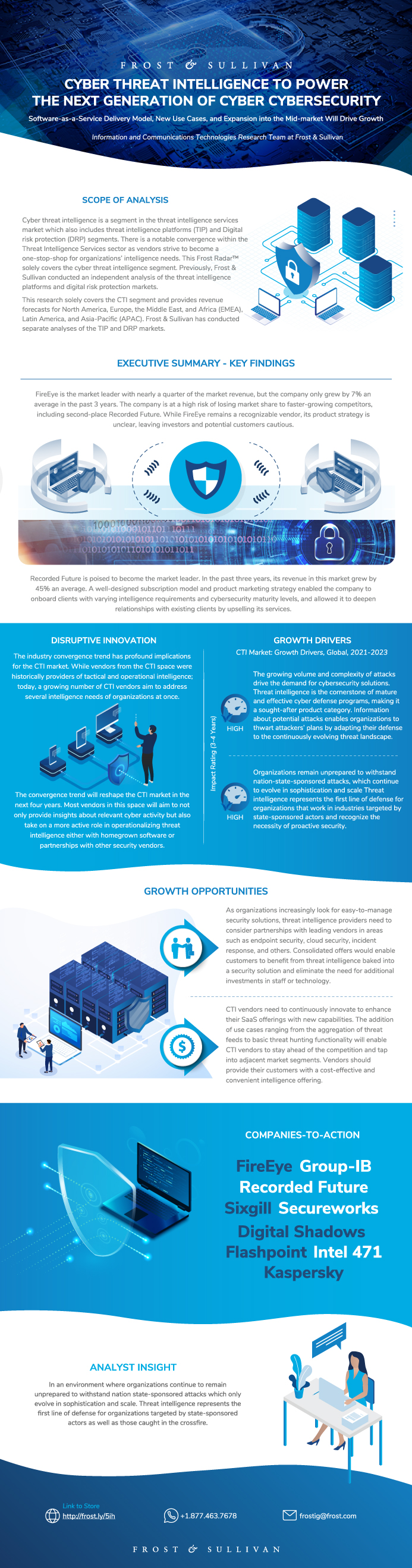
Cyber threat intelligence (CTI) is a collection of data, information, and knowledge about past, present, and future cyberattacks. It is the cornerstone of mature cyber defense programs and a sought-after product category that allows organizations to adapt their security posture to the rapidly evolving threat landscape. Information about potential attacks enables organizations to thwart attackers’ plans by anticipating their next move, and knowledge about past and present campaigns empowers organizations to increase the speed and accuracy of detecting potential breaches.
The growing volume and complexity of attacks drive the demand for cyber security solutions. Organizations increasingly recognize the importance of proactive and predictive defense for staying ahead of cyber adversaries. Security-conscious organizations bolster cyber security spending and look for innovative solutions that enable them to understand and prevent cybercrime. In an environment where organizations remain unprepared to withstand nation-state-sponsored attacks that only evolve in sophistication and scale, threat intelligence represents the first line of defense for organizations targeted by state-sponsored actors, as well as those caught in the crossfire.
CTI historically was of interest to large enterprises in industries that typically lead cyber security product adoption, such as banking and finance. Today, however, smaller enterprises across a wide range of vertical markets demonstrate an interest in threat intelligence use cases. CTI vendors, in turn, increasingly aim to meet less mature customers halfway and design tailored offerings for the midmarket. CTI vendors bring additional use cases to their customers and communicate a compelling business value to key stakeholders for whom information security is uncharted territory. The overlap between digital risk protection and CTI solutions enables vendors to demonstrate immediate business benefits of using their services and drives the market growth.
CTI is a segment of the threat intelligence services market, which also includes threat intelligence platforms and digital risk protection. There is a notable convergence as vendors strive to become a one-stop shop for organizations’ intelligence needs.
Why Is It Increasingly Difficult to Grow?
The Strategic Imperative 8™
The Impact of the Top Three Strategic Imperatives on the Cyber Threat Intelligence Market
Growth Opportunities Fuel the Growth Pipeline Engine™
Scope of Analysis
Threat Intelligence Services Market Segmentation
Threat Intelligence Services Market Convergence
CTI Use Cases
CTI Categories
Growth Metrics
Growth Drivers
Growth Drivers (continued)
Growth Restraints
Growth Restraints (continued)
Revenue Forecast
Revenue Forecast by Region
Revenue Forecast Analysis
Revenue Share
Revenue Share Analysis
Comparing CTI Solutions
Criteria for Comparison
Differentiation of Leading Vendors
CTI Vendor Types
Growth Opportunity 1: Expansion into the DRP Market
Growth Opportunity 1: Expansion into the DRP Market (continued)
Growth Opportunity 2: Expansion into the TIP Market
Growth Opportunity 2: Expansion into the TIP Market (continued)
Growth Opportunity 3: Partnerships with Security Vendors
Growth Opportunity 3: Partnerships with Security Vendors (continued)
List of Exhibits
Legal Disclaimer
Speak directly with our analytics experts for tailored recommendations.
Recent related Network Security research
15 Sep 2026 | Global | Technology Research
Growth Opportunities in Workload Identity and Access Management, Non-Human Identity Security, Threat Exposure Management, and Blockchain Security
This edition of the Cyber Security Technology Opportunity Engine (TOE) showcases emerging cybersecurity innovators advancing AI-powered security, identity and access management, data security, threat exposure management, blockchain security, cyber incident response, network protection, and agentic A...
09 Sep 2026 | Global | Technology Research
Unified Cloud Control: The Emergence of Intelligent Multi-Cloud Management Platforms, 2026-2030
This report emerges as the evolution of an integrated cloud manipulation management system as complementary technology for employer cloud manipulation management systems to enable businesses to manage increasingly distributed workloads in public, private, hybrid, edge, and sovereign clouds in one ma...
07 Aug 2026 | Global | Technology Research
Growth Opportunities in Agentic AI-based Pentesting, Exposure Validation, Blockchain-based Onchain Security, Product Security, and Cyber Resiliency Platforms
This edition of the Cyber Security Technology Opportunity Engine (TOE) captures developments related to Agentic AI-powered Offensive Security, Agentic Pentesting, Blockchain-based AI-powered Onchain Security, Agentic AI-based Exposure Validation, Agentic AI Security Operations, Supply Chain Security...
20 Jul 2026 | Global | Technology Research
Applications and Growth Opportunities for AI Governance Platforms
This report examines the growing importance of AI governance platforms in enabling responsible and scalable artificial intelligence adoption, with a focused analysis of their applications and opportunities across interoperability, data privacy, and digital ethics. As organizations increasingly deplo...
17 Jul 2026 | Global | Technology Research
Growth Opportunities in AI Data Governance, Human Risk Management, Web Exposure Management, Encryption Protocol, Agentic Threat Triage, and Cloud Data Security
This edition of the Cyber Security Technology Opportunity Engine (TOE) explores AI Data Governance and Real-Time AI Interaction Monitoring enable secure LLM adoption, while Human Risk Management and Real-Time Risk Detection deliver contextual behavioral interventions. Web Exposure Management and Con...
Purchase includes:
- Report download
- Growth Dialog™ with our experts
Growth Dialog™
A tailored session with you where we identify the:- Strategic Imperatives
- Growth Opportunities
- Best Practices
- Companies to Action
Impacting your company's future growth potential.