 USD
USD GBP
GBP  CNY
CNY  EUR
EUR  INR
INR  JPY
JPY  MYR
MYR  ZAR
ZAR  KRW
KRW  THB
THB 


Digital ID Solutions Market, Global, 2025–2030
The Digital ID Market is Driving Transformational Growth at the Intersection of Policy, Trust, and Technology
29-Jul-2026
Global
Market Research
PG3C-01-00-00-00
AE_2026_34773
Key Takeaways: Digital Identity Solutions Market
- The Digital Identity Solutions Market is evolving from identity verification into foundational digital infrastructure connecting governments, enterprises, and individuals across online and offline interactions.
- Global Digital ID Solutions Market revenue is valued at $27.70 billion in 2025 and is projected to reach $47.79 billion by 2030, representing a 11.5% CAGR from 2025 to 2030.
- Government-led digital transformation, stronger data-protection mandates, fraud prevention requirements, and demand for secure digital services are supporting expansion of the digital identity solutions market.
- Digital wallets, mobile IDs, verifiable credentials, biometrics, decentralized identity, and cryptographically verifiable credentials are reshaping the Digital ID Solutions Market.
- The market covers national and federated ID systems, digital credentials, identity wallets, and issuance, attestation, and verification infrastructure, with a focus on individual identities.
- Digital identity adoption varies regionally, with Europe progressing through structured regulatory frameworks, while North America, APAC, the Middle East and Africa, and Latin America follow different adoption models.
- The Digital Identity Solutions Market includes more than 100 competitors, with the top five accounting for 46.9% of 2025 revenue, indicating a competitive ecosystem involving major technology providers and specialized identity companies.
Report Summary: Digital Identity Solutions Market
The global Digital Identity Solutions Market is becoming an important layer of modern digital infrastructure by enabling digitally verifiable representations of identities, credentials, and attributes. The Digital ID Solutions Market supports secure access to online and offline services, faster authentication, fraud reduction, and greater control over personal-data sharing. The market encompasses national and federated identity systems, mobile IDs, verifiable credentials, identity wallets, and issuance, attestation, and verification infrastructure.
The global Digital Identity Solutions Market generated $27.70 billion in revenue in 2025 and is forecast to reach $47.79 billion by 2030, expanding at a 11.5% CAGR during 2025–2030. Government-led digital transformation, regulatory requirements, fraud prevention, and growing adoption of digital wallets are key factors supporting this expansion. The Digital ID Solutions Market is also being shaped by AI, biometrics, blockchain, decentralized identity, and cryptographically verifiable credentials.
The market is shifting from document-centric and account-based identity models toward portable, reusable, privacy-preserving credentials. Governments, enterprises, public-sector technology partners, and global development institutions are contributing to ecosystem development. At the same time, interoperability challenges, regulatory complexity, trust deficits, infrastructure gaps, and implementation costs remain important considerations for the digital identity solutions market.
Analyst Words: Digital Identity Solutions Market
“Digital identity is evolving from a verification tool into the trust infrastructure that underpins digital ecosystems.”
The Digital Identity Solutions Market is moving toward interoperable credentials, digital wallets, and privacy-preserving identity architectures. According to the analyst perspective presented in the study, future market development will increasingly depend on the ability to combine security, regulatory compliance, fraud resilience, and user experience at scale. The Digital ID Solutions Market is therefore expanding beyond identity verification toward broader digital infrastructure that connects governments, enterprises, service providers, and individuals.
Three themes are particularly important. First, digital identity is becoming foundational infrastructure for trusted digital interactions. Second, interoperable digital wallets and verifiable credentials are supporting reusable identity models. Third, market participants are increasingly required to address compliance, fraud prevention, privacy, interoperability, and scalability simultaneously.
Market Overview & Trends: Digital Identity Solutions Market
The global Digital Identity Solutions Market is undergoing a structural transition as digital identity moves from a supporting authentication function toward a broader infrastructure layer for digital economies. Digital ID systems enable individuals to prove who they are, access services, authenticate transactions, and control how personal information is shared. This expanding role is creating opportunities across government services, banking and financial services, retail, telecommunications, education, and other digitally enabled sectors.
A major trend in the Digital ID Solutions Market is the movement from document-centric and account-based identity models toward portable and cryptographically verifiable credentials. Digital identity wallets, mobile IDs, verifiable credentials, and decentralized or self-sovereign identity approaches can allow identity information to be reused across organizations and jurisdictions. These models can reduce repeated verification requirements while supporting selective disclosure and privacy-preserving interactions.
Regulation is another important market-shaping factor. Data-protection requirements, digital identity frameworks, sovereign identity initiatives, and trust-service regulations are encouraging organizations to develop interoperable and compliant identity infrastructure. Europe represents a structured policy-driven environment, while North America has developed through state, provincial, enterprise, and sector-specific initiatives. APAC shows significant diversity, with adoption often closely connected to national digital transformation and service-delivery programs.
The digital identity solutions market is also being influenced by increasing fraud risks and advances in AI and biometrics. Organizations are seeking identity systems capable of improving authentication while addressing synthetic identity, deepfake, and document-fraud risks. Digital wallets and mobile-based credentials are consequently becoming important components of the evolving Digital ID Solutions Market.
Scope of Analysis: Digital Identity Solutions Market
The Digital Identity Solutions Market study provides a global assessment of digital identity solutions covering the period 2025–2030, with 2025 as the base year and 2026–2030 as the forecast period. The market is measured in US dollars and focuses on digitally verifiable representations of a person’s identity, credentials, and attributes. The study defines Digital ID as a capability that facilitates secure access to online and offline services, enables rapid authentication, builds trust, reduces fraud, and provides individuals with greater control over personal data and its sharing.
For this research, the Digital ID Solutions Market comprises national and federated ID systems, digital credentials such as mobile IDs and verifiable credentials, identity wallets, and issuance, attestation, and verification infrastructure. The analysis focuses on individual identities rather than organizational identities. Digital identity types considered include digital identity wallets, mobile driver's licenses, digital IDs, smart cards and hardware tokens, decentralized or self-sovereign identity, document- and attribute-based identities, and user account-based or federated identities.
The scope also examines the broader ecosystem surrounding the digital identity solutions market, including governments, public-sector technology partners, and global development institutions. Government digital ID programs can support digital public infrastructure, citizen-service delivery, legally recognized trust frameworks, and interoperable identity ecosystems. Enterprise Digital ID applications can support onboarding, identity-based fraud reduction, compliance, customer experience, and secure access across business ecosystems. The research additionally evaluates regional adoption patterns across North America, Europe, Asia-Pacific, the Middle East and Africa, and Latin America, together with market drivers, restraints, opportunities, technology trends, and competitive dynamics.
Market Segmentation Analysis: Digital Identity Solutions Market
The Digital Identity Solutions Market is structured around the types of digital identities, ecosystem participants, use cases, and geographic markets identified in the study. At the solution level, the Digital ID Solutions Market includes national and federated ID systems, digital credentials, identity wallets, and issuance, attestation, and verification infrastructure. These components collectively support the creation, management, presentation, authentication, and verification of digital identity attributes across different environments.
Digital credentials include mobile IDs and verifiable credentials that provide digitally usable representations of identity attributes. Mobile IDs can support identity verification through smartphones and other digital devices, while verifiable credentials provide issuer-signed and tamper-evident identity information that can potentially be reused across organizations and jurisdictions. The Digital Identity Solutions Market also includes identity wallets, which provide users with a mechanism for storing and presenting digital identity credentials.
Another important dimension is the identity model. The Digital ID Solutions Market encompasses decentralized or self-sovereign identity approaches, document- and attribute-based identities, and account-based or federated identities. The study highlights a transition toward portable, cryptographically verifiable credentials and wallets as organizations seek reusable identity proof that can reduce repeated document submission and verification.
From an ecosystem perspective, the digital identity solutions market involves governments, public-sector technology partners, global development institutions, and enterprises. Governments act as important trust anchors by establishing national identity programs, regulatory frameworks, and digital public infrastructure. Public-sector technology partners provide technology and implementation expertise, while global development institutions support digital identity adoption through funding, guidance, and policy frameworks. Enterprises use Digital ID capabilities to improve onboarding, reduce identity-related fraud, meet regulatory requirements, and enable secure access.
The market also varies significantly by region. North America has no single national digital ID program and includes state- and provincial-level initiatives, mobile driver's licenses, and digital credentials connected with travel and public services. Europe has a highly structured and policy-driven environment, with national electronic identification systems and increasing emphasis on interoperable identity wallets. Asia-Pacific demonstrates substantial diversity in digital maturity, with identity systems often closely integrated with national service-delivery ecosystems. The Middle East and Africa include centralized government-led digital ID initiatives alongside varying levels of identity infrastructure development. Latin America is characterized by national civil-registration and biometric identity programs, primarily focused on government services and fraud reduction.
Revenue & Spending Forecast: Digital Identity Solutions Market
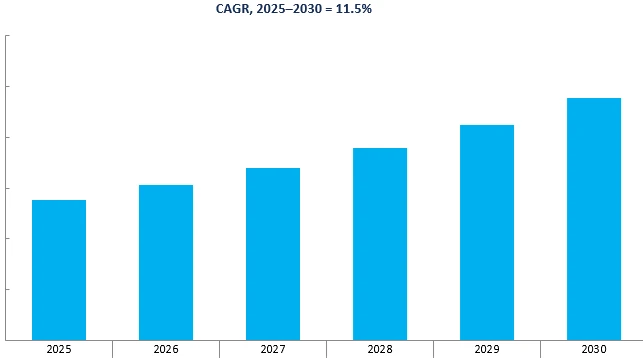
The global Digital Identity Solutions Market is forecast to experience sustained revenue expansion between 2025 and 2030. According to the study, market revenue increases from $27.70 billion in 2025 to $30.56 billion in 2026, followed by $47.79 billion in 2030.
The Digital ID Solutions Market therefore expands by approximately $20.09 billion between 2025 and 2030, equivalent to a reported 11.5% CAGR. The growth trajectory reflects increasing investment in digital public infrastructure, identity wallets, digital credentials, fraud prevention, regulatory compliance, and secure digital-service delivery. The Digital ID Solutions Market is also benefiting from the convergence of digital transformation, biometrics, AI, blockchain, and interoperable identity technologies.
Growth Drivers: Digital Identity Solutions Market
Government-led digital transformation is a major driver of the Digital Identity Solutions Market. Governments are increasingly developing digital public infrastructure and online service-delivery ecosystems that require trusted methods for identifying citizens and residents. National and federated identity systems can provide the foundational authentication layer required for accessing public services, benefits, licenses, and other digitally delivered services.
Stronger data-protection and sovereign identity requirements are also supporting the Digital ID Solutions Market. Governments and regulators are seeking identity frameworks that provide verified credentials while giving individuals greater control over personal information. The resulting demand for privacy-preserving and interoperable identity systems is creating opportunities for digital identity vendors.
Fraud prevention is another important growth driver. Increasing digital transactions and online interactions are creating greater exposure to identity theft, synthetic identities, account fraud, and document manipulation. The digital identity solutions market is responding through stronger authentication, biometrics, cryptographically verifiable credentials, and identity verification capabilities.
Digital wallets are additionally becoming an important adoption catalyst. Wallet-based identity models allow users to store and present credentials digitally, potentially reducing repeated identity verification across services. The growth of mobile-first experiences is strengthening demand for portable digital credentials and wallet infrastructure.
Finally, improvements in AI, biometrics, blockchain, and decentralized identity technologies are expanding the capabilities of the Digital ID Solutions Market. These technologies can support automated verification, stronger fraud detection, reusable credentials, and interoperable identity ecosystems.
Growth Restraints: Digital Identity Solutions Market
Interoperability remains a major challenge for the Digital Identity Solutions Market. Fragmented identity standards, different national frameworks, incompatible systems, and varying technical architectures can make it difficult for credentials issued by one organization or jurisdiction to be recognized elsewhere. This fragmentation can increase implementation complexity and slow broader adoption.
Regulatory complexity and policy uncertainty can also constrain the Digital ID Solutions Market. Digital identity systems operate at the intersection of privacy, cybersecurity, data governance, authentication, and public policy. Differences between jurisdictions can increase compliance requirements and make cross-border identity interoperability more difficult.
Trust and user-perception challenges represent another restraint. Individuals may be hesitant to adopt digital identity systems if they are concerned about surveillance, misuse of personal information, cybersecurity, or loss of control over their credentials. The digital identity solutions market therefore requires strong privacy protections, transparent governance, and effective user education.
Infrastructure and ecosystem readiness can also affect adoption. Markets with limited connectivity, fragmented public infrastructure, or insufficient technical capabilities may face difficulties implementing large-scale identity programs. In addition, high upfront implementation and ongoing maintenance costs can create barriers for governments and enterprises.
Finally, the Digital ID Solutions Market faces challenges associated with ecosystem coordination. Successful deployment often requires cooperation among governments, technology providers, financial institutions, service providers, regulators, and users. Weak coordination can slow implementation and reduce the practical value of otherwise capable identity technologies.
Competitive Landscape: Digital Identity Solutions Market
The global Digital Identity Solutions Market is characterized by a broad and fragmented competitive environment, with more than 100 competitors generating revenue above $1 million. The study identifies Thales, IN Groupe, GBG, HID Global, IBM, and Entrust among the leading competitors. Other notable participants include Signicat, TECH5, MATTR, iProov, Dock.io, MOSIP, and Indicio.
Competition in the Digital ID Solutions Market is shaped by several factors, including regional presence, cost, performance, AI-enabled capabilities, reliability, interoperability, open-source technologies, consumer experience, and adherence to relevant standards. Vendors are increasingly competing not only on identity verification capabilities but also on their ability to provide scalable identity ecosystems covering credentials, wallets, verification, issuance, and trust services.
The competitive structure reflects the growing convergence between traditional identity providers, cybersecurity companies, technology vendors, public-sector technology specialists, and emerging digital identity platforms. The Digital Identity Solutions Market therefore includes organizations with different business models and technology approaches. Some providers focus on government identity programs, while others specialize in enterprise onboarding, identity verification, digital wallets, biometric authentication, or credential infrastructure.
Distribution is primarily supported through direct sales, channel partners, platforms, and government procurement. Government projects can involve large-scale deployments and long-term infrastructure requirements, while enterprise implementations can focus on onboarding, fraud prevention, regulatory compliance, and secure access.
The study reports that the top five competitors accounted for 46.9% of market revenue in 2025, indicating a meaningful level of concentration alongside a wider competitive field. The Digital ID Solutions Market is also seeing continuing ecosystem activity and strategic development as vendors expand capabilities in AI, digital wallets, verifiable credentials, interoperability, and privacy-preserving identity.
Abbreviations
Scope of Analysis
Scope of Analysis—Types of Digital IDs
Scope of Analysis—Mergers and Acquisitions
Scope of Analysis—Recent Deals and Contracts
Segmentation
Why is it Increasingly Difficult to Grow?
The Strategic Imperative 8™
The Impact of the Top 3 Strategic Imperatives on the Digital ID Industry
Competitive Environment
Digital ID Vendor Classification and Capability Matrix
Key Ecosystem Participants in Digital ID Market
Growth Metrics
Growth Drivers
Growth Driver Analysis
Growth Restraints
Growth Restraint Analysis
Forecast Considerations
Revenue Forecast
Revenue Forecast by Region
Revenue Forecast by Customer Segment
Forecast Analysis
Revenue Share
Revenue Share Analysis
Growth Metrics
Revenue Forecast
Revenue Forecast by Customer Segment
Forecast Analysis
Growth Metrics
Revenue Forecast
Revenue Forecast by Customer Segment
Forecast Analysis
Growth Metrics
Revenue Forecast
Revenue Forecast by Customer Segment
Forecast Analysis
Growth Metrics
Revenue Forecast
Revenue Forecast by Customer Segment
Forecast Analysis
Growth Metrics
Revenue Forecast
Revenue Forecast by Customer Segment
Forecast Analysis
Growth Opportunity 1: DPI Enablement
Growth Opportunity 2: Cross-Border Travel Credentials and Interoperability
Growth Opportunity 3: Inclusive Identity Solutions for the Global South
Growth Opportunity 4: Reusable Credentials Beyond Core ID
Growth Opportunity 5: Decentralized Identity
Growth Opportunity 6: Verifiable Credentials
Benefits and Impacts of Growth Opportunities
Next Steps
List of Exhibits
Legal Disclaimer
Frequently Asked Questions (FAQs) – Digital Identity Solutions Market
1. What is the Digital Identity Solutions Market?
The Digital Identity Solutions Market comprises technologies and infrastructure that provide digitally verifiable representations of identities, credentials, and attributes. It includes national and federated ID systems, digital credentials, identity wallets, and issuance, attestation, and verification infrastructure.
2. What is the Digital ID Solutions Market used for?
The Digital ID Solutions Market supports secure access to online and offline services, identity verification, authentication, fraud prevention, digital onboarding, regulatory compliance, and secure sharing of personal identity information.
3. What is the global Digital Identity Solutions Market size in 2025?
The global Digital Identity Solutions Market generated approximately $27.70 billion in revenue in 2025, according to the research presented in this study.
4. What is the Digital Identity Solutions Market forecast for 2030?
The global Digital ID Solutions Market is forecast to reach approximately $47.79 billion by 2030, increasing from $27.70 billion in 2025.
5. What is the CAGR of the Digital Identity Solutions Market?
The Digital Identity Solutions Market is projected to expand at a 11.5% compound annual growth rate (CAGR) from 2025 to 2030.
6. What are the key technologies in the Digital ID Solutions Market?
Key technologies shaping the Digital ID Solutions Market include biometrics, artificial intelligence, blockchain, decentralized identity, digital wallets, mobile IDs, verifiable credentials, and cryptographically verifiable identity infrastructure.
7. What are the major growth drivers for the Digital Identity Solutions Market?
Major growth drivers for the Digital Identity Solutions Market include government-led digital transformation, stronger data-protection requirements, fraud prevention needs, adoption of digital wallets, increasing use of digital services, and demand for interoperable and privacy-preserving credentials.
8. What are the major restraints affecting the Digital ID Solutions Market?
Major restraints affecting the Digital ID Solutions Market include fragmented interoperability standards, regulatory complexity, trust and privacy concerns, infrastructure gaps, ecosystem readiness challenges, and high implementation and maintenance costs.
9. Who are the key companies in the Digital Identity Solutions Market?
Key companies identified in the Digital ID Solutions Market include Thales, IN Groupe, GBG, HID Global, IBM, and Entrust. Other notable participants include Signicat, TECH5, MATTR, iProov, Dock.io, MOSIP, and Indicio.
10. Which regions are covered in the Digital Identity Solutions Market?
The global Digital Identity Solutions Market analysis covers North America, Europe, Asia-Pacific, the Middle East and Africa, and Latin America, with regional differences examined in terms of adoption, regulation, identity infrastructure, and ecosystem maturity.
Speak directly with our analytics experts for tailored recommendations.
Recent related Security research
16 Oct 2026 | Global | Market Research
Customer Transformation Journeys External Risk Mitigation and Management: BitSight
This report explores how organizations are accelerating cyber risk reduction and remediation through Bitsight’s intelligent External Risk Management and Mitigation (ERMM) solution. It examines customer transformation journeys, highlighting how continuous visibility, contextualized risk intelligence,...
15 Oct 2026 | Global | Market Research
Network Detection and Response (NDR) Sector, Global, 2026–2030
This study examines the global NDR market over the 2022–2030 forecast period. It finds that rising investment reflects NDR's evolution from a discretionary security enhancement into a foundational component of enterprise cyber defense, underscoring stronger buyer commitment and heightened vendor com...
09 Oct 2026 | Global | Technology Research
Growth Opportunities in SiC MOSFET, Photodiodes, RISC-Vs, and Advanced Memory
The Microelectronics Technology Opportunity Engine covers innovations pertaining to SiC MOSFET, Photodiodes, RISC-Vs, and Advanced Memory.The Microelectronics Technology Opportunity Engine captures global electronics-related innovations and developments on a weekly basis. Developments are centered o...
09 Oct 2026 | Global | Frost Radar
Frost Radar™: Workforce Identity and Access Management, 2026
Hybrid work and software as a service have shifted security enforcement from the network perimeter to identity, transforming it into a control plane. Workforce identity and access management (IAM) now determines whether every user, device, and session should retain access based on context, risk, and...
07 Oct 2026 | Global | Frost Radar
Frost Radar™: Network Detection and Response, 2026
The rapid evolution of enterprise IT environments, driven by cloud adoption, connected devices, and hybrid infrastructure, has rendered legacy perimeter defenses inadequate. Network detection and response (NDR) has become a strategic imperative, providing continuous visibility across network traffi...
Purchase includes:
- Report download
- Growth Dialog™ with our experts
Growth Dialog™
A tailored session with you where we identify the:- Strategic Imperatives
- Growth Opportunities
- Best Practices
- Companies to Action
Impacting your company's future growth potential.
Frost & Sullivan’s latest research on the global Digital ID market highlights the pivotal role of Digital ID as a catalyst for a broader identity ecosystem, driving growth in areas such as identity and access management, fraud prevention, payments, and digital public infrastructure. Governments act as key trust anchors, establishing frameworks and enabling large-scale service delivery, while enterprises use Digital ID to streamline onboarding, reduce fraud, and improve compliance and customer experience. The ecosystem encompasses governments, public sector technology partners, and global development institutions, presenting regional disparities in adoption, regulation, and maturity across North America, Europe, Asia-Pacific, the Middle East and Africa, and Latin America.
Current trends highlight that Digital ID continues to evolve as a result of converging megatrends and technologies, including digitization, platformization, and regulatory shifts, effectively transforming identity into core infrastructure. Technologies such as AI, biometrics, decentralized identity, and digital wallets play a key role in replacing document-centric models, enabling interoperable, reusable, and cryptographically verifiable identities. A clear shift is occurring toward wallet-based and portable credentials, driven by rising fraud risks, regulatory requirements, and user demand for seamless experiences. Competition from start-ups and ecosystem players further accelerates innovation, pushing the market toward interoperable, cross-sector identity ecosystems.
The study addresses five key areas: market scope and ecosystem roles across governments, enterprises, and institutions; regional segmentation and differences in adoption models, regulation, and vendor landscapes; growth drivers such as government-led digital transformation, regulatory mandates, mobile IDs, and wallet adoption; growth restraints including interoperability challenges, regulatory complexity, trust deficits, infrastructure gaps, and high implementation costs; growth opportunities for vendors.
Digital ID serves as a critical layer of modern digital infrastructure, underpinning trust, security, and service delivery across sectors. While strong growth is expected—fueled by regulation, technology innovation, and expanding use cases—challenges around interoperability, trust, and cost persist. Long-term success will depend on building scalable, interoperable, and privacy-preserving identity ecosystems that balance innovation with governance and user trust.
Author: Deepali Sathe
| Deliverable Type | Market Research |
|---|---|
| Industries | Aerospace, Defence and Security |
| No Index | No |
| Is Prebook | No |
| Keyword 1 | Digital ID Solutions Market Report |
| Keyword 2 | Digital Identity Market Analysis |
| Keyword 3 | Identity Verification Market Forecast |
| Podcast | No |
| Predecessor | PBBC-01-00-00-00 |
| WIP Number | PG3C-01-00-00-00 |