 USD
USD GBP
GBP  CNY
CNY  EUR
EUR  INR
INR  JPY
JPY  MYR
MYR  ZAR
ZAR  KRW
KRW  THB
THB 


Digital Surgery Devices Market, Global, 2024–2029
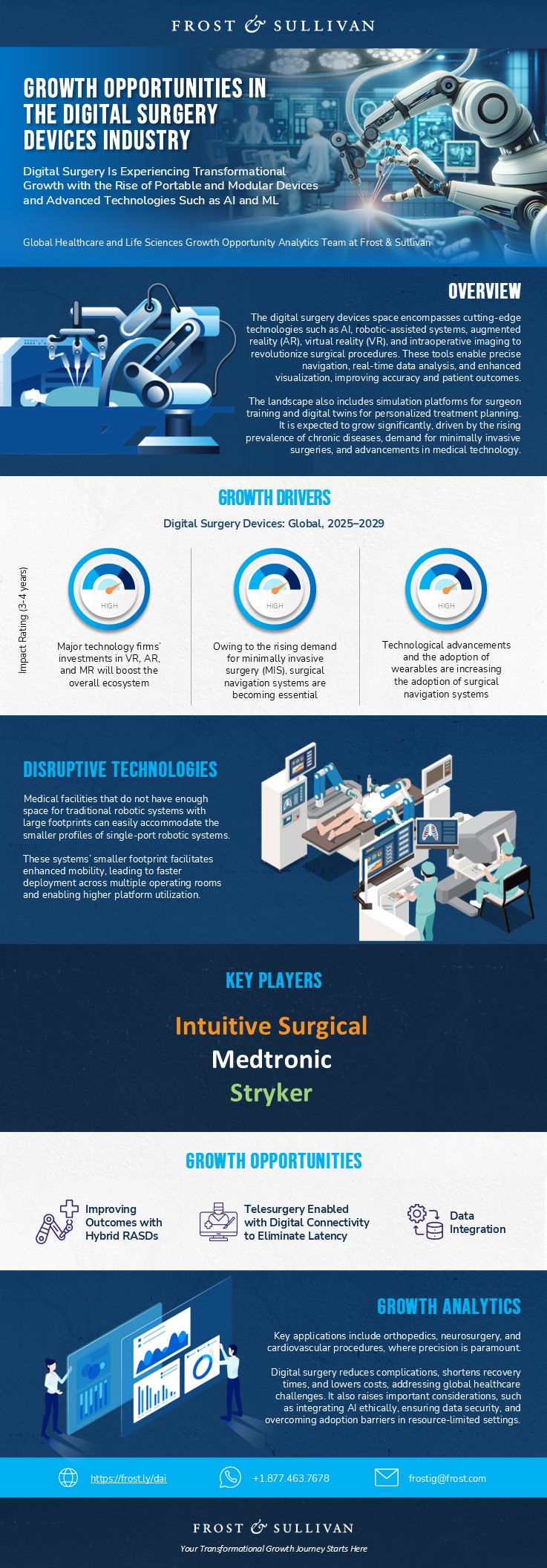
Digital Surgery is Experiencing Transformational Growth with the Rise of Portable and Modular Devices and Advanced Technologies Such as AI and ML
08-Aug-2025
Global
Market Research
KB5D-01-00-00-00
HC_2025_33711
Report Summary: Digital Surgery Devices Market
The global Digital Surgery Devices Market size was valued at USD 12.13 billion in 2024 and is projected to reach USD 24.68 billion by 2029, growing at a CAGR of 15.3%. The market is witnessing rapid expansion due to the increasing adoption of AI-driven surgical systems, robotic-assisted procedures, and advanced visualization technologies. As a key segment within the broader Medical Devices market, digital surgery solutions are transforming surgical precision, workflow efficiency, and patient outcomes.
Key Market Trends & Insights
- Rising demand for robotic-assisted procedures is significantly boosting the Digital Surgery Devices Market, particularly in complex surgeries requiring high precision.
- Integration of AI, AR, and real-time imaging is enhancing surgical navigation and decision-making capabilities.
- Strong alignment with the Minimally Invasive Surgical Instruments Market is accelerating adoption, as healthcare providers prioritize reduced recovery time and lower complication rates.
- Surgical planning and simulation platforms are gaining traction for training and preoperative visualization.
- Increasing healthcare digitization and connected device ecosystems are improving operational efficiency and patient care outcomes.
Market Size & Forecast
- 2024 Market Size: USD 12.13 Billion
- 2029 Projected Market Size: USD 24.68 Billion
- CAGR (2024–2029): 15.3%
- North America: Largest market due to advanced healthcare infrastructure
- Asia-Pacific: Fastest-growing region driven by rising investments and adoption
The growth of the Digital Surgery Devices Market is further supported by increasing investments in healthcare innovation and the rising prevalence of chronic diseases requiring surgical intervention. Hospitals and surgical centers are rapidly adopting digital solutions to improve precision, reduce errors, and enhance patient recovery outcomes.
As digital transformation accelerates across the Medical Devices market, the integration of robotics, AI, and real-time data analytics is redefining surgical care delivery. This evolution, closely linked with advancements in the Minimally Invasive Surgical Instruments Market, is expected to create significant opportunities for stakeholders, driving long-term market expansion.
Market Overview & Trends: Digital Surgery Devices Market
The Digital Surgery Devices Market is evolving rapidly as healthcare systems transition toward data-driven, precision-based surgical environments. This transformation is primarily fueled by the integration of AI, machine learning (ML), robotics, and immersive technologies such as AR and virtual reality (VR). These innovations are reshaping how surgeries are planned, executed, and monitored, making procedures safer and more efficient.
A key trend is the increasing adoption of robotic-assisted surgical systems, which enhance surgeon capabilities by offering superior dexterity, tremor reduction, and real-time feedback. This trend aligns closely with advancements in the Minimally Invasive Surgical Instruments Market, where demand for precision and reduced patient trauma is accelerating technology adoption. Additionally, surgical navigation systems are gaining traction due to their ability to provide real-time imaging and anatomical guidance, significantly improving surgical accuracy.
Another major trend is the rise of simulation-based training and digital planning tools. These platforms allow surgeons to rehearse procedures using patient-specific data, reducing intraoperative risks. The incorporation of digital twins and predictive analytics is further enhancing preoperative planning and decision-making.
Healthcare digitization is also driving interoperability between devices, enabling seamless data exchange across hospital systems. This is particularly relevant within the broader Medical Devices market, where connected ecosystems are becoming essential for improving workflow efficiency and patient outcomes.
Geographically, North America leads in adoption due to advanced healthcare infrastructure, while Asia-Pacific is emerging as a high-growth region driven by increasing healthcare investments and demand for advanced surgical technologies.
Overall, the Digital Surgery Devices Market is characterized by continuous innovation, strong investment in R&D, and a growing emphasis on patient-centric care, positioning it as a cornerstone of the future Medical Devices market landscape.
Scope of Analysis: Digital Surgery Devices Market
The Digital Surgery Devices Market analysis covers a comprehensive evaluation of technological advancements, market dynamics, and strategic developments across the global healthcare ecosystem. The study period spans from 2024 to 2029, with 2024 as the base year and forecasts extending through 2029.
This analysis includes a detailed assessment of key product categories such as robotic-assisted surgical devices, surgical navigation systems, and surgical planning and training platforms. These segments are examined in the context of their role within the broader Medical Devices market and their growing relevance to the Minimally Invasive Surgical Instruments Market.
Geographically, the scope encompasses major regions including North America, Europe, Asia-Pacific, Latin America, and the Middle East & Africa. Each region is analyzed based on adoption trends, healthcare infrastructure, and investment in digital health technologies.
The study also evaluates end users, including hospitals, ambulatory surgical centers (ASCs), and outpatient facilities. It highlights how digital surgery solutions are being integrated into diverse clinical settings to improve efficiency and patient outcomes.
Additionally, the report examines strategic initiatives such as partnerships, mergers, acquisitions, and product innovations that are shaping the competitive landscape. Emphasis is placed on the role of AI, robotics, and connectivity in driving market growth.
Overall, the scope provides a holistic view of the Digital Surgery Devices Market, enabling stakeholders to understand key opportunities, challenges, and future growth trajectories within the evolving Medical Devices market.
Revenue & Spending Forecast: Digital Surgery Devices Market
The Digital Surgery Devices Market is projected to experience strong revenue growth over the forecast period, driven by increasing adoption of advanced surgical technologies and rising demand for minimally invasive procedures.
In 2024, the global market is valued at approximately USD 12.13 billion. With continuous technological advancements and expanding clinical applications, the market is expected to reach around USD 24.68 billion by 2029, reflecting a robust compound annual growth rate (CAGR) of approximately 15.3%.
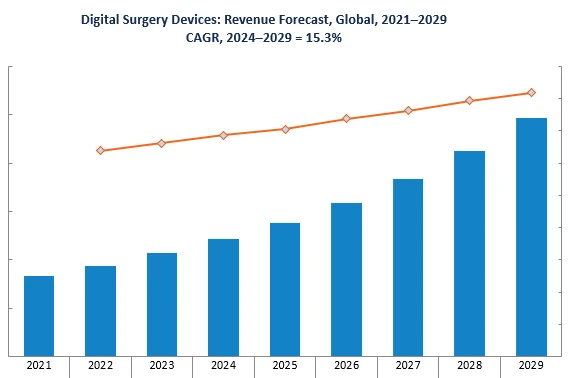
This growth is closely tied to the expansion of the Minimally Invasive Surgical Instruments Market, as healthcare providers increasingly adopt digital solutions to enhance surgical precision and reduce recovery times. Additionally, rising investments in healthcare infrastructure and digital transformation initiatives are contributing to market expansion.
Spending trends indicate a growing focus on integrating AI-powered analytics, robotic systems, and real-time imaging technologies into surgical workflows. These investments are not only improving clinical outcomes but also optimizing operational efficiency within hospitals and surgical centers.
As part of the broader Medical Devices market, the Digital Surgery Devices Market is expected to attract significant capital from both public and private sectors, further accelerating innovation and adoption across global healthcare systems.
Market Segmentation Analysis: Digital Surgery Devices Market
The Digital Surgery Devices Market is segmented based on product type, application, and end-user categories, reflecting the diverse technological landscape within modern surgical environments.
By product type, the market includes robotic-assisted surgical devices (RASDs), surgical navigation systems, and surgical planning and training platforms. RASDs represent a significant segment, offering enhanced precision and control, and are widely used in minimally invasive procedures. These systems are closely linked to the growth of the Minimally Invasive Surgical Instruments Market, as they enable complex surgeries with reduced patient trauma.
Surgical navigation devices are another critical segment, providing real-time imaging and tracking capabilities that guide surgeons during procedures. These systems are particularly valuable in specialties such as neurosurgery and orthopedics, where precision is paramount. Meanwhile, surgical planning and training devices leverage advanced simulation technologies, including AR and VR, to create immersive learning environments and improve surgical preparedness.
From an application perspective, the market spans orthopedics, neurology, cardiovascular surgery, and general surgery. Orthopedics and neurology dominate due to the high demand for precision and the complexity of procedures in these fields.
End users include hospitals, ambulatory surgical centers, and specialty clinics. Hospitals account for the largest share due to their access to advanced infrastructure and higher surgical volumes. However, ASCs are emerging as key growth areas due to the increasing shift toward outpatient procedures.
Growth Drivers: Digital Surgery Devices Market
The Digital Surgery Devices Market is driven by several high-impact factors that are accelerating adoption across healthcare systems globally.
One of the primary drivers is the increasing demand for robotic-assisted surgeries. These systems enhance precision, reduce human error, and improve surgical outcomes, making them integral to the evolution of the Minimally Invasive Surgical Instruments Market. Their ability to overcome limitations such as tremors and restricted movement significantly boosts surgeon performance.
Another key driver is the growing emphasis on minimally invasive procedures. Patients and healthcare providers are prioritizing faster recovery times, reduced hospital stays, and lower complication rates, all of which are enabled by digital surgical technologies.
Technological advancements, including AI integration, real-time data analytics, and device connectivity, are also playing a crucial role. These innovations enable better decision-making, improved workflow efficiency, and enhanced patient outcomes, strengthening the position of the Digital Surgery Devices Market within the broader Medical Devices market.
Additionally, the increasing volume of surgical procedures, driven by aging populations and rising chronic diseases, is fueling demand for advanced surgical solutions. Investments in AR, VR, and MR technologies for training and planning further support market growth.
Growth Restraints: Digital Surgery Devices Market
Despite strong growth potential, the Digital Surgery Devices Market faces several challenges that may hinder widespread adoption.
High costs associated with advanced surgical technologies remain a significant barrier. Robotic systems, AR/VR devices, and navigation platforms require substantial investment in installation, maintenance, and training. This limits adoption, particularly in cost-sensitive markets, and impacts growth within the Medical Devices market.
Another major restraint is the increased cost of surgical procedures involving digital systems. Robotic-assisted surgeries can significantly raise operational expenses compared to traditional methods, creating financial pressure for healthcare providers.
Limited availability of skilled professionals is also a concern. Operating advanced digital systems requires specialized training, and the shortage of trained surgeons can slow adoption rates.
Additionally, technological limitations such as latency in robotic systems and integration challenges with existing hospital infrastructure can impact performance and efficiency. Data security and ethical concerns related to AI usage further complicate implementation.
The scarcity of high-quality AR/VR content and applications also restricts the full potential of training and simulation platforms. These challenges, combined with regulatory complexities, create barriers to growth.
Competitive Landscape: Digital Surgery Devices Market
The Digital Surgery Devices Market is highly competitive, with a mix of established medical device companies and emerging technology innovators driving market dynamics. The ecosystem includes approximately 120 key players, reflecting strong industry participation within the broader Medical Devices market.
Leading companies such as Intuitive Surgical, Medtronic, and Stryker dominate the market, leveraging advanced robotics, strong distribution networks, and continuous innovation. These players collectively hold a significant market share, highlighting the importance of scale and technological leadership.
Competitive strategies focus on product innovation, strategic partnerships, and mergers and acquisitions. Recent acquisitions and collaborations are aimed at expanding product portfolios, integrating advanced technologies, and enhancing market reach. Companies are also investing heavily in R&D to develop next-generation surgical systems that align with the growing demand in the Minimally Invasive Surgical Instruments Market.
Emerging players and startups are contributing to innovation by introducing specialized solutions in navigation systems, simulation platforms, and AI-driven analytics. These companies are attracting investment and forming partnerships to scale their technologies.
The market is characterized by direct sales models, strong customer relationships, and a focus on performance, reliability, and clinical outcomes. As competition intensifies, companies are prioritizing differentiation through technology integration and value-based healthcare solutions.
Overall, the Digital Surgery Devices Market is expected to remain dynamic, with continuous innovation and strategic initiatives shaping its future trajectory within the global Medical Devices market.
Scope of Analysis
Segmentation
Segmentation by Application
Why is it Increasingly Difficult to Grow?
The Strategic Imperative 8™
The Impact of the Top 3 Strategic Imperatives on the Digital Surgery Devices Industry
Competitive Environment
Key Competitors
Growth Metrics
Growth Drivers
Growth Restraints
Forecast Considerations
Revenue Forecast
Revenue Forecast by Product
Revenue Forecast Analysis
Revenue Forecast by Region
Pricing Trends and Forecast Analysis
Revenue Share
Revenue Share Analysis
Competitive Benchmarking of Key Companies in Digital Surgery Devices
Critical Pain Points and Key Priorities in the Surgical Ecosystem
Medtech Strategies that Impact the Digital Surgical Ecosystem
Key Therapy Area Opportunities and Development Scenarios
Digital Surgery—Increasing Scope for Out-of-Hospital End Users
Line of Sight for Digital Surgery in 2024
Growth Metrics
Revenue Forecast
Revenue Forecast by Product
Revenue Forecast Analysis
Revenue Forecast by Region
Pricing Trends and Forecast Analysis
Forecast Analysis by Region
Evolving Roles of Robotics in Surgery
Milestones in RASDs for 2024
RASD Platforms
RASD Goals and Applications
Competitive Benchmarking of Key RASD Companies
M&As with Large Medtech Companies in the RASD Market
Recent Trends and Advances in RASDs
Increasing Focus on Endoluminal Surgery
Potential Challengers in RASDs
Future Scope for RASDs
Growth Metrics
Revenue Forecast
Revenue Forecast by Product
Revenue Forecast by Region
Pricing Trends and Forecast Analysis
Forecast Analysis by Region
Surgical Navigation Systems—Applications
Surgical Navigation Systems—Competitive Landscape
Competitive Benchmarking of Key Companies in Surgical Simulation
Recent Advances in Surgical Planning and Navigation
Milestones in Surgical Navigation for 2024
M&As with Large Medtech Companies in the Surgical Navigation Device Market
Future Scope for Surgical Navigation
Growth Metrics
Revenue Forecast
Revenue Forecast by Product
Revenue Forecast Analysis
Revenue Forecast by Region
Pricing Trends and Forecast Analysis
Forecast Analysis by Region
XR in Healthcare
Defining XR’s Value Specific to Surgery
XR Drive for Specific Surgeries
XR in Physician Education and Training
XR in Surgical Planning
Increasing Focus on the Spine
Growth Opportunity 1: Improving Outcomes with Hybrid RASDs
Growth Opportunity 2: Telesurgery Enabled with Digital Connectivity to Eliminate Latency
Growth Opportunity 3: Data Integration
Growth Opportunity 4: Software as a Service
Growth Opportunity 5: Predictability and Automation
Benefits and Impacts of Growth Opportunities
Next Steps
List of Exhibits
Legal Disclaimer
Frequently Asked Questions (FAQ) – Digital Surgery Devices Market
1. What is the market size and growth forecast of the Digital Surgery Devices Market?
The Digital Surgery Devices Market was valued at USD 12.13 billion in 2024 and is projected to reach USD 24.68 billion by 2029, growing at a CAGR of 15.3%, driven by increasing adoption of AI-powered surgical technologies and robotic-assisted procedures.
2. What is the Digital Surgery Devices Market?
The Digital Surgery Devices Market includes advanced technologies such as robotic-assisted systems, surgical navigation devices, and simulation platforms that leverage AI, AR, and real-time data to improve surgical precision and patient outcomes within the Medical Devices market.
3. What are the key drivers of the Digital Surgery Devices Market?
Growth is driven by increasing demand for minimally invasive procedures, advancements in robotic surgery, integration of AI and imaging technologies, and rising healthcare investments across the Medical Devices market.
4. How is the Digital Surgery Devices Market connected to the Minimally Invasive Surgical Instruments Market?
The Digital Surgery Devices Market complements the Minimally Invasive Surgical Instruments Market by enabling highly precise, less invasive procedures that reduce recovery time, minimize complications, and improve surgical efficiency.
5. What are the main types of digital surgery devices?
Key product categories include robotic-assisted surgical devices (RASDs), surgical navigation systems, and surgical planning and training platforms, all designed to enhance surgical accuracy and workflow efficiency.
6. Which regions are leading the Digital Surgery Devices Market?
North America leads the market due to advanced healthcare infrastructure and early technology adoption, while Asia-Pacific is the fastest-growing region driven by rising healthcare investments and digital transformation initiatives.
7. What challenges does the Digital Surgery Devices Market face?
Major challenges include high costs of robotic systems, lack of skilled professionals, integration complexities, and data security concerns, which may limit adoption in certain regions.
8. Who are the key players in the Digital Surgery Devices Market?
Leading companies include Intuitive Surgical, Medtronic, and Stryker, along with emerging players developing AI-driven surgical and navigation technologies within the Medical Devices market.
9. How does AI impact the Digital Surgery Devices Market?
AI enhances surgical precision through predictive analytics, real-time decision support, and advanced imaging, enabling safer procedures and improved patient outcomes.
10. What is the future outlook for the Digital Surgery Devices Market?
The market is expected to witness strong growth driven by continuous innovation, increasing adoption of minimally invasive procedures, and expanding applications across multiple surgical specialties in the Medical Devices market.
Speak directly with our analytics experts for tailored recommendations.
Recent related Medical Devices research
08 Oct 2026 | Global | Frost Radar
Frost Radar: Endoscopy Device Technology Ecosystem, 2026
The endoscopy device market is advancing toward higher-quality visualization and improved clinical decision-making, with innovation across 4K ultrahigh-definition display systems, image-enhanced endoscopy, and computer-aided detection systems. Advanced visualization is evolving through improvements ...
07 Oct 2026 | Global | Technology Research
Growth Opportunities in Image-Guided Cancer Ablation Systems
Image-guided cancer ablation systems are minimally invasive medical technologies that use real-time imaging to accurately guide the placement of an ablation device into a tumor, enabling localized destruction of cancerous tissue while minimizing damage to surrounding healthy structures.The increasin...
25 Sep 2026 | Global | Technology Research
Innovations and Growth Opportunities in Advanced Medical Devices, Diagnostic Solutions, and Implantables
The latest issue of Advanced MedTech Technology Opportunity Engine (TOE) spotlights a diverse slate of innovations across advanced medical devices, diagnostic solutions, and implantables.The issue features advanced medical devices such as peritoneal dialysis fluid system, cold sterilization-based au...
15 Sep 2026 | Global | Market Research
Vendor Profiles: Advanced Wound Care Management Market, Global, 2025
The wound care market is being transformed by advanced technologies and evolving care models that focus on improving patient outcomes and reducing healthcare costs. Innovations such as smart sensor-embedded dressings, artificial intelligence (AI)-based wound imaging systems, enhanced negative pressu...
28 Aug 2026 | Global | Technology Research
Innovations and Growth Opportunities in Advanced Medical Devices, Artificial Intelligence Solutions, Digital Solutions, and Medical Imaging Solutions
The latest issue of Advanced MedTech Technology Opportunity Engine (TOE) spotlights a diverse slate of innovations across advanced medical devices, artificial intelligence solutions, digital solutions, and medical imaging solutions.The issue features advanced medical devices such as active bioelectr...
Purchase includes:
- Report download
- Growth Dialog™ with our experts
Growth Dialog™
A tailored session with you where we identify the:- Strategic Imperatives
- Growth Opportunities
- Best Practices
- Companies to Action
Impacting your company's future growth potential.
Digital surgery reduces complications, shortens recovery times, and lowers costs, addressing global healthcare challenges. It also raises important considerations, such as integrating AI ethically, ensuring data security, and overcoming adoption barriers in resource-limited settings. For healthcare professionals, investors, or policymakers, understanding this market is essential to stay ahead in a rapidly evolving field, make informed decisions, and contribute to innovations that save lives. Ignoring it risks missing opportunities to improve surgical care and adapt to a technology-driven medical future where patient-centric solutions dominate.
Author: Bejoy Daniel
| Deliverable Type | Market Research |
|---|---|
| Industries | Healthcare |
| No Index | No |
| Is Prebook | No |
| Keyword 1 | cardiac surgery devices market |
| Keyword 2 | spinal surgery devices market |
| Keyword 3 | robotic surgery devices market |
| Podcast | No |
| Predecessor | MG5A-01-00-00-00 |
| WIP Number | KB5D-01-00-00-00 |