 USD
USD GBP
GBP  CNY
CNY  EUR
EUR  INR
INR  JPY
JPY  MYR
MYR  ZAR
ZAR  KRW
KRW  THB
THB 


XR is Driving a New Growth Cycle as Value Shifts from Devices to Software and Monetization
03-Apr-2026
Global
Market Research
KC34-01-00-00-00
IT_2026_34476
Report Summary: Extended Reality (XR) Market
The global Extended Reality (XR) Market size was valued at USD 35.77 billion in 2022 and is projected to reach USD 148.17 billion by 2032, growing at a CAGR of 15.3% from 2025 to 2032. The Extended Reality Market is entering a new growth phase, shifting from hardware-driven adoption toward software, platform ecosystems, and recurring monetization models.
Key Market Trends & Insights
- Platform ecosystems led by major players are redefining the Extended Reality (XR) Market, focusing on software and monetization rather than device sales.
- Enterprise adoption is expanding beyond pilots into scalable deployments across training, simulation, and industrial visualization.
- Consumer XR growth is driven by gaming, immersive media, and mobile AR experiences within the Extended Reality Market.
- Developer platforms such as game engines are shaping content creation and ecosystem expansion.
- Recurring revenue models, including subscriptions and content monetization, are strengthening the Extended Reality (XR) Market value chain.
Market Size & Forecast
- 2022 Market Size: USD 35.77 Billion
- 2032 Projected Market Size: USD 148.17 Billion
- CAGR (2025–2032): 15.3%
- North America: Leading market
- Asia Pacific: Fastest-growing region in the Extended Reality Market
The transition toward software-driven monetization, coupled with advancements in AR, VR, and MR technologies, is accelerating the evolution of the Extended Reality (XR) Market. Increasing enterprise use cases and expanding consumer applications are expected to drive long-term growth across the Extended Reality Market ecosystem.
Market Overview: Extended Reality (XR) Market
The Extended Reality (XR) Market is undergoing structural transformation, with value shifting from hardware shipments to software platforms, ecosystems, and monetization strategies. While headset sales remain cyclical, the Extended Reality Market is increasingly driven by recurring revenues from software, content, and services.
Enterprise adoption is a major growth pillar, with industries such as manufacturing, healthcare, defense, and logistics leveraging XR for training, simulation, and remote assistance. These applications are moving beyond pilot stages into scalable deployments, strengthening the Extended Reality (XR) Market.
On the consumer side, immersive gaming, augmented reality experiences, and mobile-based XR applications are driving adoption. Cross-platform compatibility and ecosystem integration are further expanding the Extended Reality Market reach.
Technology advancements in AI, cloud computing, and spatial computing are enhancing user experiences and reducing deployment costs. As a result, the Extended Reality (XR) Market is transitioning into a more mature and diversified ecosystem.
Scope of Analysis: Extended Reality (XR) Market
This study analyzes the global Extended Reality (XR) Market across technologies, applications, and regions. The Extended Reality Market includes augmented reality (AR), mixed reality (MR), and virtual reality (VR), collectively forming immersive digital experiences.
The geographic scope covers North America, Europe, Asia-Pacific, Latin America, and the Middle East & Africa. The study period spans 2022 to 2032, with 2025 as the base year for forecasting within the Extended Reality (XR) Market.
The analysis includes hardware revenues, software platforms, and content ecosystems. Consumer applications such as gaming, media, and AR advertising are evaluated alongside enterprise use cases like training simulations and industrial visualization.
Methodology involves assessing market trends, technological advancements, adoption patterns, and competitive strategies. The Extended Reality Market is evaluated based on ecosystem development, platform scalability, and monetization potential.
Market Segmentation Analysis: Extended Reality (XR) Market
The Extended Reality (XR) Market is segmented into AR, MR, and VR technologies, each contributing uniquely to the overall Extended Reality Market growth.
Augmented Reality (AR) overlays digital content onto the real world and is widely used in mobile applications, retail, and advertising. Mixed Reality (MR) blends physical and digital environments, enabling advanced interaction and enterprise use cases. Virtual Reality (VR) provides fully immersive experiences, primarily used in gaming, training, and simulation.
From an application perspective, enterprise use cases are expanding rapidly within the Extended Reality (XR) Market, including training, simulation, and remote collaboration. Consumer applications such as gaming, immersive media, and social engagement continue to drive adoption in the Extended Reality Market.
Cross-platform integration and ecosystem convergence are key trends shaping segmentation. The Extended Reality (XR) Market is evolving toward unified platforms that support multiple technologies and applications.
Revenue & Spending Forecast: Extended Reality (XR) Market
The Extended Reality (XR) Market is expected to witness strong financial growth, driven by software monetization and expanding use cases across industries.
- 2022 Market Revenue: USD 35.77 Billion
- 2032 Market Revenue: USD 148.17 Billion
The Extended Reality Market is projected to grow at a CAGR of 15.3%, reflecting rapid adoption of immersive technologies and increasing enterprise investments.
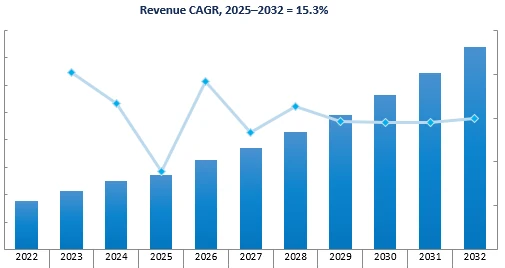
Revenue growth is increasingly driven by software platforms, content ecosystems, and recurring monetization models rather than hardware sales alone. The Extended Reality (XR) Market is also benefiting from advancements in AI and cloud technologies, enabling scalable and cost-effective deployments.
As enterprise adoption accelerates and consumer applications expand, the Extended Reality Market is expected to achieve sustained long-term growth.
Growth Drivers: Extended Reality (XR) Market
The Extended Reality (XR) Market is driven by multiple factors shaping its rapid expansion:
- Shift to Software Monetization: Increasing reliance on software platforms and recurring revenue models in the Extended Reality Market.
- Enterprise Adoption Growth: Expanding use cases in training, simulation, and remote assistance within the Extended Reality (XR) Market.
- Platform Ecosystem Expansion: Integration of hardware, software, and content ecosystems driving innovation.
- AI and Cloud Integration: Enhancing scalability and reducing deployment costs in the Extended Reality Market.
- Consumer Demand for Immersive Experiences: Growth in gaming, media, and AR applications fueling adoption.
- Cross-Platform Compatibility: Increasing accessibility and ecosystem convergence in the Extended Reality (XR) Market.
Growth Restraints: Extended Reality (XR) Market
Despite strong growth, the Extended Reality (XR) Market faces several challenges:
Hardware cyclicality and inventory risks impact short-term growth in the Extended Reality Market. High costs and complexity of enterprise integration also slow adoption.
Fragmented software standards and lack of interoperability create barriers within the Extended Reality (XR) Market. Limited daily-use applications for consumers outside gaming further constrain growth.
Additionally, price sensitivity and budget constraints affect investment decisions, particularly in uncertain economic conditions. Addressing these challenges is essential for sustained expansion of the Extended Reality Market.
Competitive Landscape: Extended Reality (XR) Market
The Extended Reality (XR) Market is highly competitive, with key players operating across hardware, software, and content ecosystems.
Platform leaders dominate through ecosystem control, developer engagement, and recurring monetization strategies. Engine providers play a critical role in content creation and runtime infrastructure within the Extended Reality Market.
Enterprise solution providers focus on workflow integration, device management, and scalability. Consumer-focused companies drive engagement through gaming, social platforms, and immersive content.
Strategic partnerships, platform expansion, and innovation are shaping competition in the Extended Reality (XR) Market, with companies increasingly prioritizing software ecosystems over standalone hardware offerings.
Scope of Analysis
Segmentation
Key Competitors
Why is it Increasingly Difficult to Grow?
The Strategic Imperative 8™
Strategic Imperative
The Impact of the Top 3 Strategic Imperatives on the XR Industry
Growth Environment
Competitive Landscape
Growth Metrics
Growth Drivers
Growth Restraints
Revenue Forecast
Revenue Forecast by Technology Type
Revenue Forecast by Usage Type
Revenue Forecast by Usage Type—VR
Revenue Forecast by Usage Type—AR-MR
Revenue Forecast by Hardware Versus Software
Revenue Forecast by Hardware Versus Software—VR
Revenue Forecast by Hardware Versus Software—AR-MR
Percent Revenue by Region
Growth Opportunity 1: Leverage Growth in Installed-Base Monetization Through Enterprise XR Software at Scale
Growth Opportunity 2: Scale Mobile AR Monetization Beyond Experimental Use Cases
Growth Opportunity 3: Ecosystem and Platform Expansion
Growth Opportunity 4: Embed AI-Driven Spatial Computing to Unlock Scalable, Everyday Use Cases
Benefits and Impacts of Growth Opportunities
Next Steps
List of Exhibits
Legal Disclaimer
Frequently Asked Questions (FAQ) – Extended Reality (XR) Market
1. What is the Extended Reality (XR) Market?
The Extended Reality (XR) Market includes technologies such as augmented reality (AR), virtual reality (VR), and mixed reality (MR) that create immersive digital experiences across consumer and enterprise applications.
2. What is driving growth in the Extended Reality Market?
Growth in the Extended Reality Market is driven by increasing demand for immersive experiences, enterprise adoption, advancements in AI and cloud computing, and the shift toward software-based monetization models.
3. How large is the Extended Reality (XR) Market?
The Extended Reality (XR) Market was valued at USD 35.77 billion in 2022 and is projected to reach USD 148.17 billion by 2032, growing at a strong CAGR of 15.3%.
4. What are the key technologies in the Extended Reality Market?
The key technologies in the Extended Reality Market include augmented reality (AR), mixed reality (MR), and virtual reality (VR), each offering different levels of immersion and interaction.
5. Which region leads the Extended Reality (XR) Market?
North America leads the Extended Reality (XR) Market due to strong technological innovation and early adoption, while Asia-Pacific is the fastest-growing region.
6. What are the major applications of the Extended Reality Market?
Major applications include gaming, immersive media, training and simulation, healthcare, industrial visualization, and remote collaboration.
7. What challenges does the Extended Reality (XR) Market face?
The Extended Reality (XR) Market faces challenges such as high hardware costs, fragmented software standards, limited interoperability, and slower enterprise integration.
8. What is the future outlook of the Extended Reality Market?
The Extended Reality Market is expected to grow rapidly, driven by advancements in AI, cloud computing, and increasing adoption across enterprise and consumer sectors.
9. How is enterprise adoption impacting the Extended Reality (XR) Market?
Enterprise adoption is accelerating the Extended Reality (XR) Market by enabling use cases such as training, simulation, remote assistance, and workflow optimization.
10. How is software monetization influencing the Extended Reality Market?
Software monetization is transforming the Extended Reality Market by shifting revenue from hardware sales to recurring income through subscriptions, platforms, and digital content.
Speak directly with our analytics experts for tailored recommendations.
Recent related Digital Enterprise research
25 Sep 2026 | Global | Frost Radar
Frost Radar™: Demand-Side Platforms, 2026
Demand-side platforms (DSPs) have evolved from programmatic buying tools into the decisioning infrastructure through which advertisers plan, execute, optimize, and measure campaigns across connected television, display, video, audio, digital out-of-home, and commerce media. Frost & Sullivan estimate...
10 Sep 2026 | Global | Frost Radar
Frost Radar™: Entertainment Metadata and Content Discovery Platforms, 2026
The entertainment metadata and content discovery platforms market sits at the center of a structural problem the industry has never fully solved: content abundance has outpaced the infrastructure needed to make that content findable. As catalogs fragment across subscription or advertisement-based vi...
07 Aug 2026 | Global | Frost Radar
Frost Radar™: Online Video Platforms for Media and Entertainment, 2026
This Frost Radar™ highlights the online video platform market at a critical inflection point: platforms have evolved from simple delivery layers into the economic engines of streaming. As the industry shifts its focus from subscriber growth to monetization efficiency, the platforms are emerging as t...
31 Jul 2026 | Global | Frost Radar
Frost Radar™: Digital Asset Management Platforms, 2026
Driven by accelerating content volumes, generative and agentic AI, governance requirements, and increasingly complex content supply chains, digital asset management platforms are expanding beyond storage and search to support content intelligence, workflow automation, rights management, omnichannel ...
23 Jul 2026 | Global | Frost Radar
Frost Radar™: Digital Media Content Security and Anti-piracy Services, 2026
Digital piracy has evolved from casual file sharing into an industrialized, organized crime enterprise that ranks among the gravest revenue threats facing global media and entertainment. The single most important problem confronting the industry today is the industrialization of live streaming pirac...
Purchase includes:
- Report download
- Growth Dialog™ with our experts
Growth Dialog™
A tailored session with you where we identify the:- Strategic Imperatives
- Growth Opportunities
- Best Practices
- Companies to Action
Impacting your company's future growth potential.
From 2026 onward, the market is expected to strengthen structurally, supported by normalization in headset shipments after a weak 2025 baseline and accelerating installed-base monetization across software and content ecosystems.
Through 2032, overall XR revenue growth will increasingly depend on recurring software, platform, and content revenues rather than hardware volumes alone, signaling a gradual transition toward a more durable and diversified XR value chain. Simplified enterprise integration, greater availability of reusable content, and continued improvements in device ergonomics and cost structures will be critical to accelerate scaled deployments.
Author: Claudia Hochman
| Deliverable Type | Market Research |
|---|---|
| Industries | Information Technology |
| No Index | No |
| Is Prebook | No |
| Keyword 1 | Extended Reality (XR) Market |
| Keyword 2 | Enterprise XR Software Platforms |
| Keyword 3 | AR/VR Training and Simulation |
| Podcast | No |
| Predecessor | K710-01-00-00-00 |
| WIP Number | KC34-01-00-00-00 |