 USD
USD GBP
GBP  CNY
CNY  EUR
EUR  INR
INR  JPY
JPY  MYR
MYR  ZAR
ZAR  KRW
KRW  THB
THB 


AI-Driven Optimization and Autonomous Deployments are Driving Transformational Growth in Europe’s Ridehailing Industry
03-Dec-2025
Europe
Market Research
MHF6-01-00-00-00
AU_2025_34155
The European ridehailing market is rapidly evolving, shaped by technological advancements, changing consumer preferences, and regulatory dynamics. While Uber and Bolt are the formidable players, local and regional competitors such as FreeNow, Cabify, inDrive, Yango Ride, and Heetch each have their own strengths and specific regions of operation, contributing to a competitive marketplace. Each company brings its own set of strategies, unique offerings, and localized approaches to cater to the diverse needs of riders.
Ridehailing companies are exploring sustainable mobility options, expanding their geographic scope, integrating multimodal transportation services, and leveraging AI and ML to enhance user experiences.
This study offers a deep dive into the evolution, structure, and future trajectory of the ridehailing value chain in Europe, tracing its transformation from 2015 to 2025 and projecting strategic shifts through 2035. As the sector matures across the continent, this research maps how the value chain has expanded beyond traditional fleet and driver operations to include complex layers of technology, regulatory engagement, sustainability mandates, and multimodal integration.
The study is structured around a detailed ridehailing value chain framework, which breaks down the industry into 7 interconnected layers:
1. Fleet & Vehicle Partnerships – including OEM collaborations, rental partners, and leasing models.
2. Technology Stack – encompassing dispatch systems, telematics, driver onboarding, payments, AI, and AV development.
3. Operations & Infrastructure – such as vehicle maintenance, insurance, EV charging, and curbside management.
4. Financial & Regulatory Ecosystem – with a focus on funding flows, local regulations, driver vehicle financing, and digital payments.
5. Multimodal Integration – reflecting partnerships with public transit, corporate mobility, and MaaS platforms.
6. Sustainability & ESG – including carbon offset programs and environmental compliance.
7. End Support & Monetization – such as customer support evolution, loyalty schemes, and revenue bundling.
Each layer is analyzed over 3 timeframes—2015, 2025, and 2035—to illustrate how the market has matured and where new value is emerging. For instance, fleet partnerships in 2015 were fragmented and unstructured, while in 2025, they are increasingly defined by EV transitions and leasing-financing hybrids. By 2035, autonomous vehicles, AI-led fleet operations, and city-driven digital twins are expected to fundamentally alter the structure and economics of urban ridehailing.
In addition to value chain evolution, the study includes operator-specific mappings for Uber, Bolt, Free Now, and Cabify, analyzing how each aligns with broader ecosystem shifts. These case studies examine areas such as AV readiness, regulatory positioning, and differentiation through customer experience or MaaS integration.
The study is intended for mobility strategists, ridehailing operators, city planners, platform operators, investors, and transport policy professionals. It answers critical questions:
• Where has value shifted in Europe’s ridehailing industry—and where will it go next?
• How should platforms adapt to increased regulation, sustainability pressure, and multimodal demands?
• What capabilities will define success in the 2035 landscape—software, AV integration, or public-private coordination?
With its forward-looking lens and structured approach, this study offers a strategic blueprint for understanding Europe’s ridehailing ecosystem.
Author: Chanchal Jetha
Report Summary: Global Ridehailing Market
The global Ridehailing Market is undergoing a structural transformation driven by digital platform expansion, multimodal mobility integration, and sustained migration from private vehicle ownership toward shared transportation. In 2024, the Ridehailing Industry generated USD 66.06 billion in revenue and is projected to reach USD 142.88 billion by 2035, growing at a CAGR of 7.3% over the forecast period.
Rising adoption of connected mobility platforms, evolving consumer expectations for on-demand transport, and advances in vehicle electrification are accelerating the scale and sophistication of global ridehailing ecosystems.
Key Market Trends & Insights
- The Ridehailing Industry is transitioning from single-service operations to integrated multimodal platforms offering taxis, private hire vehicles, micromobility, and shared pooling services.
- Europe and Asia-Pacific are experiencing rapid platform consolidation, price regulation, and electrification mandates, reshaping operating models.
- Partnerships among automakers, fintech providers, insurers, and mobility platforms are expanding value creation across the extended mobility supply chain.
- Fleet electrification is accelerating as governments impose zero-emission targets, boosting demand for EV-centric ridehailing fleets.
Market Size & Forecast
- 2024 Market Size: USD 66.06 Billion
- 2035 Market Size: USD 142.88 Billion
- CAGR (2024–2035): 7.3%
The global Ridehailing Market continues to expand as platform-based mobility becomes central to urban transport infrastructure, supported by digital payments, telematics, and regulatory formalization across both mature and emerging economies.
Market Overview & Trends: Global Ridehailing Market
The Ridehailing Industry has evolved into one of the most dynamic pillars of the global mobility ecosystem, driven by the convergence of digital platforms, consumer behavioral shifts, and regulatory modernization. Ridehailing initially emerged as a disruptive alternative to traditional taxis but has matured into a comprehensive mobility service category encompassing door-to-door transportation, pooled rides, business travel mobility, and increasingly electrified fleet operations. As platforms scale and diversify, the Ridehailing Market has become a strategic enabler of urban mobility, offering convenient, real-time transport options while reducing reliance on private vehicle ownership.
One of the most significant structural trends is the integration of multimodal transport. Leading platforms now combine ridehailing with micromobility, car rentals, public transit ticketing, and subscription-based mobility bundles. This multimodal expansion strengthens platform stickiness and aligns with city-level goals of reducing congestion and emissions. Growth in digital payments, mobile-first mobility usage, and AI-assisted route optimization further enhances user accessibility and operational efficiency across the Ridehailing Industry.
Electrification is another major trend reshaping the Ridehailing Market. Governments across Europe, China, and select U.S. states have introduced low-emission zones and EV mandates for commercial fleets. Ridehailing operators increasingly partner with automakers and charging infrastructure providers to deploy EV fleets at scale. This evolution is expected to reduce long-term operating costs, improve environmental performance, and align platforms with climate-focused mobility strategies.
Regulatory structures are also becoming more standardized globally. While early-stage ridehailing growth was characterized by regulatory ambiguity, most mature markets have now implemented licensing frameworks, safety requirements, and pricing transparency guidelines. This regulatory clarity has improved competitive fairness, established safeguards for drivers and passengers, and encouraged institutional investment into the Ridehailing Industry.
Technology remains central to market expansion. Real-time telematics, automated dispatching, digital KYC, dynamic pricing, and AI-driven demand forecasting are now core capabilities within the Ridehailing Market. Moreover, the integration of insurance, identity verification, and fleet management tools strengthens platform scalability and reliability. As consumer lifestyles increasingly prioritize convenience, flexibility, and digital access, ridehailing platforms are positioned to remain essential mobility providers within modern transport ecosystems.
Revenue & Spending Forecast: Global Ridehailing Market
Global revenue for the Ridehailing Market is projected to increase from USD 66.06 billion in 2024 to USD 142.88 billion by 2035, representing a sustained CAGR of 7.3% over the forecast period.
This trajectory reflects strong consumer demand for digital mobility, expanding urban populations, and widespread adoption of app-based transportation platforms.
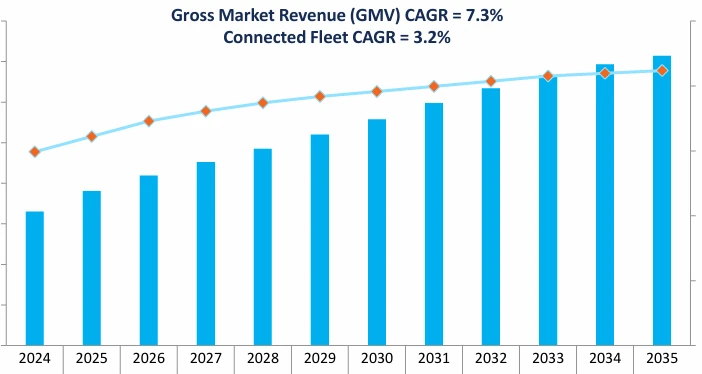
Spending patterns indicate a steady shift away from private vehicle ownership toward shared mobility solutions, particularly in densely populated cities where parking scarcity, traffic congestion, and rising fuel prices elevate the attractiveness of ridehailing services. Moreover, migration toward multimodal mobility bundles—combining ridehailing with micromobility, car-sharing, and public transit integration—supports greater cross-platform spending.
Electrification will significantly influence long-term spending. While EV adoption requires upfront investment, operational expenditures decline over time due to reduced fuel and maintenance costs, enabling platform operators and fleet owners to benefit from improved profitability. Government incentives for EV fleets, including tax benefits and access privileges in low-emission zones, further encourage capital allocation toward sustainable fleet transformation.
Corporate mobility spending is also rising, with enterprises adopting managed ridehailing programs for employee travel. These programs offer cost transparency, safety features, and policy compliance tools, making the Ridehailing Industry a strategic component of business mobility budgets.
Overall, revenue expansion through 2035 will be shaped by digital ecosystem integration, expanding EV fleets, and structured regulatory environments that support long-term platform scalability.
Scope of Analysis: Global Ridehailing Market
This analysis examines the global Ridehailing Industry, focusing on the evolution, structure, and operational dynamics of platform-based on-demand mobility services. The scope encompasses digitally enabled ridehailing platforms that connect passengers with professional or independent drivers via mobile applications, incorporating real-time navigation, automated dispatching, dynamic pricing, cashless payments, and integrated safety systems. Traditional street-hail taxi services are excluded unless they operate through digital e-hailing platforms, ensuring that the assessment centers on technology-driven mobility models.
Geographically, the analysis covers major ridehailing regions including Europe, North America, Asia-Pacific, Latin America, and the Middle East. Each region is evaluated in terms of digital maturity, regulatory frameworks, mobility infrastructure, electrification readiness, and platform adoption trends. Particular attention is placed on markets where policy modernization, sustainability mandates, and multimodal mobility strategies are reshaping competitive dynamics within the Ridehailing Market.
The scope also addresses the extended mobility value chain, including platform operators, driver-partners, payment and fintech enablers, OEM and fleet partners, telematics providers, insurance ecosystems, and charging-infrastructure collaborators. As the Ridehailing Industry transitions toward integrated mobility ecosystems, the analysis evaluates how platforms expand into micromobility, car-sharing, transit connectivity, and subscription-based mobility services. This ensures a comprehensive understanding of how digital ridehailing integrates technology, regulation, and infrastructure to deliver end-to-end urban mobility solutions.
Market Segmentation Analysis: Global Ridehailing Market
Segmentation within the Ridehailing Market reflects the diversification of mobility services, operational models, and platform strategies as the sector transitions from single-mode ride services to integrated urban mobility ecosystems.
1. By Service Type
The Ridehailing Industry includes point-to-point e-hailing, private hire vehicle services, pooled ride offerings, and business mobility services. E-hailing represents the largest segment due to its simplicity and broad user adoption. Pooled services, while initially challenged post-pandemic, are rebounding as cities promote shared mobility to reduce congestion and emissions. Corporate ridehailing solutions are gaining traction as enterprises adopt controlled mobility budgets and travel policies.
2. By Vehicle Type
The market features internal combustion engine vehicles, hybrid vehicles, and fully electric vehicles. EV penetration is rapidly increasing due to government mandates, low-emission zones, and cost benefits from reduced fuel and maintenance expenses. Partnerships between ridehailing platforms, OEMs, and charging providers are accelerating EV deployment, particularly in Europe and Asia-Pacific.
3. By Platform Model
Platform operators fall into marketplace-led models with independent drivers, fleet-management models with leased vehicles, and hybrid models that combine both approaches. Marketplace-led models dominate in emerging markets, while hybrid approaches are expanding in mature markets to support vehicle standardization and electrification.
4. By User Segment
Passenger segments include daily commuters, occasional travelers, airport transfer users, and corporate clients. Commuters drive high-frequency demand, while airport and event-driven rides contribute to revenue spikes. Business travelers rely heavily on premium ridehailing tiers offering enhanced service quality.
5. By Geography
Europe demonstrates advanced regulatory frameworks and high EV adoption; Asia-Pacific contributes large-scale user volumes and rapid digitalization; North America maintains strong revenue despite rising competition and regulatory scrutiny. Across all regions, segmentation highlights how the Ridehailing Industry adapts its service mix to local regulations, mobility needs, and platform economics.
Growth Drivers: Global Ridehailing Market
Several powerful demand- and supply-side forces are propelling the Ridehailing Industry and shaping the next decade of expansion in the global Ridehailing Market.
1. Digital adoption and smartphone penetration
With near-universal smartphone access and rising comfort with digital payments, ridehailing has become one of the most widely adopted consumer digital services globally.
2. Urban congestion and declining vehicle ownership
In major metropolitan areas, the cost and inconvenience of private vehicle ownership—insurance, parking, maintenance—are driving consumers toward on-demand transportation as a more flexible alternative.
3. Electrification of mobility fleets
Government mandates for zero-emission commercial fleets and growing corporate sustainability commitments are accelerating EV adoption. EV ridehailing fleets reduce operating costs, align with ESG goals, and improve platform brand positioning.
4. Integration into multimodal mobility ecosystems
Ridehailing services now link seamlessly with public transit, micromobility, and subscription mobility bundles, positioning platforms at the center of smart-city mobility strategies.
5. AI-enabled optimization and safety enhancements
The integration of AI and telematics in routing, demand forecasting, pricing, and driver safety monitoring enhances service quality and platform efficiency across the Ridehailing Market.
6. Regulatory stabilization
Clear licensing frameworks, safety standards, and labor classification guidelines in Europe, North America, and Asia provide operational stability and encourage investment in scaling up the Ridehailing Industry.
Growth Restraints: Global Ridehailing Market
Despite strong expansion, the Ridehailing Industry faces several challenges that may moderate growth trajectories across global markets.
1. Regulatory pressures and compliance costs
Driver classification rules, safety mandates, and fare regulations in many regions increase administrative and operational burdens. Compliance-related expenses can reduce profitability, especially for smaller operators.
2. Rising competitive intensity
The Ridehailing Market is increasingly crowded with global, regional, and local players. Competitive pricing, incentive spending, and marketing costs exert pressure on margins. Platform differentiation becomes difficult when service offerings converge.
3. Driver supply fluctuations
Driver shortages—driven by alternative gig opportunities, rising costs of vehicle ownership, and regulatory requirements—create supply-demand imbalances that impact rider wait times and platform reliability.
4. Profitability constraints
High customer acquisition costs, insurance premiums, and fleet financing expenses continue to limit profitability, particularly in markets with strict fare caps.
5. Public concerns regarding safety and labor conditions
Issues related to passenger safety, driver protections, and working conditions have prompted increased scrutiny, which can delay or restrict service deployment.
6. Macroeconomic headwinds
Inflation, interest rate pressure, and fuel price volatility influence consumer mobility budgets and driver operating costs, creating uncertainty for platform operators in the Ridehailing Industry.
Competitive Landscape: Global Ridehailing Market
The Ridehailing Market is characterized by a mix of global leaders, regional champions, and niche operators that differentiate through technology, pricing strategies, electrification initiatives, and multimodal offerings. The competitive landscape reflects both consolidation and diversification as platforms expand horizontally into adjacent mobility services.
Global players continue to dominate Tier-1 markets through extensive geographic coverage, strong capital backing, and advanced technology infrastructures. These platforms invest heavily in AI-driven matching, telematics, insurance technology, and advanced safety features to enhance user experience and optimize network efficiency within the Ridehailing Industry.
Regional operators in Europe, Latin America, the Middle East, and Asia-Pacific leverage localized strategies such as culturally relevant service features, region-specific pricing, partnerships with municipalities, and collaboration with telecom providers and digital wallets. These players often show agility in compliance with regional regulations, particularly in markets with stringent licensing and EV requirements.
Electrification is emerging as a major differentiator. Platforms that transition to EV fleets early gain economic advantages and regulatory support, especially in cities committed to carbon-neutral mobility. OEM partnerships with ridehailing companies facilitate large-scale vehicle procurement, financing programs, and charging infrastructure access.
Competition is intensifying as platforms integrate micromobility, car-sharing, and public transit ticketing into unified mobility apps. This multimodal approach strengthens ecosystem lock-in and allows companies to capture a larger share of user mobility spending.
In the long term, the most successful companies in the Ridehailing Industry will be those that combine technological leadership, operational efficiency, strong regulatory alignment, and accelerated electrification strategies.
Scope of Analysis
Why Is It Increasingly Difficult to Grow?
The Strategic Imperative 8
The Impact of the Top 3 Strategic Imperatives on the Ridehailing Industry
Ridehailing Business Model
Growth Metrics
Growth Drivers
Growth Restraints
Forecast Considerations
Gross Market Revenue and Fleet Size Forecast
Revenue and Fleet Forecast Analysis
Competitive Environment
Europe’s Ridehailing Value Chain 2015
Europe’s Ridehailing Value Chain 2025
Value Chain Comparison: Over the Years
Vehicle Acquisition Strategies, 2015 Versus 2025
Vehicle Ownership Structures
Vehicle Acquisition Strategies: Evolution 2035
Technology Infrastructure, 2015 Versus 2025
Technology Infrastructure Strategies: Evolution 2035
Operations and Services Strategies, 2015 Versus 2025
Operations and Services Strategies: Evolution 2035
Multimodal Integration Strategies, 2015 Versus 2025
Multimodal Integration Strategies: Evolution 2035
Funding and Regulation Strategies, 2015 Versus 2025
Funding and Regulation Strategies: Evolution 2035
Sustainability Strategies, 2015 Versus 2025
Sustainability Strategies: Evolution 2035
End Support and Monetization Strategies, 2015 Versus 2025
End Support and Monetization Strategies: Evolution 2035
Uber: 2025 Value Chain Mapping
Uber: 2035 Value Chain Shift
Bolt: 2025 Value Chain Mapping
Bolt: 2035 Value Chain Shift
FREENOW: 2025 Value Chain Mapping
FREENOW: 2035 Value Chain Shift
Cabify: 2025 Value Chain Mapping
Cabify: 2035 Value Chain Shift
Growth Opportunity 1: Focus on Electrification
Growth Opportunity 2: Autonomous Vehicles AVs in Ridehailing
Growth Opportunity 3: Mobility-as-a-Service MaaS Integration
Benefits and Impacts of Growth Opportunities
Next Steps
List of Exhibits
Legal Disclaimer
Speak directly with our analytics experts for tailored recommendations.
Recent related Infotainment and Telematics research
25 Sep 2026 | Global | Technology Research
Growth Opportunities in Next-Gen Wireless EV charging, Automotive Grade IoT module, Autonomous driving, E-bike Platform, UAVs, and 4D Radars
The Mobility Technology Opportunity Engine (TOE) covers innovations pertaining to EV charging, Automotive Grade IoT module, Autonomous driving, E-bike Platform, UAVs, and 4D Radars.The purpose of the Mobility Technology TOE is to raise awareness of global technology innovations in self-propelled gro...
22 Sep 2026 | Global | Market Research
Growth Opportunities in the Global EV Power Electronics Market, 2025–2032
The rapid push toward e-mobility is accelerating adoption of advanced power electronics by major OEMs. Power electronics underpin electric vehicle reliability, efficiency, and performance. Core systems, including traction inverters, onboard chargers, and DC-DC converters, are gaining strategic impor...
10 Sep 2026 | Global | Market Research
Global Robobus Market, 2026–2032
The global robobus market is at an inflection point. Large autonomous buses are no longer a concept—they are running as paid public services in China, South Korea, Norway, Switzerland, Finland, and the Netherlands. Europe is in its first wave of real deployment, with active L4 commercial service acr...
03 Sep 2026 | Global | Technology Research
Photonic and Optical Computing Chips for AI and Data Center Acceleration
The study evaluates photonic and optical computing technologies as critical enablers of next-generation AI infrastructure, addressing growing bandwidth, latency, power consumption, and scalability constraints associated with copper-based interconnects. The analysis covers photonic integrated circuit...
02 Sep 2026 | Global | Frost Radar
Frost Radar™: In-Vehicle Audio Technology Stacks, 2026
The in-vehicle entertainment industry is going through a dynamic shift. Audio entertainment in the passenger vehicle is no longer limited to music playback through multiple sources. The rise of ADAS/AD and SDVs have made audio a critical part of the passenger vehicle. Audio developers must now cater...
Purchase includes:
- Report download
- Growth Dialog™ with our experts
Growth Dialog™
A tailored session with you where we identify the:- Strategic Imperatives
- Growth Opportunities
- Best Practices
- Companies to Action
Impacting your company's future growth potential.
Ridehailing companies are exploring sustainable mobility options, expanding their geographic scope, integrating multimodal transportation services, and leveraging AI and ML to enhance user experiences. This study offers a deep dive into the evolution, structure, and future trajectory of the ridehailing value chain in Europe, tracing its transformation from 2015 to 2025 and projecting strategic shifts through 2035. As the sector matures across the continent, this research maps how the value chain has expanded beyond traditional fleet and driver operations to include complex layers of technology, regulatory engagement, sustainability mandates, and multimodal integration.
The study is structured around a detailed ridehailing value chain framework, which breaks down the industry into 7 interconnected layers: 1. Fleet & Vehicle Partnerships – including OEM collaborations, rental partners, and leasing models. 2. Technology Stack – encompassing dispatch systems, telematics, driver onboarding, payments, AI, and AV development. 3. Operations & Infrastructure – such as vehicle maintenance, insurance, EV charging, and curbside management. 4. Financial & Regulatory Ecosystem – with a focus on funding flows, local regulations, driver vehicle financing, and digital payments. 5. Multimodal Integration – reflecting partnerships with public transit, corporate mobility, and MaaS platforms. 6. Sustainability & ESG – including carbon offset programs and environmental compliance. 7. End Support & Monetization – such as customer support evolution, loyalty schemes, and revenue bundling.
Each layer is analyzed over 3 timeframes—2015, 2025, and 2035—to illustrate how the market has matured and where new value is emerging. For instance, fleet partnerships in 2015 were fragmented and unstructured, while in 2025, they are increasingly defined by EV transitions and leasing-financing hybrids. By 2035, autonomous vehicles, AI-led fleet operations, and city-driven digital twins are expected to fundamentally alter the structure and economics of urban ridehailing.
In addition to value chain evolution, the study includes operator-specific mappings for Uber, Bolt, Free Now, and Cabify, analyzing how each aligns with broader ecosystem shifts. These case studies examine areas such as AV readiness, regulatory positioning, and differentiation through customer experience or MaaS integration.
The study is intended for mobility strategists, ridehailing operators, city planners, platform operators, investors, and transport policy professionals. It answers critical questions: • Where has value shifted in Europe’s ridehailing industry—and where will it go next? • How should platforms adapt to increased regulation, sustainability pressure, and multimodal demands? • What capabilities will define success in the 2035 landscape—software, AV integration, or public-private coordination? With its forward-looking lens and structured approach, this study offers a strategic blueprint for understanding Europe’s ridehailing ecosystem.
Author: Chanchal Jetha
| Deliverable Type | Market Research |
|---|---|
| Industries | Automotive |
| No Index | No |
| Is Prebook | No |
| Keyword 1 | ride hailing market Europe |
| Keyword 2 | mobility value chain analysis |
| Keyword 3 | transportation services market research |
| Podcast | No |
| Predecessor | None |
| WIP Number | MHF6-01-00-00-00 |