 USD
USD GBP
GBP  CNY
CNY  EUR
EUR  INR
INR  JPY
JPY  MYR
MYR  ZAR
ZAR  KRW
KRW  THB
THB 


Global Capnography Devices Market, Forecast to 2031
Capnography Expansion Across Emergency, Ambulatory, and Point-of-Care Settings Drives Transformational Growth
04-Aug-2026
Global
Market Research
KCB3-01-00-00-00
HC_2026_34794
Key Takeaways: Capnography Devices Market
- The Capnography Devices Market is transitioning from traditional anesthesia and intensive-care monitoring toward continuous respiratory surveillance across emergency, ambulatory, transport, and home-care settings.
- Global Capnography Devices Market revenue was approximately $695.3 million in 2025, increasing from $625.7 million in 2023.
- Revenue is forecast to reach $1,028.8 million by 2031, representing a 6.7% CAGR from 2025 to 2031.
- Integration of capnography modules into multiparameter monitors, ventilators, and anesthesia machines is expanding adoption across healthcare environments.
- Capnography Equipment Market growth is supported by increasing demand for portable and handheld devices, disposable sampling lines and cannulas, and monitoring solutions for outpatient and minimally invasive procedures.
- Volumetric capnography is emerging as a higher-value technology because it provides deeper insights into ventilation efficiency and physiological dead-space assessment.
- AI-driven respiratory analytics, connected devices, wireless monitoring, and telehealth-integrated capnography are creating opportunities beyond traditional operating rooms and ICUs.
- The market covers integrated modules, embedded modules, spot-check/handheld portable devices, and consumables across hospitals and out-of-hospital settings.
Report Summary: Capnography Devices Market
The global Capnography Devices Market is undergoing a significant transition from its traditional role in anesthesia and intensive-care monitoring toward a broader continuous respiratory surveillance ecosystem. Growing integration of capnography into multiparameter monitoring platforms, ventilators, and anesthesia systems is expanding its use across hospitals, emergency care, ambulatory settings, transport, and home care.
The market generated approximately $695.3 million in revenue in 2025, compared with $625.7 million in 2023. It is projected to reach approximately $1,028.8 million by 2031, expanding at a 6.7% CAGR from 2025 to 2031. This growth reflects broader clinical adoption, technological integration, and increasing demand for continuous respiratory monitoring.
The Capnography Equipment Market is also benefiting from growth in portable and handheld devices, disposable sampling lines, cannulas, airway adapters, and other recurring consumables. Clinical applications are expanding beyond operating rooms and ICUs into emergency medicine, endoscopy, ambulatory surgery, dental care, transport, and home-based monitoring.
Technology development is another important market theme. Volumetric capnography is gaining attention because it provides additional insights into ventilation efficiency and physiological dead-space assessment. AI-powered respiratory analytics and connected monitoring platforms could further enhance early detection, predictive monitoring, and clinical decision-making.
Analyst Words: Capnography Devices Market
“The Capnography Devices Market is transitioning from a monitoring-in-anesthesia-and-intensive-care market toward a broader continuous respiratory surveillance ecosystem. Growth is increasingly driven by OEM integration into multiparameter platforms, expansion into ambulatory and home-care settings, and rising emphasis on predictive respiratory monitoring. Over the next five years, market expansion will be shaped by portable and connected devices and wider adoption of capnography beyond traditional OR or ICU environments.”
— Pranjali Joshi, Lead Analyst, Capnography Devices Market
The analyst perspective highlights three important developments: increasing portability and connectivity, AI-driven respiratory monitoring, and growing adoption of volumetric capnography. Together, these trends are expanding the role of capnography from conventional CO? monitoring toward broader respiratory assessment and predictive healthcare applications.
Market Overview & Trends: Capnography Devices Market
The Capnography Devices Market is evolving as healthcare providers increasingly emphasize continuous, real-time respiratory monitoring and earlier identification of respiratory deterioration. Historically concentrated in anesthesia and intensive-care environments, capnography is now being incorporated into emergency, ambulatory, transport, procedural, and home-care settings.
One of the most important trends is OEM integration. Capnography modules are increasingly integrated into multiparameter patient monitors, ventilators, and anesthesia machines, allowing healthcare providers to combine end-tidal CO? measurements with other physiological parameters within unified monitoring platforms. This integration is supporting broader deployment while reducing the need for standalone monitoring systems.
Portability is another important trend. Compact, handheld, wireless, and wearable-oriented capnography devices are enabling monitoring in ambulatory surgery centers, emergency transport, point-of-care environments, and home care. The expansion of these applications is broadening the addressable market for Capnography Equipment Market participants.
Technology is also shifting toward higher-value respiratory analytics. Volumetric capnography provides information beyond conventional time-based CO? measurements by relating CO? concentration to exhaled tidal volume. This supports assessment of ventilation efficiency and physiological dead space.
AI and connected healthcare represent emerging opportunities. AI-powered analytics can potentially support predictive respiratory monitoring, while cloud connectivity and telehealth integration can facilitate remote surveillance. These developments are positioning the Capnography Devices Market as part of a more connected and data-driven respiratory monitoring ecosystem.
Scope of Analysis: Capnography Devices Market
The study analyzes the global Capnography Devices Market from 2023 to 2031, with 2025 as the base year and 2026–2031 as the forecast period. Market sizing is based on the value of capnography products from an original equipment manufacturer perspective and covers products used across hospital and out-of-hospital healthcare settings.
The scope includes integrated modules, embedded modules, spot-check/handheld portable devices, and consumables. Integrated modules are plug-and-play sensor modules or boards connected to multiparameter monitors or host devices. Embedded modules are capnography measurement engines physically built into host devices during manufacturing.
Spot-check and handheld portable devices include compact, battery-operated systems designed for applications such as emergency medical services, ambulance transport, rapid verification of intubation, and point-of-care monitoring. Consumables include recurring products such as sampling lines, nasal cannulas, moisture traps, and airway adapters.
The study segments the Capnography Equipment Market by product, sampling method, technology, end user, and region. Product segmentation covers integrated modules, spot-check/handheld portable devices, embedded modules, and consumables. Sampling methods include sidestream/microstream and mainstream technologies. Technology segmentation includes time-based and volumetric capnography.
End users are divided into hospitals and out-of-hospital settings, while regional coverage includes North America, Europe, Asia-Pacific, Latin America, and the Middle East & Africa.
Market Segmentation Analysis: Capnography Devices Market
The Capnography Devices Market is segmented across product type, sampling method, technology, end user, and geography, reflecting the diverse applications and technological configurations used for respiratory monitoring.
By Product
Integrated modules are modular plug-and-play solutions that connect capnography functionality to multiparameter monitors or host devices. Their integration enables hospitals to add CO? monitoring capabilities to existing monitoring platforms. Embedded modules are physically incorporated into host devices during manufacturing and are commonly used in anesthesia machines, ventilators, and advanced patient-monitoring systems.
Spot-check/handheld portable devices represent an important area of market expansion. These compact, battery-operated systems are designed for rapid respiratory assessment in emergency medical services, ambulance transport, procedural care, and point-of-care applications. Their portability supports the expansion of the Capnography Equipment Market beyond conventional fixed monitoring environments.
Consumables form a recurring component of the market and include sampling lines, nasal cannulas, moisture traps, and airway adapters. Increasing utilization of capnography creates recurring demand for these products.
By Sampling Method
The market is divided into sidestream/microstream and mainstream capnography. Mainstream devices measure CO? directly at the patient's airway and provide rapid measurements, making them particularly relevant for intubated patients in ICUs, operating rooms, and ventilation settings.
Sidestream capnography continuously aspirates a sample of exhaled gas through a sampling tube to a remote sensor. It is widely used for intubated and non-intubated patients and is applicable to procedural sedation, transport, and general patient monitoring.
By Technology
The two technology segments are time-based and volumetric capnography. Time-based capnography displays CO? concentration against time during respiratory cycles and represents conventional capnography monitoring.
Volumetric capnography measures and displays CO? concentration against exhaled tidal volume. It provides additional insights into ventilation efficiency and physiological dead space, positioning volumetric technology as an emerging higher-value segment.
By End User
The market is divided into hospitals and out-of-hospital settings. Hospitals include inpatient and hospital-based care areas where capnography is used for airway management, anesthesia, sedation, ventilation, and continuous respiratory monitoring.
Out-of-hospital applications include ambulatory surgery centers, dental practices, transitional care, emergency services, transport, and home-based monitoring. Increasing decentralization of healthcare is creating additional opportunities for portable Capnography Devices Market solutions.
By Region
The geographical segmentation includes North America, Europe, Asia-Pacific, Latin America, and the Middle East & Africa. Regional adoption varies according to healthcare infrastructure, clinical guidelines, reimbursement conditions, technology adoption, and availability of respiratory monitoring equipment.
Revenue & Spending Forecast: Capnography Devices Market
The global Capnography Devices Market generated approximately $695.3 million in revenue in 2025, increasing from $625.7 million in 2023. According to the forecast, market revenue is expected to reach approximately $1,028.8 million by 2031, representing a 6.7% CAGR from 2025 to 2031.
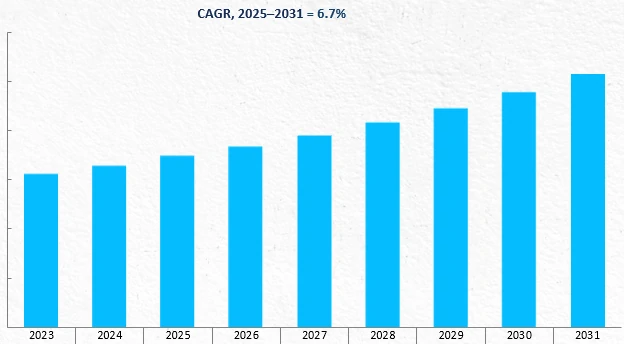
The expansion is supported by increasing integration of capnography into multiparameter monitoring platforms, ventilators, and anesthesia systems, alongside higher utilization of portable and handheld devices. Recurring demand for sampling lines, cannulas, airway adapters, and other consumables also contributes to market expansion. Growth in outpatient procedures, emergency care, ambulatory monitoring, and respiratory disease management is creating additional demand.
The Capnography Equipment Market is therefore expected to benefit from both equipment deployment and recurring consumable requirements. Technology upgrades toward connected, portable, and analytically enhanced systems are expected to support continued revenue expansion through the forecast period.
Growth Drivers: Capnography Devices Market
The Capnography Devices Market is being supported by several structural and clinical growth drivers.
Integration with Multiparameter Monitoring Platforms
OEM integration of capnography modules into multiparameter monitors, ventilators, and anesthesia machines is expanding the availability of CO? monitoring across healthcare environments. Integration allows healthcare providers to access capnography alongside other physiological parameters, supporting broader clinical utilization.
Increasing Demand for Disposable Consumables
Sampling lines, nasal cannulas, airway adapters, and other disposable products generate recurring revenue and support wider utilization of capnography systems. Increasing procedure volumes directly contribute to demand for these products.
Expansion of Outpatient and Minimally Invasive Procedures
Growth in outpatient procedures and minimally invasive surgeries is increasing the need for respiratory monitoring in ambulatory surgery centers and other nontraditional clinical settings. Capnography can support monitoring during sedation and procedural care, expanding the addressable market.
Growth of Portable and Handheld Devices
Smaller, portable, battery-operated capnography systems are supporting adoption in emergency transport, ambulatory care, point-of-care environments, and home monitoring. Portability enables healthcare providers to extend respiratory surveillance beyond traditional hospital environments.
Broader Clinical Adoption
Clinical safety guidelines and increasing awareness of respiratory monitoring are supporting adoption beyond operating rooms and ICUs. Applications in emergency care, endoscopy, dental procedures, neonatal and pediatric care, and transport are creating additional demand.
Respiratory Disease Burden
Increasing prevalence of respiratory conditions such as COPD, asthma, sleep apnea, and respiratory infections is increasing demand for continuous respiratory monitoring. These applications support the longer-term expansion of the Capnography Equipment Market.
Connected and AI-Enabled Monitoring
Wireless connectivity, telehealth integration, and AI-powered respiratory analytics represent emerging growth opportunities. These technologies can support remote monitoring, early detection of respiratory abnormalities, risk stratification, and predictive healthcare workflows.
Growth Restraints: Capnography Devices Market
Despite expanding applications, the Capnography Devices Market faces several constraints that can influence adoption and investment.
Lack of Dedicated Reimbursement
The absence of dedicated reimbursement codes for capnography can result in additional per-patient costs for healthcare providers. This issue is particularly relevant in outpatient, ambulatory, and home-care environments where reimbursement structures can influence technology adoption.
Budget Constraints
Healthcare facilities in emerging markets and smaller institutions may face limited capital budgets for advanced respiratory monitoring systems. High initial investment requirements can slow deployment where healthcare infrastructure and purchasing capacity are constrained.
Price Competition
Increasing competition from lower-cost suppliers can place pressure on margins and potentially slow the premiumization of advanced capnography technologies. Manufacturers therefore need to balance technology innovation with cost competitiveness.
Technical Limitations
Technical factors such as moisture sensitivity, sampling-line blockage, and performance limitations in low-tidal-volume patients can affect device utilization. These issues may be particularly relevant in neonatal, pediatric, and other specialized applications.
Clinical and Operational Requirements
Successful implementation requires appropriate clinical workflows, trained personnel, and integration with existing monitoring infrastructure. These requirements can create additional adoption barriers for healthcare facilities with limited technical resources.
Fragmented Healthcare Environments
Differences in healthcare infrastructure, reimbursement policies, clinical practices, and technology adoption across regions can lead to uneven penetration. This creates different market development conditions for Capnography Devices Market suppliers across geographic markets.
Competitive Landscape: Capnography Devices Market
The global Capnography Devices Market is characterized by competition among medical-device manufacturers offering integrated modules, monitoring systems, handheld devices, consumables, and respiratory monitoring technologies. The study identifies more than 40 competitors with revenue greater than $1 million, indicating a broad competitive environment.
The leading competitors identified include Medtronic, Masimo, Philips Healthcare, Dräger, and Nihon Kohden. Other notable companies include Becton, Dickinson and Company, ICU Medical, and Mindray. The top five competitors accounted for approximately 62% of OEM business revenue in 2025, according to the study.
Competition is shaped by several factors, including cost, performance, technology, OEM relationships, customer relationships, service, and distribution. OEM relationships are particularly important because capnography modules can be incorporated directly into multiparameter monitors, ventilators, and anesthesia machines. This creates opportunities for suppliers with strong technology integration capabilities and established medical-device partnerships.
Distribution structures vary according to product type and end user. Direct hospital sales remain important, while OEM integration enables capnography functionality to be incorporated into broader patient-monitoring platforms. Distributors also play a role in serving EMS, respiratory-care, and healthcare markets. Anesthesia equipment channels and consumable replacement sales provide additional routes to market.
The competitive environment is also being influenced by product development focused on portable, connected, and patient-centric monitoring. Smaller wireless systems can expand the addressable market into ambulatory and home-care environments, while integrated EtCO? and SpO? solutions can provide broader physiological monitoring capabilities.
Technology differentiation is becoming increasingly important. Volumetric capnography provides deeper respiratory insights than conventional time-based measurements, while AI-enabled analytics can potentially support predictive monitoring and earlier intervention. These capabilities may create new differentiation opportunities for Capnography Equipment Market participants.
Mergers and acquisitions also contribute to competitive dynamics. The study notes that Danaher completed its acquisition of Masimo in June 2026, following its initial announcement in February, while Intersurgical announced the acquisition of Teleflex's Acute Care and Interventional Urology businesses in December 2025. Such corporate activity can influence product portfolios, distribution capabilities, and competitive positioning across adjacent medical-device markets.
Scope of Analysis
Segmentation
Definitions
Why is it Increasingly Difficult to Grow?
The Strategic Imperative 8™
The Impact of the Top 3 Strategic Imperatives on the Capnography Industry
Growth Metrics
Growth Environment
Ecosystem
Competitive Environment
Key Competitors
Growth Drivers
Growth Restraints
Growing and Emerging Applications
Use of AI in Capnography
Utilization Trends
Adoption of Capnography Across Out-of-Hospital Care Settings, Global, 2025
Capnography Segment Dynamics: Technology
General Standards and Guidelines for Capnography—Clinical Guidelines
General Standards and Guidelines for Capnography—Technical Guidelines and Device Standards
General Standards and Guidelines for Capnography—Regulatory Guidelines
Reimbursement Framework for Capnography
Forecast Considerations
Revenue Forecast
Revenue Forecast by Product
Revenue Forecast by Sampling Method
Revenue Forecast by Technology
Revenue Forecast by End User
Revenue Forecast by Region
Revenue Forecast Analysis
Revenue Share
Revenue Share Analysis
Product Mapping
Growth Metrics
Revenue Forecast
Revenue Forecast by Product
Revenue Forecast by Sampling Method
Revenue Forecast by Technology
Revenue Forecast by End User
Forecast Analysis
Growth Metrics
Revenue Forecast
Revenue Forecast by Product
Revenue Forecast by Sampling Method
Revenue Forecast by Technology
Revenue Forecast by End User
Forecast Analysis
Growth Metrics
Revenue Forecast
Revenue Forecast by Product
Revenue Forecast by Sampling Method
Revenue Forecast by Technology
Revenue Forecast by End User
Forecast Analysis
Growth Metrics
Revenue Forecast
Revenue Forecast by Product
Revenue Forecast by Sampling Method
Revenue Forecast by Technology
Revenue Forecast by End User
Forecast Analysis
Growth Metrics
Revenue Forecast
Revenue Forecast by Product
Revenue Forecast by Sampling Method
Revenue Forecast by Technology
Revenue Forecast by End User
Forecast Analysis
Growth Opportunity 1: Wearable, Miniaturized, and Connected Capnography
Growth Opportunity 2: Telehealth-Integrated Home Capnography
Growth Opportunity 3: AI-Powered Predictive Capnography
Benefits and Impacts of Growth Opportunities
Next Steps
List of Exhibits
Legal Disclaimer
Frequently Asked Questions (FAQs) – Capnography Devices Market
1. What is the Capnography Devices Market?
The Capnography Devices Market comprises devices, modules, portable systems, and consumables used to measure and monitor carbon dioxide (CO2) in exhaled respiratory gases. The market includes integrated modules, embedded modules, spot-check and handheld portable devices, and consumables used across hospital and out-of-hospital settings.
2. What was the revenue of the Capnography Devices Market in 2025?
The global Capnography Devices Market generated approximately $695.3 million in revenue in 2025, compared with $625.7 million in 2023.
3. What will be the Capnography Devices Market size by 2031?
The global Capnography Devices Market is forecast to reach approximately $1,028.8 million by 2031, representing a 6.7% CAGR from 2025 to 2031.
4. What are the major segments of the Capnography Equipment Market?
The Capnography Equipment Market is segmented by product, sampling method, technology, end user, and region. Product segments include integrated modules, spot-check and handheld portable devices, embedded modules, and consumables. Sampling methods include sidestream/microstream and mainstream, while technologies include time-based and volumetric capnography.
5. What are the key applications of capnography devices?
Capnography devices are used for respiratory monitoring across anesthesia, intensive care, emergency medicine, ventilation, procedural sedation, transport, ambulatory care, endoscopy, dental procedures, neonatal and pediatric care, and home-based monitoring.
6. What is driving growth in the Capnography Devices Market?
Growth is supported by OEM integration into multiparameter monitors, ventilators, and anesthesia machines; increasing outpatient procedures; greater adoption of portable and handheld devices; rising demand for disposable sampling products; broader clinical use; and increasing respiratory monitoring requirements. Connected monitoring and AI-enabled respiratory analytics also represent emerging opportunities.
7. What are the key trends in the Capnography Equipment Market?
Important trends include portable and connected capnography, integration with multiparameter monitoring systems, increasing use in ambulatory and home-care settings, growth of volumetric capnography, telehealth integration, and the development of AI-driven respiratory analytics for predictive monitoring and early detection.
8. Which regions are covered in the Capnography Devices Market?
The global Capnography Devices Market covers North America, Europe, Asia-Pacific, Latin America, and the Middle East & Africa. The study evaluates market opportunities, trends, and growth across these major geographic regions.
9. What are the major restraints affecting the Capnography Devices Market?
Major restraints include the absence of dedicated reimbursement codes in some settings, healthcare budget constraints, price competition from lower-cost suppliers, and technical limitations such as moisture sensitivity, sampling-line blockage, and performance challenges in low-tidal-volume patients.
10. Who are the leading companies in the Capnography Devices Market?
Leading companies identified in the study include Medtronic, Masimo, Philips Healthcare, Dräger, and Nihon Kohden. Other notable participants include Becton, Dickinson and Company, ICU Medical, and Mindray. The study identifies more than 40 competitors with revenue greater than $1 million.
Speak directly with our analytics experts for tailored recommendations.
Recent related Medical Devices research
08 Oct 2026 | Global | Frost Radar
Frost Radar: Endoscopy Device Technology Ecosystem, 2026
The endoscopy device market is advancing toward higher-quality visualization and improved clinical decision-making, with innovation across 4K ultrahigh-definition display systems, image-enhanced endoscopy, and computer-aided detection systems. Advanced visualization is evolving through improvements ...
07 Oct 2026 | Global | Technology Research
Growth Opportunities in Image-Guided Cancer Ablation Systems
Image-guided cancer ablation systems are minimally invasive medical technologies that use real-time imaging to accurately guide the placement of an ablation device into a tumor, enabling localized destruction of cancerous tissue while minimizing damage to surrounding healthy structures.The increasin...
25 Sep 2026 | Global | Technology Research
Innovations and Growth Opportunities in Advanced Medical Devices, Diagnostic Solutions, and Implantables
The latest issue of Advanced MedTech Technology Opportunity Engine (TOE) spotlights a diverse slate of innovations across advanced medical devices, diagnostic solutions, and implantables.The issue features advanced medical devices such as peritoneal dialysis fluid system, cold sterilization-based au...
15 Sep 2026 | Global | Market Research
Vendor Profiles: Advanced Wound Care Management Market, Global, 2025
The wound care market is being transformed by advanced technologies and evolving care models that focus on improving patient outcomes and reducing healthcare costs. Innovations such as smart sensor-embedded dressings, artificial intelligence (AI)-based wound imaging systems, enhanced negative pressu...
28 Aug 2026 | Global | Technology Research
Innovations and Growth Opportunities in Advanced Medical Devices, Artificial Intelligence Solutions, Digital Solutions, and Medical Imaging Solutions
The latest issue of Advanced MedTech Technology Opportunity Engine (TOE) spotlights a diverse slate of innovations across advanced medical devices, artificial intelligence solutions, digital solutions, and medical imaging solutions.The issue features advanced medical devices such as active bioelectr...
Purchase includes:
- Report download
- Growth Dialog™ with our experts
Growth Dialog™
A tailored session with you where we identify the:- Strategic Imperatives
- Growth Opportunities
- Best Practices
- Companies to Action
Impacting your company's future growth potential.