 USD
USD GBP
GBP  CNY
CNY  EUR
EUR  INR
INR  JPY
JPY  MYR
MYR  ZAR
ZAR  KRW
KRW  THB
THB 


Global Lubricant Growth Opportunities
Product Development Focused on Electric Vehicles Creates Growth Opportunities
07-Jun-2024
Global
Market Research
PF89-01-00-00-00
CM_2024_780
Report Summary: Lubricants Market
The global lubricants market size was valued at approximately USD 230.40 billion in 2023 and is projected to reach nearly USD 510.17 billion by 2030, expanding at a CAGR of 12.0% during the forecast period. Rising industrial automation, increasing vehicle production, growth in construction activities, and demand for high-performance synthetic lubricants are driving market expansion globally. Product innovation focused on electric vehicles (EVs), advanced additives, and sustainable formulations is also reshaping industry dynamics across automotive and industrial sectors.
Key Market Trends & Insights
- The lubricants market is witnessing strong demand for premium-grade synthetic and semi-synthetic lubricant formulations.
- Growth in EV production is accelerating innovation in eFluids, thermal management lubricants, and specialized transmission fluids.
- Industrial automation and machinery modernization are increasing demand for hydraulic oils, industrial process oils, and metalworking fluids.
- Higher-grade base oils and advanced additive technologies are supporting average selling price growth across the industry.
- Sustainability regulations and carbon reduction initiatives are encouraging adoption of bio-based and energy-efficient lubricant solutions.
Market Size & Forecast
- 2023 Market Size: USD 230.40 Billion
- 2030 Projected Market Size: USD 510.17 Billion
- CAGR (2024–2030): 12.0%
- Revenue Growth Supported by Industrial and Automotive Demand
- EV-Focused Lubricant Innovation Emerging as Major Industry Opportunity
The lubricants market continues evolving through technological advancement, changing mobility trends, and rising demand for operational efficiency across transportation, manufacturing, mining, construction, and industrial applications. Manufacturers are increasingly investing in advanced formulations that improve equipment durability, thermal stability, fuel efficiency, and emission reduction performance across modern machinery and vehicle platforms.
Market Overview & Trends: Lubricants Market
The lubricants market plays a critical role across automotive, industrial, construction, mining, marine, aerospace, and manufacturing sectors by reducing friction, minimizing wear, improving operational efficiency, and extending equipment lifespan. Lubricants are essential for maintaining machinery reliability, optimizing thermal performance, and reducing downtime across high-performance industrial and transportation systems.
The market is undergoing significant transformation due to changing mobility trends, industrial modernization, sustainability initiatives, and rapid technological advancement in automotive engineering. Growing adoption of electric vehicles is reshaping product development priorities across the lubricants market, particularly in eFluids, battery cooling systems, transmission fluids, thermal management solutions, and advanced greases designed for EV platforms.
Demand for premium synthetic lubricants and higher-grade base oils continues increasing as industries prioritize energy efficiency, equipment durability, emission reduction, and extended drain intervals. Manufacturers are increasingly focusing on advanced additive technologies, low-viscosity formulations, and environmentally sustainable lubricant solutions to meet evolving regulatory and operational requirements.
Industrial automation and infrastructure development remain major contributors to market growth. Expansion in manufacturing facilities, construction activities, mining operations, and heavy industrial equipment usage is driving demand for hydraulic fluids, industrial oils, metalworking fluids, and process lubricants. Growth in off-highway construction equipment and industrial machinery deployment is also strengthening long-term consumption trends.
The lubricants market is additionally influenced by supply chain dynamics, crude oil price volatility, raw material availability, and sustainability regulations affecting formulation strategies and production economics. Bio-based lubricants, recycled base oils, and low-carbon manufacturing approaches are becoming increasingly important across both industrial and automotive applications.
Asia-Pacific continues representing a major consumption hub due to expanding industrialization, automotive production growth, infrastructure investments, and manufacturing activity. North America and Europe remain strong markets for high-performance synthetic lubricants and advanced industrial lubrication technologies.
Scope of Analysis: Lubricants Market
This study analyses the global lubricants market across automotive, industrial, commercial, and construction applications. The report evaluates current market conditions, future growth opportunities, product innovation trends, sustainability developments, raw material dynamics, and evolving demand patterns influencing lubricant consumption worldwide.
The scope includes engine oils, transmission fluids, gear oils, hydraulic fluids, greases, industrial process oils, metalworking fluids, and specialized industrial lubricants. The study also evaluates emerging eFluids developed specifically for electric vehicle platforms, including brake fluids, thermal management fluids, and EV transmission lubricants.
Application analysis covers passenger vehicles, on-road commercial vehicles, off-highway construction equipment, and industrial sectors. The research examines the influence of industrial automation, vehicle production growth, infrastructure expansion, manufacturing modernization, and energy-efficiency regulations on lubricant demand across major industries.
Geographically, the study covers North America, Europe, Asia-Pacific, Latin America, and the Middle East & Africa. The study period spans from 2019 to 2030, with 2023 considered the base year for forecasting and market evaluation. Revenue estimates are presented in US dollars and reflect manufacturer-level sales across direct distribution, industrial procurement, OEM supply agreements, and aftermarket sales channels within the lubricants market.
Revenue & Spending Forecast: Lubricants Market
The global lubricants market generated approximately USD 230.40 billion in 2023 and is projected to reach nearly USD 510.17 billion by 2030, registering a CAGR of 12.0% during the forecast period. Revenue growth is supported by rising industrialization, expanding automotive production, infrastructure development, and increasing adoption of premium synthetic lubricant formulations.
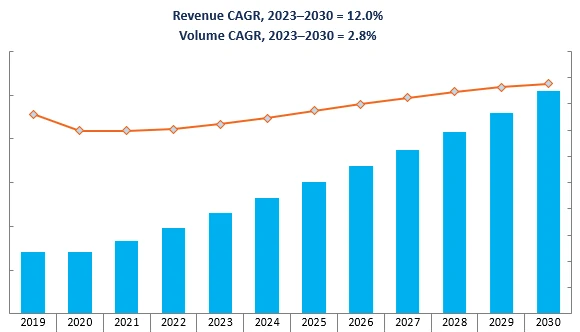
Growing demand for industrial automation, heavy machinery operations, and advanced manufacturing equipment continues driving lubricant consumption across industrial sectors worldwide. Automotive applications also remain a major contributor as passenger vehicle ownership, commercial transportation activity, and construction equipment deployment continue increasing globally.
The lubricants market is experiencing strong pricing momentum due to higher adoption of advanced additive technologies, premium base oils, and EV-focused lubricant solutions. Manufacturers are increasingly introducing specialized formulations designed for electric mobility platforms, thermal management systems, and high-efficiency industrial equipment.
Demand for synthetic and semi-synthetic lubricants is expected to accelerate further due to regulatory pressure for improved fuel economy, lower emissions, reduced maintenance requirements, and extended equipment life cycles. Industrial sectors including manufacturing, mining, marine, aerospace, and construction are also expected to increase spending on high-performance lubrication technologies that improve operational reliability and energy efficiency.
Market Segmentation Analysis: Lubricants Market
The lubricants market is segmented by product type and application across automotive and industrial end-use sectors. Product segmentation includes engine oils, transmission fluids, gear oils, hydraulic fluids, greases, industrial process oils, metalworking fluids, and general industrial oils.
Engine oil remains one of the largest product categories due to widespread use across passenger vehicles, commercial fleets, and industrial equipment. Demand for synthetic engine oils and low-viscosity lubricants continues increasing as vehicle manufacturers focus on fuel efficiency, emission reduction, and extended engine durability.
Transmission fluids and hydraulic oils are witnessing growing demand across industrial automation systems, construction machinery, heavy equipment, and advanced mobility platforms. Industrial process oils and metalworking fluids also maintain strong consumption patterns across manufacturing, machining, and industrial production environments.
Application segmentation includes passenger vehicles, on-road commercial vehicles, off-highway construction equipment, and industrial operations. Passenger vehicle applications account for significant lubricant consumption due to expanding vehicle ownership and rising automotive production globally.
The industrial segment represents a major growth opportunity within the lubricants market driven by machinery modernization, manufacturing expansion, mining activities, and increasing automation deployment. Off-highway construction equipment is also generating strong demand for high-performance lubricants capable of operating under extreme temperature and heavy-load conditions.
The market further segments by base oil groups, including Group I, Group II, Group III, Group IV synthetic oils, and Group V specialty oils. Demand for higher-grade base oils is increasing due to superior oxidation stability, thermal performance, and operational efficiency benefits.
Growth Drivers: Lubricants Market
Increasing global vehicle production remains a major growth driver for the lubricants market. Rising passenger vehicle ownership, commercial transportation expansion, and construction equipment deployment continue supporting strong lubricant consumption across automotive applications.
Demand for specialized lubricants designed for advanced vehicle systems is also accelerating market growth. Modern automotive platforms increasingly require high-performance transmission fluids, thermal management solutions, and synthetic lubricants capable of supporting fuel efficiency and emission reduction targets.
The use of higher-grade base oils and advanced additive technologies is significantly contributing to revenue expansion across the lubricants market. Premium formulations offering extended drain intervals, improved thermal stability, enhanced wear protection, and operational efficiency are witnessing rising adoption across industrial and transportation sectors.
Industrial automation and machinery modernization continue generating substantial lubricant demand. Manufacturing facilities, mining operations, processing plants, and heavy industrial equipment increasingly rely on advanced hydraulic fluids, industrial oils, and metalworking lubricants to improve productivity and reduce downtime.
Growing infrastructure and construction activities worldwide are additionally supporting demand for lubricants used in off-highway construction equipment, heavy-duty machinery, and industrial systems. Rising EV adoption is also creating new opportunities for specialized eFluids and next-generation lubrication technologies.
Growth Restraints: Lubricants Market
The increasing adoption of electric vehicles represents one of the major long-term restraints affecting the lubricants market. EV platforms require significantly lower lubricant volumes compared with traditional internal combustion engine vehicles, reducing overall automotive lubricant consumption potential.
Raw material procurement challenges and crude oil price volatility also continue affecting market stability. Fluctuations in base oil prices, additive costs, and supply chain disruptions may pressure manufacturing margins and create pricing uncertainty across lubricant product categories.
Technological advancements supporting longer drain intervals are limiting lubricant replacement frequency across automotive and industrial applications. Improved engine efficiency, advanced synthetic formulations, and enhanced machinery reliability are reducing lubricant consumption rates over time.
The increasing use of smaller and fuel-efficient engines is further impacting lubricant demand growth. Modern engine technologies designed for efficiency optimization often require lower lubricant volumes and extended maintenance cycles compared with older systems.
Public transportation adoption and mobility-sharing trends may also restrain lubricant consumption growth in urban markets. Sustainability regulations promoting emission reduction and energy efficiency are additionally encouraging development of lower-consumption vehicle and machinery technologies.
Competitive Landscape: Lubricants Market
The global lubricants market is highly competitive, with more than 1,000 companies operating across automotive, industrial, marine, aerospace, and specialty lubricant segments. Competition is driven by product performance, pricing strategies, supply consistency, technological innovation, brand reputation, and distribution network strength.
Major industry participants include Royal Dutch Shell plc, Exxon Mobil Corporation, BP plc, Chevron Corporation, Petro-Canada Lubricants, FUCHS, Total Lubrifiants, Klüber Lubrication, Neste, Morris Lubricants, and Valvoline. These companies compete through advanced formulation technologies, premium synthetic lubricant portfolios, OEM partnerships, and global supply chain capabilities.
Manufacturers are increasingly investing in EV-focused lubricant development, bio-based formulations, low-viscosity products, and sustainable production technologies to strengthen competitive positioning within the lubricants market. Product innovation related to thermal management fluids, industrial automation lubricants, and advanced additive technologies is becoming a key differentiator.
Distribution strategies remain heavily dependent on direct industrial sales, OEM agreements, distributors, aftermarket service networks, and eCommerce platforms. Strategic acquisitions, regional expansion initiatives, refinery upgrades, and sustainability-focused investments continue shaping competitive dynamics across the global lubricants industry.
Why is it Increasingly Difficult to Grow?
The Strategic Imperative 8™
The Impact of the Top 3 Strategic Imperatives on the Global Lubricants Industry
Growth Opportunities Fuel the Growth Pipeline Engine™
Scope of Analysis
Segmentation
Geographic Scope
Growth Metrics
Growth Drivers
Growth Driver Analysis
Growth Restraints
Growth Restraint Analysis
Revenue and Volume Forecast
Revenue and Volume Forecast Analysis
Average Price Forecast
Pricing Trends and Forecast Analysis
Revenue Forecast by End User
Volume Forecast by End User
Revenue Forecast by Region
Volume Forecast by Region
Forecast Analysis by Region
Regulations on Lubricants—Major Decision-Makers
Recent Developments in Regulations
Other Major Regulations—Specific Regulations Affecting Industrial Lubricants and Environmental Regulations That Impact All Lubricants
Volume Forecast by Base Oil Group
Viscosity Grade and Base Oil Trends
Competitive Environment
Revenue Share
Revenue Share Analysis
Value Chain
Value Chain Discussion
M&As in the Global Lubricants Industry
Sustainability Factors Affecting the Global Lubricants Industry
Circular Economy—RRBOs
RRBOs (Case Study—PURAGLOBE GmbH)
RRBOs (Case Study—Avista Oil AG)
RRBOs (Case Study—Neste Corp.)
RRBOs (Case Study—ReGen III Corp.)
Bio-based Lubricants
Bio-based Lubricants (Case Study—Biosynthetic Technologies, LLC)
Bio-based Lubricants (Case Study—BioBlend Renewable Resources, LLC)
Bio-based Lubricants (Case Study—Renewable Lubricants, Inc.)
Bio-based Lubricants (Case Study—FUCHS)
Segment Characteristics and Overview
Growth Metrics
Forecast Assumptions—Passenger Vehicle (OEM/First-fill)
Forecast Assumptions—Passenger Vehicle (Maintenance/Refill)
Revenue and Volume Forecast
Revenue and Volume Forecast Analysis
Revenue Forecast by Product Type
Volume Forecast by Product Type
Volume Forecast by Base Oil Group
Revenue and Volume Forecast Analysis by Product Type
eFluid Trends and Analysis
Revenue Forecast by Region
Volume Forecast by Region
Volume Forecast Analysis by Region
Segment Characteristics and Overview
Growth Metrics
Forecast Assumptions—Commercial Vehicles (OEM/First-fill)
Forecast Assumptions—Commercial Vehicles (Maintenance/Refill)
Revenue and Volume Forecast
Revenue and Volume Forecast Analysis
Revenue Forecast by Product Type
Volume Forecast by Product Type
Volume Forecast by Base Oil Group
Revenue and Volume Forecast Analysis by Product Type
eFluid Trends and Analysis
Revenue Forecast by Region
Volume Forecast by Region
Volume Forecast Analysis by Region
Segment Characteristics and Overview
Growth Metrics
Forecast Assumptions—Construction Equipment (OEM/First-fill)
Forecast Assumptions—Construction Equipment (Maintenance/Refill)
Revenue and Volume Forecast
Revenue and Volume Forecast Analysis
Revenue Forecast by Product Type
Volume Forecast by Product Type
Volume Forecast by Base Oil Group
Revenue and Volume Forecast Analysis by Product Type
Volume Forecast by Region
Volume Forecast by Region
Volume Forecast Analysis by Region
Segment Characteristics and Overview
Growth Metrics
Forecast Assumptions—Industrial (OEM/First-fill)
Forecast Assumptions—Industrial (Maintenance/Refill)
Revenue and Volume Forecast
Revenue and Volume Forecast Analysis
Revenue Forecast by Product Type
Volume Forecast by Product Type
Volume Forecast by Base Oil Group
Revenue and Volume Forecast Analysis by Product Type
Revenue Forecast by Region
Volume Forecast by Region
Volume Forecast Analysis by Region
Growth Opportunity 1—Lubricants Formulated with Higher-quality Base Oils
Growth Opportunity 2—Automatic Lubrication Systems for the Industrial Sector
Growth Opportunity 3—Lubricants for Electric Vehicles and Heavy Equipment
Your Next Steps
Why Frost, Why Now?
Legal Disclaimer
 List of Figures
- Automotive Aftermarket: Replacement Parts and Accessories Revenue, Global, 2022–2028
- Automotive Aftermarket: Highlights in Numbers, Global, 2022–2023
- Automotive Aftermarket: Highlights in Trends, Global, 2023
- Automotive Aftermarket: Predictions in Numbers, Global, 2023–2024
- Automotive Aftermarket: Predictions in Trends, Global, 2024
- Automotive Aftermarket: Questions That This Study Will Answer, Global, 2023–2024
- Automotive Aftermarket: Light VIO, Global, 2023 and 2024f
- Automotive Aftermarket: Manufacturer-level Replacement Parts Revenue by Category, Global, 2023–2024f
- Automotive Aftermarket: Regional Growth Opportunity, Key Countries, 2023–2024f
- Automotive Aftermarket: Average Vehicle Age, Global, 2023
- Automotive Aftermarket: Average Annual Miles Driven per Vehicle, Selected Markets, 2022–2024f
- Automotive Aftermarket: Trends across Regions, Global, 2023
- Global Automotive Aftermarket Outlook: Automotive New Vehicle Sales in Select Markets, 2019–2023
- Global Automotive Aftermarket Outlook: 4Ps of Private Labels in the Aftermarket, Global, 2023
- Global Automotive Aftermarket eRetailing Favorable Penetration Influencers, 2024
- Global Automotive Aftermarket eRetailing Penetration, Forecast Scenarios, 2022–2030f
- Penetration of Different Vehicle Types in New Vehicle Sales, Select Markets, 2023
- Automotive Aftermarket: OEM Activity, 2023
- Automotive Aftermarket: eCommerce Activity, 2023
- Automotive Aftermarket: Supplier Activity, 2023
- Automotive Aftermarket: Policy and Regulation Activities, 2023
- Automotive Aftermarket: Policy and Regulation Activities, 2023 and 2024
- GDP Growth, United States, 2023–2024
- New Vehicle Sales, United States, 2023–2024
- GDP Growth, Canada, 2023–2024
- New Vehicle Sales, Canada, 2023–2024
- Automotive Aftermarket: Aftermarket Dashboard, North America, 2023–2024
- Automotive Aftermarket: Revenue by Part Type, North America, 2023–2024
- Automotive Aftermarket: VIO Age, North America, 2024
- Automotive Aftermarket: VIO Brand Share, North America, 2024
- Automotive Aftermarket: Model Mix, North America, 2023–2024
- Automotive Aftermarket: Opportunity Areas, North America, 2024
- GDP Growth, Europe, 2023–2024
- New Vehicle Sales, Europe, 2023–2024
- Automotive Aftermarket: Aftermarket Dashboard, Europe, 2023–2024
- Automotive Aftermarket: Revenue by Part Type, Europe, 2023–2024
- Automotive Aftermarket: VIO Brand Share, Western Europe, 2024
- Automotive Aftermarket: VIO Brand Share, Eastern Europe, 2024
- Automotive Aftermarket: Model Mix, Europe, 2023–2024
- Automotive Aftermarket: Opportunity Areas, Europe, 2024
- GDP Growth, China, 2023–2024
- New Vehicle Sales, China, 2023–2024
- Automotive Aftermarket: Aftermarket Dashboard, China, 2023–2024
- Automotive Aftermarket: Revenue by Part Type, China, 2023–2024
- Automotive Aftermarket: VIO Age, China, 2024
- Automotive Aftermarket: VIO Brand Share, China, 2024
- Automotive Aftermarket: Model Mix, China, 2023–2024
- Automotive Aftermarket: Opportunity Areas, China, 2024
- GDP Growth, India, 2023–2024
- New Vehicle Sales, China, 2023–2024
- Automotive Aftermarket: Aftermarket Dashboard, India, 2023–2024
- Automotive Aftermarket: Revenue by Part Type, India, 2023–2024
- Automotive Aftermarket: VIO Age, India, 2024
- Automotive Aftermarket: VIO Brand Share, India, 2024
- Automotive Aftermarket: Model Mix, India, 2023–2024
- Automotive Aftermarket: Opportunity Areas, India, 2024
- GDP Growth, LATAM, 2023–2024
- New Vehicle Sales, LATAM, 2023–2024
- Automotive Aftermarket: Aftermarket Dashboard, LATAM, 2023–2024
- Automotive Aftermarket: Revenue by Part Type, LATAM, 2023–2024
- Automotive Aftermarket: VIO Age, LATAM, 2024
- Automotive Aftermarket: VIO Brand Share, LATAM, 2024
- Automotive Aftermarket: Model Mix, LATAM, 2023–2024
- Lubricants: Growth Metrics, Global, 2023
- Lubricants: Growth Drivers, Global, 2024–2030
- Lubricants: Growth Restraints, Global, 2024–2030
- Lubricants: Revenue and Volume Forecast, Global, 2019–2030
- Lubricants: Average Price Forecast, Global, 2019–2030
- Lubricants: Revenue Forecast by End User, Global, 2019–2030
- Lubricants: Volume Forecast by End User, Global, 2019–2030
- Lubricants: Revenue Forecast by Region, Global, 2019–2030
- Lubricants: Volume Forecast by Region, Global, 2019–2030
- Lubricants: Volume Forecast by Base Oil Group, Global, 2019–2030
- Lubricants: Competitive Structure, Global, 2023
- Lubricants: Revenue Share of Top Participants, Global, 2023
- Lubricants: Value Chain Analysis, Global, 2023
- Lubricants for Passenger Vehicles: Growth Metrics, Global, 2023
- Lubricants for Passenger Vehicles: First-fill Forecast Assumptions, Global, 2023–2030
- Lubricants for Passenger Vehicles: Refill Forecast Assumptions, Global, 2023–2030
- Lubricants for Passenger Vehicles: Revenue and Volume Forecast, Global, 2019–2030
- Lubricants for Passenger Vehicles: Revenue Forecast by Product Type, Global, 2019–2030
- Lubricants for Passenger Vehicles: Volume Forecast by Product Type, Global, 2019–2030
- Lubricants for Passenger Vehicles: Volume Forecast by Base Oil Group, Global, 2019–2030
- Lubricants for Passenger Vehicles: Percent Share by Vehicle Type, Global, 2023
- Lubricants for Passenger Vehicles: Percent Share by Vehicle Type, Global, 2030
- Lubricants for Passenger Vehicles: eFluid Volume Forecast, 2020–2030
- Lubricants for Passenger Vehicles: Revenue Forecast by Region, Global, 2019–2030
- Lubricants for Passenger Vehicles: Volume Forecast by Region, Global, 2019–2030
- Lubricants for On-road Commercial Vehicles: Growth Metrics, Global, 2023
- Lubricants for On-road Commercial Vehicles: First-fill Forecast Assumptions, Global, 2023–2030
- Lubricants for On-road Commercial Vehicles: Refill Forecast Assumptions, Global, 2023–2030
- Lubricants for On-road Commercial Vehicles: Revenue and Volume Forecast, Global, 2019–2030
- Lubricants for On-road Commercial Vehicles: Revenue Forecast by Product Type, Global, 2019–2030
- Lubricants for On-road Commercial Vehicles: Volume Forecast by Product Type, Global, 2019–2030
- Lubricants for On-road Commercial Vehicles: Volume Forecast by Base Oil Group, Global, 2019–2030
- Lubricants for On-road Commercial Vehicles: eFluid Volume Forecast, Global, 2020–2030
- Lubricants for On-road Commercial Vehicles: Revenue Forecast by Region, Global, 2019–2030
- Lubricants for On-road Commercial Vehicles: Volume Forecast by Region, Global, 2019–2030
- Lubricants for Off-highway Construction Equipment: Growth Metrics, Global, 2023
- Lubricants for Off-highway Construction Equipment: First-fill Forecast Assumptions, Global, 2023–2030
- Lubricants for Off-highway Construction Equipment: Refill Forecast Assumptions, Global, 2023–2030
- Lubricants for Off-highway Construction Equipment: Revenue and Volume Forecast, Global, 2019–2030
- Lubricants for Off-highway Construction Equipment: Revenue Forecast by Product Type, Global, 2019–2030
- Lubricants for Off-highway Construction Equipment: Volume Forecast by Product Type, Global, 2019–2030
- Lubricants for Off-highway Construction Equipment: Volume Forecast by Base Oil Group, Global, 2019–2030
- Lubricants for Off-highway Construction Equipment: Revenue Forecast by Region, Global, 2019–2030
- Lubricants for Off-highway Construction Equipment: Volume Forecast by Region, Global, 2019–2030
- Industrial Lubricants: Growth Metrics, Global, 2023
- Industrial Lubricants: First-fill Forecast Assumptions, Global, 2023–2030
- Industrial Lubricants: Refill Forecast Assumptions, Global, 2023–2030
- Industrial Lubricants: Revenue and Volume Forecast, Global, 2019–2030
- Industrial Lubricants: Revenue Forecast by Product Type, Global, 2019–2030
- Industrial Lubricants: Volume Forecast by Product Type, Global, 2019–2030
- Industrial Lubricants: Volume Forecast by Base Oil Group, Global, 2019–2030
- Industrial Lubricants: Revenue Forecast by Region, Global, 2019–2030
- Industrial Lubricants: Volume Forecast by Region, Global, 2019–2030
Frequently Asked Questions (FAQ) – Lubricants Market
1. What is the lubricants market?
The lubricants market includes products used to reduce friction, minimize wear, improve thermal stability, and enhance operational efficiency across automotive, industrial, construction, marine, aerospace, and manufacturing applications.
2. What is driving growth in the lubricants market?
Growth in the lubricants market is driven by rising vehicle production, industrial automation, infrastructure development, demand for premium synthetic lubricants, and increasing adoption of advanced machinery across industrial sectors.
3. What is the projected revenue forecast for the lubricants market?
The global lubricants market was valued at approximately USD 230.40 billion in 2023 and is projected to reach nearly USD 510.17 billion by 2030, growing at a CAGR of 12.0% during the forecast period.
4. What are the major product categories in the lubricants market?
Major product categories include engine oils, transmission fluids, gear oils, hydraulic fluids, greases, industrial process oils, metalworking fluids, and specialty industrial lubricants.
5. How are electric vehicles influencing the lubricants market?
Electric vehicles are driving demand for specialized eFluids, battery cooling fluids, transmission lubricants, and thermal management solutions while reducing overall demand for traditional engine oils.
6. Which industries are major consumers in the lubricants market?
Major end-use industries include automotive, manufacturing, mining, construction, aerospace, marine, energy, transportation, and heavy industrial equipment sectors.
7. What are synthetic lubricants?
Synthetic lubricants are advanced lubricant formulations engineered to provide superior thermal stability, oxidation resistance, wear protection, and extended drain intervals compared with conventional mineral-based lubricants.
8. What challenges are affecting the lubricants market?
Key challenges affecting the lubricants market include crude oil price volatility, raw material shortages, increasing EV adoption, longer lubricant drain intervals, sustainability regulations, and fluctuating industrial demand.
9. Which regions dominate the lubricants market?
Asia-Pacific dominates the lubricants market due to rapid industrialization, automotive production growth, infrastructure expansion, and increasing manufacturing activities across emerging economies.
10. What is the future outlook for the lubricants market?
The future outlook for the lubricants market remains positive due to growing industrial automation, demand for high-performance synthetic lubricants, EV-focused fluid innovation, and increasing investment in sustainable lubricant technologies.
Speak directly with our analytics experts for tailored recommendations.
Recent related Specialty Chemicals research
09 Oct 2026 | Global | Technology Research
Innovations in Transparent Ceramics, Biomaterials, Compostable Bioplastics, Graphite, Silica Foam, Aerogels, and Other Advanced Materials for Diverse Applications
This issue of High-Tech Materials Technology Opportunity Engine (TOE) profiles significant advances in high-tech materials for various industrial applications. The featured innovations include Large-sized Transparent and Bonded Ceramics for High-Power Laser Systems, High-Strength Transparent Alumina...
08 Oct 2026 | South Asia, Middle East & North Africa | Market Research
Growth Opportunities for Sulphur Derivatives in MENA, 2025–2030
The MENA region plays a critical role in global sulphur supply; however, a significant share of value creation remains concentrated in exports and commodity derivatives. As global demand evolves and advanced applications for sulphur-based products gain momentum, the region’s competitive advantage li...
02 Oct 2026 | Global | Technology Research
Innovations in Nanotechnology Including Nanocoatings, Nanolithography, Carbon Nanotubes, Nanofluids, Graphene, Ceramic Aerogels, Nanocatalysts, and Nanocomposites
This issue of the Nanotechnology Opportunity Engine profiles significant advances in nanotechnology for various industrial applications. The featured innovations include Sulfate-Free CNCs for Versatile Applications, Contact-Active Antimicrobial Nanocoating With Broad-Spectrum Protection, Nanoimprint...
29 Sep 2026 | Global | Market Research
Electronic Chemical Market, Global, 2025–2032
Electronic chemicals constitute a foundational input to semiconductor, printed circuit board (PCB), and flat panel display (FPD) manufacturing, underpinning the precision, purity, and performance requirements of increasingly sophisticated electronic devices. This study presents a comprehensive analy...
18 Sep 2026 | Global | Technology Research
Innovations in Surface Technologies for Automotive Coatings, Protective Coatings, Oleophobic Coatings, Plasma Coatings, Icephobic Coatings, and Others
This edition of the Advanced Coating & Surface Technology Opportunity Engine profiles significant advances in advanced coatings and surface treatments for various industrial applications. The featured innovations include Ultra-Black Nanocarbon Coatings for Next-Generation Automotive Surface Finishes...
Purchase includes:
- Report download
- Growth Dialog™ with our experts
Growth Dialog™
A tailored session with you where we identify the:- Strategic Imperatives
- Growth Opportunities
- Best Practices
- Companies to Action
Impacting your company's future growth potential.
| Deliverable Type | Market Research |
|---|---|
| Author | Christeena Thomas |
| Industries | Chemicals and Materials |
| No Index | No |
| Is Prebook | No |
| Keyword 1 | global lubricant industry |
| Keyword 2 | industrial lubricants market |
| Keyword 3 | automotive lubricants market |
| List of Charts and Figures | Automotive Aftermarket: Replacement Parts and Accessories Revenue, Global, 2022–2028~ Automotive Aftermarket: Highlights in Numbers, Global, 2022–2023~ Automotive Aftermarket: Highlights in Trends, Global, 2023~ Automotive Aftermarket: Predictions in Numbers, Global, 2023–2024~ Automotive Aftermarket: Predictions in Trends, Global, 2024~ Automotive Aftermarket: Questions That This Study Will Answer, Global, 2023–2024~ Automotive Aftermarket: Light VIO, Global, 2023 and 2024f~ Automotive Aftermarket: Manufacturer-level Replacement Parts Revenue by Category, Global, 2023–2024f~ Automotive Aftermarket: Regional Growth Opportunity, Key Countries, 2023–2024f~ Automotive Aftermarket: Average Vehicle Age, Global, 2023~ Automotive Aftermarket: Average Annual Miles Driven per Vehicle, Selected Markets, 2022–2024f~ Automotive Aftermarket: Trends across Regions, Global, 2023~ Global Automotive Aftermarket Outlook: Automotive New Vehicle Sales in Select Markets, 2019–2023~ Global Automotive Aftermarket Outlook: 4Ps of Private Labels in the Aftermarket, Global, 2023~ Global Automotive Aftermarket eRetailing Favorable Penetration Influencers, 2024~ Global Automotive Aftermarket eRetailing Penetration, Forecast Scenarios, 2022–2030f~ Penetration of Different Vehicle Types in New Vehicle Sales, Select Markets, 2023~ Automotive Aftermarket: OEM Activity, 2023~ Automotive Aftermarket: eCommerce Activity, 2023~ Automotive Aftermarket: Supplier Activity, 2023~ Automotive Aftermarket: Policy and Regulation Activities, 2023~ Automotive Aftermarket: Policy and Regulation Activities, 2023 and 2024~ GDP Growth, United States, 2023–2024~ New Vehicle Sales, United States, 2023–2024~ GDP Growth, Canada, 2023–2024~ New Vehicle Sales, Canada, 2023–2024~ Automotive Aftermarket: Aftermarket Dashboard, North America, 2023–2024~ Automotive Aftermarket: Revenue by Part Type, North America, 2023–2024~ Automotive Aftermarket: VIO Age, North America, 2024~ Automotive Aftermarket: VIO Brand Share, North America, 2024~ Automotive Aftermarket: Model Mix, North America, 2023–2024~ Automotive Aftermarket: Opportunity Areas, North America, 2024~ GDP Growth, Europe, 2023–2024~ New Vehicle Sales, Europe, 2023–2024~ Automotive Aftermarket: Aftermarket Dashboard, Europe, 2023–2024~ Automotive Aftermarket: Revenue by Part Type, Europe, 2023–2024~ Automotive Aftermarket: VIO Brand Share, Western Europe, 2024~ Automotive Aftermarket: VIO Brand Share, Eastern Europe, 2024~ Automotive Aftermarket: Model Mix, Europe, 2023–2024~ Automotive Aftermarket: Opportunity Areas, Europe, 2024~ GDP Growth, China, 2023–2024~ New Vehicle Sales, China, 2023–2024~ Automotive Aftermarket: Aftermarket Dashboard, China, 2023–2024~ Automotive Aftermarket: Revenue by Part Type, China, 2023–2024~ Automotive Aftermarket: VIO Age, China, 2024~ Automotive Aftermarket: VIO Brand Share, China, 2024~ Automotive Aftermarket: Model Mix, China, 2023–2024~ Automotive Aftermarket: Opportunity Areas, China, 2024~ GDP Growth, India, 2023–2024~ New Vehicle Sales, China, 2023–2024~ Automotive Aftermarket: Aftermarket Dashboard, India, 2023–2024~ Automotive Aftermarket: Revenue by Part Type, India, 2023–2024~ Automotive Aftermarket: VIO Age, India, 2024~ Automotive Aftermarket: VIO Brand Share, India, 2024~ Automotive Aftermarket: Model Mix, India, 2023–2024~ Automotive Aftermarket: Opportunity Areas, India, 2024~ GDP Growth, LATAM, 2023–2024~ New Vehicle Sales, LATAM, 2023–2024~ Automotive Aftermarket: Aftermarket Dashboard, LATAM, 2023–2024~ Automotive Aftermarket: Revenue by Part Type, LATAM, 2023–2024~ Automotive Aftermarket: VIO Age, LATAM, 2024~ Automotive Aftermarket: VIO Brand Share, LATAM, 2024~ Automotive Aftermarket: Model Mix, LATAM, 2023–2024~ Lubricants: Growth Metrics, Global, 2023~ Lubricants: Growth Drivers, Global, 2024–2030~ Lubricants: Growth Restraints, Global, 2024–2030~ Lubricants: Revenue and Volume Forecast, Global, 2019–2030~ Lubricants: Average Price Forecast, Global, 2019–2030~ Lubricants: Revenue Forecast by End User, Global, 2019–2030~ Lubricants: Volume Forecast by End User, Global, 2019–2030~ Lubricants: Revenue Forecast by Region, Global, 2019–2030~ Lubricants: Volume Forecast by Region, Global, 2019–2030~ Lubricants: Volume Forecast by Base Oil Group, Global, 2019–2030~ Lubricants: Competitive Structure, Global, 2023~ Lubricants: Revenue Share of Top Participants, Global, 2023~ Lubricants: Value Chain Analysis, Global, 2023~ Lubricants for Passenger Vehicles: Growth Metrics, Global, 2023~ Lubricants for Passenger Vehicles: First-fill Forecast Assumptions, Global, 2023–2030~ Lubricants for Passenger Vehicles: Refill Forecast Assumptions, Global, 2023–2030~ Lubricants for Passenger Vehicles: Revenue and Volume Forecast, Global, 2019–2030~ Lubricants for Passenger Vehicles: Revenue Forecast by Product Type, Global, 2019–2030~ Lubricants for Passenger Vehicles: Volume Forecast by Product Type, Global, 2019–2030~ Lubricants for Passenger Vehicles: Volume Forecast by Base Oil Group, Global, 2019–2030~ Lubricants for Passenger Vehicles: Percent Share by Vehicle Type, Global, 2023~ Lubricants for Passenger Vehicles: Percent Share by Vehicle Type, Global, 2030~ Lubricants for Passenger Vehicles: eFluid Volume Forecast, 2020–2030~ Lubricants for Passenger Vehicles: Revenue Forecast by Region, Global, 2019–2030~ Lubricants for Passenger Vehicles: Volume Forecast by Region, Global, 2019–2030~ Lubricants for On-road Commercial Vehicles: Growth Metrics, Global, 2023~ Lubricants for On-road Commercial Vehicles: First-fill Forecast Assumptions, Global, 2023–2030~ Lubricants for On-road Commercial Vehicles: Refill Forecast Assumptions, Global, 2023–2030~ Lubricants for On-road Commercial Vehicles: Revenue and Volume Forecast, Global, 2019–2030~ Lubricants for On-road Commercial Vehicles: Revenue Forecast by Product Type, Global, 2019–2030~ Lubricants for On-road Commercial Vehicles: Volume Forecast by Product Type, Global, 2019–2030~ Lubricants for On-road Commercial Vehicles: Volume Forecast by Base Oil Group, Global, 2019–2030~ Lubricants for On-road Commercial Vehicles: eFluid Volume Forecast, Global, 2020–2030~ Lubricants for On-road Commercial Vehicles: Revenue Forecast by Region, Global, 2019–2030~ Lubricants for On-road Commercial Vehicles: Volume Forecast by Region, Global, 2019–2030~ Lubricants for Off-highway Construction Equipment: Growth Metrics, Global, 2023~ Lubricants for Off-highway Construction Equipment: First-fill Forecast Assumptions, Global, 2023–2030~ Lubricants for Off-highway Construction Equipment: Refill Forecast Assumptions, Global, 2023–2030~ Lubricants for Off-highway Construction Equipment: Revenue and Volume Forecast, Global, 2019–2030~ Lubricants for Off-highway Construction Equipment: Revenue Forecast by Product Type, Global, 2019–2030~ Lubricants for Off-highway Construction Equipment: Volume Forecast by Product Type, Global, 2019–2030~ Lubricants for Off-highway Construction Equipment: Volume Forecast by Base Oil Group, Global, 2019–2030~ Lubricants for Off-highway Construction Equipment: Revenue Forecast by Region, Global, 2019–2030~ Lubricants for Off-highway Construction Equipment: Volume Forecast by Region, Global, 2019–2030~ Industrial Lubricants: Growth Metrics, Global, 2023~ Industrial Lubricants: First-fill Forecast Assumptions, Global, 2023–2030~ Industrial Lubricants: Refill Forecast Assumptions, Global, 2023–2030~ Industrial Lubricants: Revenue and Volume Forecast, Global, 2019–2030~ Industrial Lubricants: Revenue Forecast by Product Type, Global, 2019–2030~ Industrial Lubricants: Volume Forecast by Product Type, Global, 2019–2030~ Industrial Lubricants: Volume Forecast by Base Oil Group, Global, 2019–2030~ Industrial Lubricants: Revenue Forecast by Region, Global, 2019–2030~ Industrial Lubricants: Volume Forecast by Region, Global, 2019–2030~ |
| Podcast | No |
| Predecessor | MFED-01-00-00-00 |
| WIP Number | PF89-01-00-00-00 |
Global Lubricant Growth Opportunities
$4,950.00
Special Price $3,712.50 save 25 %