 USD
USD GBP
GBP  CNY
CNY  EUR
EUR  INR
INR  JPY
JPY  MYR
MYR  ZAR
ZAR  KRW
KRW  THB
THB 


Global Motor Services Market, 2021–2029
Condition Monitoring Services, Along with Digital Integration Capabilities, To Become a Key Differentiator
24-Dec-2025
Global
Market Research
KABA-01-00-00-00
IA_2025_34221
Report Summary: Motor Services Market
The global Motor Services Market size was estimated at USD 5.96 billion in 2024 and is projected to reach approximately USD 7.22 billion by 2029, growing at a CAGR of about 3.8% from 2025 to 2029. The rising emphasis on operational reliability, energy efficiency, and lifecycle optimization of electric motors is driving sustained demand across industrial sectors, including the Automotive Service Market.
Key Market Trends & Insights
- Asia Pacific accounted for the largest share of the global Motor Services Market in 2024, supported by expanding manufacturing capacity and infrastructure development.
- In mature markets such as North America and Europe, stricter energy-efficiency regulations are accelerating demand for motor retrofits, upgrades, and advanced maintenance services.
- Repair, maintenance, and rewinding services continue to dominate market activity due to the large installed base of industrial motors.
- Adoption of predictive maintenance, condition monitoring, and IIoT-enabled diagnostics is reshaping service delivery models within the Automotive Service Market.
- OEMs and third-party providers are increasingly offering bundled and long-term service contracts to improve asset uptime and reduce total cost of ownership.
Market Size & Forecast
- 2024 Market Size: USD 5.96 Billion
- 2029 Projected Market Size: USD 7.22 Billion
- CAGR (2025–2029): 3.8%
- Asia Pacific: Largest regional market in 2024
- Advanced Services: Fastest-growing service category
The steady expansion of the Motor Services Market reflects a structural shift toward preventive and digitally enabled maintenance models. As industries focus on minimizing downtime, improving efficiency, and complying with energy regulations, demand across the Automotive Service Market and broader industrial motor ecosystem is expected to remain resilient over the forecast period.
Market Overview: Pharmaceutical Excipients Market, Global, 2024–2030
The Motor Services Market forms a critical component of the global industrial ecosystem, supporting the performance, efficiency, and reliability of electric motors used across manufacturing, utilities, transportation, and infrastructure. Motors account for a significant share of global electricity consumption, making maintenance and servicing essential for cost control and sustainability. As a result, the Automotive Service Market and other industrial verticals increasingly rely on structured service contracts rather than ad-hoc repairs.
A key structural trend shaping the Motor Services Market is the shift from corrective maintenance toward predictive and condition-based services. Digital integration, including Industrial Internet of Things (IIoT), vibration analysis, thermal imaging, and remote diagnostics, is enabling early fault detection and reducing unplanned downtime. These capabilities are becoming core differentiators for service providers competing within the Automotive Service Market.
Another notable trend is the bundling of services. OEMs and third-party providers are offering packaged maintenance, monitoring, and lifecycle management contracts, improving customer retention and recurring revenue visibility. Advanced services such as remote monitoring and analytics are gaining traction, particularly in large industrial plants where motor failure can disrupt production.
Regulatory pressure is also influencing market dynamics. Energy-efficiency mandates are pushing end users to upgrade or retrofit existing motors, thereby increasing demand for engineering, consulting, and retrofit services. Meanwhile, geopolitical uncertainty and cost pressures are encouraging asset life extension rather than full replacement, benefiting the Motor Services Market.
Regionally, emerging economies are witnessing faster adoption of structured service models as industrial automation expands. In mature markets, growth is increasingly driven by digitalization, compliance, and value-added services rather than volume expansion. Overall, the Automotive Service Market and broader motor services ecosystem are evolving toward technology-enabled, outcome-focused service delivery.
Scope of Analysis: Motor Services Market
The scope of this analysis covers the global Motor Services Market, examining revenue generated from services associated with the installation, maintenance, repair, monitoring, and lifecycle management of electric motors used in industrial and automotive applications. The Automotive Service Market is included as a key end-use vertical within the broader motor services ecosystem.
The study period spans 2021–2029, with 2024 as the base year and 2025–2029 as the forecast period. Revenue estimates are expressed in U.S. dollars, reflecting market activity across OEMs and third-party service providers. The analysis excludes traction motors used in railways, electric vehicles, drones, and other transportation platforms.
Geographic coverage includes North America, Europe, Asia Pacific, Latin America, and the Middle East & Africa. Market evaluation considers economic conditions, regulatory frameworks, industrial activity, and technology adoption patterns influencing service demand.
Methodologically, the analysis integrates bottom-up revenue modeling, industry interviews, and validation against installed motor base data. Forecast assumptions account for service penetration rates, digital adoption, and replacement cycles. Segment-level revenue breakdowns are analyzed structurally but are not disclosed numerically, in line with your requirement.
Revenue & Spending Forecast: Motor Services Market
The global Motor Services Market generated approximately USD 5.96 billion in revenue in 2024 and is forecast to reach around USD 7.22 billion by 2029, reflecting a CAGR of approximately 3.8% over the forecast period. Revenue growth remains steady, supported by mandatory maintenance requirements, efficiency regulations, and the expanding installed base of motors across industries.
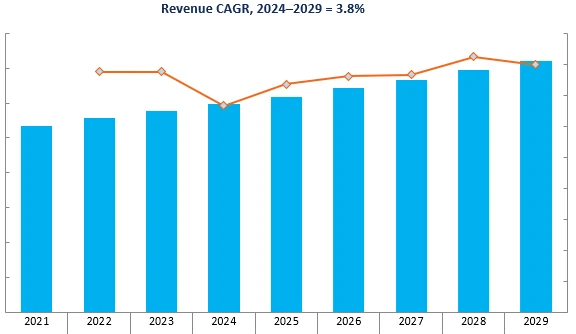
Spending within the Automotive Service Market remains resilient as manufacturers increasingly invest in preventive and predictive maintenance to minimize downtime and improve equipment lifespan. Although annual growth rates are moderate, recurring service contracts and digital monitoring solutions are enhancing revenue stability.
Emerging markets contribute incremental growth through industrial expansion, while mature regions sustain spending through compliance-driven upgrades and advanced services adoption. Overall, the Motor Services Market is transitioning toward predictable, service-led revenue models with a strong emphasis on digital integration.
Market Segmentation Analysis: Motor Services Market
The Motor Services Market is segmented by service type, end-user industry, motor voltage class, service provider type, and region. These segments collectively define demand patterns across the Automotive Service Market and broader industrial sectors.
By service type, the market includes maintenance, repair and rewinding, installation and commissioning, spare parts and consumables, advanced services, retrofits, engineering and consulting, replacement services, training, and end-of-life management. Repair and rewinding services account for the largest share due to their critical role in restoring motor functionality and preventing extended downtime. Advanced services, including condition monitoring and IIoT-enabled diagnostics, represent the fastest-growing segment.
By end-user industry, oil & gas, chemicals and petrochemicals, power generation, food & beverage, metals & mining, and the Automotive Service Market are key contributors. Automotive manufacturing and ancillary facilities rely heavily on preventive maintenance to ensure uninterrupted production and energy efficiency.
By motor type, low-voltage motors dominate in terms of unit volume, while high-voltage motors contribute disproportionately to revenue due to their complexity and service intensity. From a service provider perspective, third-party providers account for a larger share of service activity, while OEMs retain strength through warranty-linked and bundled service offerings.
Regionally, Asia Pacific leads in overall demand, followed by Europe and North America. Each region exhibits distinct service adoption patterns shaped by regulatory enforcement, industrial maturity, and digital readiness.
Growth Drivers: Motor Services Market
Growth in the Motor Services Market is primarily driven by the increasing shift toward bundled and outcome-based service offerings. OEMs and specialized service providers are increasingly combining maintenance, repair, condition monitoring, and diagnostics into integrated service packages. These bundled models simplify procurement for end users while enabling predictive maintenance, allowing early detection of faults and reducing the likelihood of unplanned motor failures. The availability of both online and offline condition monitoring services further supports widespread adoption across industries.
Technological advancement represents another major growth driver. The adoption of Industrial Internet of Things (IIoT), machine learning, and advanced analytics has significantly improved the ability to collect and analyze real-time motor performance data. This enables end users to track efficiency, predict degradation, and plan long-term maintenance strategies based on actual equipment behavior rather than fixed schedules. Such data-driven approaches are increasingly embedded in the Automotive Service Market and industrial motor servicing ecosystems.
The inherent wear and tear associated with electric motors also sustains recurring demand. Motors contain rotating components that degrade over time, making scheduled inspection, maintenance, and rewinding services essential to avoid sudden breakdowns. In many industrial environments, certain maintenance activities are mandatory, directly supporting revenue generation in the Motor Services Market.
Additionally, the large and continuously expanding installed base of motors globally ensures a stable service demand pipeline. Rising industrial motor sales add to this base, creating long-term opportunities across maintenance and repair services. Regulatory enforcement of energy-efficiency standards further accelerates servicing activity, as compliance with IEC, NEMA, and similar regulations often requires sustained maintenance and performance optimization rather than full motor replacement.
Growth Restraints: Motor Services Market
Growth in the Motor Services Market is constrained by intense competition from low-cost regional and unorganized service providers. In many developing and price-sensitive markets, these providers offer basic maintenance and repair services at significantly lower prices than OEM-authorized service centers. Once the motor warranty period expires, end users often shift away from OEMs in favor of these cost-competitive alternatives, gradually eroding the market share of larger service providers that rely on standardized service offerings.
Another major restraint is the limited adoption of long-term service contracts, particularly for small and medium-sized motors. Both OEMs and independent service providers face challenges in securing extended maintenance agreements, as customers are often reluctant to renew contracts when motors continue to operate satisfactorily without visible performance issues. This behavior reduces recurring revenue visibility and limits long-term planning within the Motor Services Market.
The widespread availability of counterfeit spare parts presents an ongoing threat to service quality and revenue integrity. Despite OEM initiatives such as direct sales models, authorized distributor networks, and collaboration with EPC firms, counterfeit components remain prevalent in several regions. These parts not only undercut pricing but also compromise motor performance, negatively affecting trust in formal service ecosystems.
In addition, geopolitical uncertainty and macroeconomic volatility have temporarily slowed capital expenditure in certain industries. Delayed expansion and modernization projects reduce near-term demand for motor servicing. However, these impacts are largely cyclical, and long-term fundamentals remain supported by technology adoption and regulatory compliance requirements.
Competitive Landscape: Motor Services Market
The Motor Services Market is highly fragmented, with more than 500 active competitors operating globally across organized and unorganized service ecosystems. Competition intensity varies by region and motor size, with Tier I OEMs competing on reliability, advanced technology, and lifecycle support, while Tier II and regional players compete aggressively on pricing and service flexibility. Price sensitivity remains particularly high among small and mid-sized customers, limiting margin expansion for standardized service offerings.
Competitive differentiation in the market is primarily driven by service reliability, technical expertise, digital monitoring capabilities, response time, and total cost of ownership optimization. OEM-led service providers benefit from strong installed bases, proprietary motor knowledge, and bundled service contracts, whereas independent service providers leverage local presence and cost advantages. As a result, competition is increasingly shifting from transactional repairs toward value-added and digitally enabled service models.
Key end-user demand is concentrated in energy-intensive industries such as oil & gas, chemical and petrochemical processing, and power generation, where motor downtime directly impacts operational continuity. Leading players in the global Motor Services Market include ABB, Siemens/Innomotics, Nidec, and WEG, which collectively accounted for approximately 34.1% of total market revenue in 2024. These companies maintain competitive strength through global service networks, advanced diagnostics, and long-term customer relationships.
Other notable competitors such as SEW Eurodrive, Toshiba, Wolong, Crompton Greaves, Bharat Bijlee, and Fuji Electric strengthen regional competition by offering localized service capabilities and customized support models. Distribution structures typically combine direct sales, channel partners, authorized service centers, and third-party service providers, enabling broad market coverage.
The competitive environment has been further shaped by consolidation activity. Recent acquisitions—including Integrated Power Services’ acquisition of ABB Industrial Services assets, WEG’s acquisition of Regal Rexnord’s motor and generator business, and ABB and Nidec’s targeted service acquisitions—highlight the strategic focus on expanding service footprints, enhancing technical depth, and strengthening aftermarket capabilities. Overall, competitive dynamics favor players that can balance scale, digital innovation, and localized service execution.
Scope of Analysis
Segmentation
Segmentation by Region
Market Definitions—End Users
Market Definitions—Service Types
Why is it Increasingly Difficult to Grow?
The Strategic Imperative 8™
The Impact of the Top 3 Strategic Imperatives on the Global Motor Services Industry
Competitive Environment
Key Competitors
Growth Metrics
Growth Drivers
Growth Restraints
Forecast Considerations
Revenue Forecast
Percent Revenue by Region
Revenue Forecast by Region
Percent Revenue by Industry Vertical
Revenue Forecast by Industry Vertical
Revenue Forecast Analysis
Percent Revenue by Service Type
Revenue Forecast by Service Type
Revenue Forecast Analysis
Percent Revenue by Type of Service Provider
Percent Revenue by Motor Type
Pricing Trends and Forecast Analysis
Revenue Share
Revenue Share Analysis
Growth Metrics
Revenue Forecast
Revenue Forecast by End User
Forecast Analysis
Growth Metrics
Revenue Forecast
Revenue Forecast by End User
Forecast Analysis
Growth Metrics
Revenue Forecast
Revenue Forecast End User
Forecast Analysis
Growth Metrics
Revenue Forecast
Revenue Forecast by End User
Forecast Analysis
Growth Metrics
Revenue Forecast
Revenue Forecast by End User
Forecast Analysis
Growth Opportunity 1: Packaged Services for Enhanced Revenue and Customer Acquisition
Growth Opportunity 2: Monitoring Services for Effective Motor Servicing
Growth Opportunity 3: Matching Varying and Emerging End-User Needs
Benefits and Impacts of Growth Opportunities
Next Steps
List of Exhibits
Legal Disclaimer
Frequently Asked Questions (FAQ) – Motor Services Market
1. What is the Motor Services Market?
2. How is the Automotive Service Market linked to motor services?
3. What is the current size of the Motor Services Market?
4. What is the revenue outlook for the Motor Services Market?
5. What are the key growth drivers in the Motor Services Market?
6. What factors restrain growth in the Motor Services Market?
7. Which industries generate the highest demand for motor services?
8. Who are the leading companies in the Motor Services Market?
9. How competitive is the Motor Services Market?
10. What is the long-term outlook for the Motor Services Market?
Speak directly with our analytics experts for tailored recommendations.
Recent related Power Transmission research
06 Aug 2026 | Global | Market Research
Machine Tools Sector, Global, 2023–2030
This study provides an in-depth understanding of the machine tools industry. It discusses the key trends and challenges faced by machine tool manufacturers, in addition to providing forecasts until 2030. The study provides a region-wise breakdown with discussions on key industries. Machine tool manu...
27 Jul 2026 | Global | Technology Research
Advancements in Wide-Bandgap Materials (GaN, SiC, Ga₂O₃) for Power and RF Electronics
This study examines the technology landscape, commercialization progress, and future growth opportunities of wide-bandgap (WBG) semiconductor materials, with a primary focus on silicon carbide (SiC), gallium nitride (GaN), and gallium oxide (Ga₂O₃) for power and RF electronics. It evaluates how thes...
12 Mar 2026 | Global | Market Research
Diesel Pumps Market, Global, 2025–2026
This Frost & Sullivan analysis offers an understanding of the diesel pumps market and the key trends shaping adoption. Recent trends show end users shifting toward cleaner energy sources. However, some regions still present opportunities. The main challenge for suppliers is to provide reliable, off-...
16 Sep 2025 | Global | Strategic Imperatives
Top 10 Strategic Imperatives in the Machines Industry, 2025
This deliverable focuses on the major trends in the machines industry, as companies look to identify and invest in areas that support energy savings. Many emerging developments aim to achieve a balance between efficiency and growth. In the IIoT era, manufacturers are looking to identify emerging ind...
22 Aug 2025 | Global | Market Research
Global Heat Exchangers Market, 2024–2029
The study provides a detailed understanding of the global heat exchanger market across all major regions: North America, Latin America, Europe, the Middle East & Africa, and Asia-Pacific. It discusses the major heat exchanger types and trends driving demand. Currently, companies face challenges such...
Purchase includes:
- Report download
- Growth Dialog™ with our experts
Growth Dialog™
A tailored session with you where we identify the:- Strategic Imperatives
- Growth Opportunities
- Best Practices
- Companies to Action
Impacting your company's future growth potential.