 USD
USD GBP
GBP  CNY
CNY  EUR
EUR  INR
INR  JPY
JPY  MYR
MYR  ZAR
ZAR  KRW
KRW  THB
THB 


AI, Data Platforms, and Interoperable Cloud Architectures are Driving Transformational Growth in Healthcare Cloud
11-Aug-2026
Global
Market Research
PG9Q-01-00-00-00
HC_2026_34814
Key Takeaways: Healthcare Cloud Market
- The global Healthcare Cloud Market is transitioning from basic infrastructure migration toward integrated platforms for healthcare data, analytics, interoperability, and AI-enabled workflows.
- Market revenue is projected to increase from $68.38 billion in 2025 to $190.78 billion by 2031, representing an 18.7% CAGR during 2025–2031.
- AI-enabled applications, healthcare analytics, interoperable data platforms, and cloud-native workflows are becoming the primary catalysts for market expansion.
- North America remains the largest regional market, supported by mature cloud ecosystems, healthcare IT investment, and advanced AI adoption.
- Asia-Pacific is expected to be the fastest-growing region as healthcare digitization and technology investment accelerate.
- SaaS currently plays a dominant role, while PaaS is gaining strategic importance because of AI, interoperability, analytics, and application development requirements.
- Hybrid and multi-cloud architectures are gaining traction as healthcare organizations balance scalability, compliance, security, and data sovereignty.
- The healthcare cloud computing market is increasingly moving toward platform-based ecosystems rather than isolated cloud applications.
- Growth in the Healthcare cloud-based analytics market is supported by demand for real-time insights, population health management, clinical decision support, and operational optimization.
- Data privacy, cybersecurity, legacy-system integration, vendor lock-in, and implementation complexity remain significant barriers to adoption.
Report Summary: Healthcare Cloud Market
The global Healthcare Cloud Market is entering a more advanced phase of transformation as healthcare providers, payers, clinics, digital health companies, and public health organizations increasingly use cloud environments as foundational platforms for data management and operational integration. Rather than focusing only on infrastructure migration, organizations are prioritizing cloud architectures that connect clinical, administrative, financial, and analytical workloads.
The healthcare cloud computing market is being shaped by the convergence of cloud infrastructure, AI, data platforms, interoperability technologies, and digital healthcare applications. Healthcare organizations are increasingly adopting hybrid and multi-cloud environments to manage sensitive workloads while maintaining scalability and flexibility.
A major growth opportunity is emerging around the Healthcare cloud-based analytics market, where cloud-hosted data platforms support advanced analytics, AI model deployment, population health management, remote patient monitoring, and clinical decision-making. The market is also shifting toward long-term platform partnerships involving hyperscalers, healthcare technology companies, EHR providers, and systems integrators.
According to the supplied Frost & Sullivan analysis, global Healthcare Cloud Market revenue is forecast to rise from $68.38 billion in 2025 to $190.78 billion in 2031, at an 18.7% CAGR. This growth reflects increasing investments in AI-ready infrastructure, interoperability, cybersecurity, data sovereignty, and cloud-native healthcare environments.
Analyst Words: Healthcare Cloud Market
Tanuja Sahay, Research Director, Healthcare & Life Sciences, highlights a fundamental change in how the Healthcare Cloud Market is creating value. Her perspective indicates that healthcare cloud is moving beyond infrastructure delivery toward greater control and utilization of healthcare data, AI capabilities, and clinical workflows. As infrastructure becomes increasingly standardized, differentiation will depend less on raw computing capacity and more on the intelligence layers built above it.
Sahay's outlook also points to a structural shift from application-level migration toward AI-ready data platforms and orchestration layers. Healthcare organizations are increasingly selecting cloud providers based on their ability to integrate data, AI, governance, and workflows across complex environments. This means the healthcare cloud computing market is evolving toward long-term ecosystem relationships rather than isolated technology purchases. The growing importance of interoperability and AI also creates opportunities for providers capable of connecting healthcare data with scalable analytical and operational platforms.
Market Overview & Trends: Healthcare Cloud Market
The Healthcare Cloud Market is expanding as healthcare organizations move from early-stage cloud adoption toward integrated, platform-oriented environments. Cloud technology is increasingly used to support electronic health records, revenue cycle management, telehealth, patient engagement, clinical analytics, data lakes, disaster recovery, and AI workloads.
One of the most important trends is the integration of AI with healthcare cloud environments. AI-enabled healthcare applications require scalable computing, high-quality datasets, secure data environments, and flexible deployment architectures. Consequently, healthcare organizations are investing in cloud platforms capable of supporting machine learning, predictive analytics, clinical decision support, and automation.
Interoperability is another major market trend. Healthcare organizations increasingly require systems to exchange data across hospitals, clinics, payers, laboratories, digital health platforms, and government systems. FHIR-enabled APIs and interoperable data platforms are therefore becoming increasingly important within the healthcare cloud computing market.
The Healthcare cloud-based analytics market is also gaining momentum as organizations seek real-time visibility into clinical and operational performance. Cloud-based analytics can support population health, resource utilization, patient risk assessment, financial management, and care coordination.
Hybrid and multi-cloud deployment is becoming increasingly common. Healthcare providers want to combine the scalability of public cloud with the control, security, and compliance capabilities of private environments. At the same time, data sovereignty requirements are influencing regional cloud strategies.
The market is also experiencing a shift in spending priorities. Buyers are increasingly allocating budgets toward PaaS, IaaS, data platforms, cybersecurity, interoperability, and AI-ready infrastructure rather than standalone application migration.
Scope of Analysis: Healthcare Cloud Market
The Healthcare Cloud Market analysis covers cloud-delivered software, platforms, and infrastructure used by healthcare providers and payers to support clinical, administrative, analytical, and financial operations. Cloud technologies enable organizations to scale access to applications and data while reducing dependence on traditional on-premises infrastructure.
The study covers the global market for 2025–2031, using 2025 as the base year and 2026–2031 as the forecast period. Market analysis is presented in U.S. dollars and evaluates growth across geographic regions, service models, and deployment models.
Geographically, the study covers North America; Europe, the Middle East, and Africa (EMEA); Asia-Pacific (APAC); and Latin America (LATAM). Service-model segmentation includes Software-as-a-Service (SaaS), Infrastructure-as-a-Service (IaaS), and Platform-as-a-Service (PaaS). Deployment models include public cloud, private cloud, and hybrid cloud.
The analysis focuses on healthcare providers and payers and excludes life sciences research, pharmaceutical development, consumer wellness applications, and enterprise IT spending that is not directly connected to healthcare provider or payer operations.
Market Segmentation Analysis: Healthcare Cloud Market
The Healthcare Cloud Market can be segmented across region, service model, and deployment model, with each dimension reflecting different technology priorities and adoption requirements.
By Region
North America represents the largest regional market. Its position is supported by mature cloud infrastructure, advanced healthcare IT ecosystems, established EHR adoption, strong cybersecurity investment, and increasing deployment of AI technologies. Healthcare providers and payers in the region are increasingly transitioning from basic cloud migration toward integrated data and AI platforms.
Asia-Pacific is positioned as the fastest-growing region. Large-scale healthcare digitization initiatives, expanding healthcare IT investment, growing cloud adoption, and increasing demand for connected healthcare services are accelerating the regional healthcare cloud computing market.
Europe, the Middle East, and Africa (EMEA) presents a diverse adoption environment. Data sovereignty, healthcare regulations, privacy requirements, and national digital-health strategies significantly influence cloud deployment decisions. European markets in particular emphasize governance, security, and controlled data exchange.
Latin America is developing as healthcare organizations increasingly modernize IT infrastructure and adopt cloud-based applications. Cost efficiency, remote healthcare services, and expanding digital-health initiatives provide opportunities for cloud vendors.
By Service Model
SaaS remains a major segment because healthcare organizations can access applications without managing the underlying infrastructure. EHR-related applications, revenue cycle management, telehealth, patient engagement, healthcare CRM, and population health platforms are important use cases.
IaaS provides the foundational computing, storage, networking, virtualization, and data-management resources required for healthcare cloud environments. It supports clinical data storage, disaster recovery, imaging archives, data lakes, and AI training workloads.
PaaS is emerging as a strategically important segment. Healthcare organizations increasingly need platforms for application development, interoperability, analytics, AI/ML deployment, and integration. This makes PaaS particularly relevant to the expanding Healthcare cloud-based analytics market.
By Deployment Model
Public cloud provides scalability and flexible resource utilization and is increasingly used for analytics, applications, and data workloads.
Private cloud remains relevant for organizations requiring greater control over sensitive healthcare workloads and infrastructure.
Hybrid cloud is gaining importance because it allows healthcare organizations to combine public and private environments. Hybrid architectures support regulatory compliance, data sovereignty, scalability, and workload optimization, making them a key component of the evolving healthcare cloud computing market.
Revenue & Spending Forecast: Healthcare Cloud Market
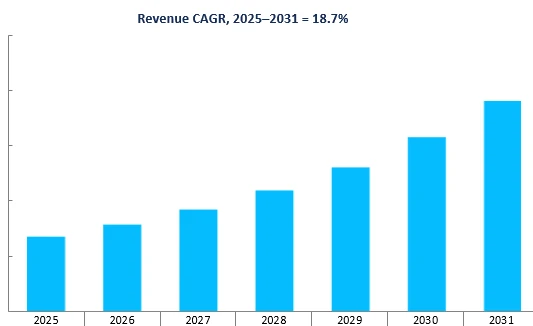
The global Healthcare Cloud Market is projected to expand significantly from $68.38 billion in 2025 to $190.78 billion by 2031, registering a compound annual growth rate (CAGR) of 18.7% during 2025–2031. This growth reflects increasing healthcare investments in cloud infrastructure, AI-ready platforms, interoperable data environments, cybersecurity, and cloud-native applications. Spending is also shifting from standalone application migration toward PaaS, IaaS, data platforms, and integrated cloud ecosystems. The expanding healthcare cloud computing market is further supported by demand for scalable analytics, AI deployment, real-time data exchange, and hybrid cloud architectures. Meanwhile, the Healthcare cloud-based analytics market is expected to benefit from growing adoption of predictive analytics, population health management, clinical decision support, and operational intelligence.
Growth Drivers: Healthcare Cloud Market
The Healthcare Cloud Market is being supported by several structural growth drivers:
AI-enabled healthcare applications
The rapid adoption of AI-enabled applications, advanced analytics, and cloud-native workflows is increasing demand for scalable cloud infrastructure. AI workloads require flexible computing and secure data environments, making cloud platforms increasingly important.
Interoperability and FHIR-enabled data exchange
Healthcare organizations are placing greater emphasis on interoperability. FHIR-enabled APIs, connected data environments, and integration platforms allow information to move between clinical and administrative systems, supporting the expansion of the healthcare cloud computing market.
Hybrid and multi-cloud adoption
Healthcare providers are increasingly adopting hybrid and multi-cloud architectures to balance scalability, security, compliance, flexibility, and data sovereignty. This model enables organizations to allocate workloads according to business and regulatory requirements.
Healthcare cybersecurity investment
Increasing cyber threats and growing volumes of sensitive healthcare information are driving investment in secure cloud environments, data governance, identity management, and cybersecurity platforms.
Telehealth and remote patient monitoring
The continued adoption of telehealth, remote patient monitoring, and digital care delivery platforms is creating demand for cloud environments capable of supporting real-time data processing and scalable connectivity.
Migration toward cloud-native infrastructure
Healthcare organizations are gradually modernizing legacy IT environments. Migration toward cloud-native infrastructure provides a foundation for AI, analytics, application modernization, and integrated healthcare workflows.
These factors collectively strengthen demand across the Healthcare cloud-based analytics market and the wider healthcare technology ecosystem.
Growth Restraints: Healthcare Cloud Market
Despite strong growth prospects, the Healthcare Cloud Market faces several adoption barriers.
Data privacy and cybersecurity concerns
Healthcare data contains highly sensitive patient information. Concerns surrounding privacy, cybersecurity, regulatory compliance, and unauthorized access continue to slow cloud migration, particularly for mission-critical clinical workloads.
Legacy-system integration
Many healthcare organizations continue to operate fragmented legacy systems. Integrating these environments with modern cloud platforms can be complex, costly, and time-consuming. Integration challenges remain a significant constraint on the healthcare cloud computing market.
Vendor lock-in
Dependence on hyperscalers and proprietary cloud ecosystems can create concerns around long-term flexibility, interoperability, migration costs, and negotiating power.
Data sovereignty
Regional regulations may require healthcare information to remain within specific geographic boundaries. These requirements can limit deployment options and increase infrastructure complexity.
Implementation costs and skills shortages
Smaller healthcare organizations may lack the financial resources, cloud expertise, cybersecurity capabilities, and internal personnel needed to implement advanced cloud environments.
Operational disruption
Migrating mission-critical healthcare workloads can create operational risks. Organizations must maintain continuity of clinical services while modernizing infrastructure, applications, and data environments.
Competitive Landscape: Healthcare Cloud Market
The global Healthcare Cloud Market is highly competitive and includes hyperscalers, enterprise technology companies, healthcare IT vendors, EHR providers, data platform companies, and specialized healthcare technology firms. The supplied Frost & Sullivan analysis identifies more than 100 vendors globally, with approximately 60 companies having meaningful participation in healthcare cloud infrastructure, platforms, and applications.
The competitive environment is increasingly influenced by AI capabilities, healthcare data platforms, interoperability, workflow integration, healthcare domain expertise, ecosystem partnerships, total cost of ownership, and performance scalability.
Leading Competitors
Major companies identified in the analysis include:
- Amazon Web Services (AWS)
- Microsoft Azure
- Google Cloud
- Oracle and Oracle Health
- IBM
- Salesforce
- SAP
The top five competitors account for approximately 65% of global healthcare cloud revenue in 2025, reflecting the strong position of hyperscalers and selected enterprise healthcare technology providers.
Other Notable Competitors
The competitive ecosystem also includes Philips, Siemens Healthineers, GE HealthCare, InterSystems, Snowflake, Databricks, ServiceNow, Nectar, Cognizant, NTT DATA, Fujitsu, Alibaba Cloud, and Tencent Cloud.
Competitive differentiation is shifting from infrastructure capacity toward integrated healthcare capabilities. Vendors that can combine cloud infrastructure with AI, healthcare data, interoperability, analytics, cybersecurity, and workflow integration are positioned to capture greater strategic value.
The distribution structure includes direct enterprise sales, hyperscaler partner ecosystems, healthcare platform partnerships, systems integrators, managed service providers, channel partners, value-added resellers, and government procurement frameworks.
M&A activity is also contributing to competitive repositioning. Notable transactions identified in the analysis include Qualtrics' acquisition of Genz Foresight, Nordic Capital's acquisition of Arcadia, Francisco Partners' acquisition of AdvancedMD, IBM's acquisition of Apptio, Oracle's acquisition of Cerner, and Microsoft's acquisition of Nuance Communications.
Overall, competition is moving toward platform ecosystems. As infrastructure becomes increasingly standardized, vendors are competing on the ability to provide integrated data, AI, interoperability, security, and healthcare workflows. This trend will remain central to the evolution of the healthcare cloud computing market and the Healthcare cloud-based analytics market.
Scope of Analysis
Segmentation
Service Models: Definitions and Scope
Deployment Models: Definitions and Scope
Why is it Increasingly Difficult to Grow?
The Strategic Imperative 8™
The Impact of the Top 3 Strategic Imperatives on the Global Healthcare Cloud Industry
Growth Metrics
Growth Environment—Market Transformation and Investment Priorities
Growth Environment—Competitive Dynamics and Strategic Implications
Healthcare Cloud Evolution: From Migration to Platformization
Healthcare Cloud Service Model
Healthcare Cloud Deployment Model
Beyond Deployment: Emerging Healthcare Cloud Operating Strategies
Strategic Shifts Reshaping Healthcare Cloud Investments Through 2031
Healthcare Cloud Value Chain and Operating Model
Strategic Control Points in the Healthcare Cloud Ecosystem
Healthcare Cloud Adoption is Driven by High-Value, Outcome-Oriented Use Cases
Frost & Sullivan's Global Healthcare Cloud User Survey, 2025
Competitive Environment
Key Competitors
Key Competitors by Service Models
Key Competitors by Deployment Models
Growth Drivers
Growth Restraints
Forecast Considerations
Revenue Forecast
Revenue Forecast by Service Model
Revenue Forecast by Deployment Model
Forecast Analysis
Revenue Forecast by Region
Revenue Forecast Analysis by Region
Pricing Trends and Forecast Analysis
Healthcare Cloud Monetization is Expanding Beyond Infrastructure Consumption Toward Data, AI, and Platform-Led Value Creation
Global Healthcare Cloud Pricing Models
Revenue Share: Competitive Heatmap
Revenue Share Analysis
Companies to Watch—Leaders
Companies to Watch—Challengers
Companies to Watch—Differentiated Healthcare Cloud Providers
Growth Metrics
Revenue Forecast
Revenue Forecast by Region
Forecast Analysis
Growth Metrics
Revenue Forecast
Revenue Forecast by Region
Forecast Analysis
Growth Metrics
Revenue Forecast
Revenue Forecast by Region
Forecast Analysis
Growth Opportunity 1: Enterprise-Wide AI Deployment
Growth Opportunity 2: Healthcare Data Platforms and Interoperable Ecosystems
Growth Opportunity 3: Cyber Resilience, Governance, and Trusted Cloud Operations
Benefits and Impacts of Growth Opportunities
Next Steps
List of Exhibits
Legal Disclaimer
Frequently Asked Questions (FAQs) – Healthcare Cloud Market
1. What is the Healthcare Cloud Market?
2. How large is the Healthcare Cloud Market?
3. What is driving growth in the healthcare cloud computing market?
4. What are the major service models in the Healthcare Cloud Market?
5. What is the Healthcare cloud-based analytics market?
6. Which region dominates the Healthcare Cloud Market?
7. Which region is expected to grow fastest?
8. What are the key restraints affecting the Healthcare Cloud Market?
9. Who are the leading companies in the Healthcare Cloud Market?
10. What is the future outlook for the Healthcare Cloud Market?
Speak directly with our analytics experts for tailored recommendations.
Recent related Digital Health research
07 Sep 2026 | Global | Technology Research
Synthetic Antibodies and AI-Optimized Immunotherapies
Artificial intelligence is becoming increasingly relevant to antibody discovery and immunotherapy development, supporting target identification, de novo antibody design, antibody engineering, clinical intelligence, and bioprocessing. Advances in generative AI, protein language models, diffusion mode...
26 Aug 2026 | Global | Frost Radar
Frost Radar™: Healthcare Infrastructure Cybersecurity in the United States, 2026
Healthcare organizations are expanding their digital environments across cloud infrastructure, connected medical devices, applications, identities, operational technology, and distributed care settings, creating a broader and increasingly interconnected attack surface. Cybersecurity is, therefore, e...
24 Aug 2026 | Global | Market Research
Growth Opportunities in Real-Time Location Systems in the Healthcare Industry, Forecast to 2031
The global healthcare RTLS market is evolving beyond traditional asset tracking toward intelligent location platforms that enable real-time visibility, workflow optimization, and operational decision-making across healthcare environments. As healthcare providers continue investing in digital transfo...
21 Aug 2026 | Global | Technology Research
Innovations and Growth Opportunities in AI-Driven Biomanufacturing, Advanced Cell and Gene Therapies, and Precision Immunotherapy
This edition of the Life Science, Health & Wellness Technology Opportunity Engine (TOE) provides a comprehensive overview of breakthrough innovations reshaping biomanufacturing, cell and gene therapy, precision immunotherapy, anti-infectives, and neurotherapeutics across oncology, infectious disease...
06 Aug 2026 | Global | Technology Research
Decentralized Clinical Trials Powered by Blockchain and Digital Twins
This report examines how decentralized clinical trials (DCTs), enabled by blockchain, digital twins, and artificial intelligence, are reshaping global clinical research. It traces the shift from site-centric to patient-centric models and quantifies the growing scale, globalization, and complexity of...
Purchase includes:
- Report download
- Growth Dialog™ with our experts
Growth Dialog™
A tailored session with you where we identify the:- Strategic Imperatives
- Growth Opportunities
- Best Practices
- Companies to Action
Impacting your company's future growth potential.
A defining shift in the market is the move away from isolated application deployment toward platform-based environments that can support data integration, analytics, and AI-enabled use cases at scale. Healthcare providers and payers are increasingly prioritizing investments in hybrid cloud architectures, healthcare data platforms, and cloud-native environments that allow them to manage rising data volumes while improving care coordination and decision-making.
This transition is also redefining value creation, with greater emphasis on data platforms, interoperability, and AI-driven workflows rather than standalone infrastructure.
Regional dynamics play a significant role in shaping growth. North America remains the largest market due to established cloud ecosystems and advancing AI deployment, while Asia-Pacific is the fastest-growing region, supported by large-scale digitization initiatives and expanding healthcare IT investments. Europe, the Middle East, and Africa (EMEA) are driven by regulatory frameworks and data sovereignty requirements, influencing the pace and structure of cloud adoption.
As the market evolves, spending is shifting toward infrastructure and platform layers, particularly PaaS and IaaS, driven by demand for AI-ready environments and interoperable data systems. At the same time, healthcare organizations are moving toward integrated platform strategies and long-term ecosystem partnerships, reflecting a shift in buyer priorities from point solutions to unified cloud environments.
This Frost & Sullivan report analyzes these structural shifts, providing detailed insights into market growth, segmentation, regional trends, and the strategic direction of healthcare cloud adoption.
Author: Tanuja Sahay
| Deliverable Type | Market Research |
|---|---|
| Industries | Healthcare |
| No Index | No |
| Is Prebook | No |
| Podcast | No |
| Predecessor | K656-01-00-00-00 |
| WIP Number | PG9Q-01-00-00-00 |