 USD
USD GBP
GBP  CNY
CNY  EUR
EUR  INR
INR  JPY
JPY  MYR
MYR  ZAR
ZAR  KRW
KRW  THB
THB 


Healthcare Cybersecurity, Global, 2026–2031
Patient-Safety Resilience is Driving Transformational Growth in Connected Healthcare Ecosystems
22-Jul-2026
Global
Market Research
KC66-01-00-00-00
HC_2026_34754
Key Takeaways: Healthcare Cybersecurity Market
- The Healthcare Cybersecurity Market is forecast to grow from USD 43.81 billion in 2025 to USD 96.42 billion by 2031, registering a CAGR of 14.1% during the forecast period.
- The Cyber Security in Healthcare market is evolving from traditional IT security into a patient safety and operational resilience strategy as digital healthcare ecosystems expand.
- Infrastructure and enterprise network security remain the largest market segment, while cloud security, IoT and medical device security, and application security are expected to witness the fastest adoption.
- Rising ransomware attacks, identity-based threats, third-party security risks, and stricter regulatory compliance continue to accelerate cybersecurity investments across hospitals and healthcare networks.
- Artificial intelligence (AI), zero-trust architecture, identity-centric security, and cyber exposure management are becoming essential technologies for modern healthcare cybersecurity strategies.
- Increasing adoption of cloud platforms, connected medical devices (IoMT), telehealth services, and electronic health records (EHRs) is significantly expanding the demand for integrated cybersecurity solutions.
- Healthcare providers are increasingly partnering with managed security service providers (MSSPs) and adopting unified cybersecurity platforms to improve threat visibility, automate incident response, and strengthen cyber resilience.
- North America currently leads cybersecurity adoption, while Asia-Pacific and emerging healthcare markets are expected to generate strong future growth opportunities through accelerated healthcare digitization.
Report Summary: Healthcare Cybersecurity Market
The Healthcare Cybersecurity Market is undergoing rapid transformation as healthcare organizations increasingly recognize cybersecurity as a critical component of patient safety, operational resilience, and regulatory compliance. The widespread adoption of electronic health records (EHRs), cloud-based hospital infrastructure, connected medical devices, telehealth platforms, and AI-enabled clinical applications has expanded the cyber threat landscape, making cybersecurity investments a strategic priority rather than a standalone IT expense.
The Cyber Security in Healthcare market continues to benefit from rising ransomware attacks, increasing regulatory scrutiny, and the need to secure interconnected healthcare ecosystems. Healthcare providers are modernizing legacy infrastructure while deploying integrated cybersecurity platforms that combine network protection, cloud security, endpoint security, identity management, and continuous threat monitoring. These solutions help organizations improve operational continuity while protecting sensitive patient information.
Between 2025 and 2031, cybersecurity spending will continue to accelerate as hospitals, integrated delivery networks (IDNs), ambulatory care centers, diagnostic laboratories, and healthcare technology vendors strengthen their digital infrastructure. Investments in AI-driven threat detection, zero-trust architecture, cloud-native security, and managed cybersecurity services will remain central to long-term market growth.
Analyst Perspective – Alejandra Parra, Industry Analyst, Healthcare & Life Sciences
"Healthcare cybersecurity is no longer defined by protecting systems alone; it is becoming a core resilience layer for patient safety, clinical continuity, and digital care delivery. As providers expand connected infrastructure, cloud environments, medical devices, and application-driven workflows, cyber risk is moving closer to the bedside—requiring healthcare organizations to shift from reactive defense to continuous, integrated, and operationally aligned security."
— Alejandra Parra, Industry Analyst, Healthcare & Life Sciences
Top 3 Growth Perspectives
- Healthcare cybersecurity is evolving into a patient safety strategy. Cybersecurity investments are increasingly focused on protecting clinical operations, ensuring uninterrupted care delivery, and strengthening operational resilience rather than simply defending IT infrastructure.
- Infrastructure, network security, and connected device protection will remain the foundation of market growth. As healthcare organizations deploy cloud platforms, connected medical devices, and digital applications, demand for integrated security across hybrid environments will continue to expand.
- AI-driven cybersecurity platforms and managed security services will reshape the market. Automation, predictive threat intelligence, identity-centric security, and platform consolidation will enable healthcare providers to improve visibility, prioritize cyber risks, and respond faster to increasingly sophisticated attacks.
Market Overview & Trends: Healthcare Cybersecurity Market
The Healthcare Cybersecurity Market is experiencing sustained expansion as digital transformation reshapes healthcare delivery worldwide. Hospitals, diagnostic laboratories, ambulatory care centers, and integrated delivery networks are rapidly adopting cloud computing, connected medical devices, artificial intelligence, electronic health records, and telehealth platforms. While these technologies improve clinical efficiency and patient outcomes, they also significantly increase the healthcare industry's cyberattack surface, driving greater demand for comprehensive cybersecurity solutions.
A defining trend within the Cyber Security in Healthcare market is the shift from reactive cybersecurity practices toward proactive, risk-based security models. Healthcare organizations are implementing zero-trust architectures, identity-centric access management, continuous authentication, and AI-powered security operations to detect and mitigate threats before they impact clinical services. Cybersecurity is increasingly becoming a strategic business function aligned with patient care rather than an isolated IT responsibility.
Cloud migration remains one of the strongest growth catalysts. Healthcare providers are moving critical applications and patient data to hybrid and multi-cloud environments, increasing demand for cloud workload protection, API security, encryption technologies, compliance management, and identity governance. At the same time, rapid growth in Internet of Medical Things (IoMT) deployments is creating new opportunities for specialized medical device cybersecurity solutions capable of protecting imaging systems, infusion pumps, wearable devices, and connected monitoring equipment.
Platform consolidation is another important trend influencing the Healthcare Cybersecurity Market. Instead of relying on multiple standalone security tools, organizations increasingly prefer unified cybersecurity platforms that integrate endpoint detection and response (EDR), extended detection and response (XDR), cloud security, identity management, network security, and real-time threat intelligence into a centralized environment. Artificial intelligence is further enhancing these platforms by automating threat detection, improving vulnerability prioritization, and enabling faster incident response. As cyber threats continue to evolve in complexity, investments in integrated, AI-enabled cybersecurity solutions are expected to remain a defining characteristic of the Healthcare Cybersecurity Market throughout the forecast period.
Scope of Analysis: Healthcare Cybersecurity Market
The Healthcare Cybersecurity Market study provides a comprehensive assessment of cybersecurity technologies, services, and platforms designed to protect healthcare organizations from increasingly sophisticated cyber threats. The report evaluates how hospitals, integrated delivery networks (IDNs), ambulatory care centers, diagnostic laboratories, healthcare payers, and medical device manufacturers are strengthening cyber resilience while accelerating digital transformation. The analysis examines cybersecurity investments across infrastructure, enterprise networks, cloud environments, Internet of Medical Things (IoMT) ecosystems, connected medical devices, healthcare applications, and data privacy management.
The study covers a global geographic scope, including North America, Europe, Asia-Pacific (APAC), Latin America (LATAM), and the Middle East & Africa (MEA). The research period spans 2025–2031, with 2025 serving as the base year and 2026–2031 representing the forecast period. Market estimates are presented in US dollars.
In addition to revenue forecasting, the report investigates evolving business models, emerging technology trends, regulatory developments, cybersecurity best practices, deployment strategies, and vendor innovation. The Cyber Security in Healthcare market analysis also evaluates regional adoption patterns, competitive positioning, investment priorities, and technology use cases influencing future demand. Special emphasis is placed on how AI-driven security, identity management, cloud-native protection, IoMT security, and unified cybersecurity platforms are transforming healthcare cybersecurity strategies worldwide.
Segmentation Analysis: Healthcare Cybersecurity Market
The Healthcare Cybersecurity Market is segmented according to the primary cybersecurity domains that protect modern digital healthcare environments. Each segment addresses distinct operational risks while collectively supporting secure healthcare delivery and regulatory compliance.
Infrastructure and Enterprise Network Security remains the largest segment within the Healthcare Cybersecurity Market, encompassing secure wide-area network deployment, endpoint protection, transport layer security, unified endpoint management (UEM), firewalls, intrusion detection systems, and enterprise network monitoring. As healthcare organizations modernize aging infrastructure and connect multiple facilities, network security continues to represent the foundation of cybersecurity investments.
The Cloud Security segment is expanding rapidly as hospitals migrate electronic health records (EHRs), clinical applications, and patient databases to hybrid and multi-cloud environments. This segment includes cloud compliance management, API security, identity governance, third-party integration security, data encryption, workload protection, and managed cloud security services that ensure regulatory compliance and operational resilience.
IoT and Medical Device Security has become one of the fastest-growing segments due to the widespread adoption of connected medical devices and Internet of Medical Things (IoMT) ecosystems. Solutions within this segment protect imaging systems, infusion pumps, wearable devices, patient monitoring equipment, handheld clinical devices, and connected diagnostic technologies through vulnerability assessments, device authentication, continuous monitoring, and lifecycle security management.
The Application Security segment focuses on protecting electronic medical record (EMR) platforms, healthcare applications, patient portals, telemedicine solutions, connected care ecosystems, APIs, health information exchanges (HIEs), and third-party software integrations. As healthcare increasingly relies on digital workflows, application security plays a critical role in safeguarding sensitive patient information.
Supporting these four core segments is Data Privacy Management, which enables organizations to maintain compliance with evolving healthcare regulations while protecting patient identities and confidential medical information. Together, these segments enable healthcare providers to build integrated cybersecurity ecosystems that enhance patient safety, operational continuity, and long-term cyber resilience across the global Cyber Security in Healthcare market.
Revenue & Spending Forecast: Healthcare Cybersecurity Market
The Healthcare Cybersecurity Market is projected to witness strong and sustained expansion throughout the forecast period, reflecting increasing cybersecurity investments across hospitals, healthcare systems, diagnostic laboratories, ambulatory care centers, and digital healthcare providers. According to the study, the market is expected to increase from USD 43.81 billion in 2025 to USD 96.42 billion by 2031, representing a robust compound annual growth rate (CAGR) of 14.1%.
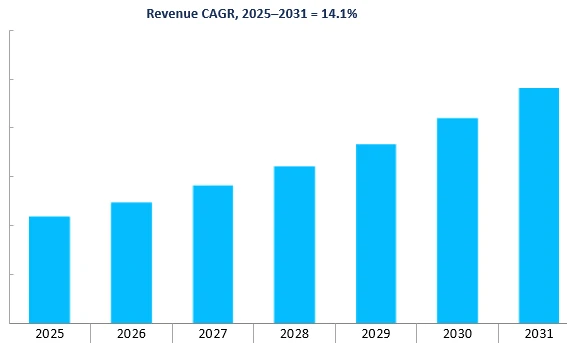
Annual market revenue is forecast to reach USD 49.72 billion in 2026, USD 56.54 billion in 2027, USD 64.42 billion in 2028, USD 73.55 billion in 2029, and USD 84.13 billion in 2030 before approaching nearly USD 100 billion by 2031. This consistent upward trajectory highlights the strategic importance of cybersecurity as healthcare organizations expand digital infrastructure and adopt connected technologies.
Spending across the Cyber Security in Healthcare market is increasingly directed toward integrated security platforms that combine infrastructure security, cloud protection, identity management, endpoint security, IoMT protection, and AI-powered threat intelligence. Organizations are also increasing investments in managed security services (MSSPs), zero-trust architecture, cyber exposure management, extended detection and response (XDR), and automated security operations to strengthen resilience against ransomware, phishing, insider threats, and supply chain attacks.
North America is expected to remain the largest contributor to cybersecurity spending due to mature healthcare IT infrastructure and stringent regulatory requirements. However, Asia-Pacific and other emerging markets are anticipated to record the fastest spending growth as governments accelerate healthcare digitization, cloud adoption, and connected medical device deployment. These trends position the Healthcare Cybersecurity Market for sustained long-term growth throughout the forecast period.
Growth Drivers: Healthcare Cybersecurity Market
The Healthcare Cybersecurity Market is expanding rapidly as healthcare organizations increasingly recognize cybersecurity as a critical component of patient safety, operational resilience, and digital transformation. One of the strongest growth drivers is the growing convergence of connected healthcare ecosystems, where hospitals rely on cloud platforms, Internet of Medical Things (IoMT) devices, electronic health records (EHRs), telehealth platforms, and AI-enabled clinical applications. As digital connectivity expands, healthcare providers are investing heavily in integrated security solutions to protect sensitive patient information and maintain uninterrupted clinical operations.
Another major driver in the Cyber Security in Healthcare market is the rise in ransomware attacks, identity-based threats, and sophisticated cybercriminal activity targeting healthcare institutions. Cyber incidents now directly affect patient care, prompting organizations to prioritize proactive security strategies instead of traditional reactive approaches.
Regulatory requirements are also accelerating market growth. Compliance frameworks, including the FDA's cybersecurity guidance, the PATCH Act, HIPAA regulations, and regional healthcare security mandates, require providers to continuously strengthen cybersecurity capabilities across medical devices, healthcare applications, and enterprise infrastructure.
Healthcare organizations are increasingly adopting identity-centric security, zero-trust architectures, cyber exposure management, AI-powered threat detection, and extended detection and response (XDR) platforms. Platform consolidation further supports market expansion by improving visibility, reducing operational complexity, and enabling coordinated security operations across multiple healthcare environments. The continued migration toward cloud-native healthcare infrastructure and connected medical ecosystems ensures sustained demand for comprehensive cybersecurity solutions throughout the forecast period.
Growth Restraints: Healthcare Cybersecurity Market
Despite strong growth prospects, the Healthcare Cybersecurity Market continues to face several operational and organizational challenges. One of the primary restraints is the complexity of securing highly fragmented healthcare environments that combine legacy systems, modern cloud platforms, third-party vendors, and thousands of connected medical devices. This fragmented infrastructure makes it difficult to implement standardized cybersecurity policies across entire healthcare networks.
Resource limitations remain another significant barrier within the Cyber Security in Healthcare market. Many healthcare providers, particularly small and mid-sized hospitals, struggle with limited cybersecurity budgets, shortages of qualified cybersecurity professionals, and competing investment priorities. These constraints delay modernization efforts and reduce the ability to implement advanced security technologies.
Legacy infrastructure further complicates cybersecurity adoption. Older medical equipment often lacks native security capabilities, making integration with modern cybersecurity platforms expensive and technically challenging. Organizations also face difficulties transitioning from reactive security models toward predictive, risk-based cybersecurity frameworks.
Additionally, the high cost of deploying enterprise-wide cybersecurity platforms—including continuous monitoring, identity management, AI-driven analytics, regulatory compliance, and managed security services—can slow adoption, particularly among resource-constrained healthcare providers. Addressing these challenges will require greater investment in workforce development, technology modernization, interoperability, and unified cybersecurity governance.
Competitive Landscape: Healthcare Cybersecurity Market
The Healthcare Cybersecurity Market remains moderately consolidated, with approximately 150 major cybersecurity vendors generating annual revenues exceeding USD 1 million. Competition is centered on delivering integrated cybersecurity platforms capable of protecting hybrid healthcare environments, connected medical devices, cloud infrastructure, healthcare applications, and sensitive patient information.
Key competitive factors include advanced threat detection and response, AI-powered security analytics, platform scalability, IoMT visibility, identity and access management, regulatory compliance, ease of deployment, and healthcare-specific expertise. Vendors are increasingly differentiating themselves by offering unified platforms that combine cloud security, endpoint protection, zero-trust architectures, identity governance, security orchestration, and managed detection and response (MDR) capabilities.
Leading companies operating in the Cyber Security in Healthcare market include Palo Alto Networks, Fortinet, Cisco Security, Check Point Software Technologies, Trend Micro, Broadcom (Symantec), CrowdStrike, IBM Security, Imprivata, and Zscaler. Other notable participants include Microsoft, Amazon Web Services (AWS), Rapid7, Claroty, Armis, Ordr, Cylera, CyberArk, Censinet, and Axonius, each offering specialized capabilities for healthcare infrastructure protection, medical device security, and cyber risk management.
Strategic mergers and acquisitions continue to reshape the competitive environment. Recent transactions—including Axonius' acquisition of Cynerio, ServiceNow's acquisition of Armis, and Cisco's acquisition of Splunk—highlight the industry's focus on expanding cybersecurity automation, asset visibility, threat intelligence, and healthcare-specific security capabilities.
Scope of Analysis
Segmentation
Why Is It Increasingly Difficult to Grow?
The Strategic Imperative 8™
The Impact of the Top 3 Strategic Imperatives on the Healthcare Cybersecurity Industry
Growth Metrics
Growth Environment
Shift from IT Protection to Patient-Safety Resilience
Healthcare Cybersecurity Maturity Remains Largely Reactive
Infrastructure and Enterprise Networks Security: Potential Risk Areas
Cloud Security: Potential Risk Areas
IoT and Medical Devices: Potential Risk Areas for Cybersecurity Attacks in Healthcare
Application Security: Potential Risk Areas
Types of Security Threats
The Impact of Cyberattacks on Patient Outcomes
Cost of a Data Breach
AI is Becoming Both an Attack Multiplier and a Defensive Need
Regulations are Driving Healthcare Cybersecurity Transformation
Medical Devices Security
Platform Consolidation and Cyber Exposure Management
Competitive Environment
Key Competitors
Competitor Matrix
Growth Drivers
Growth Restraints
Healthcare Cybersecurity Industry Snapshot
Forecast Considerations
Revenue Forecast
Revenue Forecast by Segment
Revenue Forecast Analysis
Revenue Share
Growth Metrics
Revenue Forecast
Revenue Forecast by Region
Forecast Analysis
Companies to Watch
Growth Metrics
Revenue Forecast
Revenue Forecast by Region
Companies to Watch
Growth Metrics
Revenue Forecast by Region
Forecast Analysis
Companies to Watch
Growth Metrics
Revenue Forecast
Revenue Forecast by Region
Forecast Analysis
Companies to Watch
Growth Opportunity 1: Biometric and Identity-Linked Security for Clinical Environments
Growth Opportunity 2: AI-Driven Cyber Exposure Management Platforms
Growth Opportunity 3: Embedding Cybersecurity into Digital Care Delivery and Patient Safety
Growth Opportunity 4: Healthcare-Focused Managed Security Services
Benefits and Impacts of Growth Opportunities
Next Steps
List of Exhibits
Legal Disclaimer
Frequently Asked Questions (FAQs) – Healthcare Cybersecurity Market
1. What is the Healthcare Cybersecurity Market?
2. What factors are driving the growth of the Healthcare Cybersecurity Market?
3. Why is Cyber Security in Healthcare market becoming increasingly important?
4. Which market segments are covered in the Healthcare Cybersecurity Market?
5. What is the forecast growth outlook for the Healthcare Cybersecurity Market?
6. Which technologies are transforming the Cyber Security in Healthcare market?
7. What challenges are limiting Healthcare Cybersecurity Market growth?
8. Which regions are expected to lead the Healthcare Cybersecurity Market?
9. Who are the leading companies in the Healthcare Cybersecurity Market?
10. What opportunities exist in the Healthcare Cybersecurity Market?
Speak directly with our analytics experts for tailored recommendations.
Recent related Digital Health research
06 Oct 2026 | Global | Technology Research
Trends in Laboratory Automation, Global, 2021–2025
This research study provides a comprehensive assessment of the recent trends, technological advancements, and strategic developments shaping the global laboratory automation industry. The analysis traces the evolution of laboratory automation from task-specific automation systems to integrated, inte...
21 Sep 2026 | Europe | Market Research
HLTH Europe 2026: Five Key Takeaways and Growth Opportunities
HLTH Europe 2026, held in Amsterdam, brought together more than 5,000 stakeholders spanning providers, payers, health systems, technology vendors, start-ups, investors, and policymakers, providing a comprehensive view of the evolving European digital health landscape. Across conference sessions and ...
21 Sep 2026 | Global | Frost Radar
Frost Radar: Smart Nutraceuticals for Brain Health, 2026
This Frost Radar evaluates the evolving smart nutraceuticals landscape as consumer awareness of cognitive health, lifestyle-related stress, and healthy aging creates demand for scientifically validated, natural, and multifunctional brain health solutions. The market remains fragmented, with differen...
18 Sep 2026 | Global | Technology Research
Innovations and Growth Opportunities in AI-Enabled Discovery and Diagnostics, Precision Therapeutics, and Next-Generation Vaccine Platforms
This edition of the Life Science, Health & Wellness Technology Opportunity Engine (TOE) provides a comprehensive overview of breakthrough innovations transforming AI-enabled discovery, precision diagnostics, cell engineering, targeted therapeutics, vaccines, and skin health across oncology, metaboli...
07 Sep 2026 | Global | Technology Research
Synthetic Antibodies and AI-Optimized Immunotherapies
Artificial intelligence is becoming increasingly relevant to antibody discovery and immunotherapy development, supporting target identification, de novo antibody design, antibody engineering, clinical intelligence, and bioprocessing. Advances in generative AI, protein language models, diffusion mode...
Purchase includes:
- Report download
- Growth Dialog™ with our experts
Growth Dialog™
A tailored session with you where we identify the:- Strategic Imperatives
- Growth Opportunities
- Best Practices
- Companies to Action
Impacting your company's future growth potential.
This study analyzes the global healthcare cybersecurity market from 2025 to 2031, covering infrastructure and enterprise network security, cloud security, IoT and medical device security, and application security. It examines the key drivers, restraints, competitive dynamics, revenue forecasts, regional trends, and growth opportunities shaping the market. The analysis highlights how ransomware, identity-based attacks, third-party risk, regulatory pressure, and legacy infrastructure challenges are pushing cybersecurity from a traditional IT function into a strategic healthcare priority.
The market is expected to grow steadily as providers invest in integrated platforms, cyber exposure management, identity-centric security, and life cycle-based protection for connected assets. Infrastructure and network security will remain the largest and fastest-growing segment, while application security will gain momentum as digital front doors, APIs, and patient engagement platforms expand. IoT and medical device security will remain central to cyber-physical resilience, and cloud security will continue to grow as part of broader hybrid and platform-based security strategies.
As healthcare organizations move from reactive defense toward proactive and predictive cybersecurity models, vendors that can unify visibility, prioritize risk, automate response, and align cybersecurity with clinical workflows will be best positioned for growth. The study identifies emerging opportunities in AI-driven cyber exposure management, biometric and identity-linked security, embedding cybersecurity into digital care delivery and patient safety frameworks, and healthcare-focused managed cybersecurity services.
Author: Alejandra Parra
| Deliverable Type | Market Research |
|---|---|
| Industries | Healthcare |
| No Index | No |
| Is Prebook | No |
| Keyword 1 | Healthcare Cybersecurity Market Report |
| Keyword 2 | Healthcare Security Market Analysis |
| Keyword 3 | Healthcare Cybersecurity Forecast |
| Podcast | No |
| Predecessor | KAF5-01-00-00-00 |
| WIP Number | KC66-01-00-00-00 |