 USD
USD GBP
GBP  CNY
CNY  EUR
EUR  INR
INR  JPY
JPY  MYR
MYR  ZAR
ZAR  KRW
KRW  THB
THB 


Hemodynamic Monitoring Systems Market, Global, 2025–2030
Hemodynamic Monitoring is Experiencing Transformational Growth Due to Emerging Wearable, Non-Invasive, and AI-Enabled Solutions
27-Nov-2025
Global
Market Research
KBFE-01-00-00-00
HC_2025_34138
Report Summary: Hemodynamic Monitoring Systems Market
The global hemodynamic monitoring systems market reached a value of USD 1.50 billion in 2024 and is projected to rise to USD 1.99 billion by 2030, expanding at a CAGR of 4.8% from 2025 to 2030. Growth is supported by the rapid adoption of minimally invasive and non-invasive monitoring technologies, rising cardiovascular disease prevalence, and the increasing use of AI-enabled clinical analytics that enhance decision-making in high-acuity environments. Hospitals worldwide are modernizing critical care workflows, expanding digital monitoring capabilities, and deploying next-generation systems across operating rooms (ORs), emergency departments (EDs), intensive care units (ICUs), and cardiac care units—a trend expected to accelerate throughout the forecast period.
Key Market Trends & Insights
- North America accounted for the largest share of the global hemodynamic monitoring systems market in 2024, driven by advanced hospital infrastructure, high adoption of precision monitoring technologies, and strong integration of clinical informatics.
- Asia-Pacific remains the fastest-growing regional market, supported by rising healthcare expenditure, increasing cardiac disease burden, and broader access to high-acuity monitoring solutions in China, India, and Southeast Asia.
- Demand for minimally invasive and non-invasive monitoring platforms continues to rise, as hospitals shift away from traditional invasive systems to reduce complications, shorten recovery times, and improve workflow efficiency.
- The convergence of AI, wearable sensors, and wireless technologies is enabling real-time analytics, earlier clinical intervention, and adoption of hybrid care models, including remote monitoring and hospital-at-home programs.
- Integration with electronic medical records (EMR), predictive analytics, and clinical decision-support systems is becoming a major purchasing criterion for health systems seeking improved operational efficiency.
Market Size & Forecast
- 2024 Market Size: USD 1.50 Billion
- 2030 Projected Market Size: USD 1.99 Billion
- CAGR (2025–2030): 4.8%
- Largest Market (2024): North America
- Fastest-Growing Market: Asia-Pacific
Market Growth Context
Demand for hemodynamic monitoring is rising globally as hospitals prioritize precision cardiovascular care, earlier clinical intervention, and workflow efficiency. The growing burden of cardiac diseases—such as heart failure, sepsis, and arrhythmias—is driving wider adoption of minimally invasive and non-invasive monitoring systems across ICUs, operating rooms, and emergency departments.
The market is also benefiting from advances in AI-enabled analytics, wireless sensors, and portable monitoring platforms, which support real-time decision-making and enable emerging care models like remote monitoring and hospital-at-home programs. Leading vendors continue to innovate with smarter, interoperable devices, reinforcing hemodynamic monitoring as an essential component of modern acute and chronic care delivery.
Market Overview & Trends: Hemodynamic Monitoring Systems Market
The hemodynamic monitoring devices market is undergoing a structural transformation fueled by advancements in device design, sensing technology, data analytics, and the shift toward precision medicine. Hospitals facing financial and workforce pressures are demanding solutions that deliver real-time insights, automate clinical decisions, and reduce preventable deterioration events. This has accelerated the uptake of non-invasive and minimally invasive platforms that reduce procedural risk while maintaining clinical accuracy. The PDF identifies disruptive technologies such as wearable sensors, AI-augmented decision-support platforms, and wireless systems as primary forces redefining market competition
AI is among the most influential technology trends. Vendors are integrating predictive analytics capable of identifying hypotension, analyzing stroke volume variation, and interpreting multi-parameter hemodynamic profiles. BD’s HemoSphere Alta platform, Retia Medical’s multi-beat analysis (MBA), GE Healthcare’s AI.i platform, and Masimo’s PulseCO algorithm illustrate how AI integration is enhancing monitoring precision and clinical workflow efficiency
These innovations enable a transition from reactive to proactive care by supporting early detection of hemodynamic instability.
Non-invasive and minimally invasive devices are increasingly preferred due to lower infection risks and suitability for fast-growing care environments such as ambulatory surgical centers and out-of-hospital care. Finger-cuff technologies, photoplethysmography-based solutions, bioreactance, and esophageal Doppler systems are gaining attention, especially as hospitals emphasize patient comfort and reduced procedural burden.
The market is also shaped by demographic pressures, with cardiovascular diseases remaining the leading global cause of mortality. Aging populations in Europe, Japan, China, and North America continue to expand demand for high-acuity monitoring solutions. Asia-Pacific’s position as the fastest-growing region is attributed to accelerating healthcare investments, improved critical care capacity, and a growing cluster of local manufacturers in China, Japan, and India producing technologically capable yet cost-accessible systems
On the commercial front, acquisitions are reshaping market leadership. BD’s acquisition of Edwards Lifesciences’ critical care business, Masimo’s acquisition of LiDCO, and Baxter’s acquisitions to strengthen non-invasive portfolios demonstrate strategic expansion. Across the ecosystem, hospitals increasingly favor integrated monitoring platforms with analytics, connectivity, and remote monitoring capability—establishing a new competitive baseline in the hemodynamic monitoring systems market.
Revenue & Spending Forecast: Hemodynamic Monitoring Systems Market
The global hemodynamic monitoring systems market is set for sustained expansion throughout the forecast period. According to the PDF, market revenue increased from USD 1,500.7 million in 2024 to a projected USD 1,989.7 million by 2030, representing a CAGR of 4.8% during 2025–2030
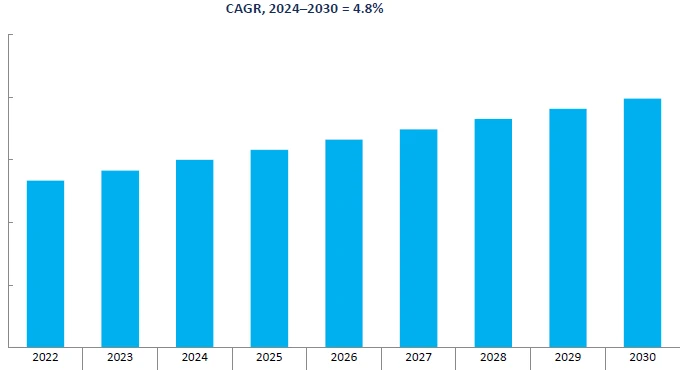
Growth is driven by accelerated adoption of non-invasive and minimally invasive technologies, advancements in AI-driven analytics, and the rising burden of cardiovascular diseases globally.
This revenue trajectory indicates continued strengthening of the hemodynamic monitoring devices market, supported by innovation, expanding clinical use cases, and a transition toward precision cardiovascular care.
Scope of Analysis: Hemodynamic Monitoring Systems Market
This assessment covers the global Hemodynamic monitoring market across devices, consumables, and services, evaluating their demand patterns across intensive care units, emergency care, operating rooms, catheterization labs, ambulatory surgical centers, and home/remote care settings. The study period spans 2022–2030, with 2024 as the base year and 2025–2030 as the forecast window
Products included in the scope are invasive, minimally invasive, and non-invasive hemodynamic monitoring devices as well as accessories such as sensors, catheters, cuffs, and disposable components used for continuous cardiovascular monitoring. The analysis also covers services linked to system maintenance, software integration, and subscription offerings. Regional coverage is comprehensive, covering North America, Europe, Asia-Pacific, Latin America, and the Middle East & Africa, derived from both primary interviews and secondary validation using filings, regulatory data, and vendor disclosures.
The PDF emphasizes analysis of trends shaping the hemodynamic monitoring devices market, including the expansion of multiparameter integration, with many vendors incorporating hemodynamic modules into broader patient monitoring ecosystems. However, multiparameter monitors themselves are excluded from the market sizing to maintain clarity in revenue attribution.
The methodology incorporates macroeconomic factors such as healthcare inflation, tariff impact, GDP growth variations, and regulatory frameworks—including 2025 FDA guidance on AI-enabled devices—all of which influence innovation, pricing, and adoption of advanced hemodynamic solutions
This structured analytical scope supports a reliable forecast and competitive interpretation.
Market Segmentation Analysis: Hemodynamic Monitoring Systems Market
By Product
The hemodynamic monitoring devices market is segmented into devices, consumables & accessories, and services.
- Devices form the highest-value segment driven by AI integration, new non-invasive platforms, wireless systems, and enhanced user interfaces.
- Consumables & accessories represent the key recurring revenue engine, propelled by the need for disposable sensors, cuffs, and catheters. Their high volume makes them essential to hospital expenditure models.
- Services—including maintenance, data analytics, and subscription platforms—are increasingly bundled with device purchases, supporting long-term vendor relationships.
By Type
The market includes invasive, minimally invasive, and non-invasive monitoring technologies:
- Invasive monitoring (pulmonary artery catheters, arterial lines) remains essential in high-acuity ICU and surgical settings requiring precise cardiac output and pressure measurement.
- Minimally invasive solutions balance accuracy and safety, appealing to hospitals seeking reduced complication risks.
- Non-invasive systems—bioimpedance, bioreactance, finger-cuff BP sensors, esophageal Doppler, photoplethysmography—are the fastest-growing, driven by patient comfort and use in outpatient and home-care settings.
By Region
- North America holds the largest revenue base due to extensive vendor presence, adoption of advanced platforms, and reimbursement support.
- Europe demonstrates steady growth driven by aging populations, increased surgical volumes, and early adoption of minimally invasive tools.
- Asia-Pacific is the fastest-growing region, supported by rising hospital capacity, affordability enhancements, and increasing prevalence of cardiac diseases.
- LATAM & MEA show moderate growth with adoption constraints linked to cost pressures and limited availability of dedicated hemodynamic technologies, often relying on multiparameter monitors.
Overall, segmentation highlights strong global momentum toward non-invasive and AI-supported solutions, reshaping competitive dynamics within the Hemodynamic monitoring devices market.
Growth Drivers: Hemodynamic Monitoring Systems Market
Key growth drivers identified in the PDF include the rapid development of advanced sensors and non-invasive, minimally invasive, and wearable hemodynamic technologies. These innovations significantly improve patient safety and comfort while expanding applicability into outpatient and remote monitoring environments. AI-powered platforms capable of predictive analytics, early deterioration detection, and workflow optimization are further accelerating adoption, especially in high-acuity settings where timely clinical decisions are crucial
Personalized cardiovascular care is another major driver. Clinicians increasingly prefer data-rich hemodynamic insights for fluid management, vasoactive drug titration, and intervention planning. The Hemodynamic monitoring devices market supports this shift by generating continuous, high-resolution cardiac output, blood pressure, and perfusion parameters needed for individualized therapy.
The rising global incidence of cardiovascular disorders—heart failure, myocardial infarction, shock, hypertension—combined with aging populations, is expanding the patient pool requiring hemodynamic monitoring across ICUs, emergency departments, and surgical theaters. Growth in remote monitoring and home-care adoption also supports demand for non-invasive and wearable solutions.
Vendor initiatives—including product innovation, awareness programs, AI integration, and clinical-validation efforts—collectively strengthen growth prospects. Overall, these drivers position the Hemodynamic monitoring market for stable medium-term growth.
Growth Restraints: Hemodynamic Monitoring Systems Market
Despite positive growth, several challenges limit full-scale adoption of advanced hemodynamic systems. High device and consumable costs impose financial pressure on hospitals, especially in low- and middle-income economies where budgets remain constrained. The PDF highlights cost concerns as a high-severity barrier over the next 5–6 years
Limited awareness and insufficient clinician training further affect adoption of minimally invasive and non-invasive technologies in emerging markets. In addition, evidence gaps concerning the accuracy and clinical effectiveness of some non-invasive systems in critically ill patients reduce confidence among intensivists and surgeons.
Implementation barriers also arise from infrastructure constraints. Many hospitals in developing regions lack advanced IT systems required to integrate AI-driven and analytics-enabled monitoring platforms. Tariff-related cost increases on imported devices additionally strain supply availability and pricing stability.
These challenges collectively restrain the full potential of the hemodynamic monitoring devices market, creating a slower adoption curve in certain geographies despite technological advancements.
Competitive Landscape: Hemodynamic Monitoring Systems Market
The competitive environment in the hemodynamic monitoring systems market is moderately concentrated, with the top five vendors accounting for 57.8% of global revenue in 2024
Leading participants include BD, ICU Medical, Getinge, Baxter, and Masimo, each offering differentiated portfolios across invasive, minimally invasive, and non-invasive modalities.
BD emerged as a dominant competitor following its 2024 acquisition of Edwards Lifesciences’ critical care unit. The enhanced HemoSphere Alta platform integrates predictive algorithms and advanced analytics for actionable clinical decision-making.
ICU Medical maintains strength through its Cogent platform supporting dual-mode (minimally invasive + invasive) monitoring.
Baxter leads the non-invasive segment through bioreactance-based Starling systems, enabling personalized fluid management.
Masimo strengthened its position through the LiDCO acquisition, adding PulseCO algorithm-driven analytics.
Getinge continues innovation with its PiCCO, PulsioFlex, and the newly introduced Pulsiocare system.
Other relevant companies—Philips, GE Healthcare, Mindray, Fysicon (Canon), Retia Medical, Deltex Medical, Uscom, Osypka Medical, and Nihon Kohden—expand competitive diversity across geographies, with several focusing on specialized non-invasive or AI-driven solutions.
The market is also shaped by continuous M&A activity. Key acquisitions—BD-Edwards (2024), ICU Medical-Smiths Medical (2022), Masimo-LiDCO (2021), and Baxter-toSense (2020)—have accelerated portfolio consolidation and technological advancement.
Overall, competitive strategies center on AI integration, improved usability, wearable platforms, and expansion into remote monitoring—further intensifying competition in the global hemodynamic monitoring devices market.
Scope of Analysis
Segmentation
Why is it Increasingly Difficult to Grow?
The Strategic Imperative 8™
The Impact of the Top 3 Strategic Imperatives on the Hemodynamic Monitoring Systems Industry
Competitive Environment
Key Competitors
Growth Metrics
Growth Drivers
Growth Restraints
Forecast Considerations
Revenue Forecast
Revenue Forecast by Product
Revenue Forecast by Type
Revenue Forecast by Region
Revenue Forecast Analysis
Pricing Trends and Forecast Analysis
Revenue Share
Revenue Share Analysis
Key Company Product Mapping
Key Acquisitions
Key Trends in the Hemodynamic Monitoring Systems Industry
Hemodynamic Monitoring Overview
End-User Trends
Product Type Trends
Type Overview
Artificial Intelligence/Machine Learning in Hemodynamic Monitoring Systems
Growth Metrics
Revenue Forecast
Revenue Forecast by Product
Revenue Forecast by Type
Forecast Analysis
Growth Metrics
Revenue Forecast
Revenue Forecast by Product
Revenue Forecast by Type
Forecast Analysis
Growth Metrics
Revenue Forecast
Revenue Forecast by Product
Revenue Forecast by Type
Forecast Analysis
Growth Metrics
Revenue Forecast
Revenue Forecast by Product
Revenue Forecast by Type
Forecast Analysis
Growth Metrics
Revenue Forecast
Revenue Forecast by Product
Revenue Forecast by Type
Forecast Analysis
Growth Opportunity 1: Wearables
Growth Opportunity 2: AI-Based Analytics
Growth Opportunity 3: Remote Monitoring
Benefits and Impacts of Growth Opportunities
Next Steps
List of Exhibits
Legal Disclaimer
Frequently Asked Questions (FAQ) – Hemodynamic Monitoring Systems Market
1. What is the current size of the global hemodynamic monitoring systems market?
2. What is the expected market size of hemodynamic monitoring devices by 2030?
3. What factors are driving growth in the Hemodynamic monitoring market?
4. Which product categories are included in the hemodynamic monitoring devices market?
5. Which region currently holds the largest market share?
6. Which region is expected to grow the fastest?
7. What role does AI play in the hemodynamic monitoring systems market?
8. What challenges may limit adoption of hemodynamic monitoring devices?
9. Who are the major companies operating in this market?
10. What is the long-term outlook for the Hemodynamic monitoring market?
Speak directly with our analytics experts for tailored recommendations.
Recent related Advanced Medical Technologies research
25 Sep 2026 | Global | Technology Research
Innovations and Growth Opportunities in Advanced Medical Devices, Diagnostic Solutions, and Implantables
The latest issue of Advanced MedTech Technology Opportunity Engine (TOE) spotlights a diverse slate of innovations across advanced medical devices, diagnostic solutions, and implantables.The issue features advanced medical devices such as peritoneal dialysis fluid system, cold sterilization-based au...
18 Sep 2026 | Global | Technology Research
Innovations and Growth Opportunities in AI-Enabled Discovery and Diagnostics, Precision Therapeutics, and Next-Generation Vaccine Platforms
This edition of the Life Science, Health & Wellness Technology Opportunity Engine (TOE) provides a comprehensive overview of breakthrough innovations transforming AI-enabled discovery, precision diagnostics, cell engineering, targeted therapeutics, vaccines, and skin health across oncology, metaboli...
28 Aug 2026 | Global | Technology Research
Innovations and Growth Opportunities in Advanced Medical Devices, Artificial Intelligence Solutions, Digital Solutions, and Medical Imaging Solutions
The latest issue of Advanced MedTech Technology Opportunity Engine (TOE) spotlights a diverse slate of innovations across advanced medical devices, artificial intelligence solutions, digital solutions, and medical imaging solutions.The issue features advanced medical devices such as active bioelectr...
25 Aug 2026 | Global | Technology Research
Breakthrough Innovations in Point-of-Care Diagnostics
This research analyzes how point-of-care (PoC) diagnostics is evolving from simple tests to decentralized, connected, and clinically actionable testing platforms across hospitals, outpatient settings, homes, and pharmacies.The study assesses key technology shifts, including rapid molecular testing, ...
25 Aug 2026 | Global | Technology Research
Innovations and Growth Opportunities in Digital Biomarkers
A digital biomarker refers to measurable data about physiological functions or behaviors collected through digital devices and technologies, such as wearables, implants, ingestible sensors, smartphones, and mobile applications. These biomarkers provide continuous, real-time insights into an individu...
Purchase includes:
- Report download
- Growth Dialog™ with our experts
Growth Dialog™
A tailored session with you where we identify the:- Strategic Imperatives
- Growth Opportunities
- Best Practices
- Companies to Action
Impacting your company's future growth potential.
Acquisitions over the past decade have led to an improved ecosystem of monitoring solutions, with vendors such as BD, Getinge, ICU Medical, Baxter, and Masimo playing a key role in the hemodynamic monitoring market.
This Frost & Sullivan study analyzes invasive, minimally invasive, and non-invasive hemodynamic monitoring solutions. It covers hemodynamic monitoring devices, consumables and accessories, and services. Regional coverage covers North America, Europe, Asia-Pacific, Latin America, and the Middle East, and Africa. The study offers valuable insights into market size, growth rates, opportunities, strategic imperatives, notable market participants, new technologies, and end users. The study period spans 2022 to 2030, with 2024 as the base year and 2025 to 2030 as the forecast.
Author: Utkarsha Kaustubh Soundankar
| Deliverable Type | Market Research |
|---|---|
| Industries | Healthcare |
| No Index | No |
| Is Prebook | No |
| Keyword 1 | hemodynamic monitoring market |
| Keyword 2 | patient monitoring market |
| Keyword 3 | clinical monitoring |
| Podcast | No |
| Predecessor | K517-01-00-00-00 |
| WIP Number | KBFE-01-00-00-00 |