 USD
USD GBP
GBP  CNY
CNY  EUR
EUR  INR
INR  JPY
JPY  MYR
MYR  ZAR
ZAR  KRW
KRW  THB
THB 


Humanoids Market, Global, 2025–2032
Innovative Humanoid Technologies and Business Models are Driving Transformational Growth Across Multiple Regions
19-Dec-2025
Global
Market Research
MHF7-01-00-00-00
IA_2025_34207
Report Summary: Humanoid Robot Market
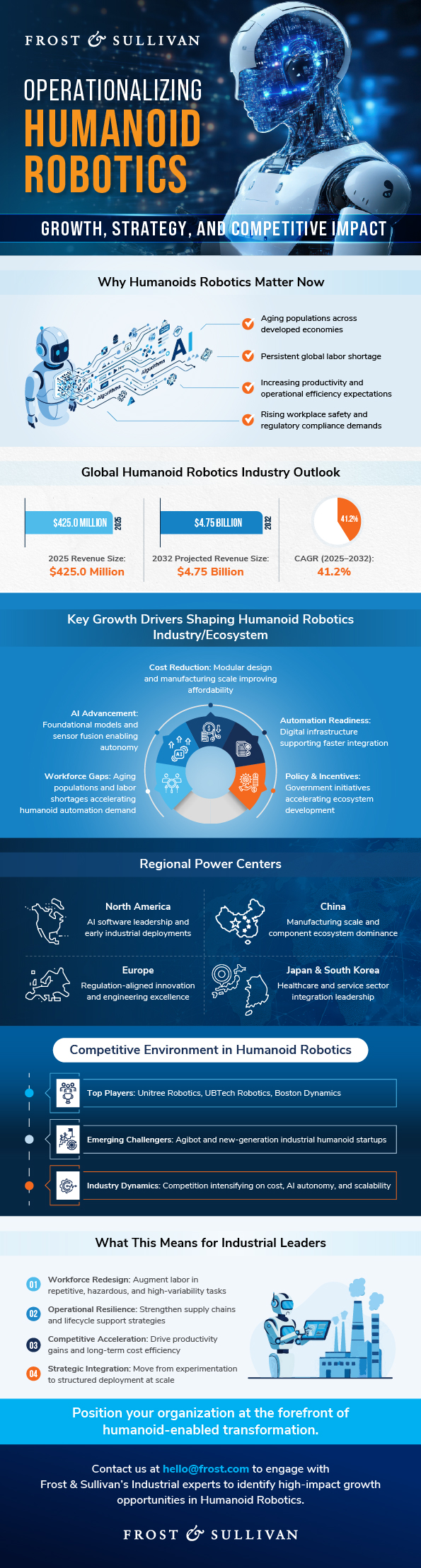
The global Humanoid Robot Market size was estimated at USD 425.0 million in 2025 and is projected to reach USD 4.75 billion by 2032, growing at a CAGR of over 41.2% from 2026 to 2032. Rapid advancements in artificial intelligence, robotics hardware, and increasing demand for workforce automation are driving strong growth across the Humanoids Market.
Key Market Trends & Insights
- North America accounted for a significant share of the global Humanoid Robot Market in 2025, supported by strong AI innovation, venture funding, and early commercial deployments.
- In China, aggressive investments in robotics manufacturing and government-backed automation initiatives are accelerating humanoid robot adoption.
- By application, industrial and logistics environments represented the largest share of early deployments in 2025.
- Rising focus on AI-driven perception, mobility, and human–robot interaction is improving humanoid performance in unstructured environments.
- Asia Pacific (excluding China) is expected to witness rapid growth over the forecast period, driven by public-sector programs and expanding research adoption.
Market Size & Forecast
- 2025 Market Size: USD 425.0 Million
- 2032 Projected Market Size: USD 4.75 Billion
- CAGR (2026–2032): Over 41.2%
- North America & China: Largest markets
- Asia Pacific: Fastest-growing region
The increasing need to address labor shortages, rising operational costs, and demographic shifts is accelerating interest in humanoid robots across industrial, healthcare, and service sectors. As foundational AI models, sensor fusion, and actuator technologies continue to mature, humanoids are transitioning from pilot deployments toward scalable commercial solutions. Over the forecast period, the Humanoid Robot Market is expected to emerge as a transformative segment within the broader automation ecosystem, reinforcing long-term growth potential for the Humanoids Market.
Market Overview & Trends: Humanoid Robot Market
The Humanoid Robot Market represents a convergence of robotics, artificial intelligence, semiconductors, and advanced manufacturing. Unlike traditional industrial robots, humanoids are designed to operate in environments built for humans, enabling them to perform tasks that require mobility, dexterity, and adaptive decision-making. This human-centric design is expanding the addressable market across industries where conventional automation is limited.
A key trend shaping the Humanoids Market is the rapid evolution of foundational AI models that enable perception, reasoning, and natural human–robot interaction. Multimodal AI systems combining vision, language, and action are accelerating skill acquisition and reducing the need for task-specific programming. Simulation-first development, digital twins, and AI-enhanced training environments are shortening development cycles and lowering deployment risk.
Another major trend is the emergence of new business models, including Robots-as-a-Service (RaaS), leasing, and pay-per-use frameworks. These models reduce upfront capital barriers and enable enterprises to adopt humanoids incrementally. At the same time, falling hardware costs—particularly in actuators, sensors, and batteries—are improving economic feasibility.
Regionally, China is advancing rapidly toward mass production, while North America leads in AI innovation and private funding. Europe emphasizes regulatory alignment and trust-based AI deployment. Collectively, these trends are transforming the Humanoid Robot Market from a technology showcase into a commercially viable automation segment.
Scope of Analysis: Humanoid Robot Market
This analysis of the Humanoid Robot Market covers the global industry over a study period from 2024 to 2032, with 2025 as the base year and 2026–2032 as the forecast period. Market values are presented in US dollars and reflect revenue generated from the sale of fully assembled humanoid robots by original equipment manufacturers.
The scope includes humanoid robots deployed across industrial, commercial, and service environments. Component-level revenues and downstream services are excluded to maintain focus on the core Humanoids Market. Geographic coverage includes North America, China, Europe, Asia Pacific (excluding China), and other regions where humanoid activity is emerging.
The study incorporates qualitative and quantitative analysis of market drivers, restraints, competitive dynamics, and adoption patterns. Forecasts are based on conservative assumptions around technology readiness, regulatory evolution, and enterprise adoption timelines, ensuring realistic long-term projections for the Humanoid Robot Market.
Revenue & Spending Forecast: Humanoid Robot Market
The global Humanoid Robot Market generated approximately USD 425.0 million in 2025, reflecting limited but growing commercial deployments. By 2032, market revenue is projected to reach USD 4.75 billion, driven by rapid expansion in industrial, healthcare, and service-sector applications.
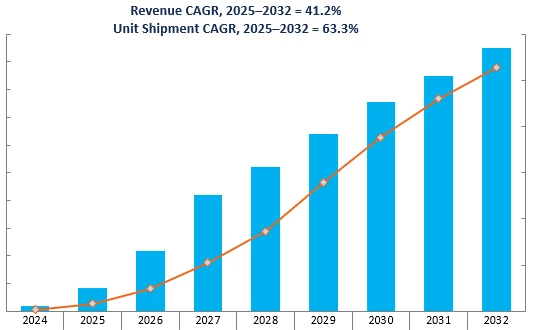
This growth trajectory reflects a CAGR exceeding 41.2% over the forecast period, positioning the Humanoids Market as one of the fastest-growing segments within the broader robotics industry. Spending growth is expected to accelerate in the latter half of the forecast period as costs decline and deployment confidence improves.
Market Segmentation Analysis: Humanoid Robot Market
The Humanoid Robot Market is segmented by end-user industry, deployment environment, and geographic region. Manufacturing and logistics represent the most advanced adoption segment, where humanoids are used for material handling, inspection, warehouse operations, and repetitive tasks that complement existing automation.
Healthcare is emerging as a strategic growth segment, with humanoids supporting elderly care, patient monitoring, rehabilitation, and assistive services. Education and research institutions are adopting humanoids as teaching assistants and research platforms, while customer engagement applications are expanding in retail, hospitality, and public spaces.
Home-use humanoids currently account for a small share of the Humanoids Market, but declining costs and improved autonomy are expected to support long-term adoption. Across all segments, adoption is influenced by safety standards, AI maturity, and return-on-investment considerations.
Growth Drivers: Humanoid Robot Market
The Humanoid Robot Market is being propelled by a combination of policy support, expanding application breadth, and rapid technological progress. One of the most significant near- to mid-term growth drivers is government support through subsidies, national robotics programs, and favorable policy frameworks. Public-sector funding and long-term automation roadmaps in North America, China, Europe, and parts of Asia Pacific are accelerating R&D investments, de-risking early deployments, and establishing a clear strategic direction for the Humanoids Market.
Another critical driver is the expanding number of commercial and industrial use cases for humanoid robots. Adoption is increasing across manufacturing, logistics, security, facility management, and caregiving environments, where humanoids are deployed for repetitive tasks, material handling, hazardous operations, and continuous surveillance. As proof-of-concept projects transition into scaled pilots, use-case diversity is becoming a key demand catalyst.
Rapid improvements in artificial intelligence and physical robot components further strengthen market momentum. Advances in perception, motion planning, sensor fusion, batteries, and lightweight materials are enabling more natural human–robot interaction, higher energy efficiency, and improved autonomy. These technological gains allow humanoids to execute increasingly complex tasks in unstructured environments.
Economic pressures also play a growing role. Rising labor costs and workforce shortages are encouraging enterprises to evaluate humanoids as a long-term cost-management solution. As learning curves improve and unit costs decline toward targeted affordability thresholds, return on investment becomes more attractive. Finally, global demographic aging and shortages of skilled labor, particularly in developed economies, are expected to significantly accelerate demand for humanoid robots over the latter half of the forecast period, reinforcing sustained expansion of the Humanoid Robot Market.
Growth Restraints: Humanoid Robot Market
Despite strong long-term potential, the Humanoid Robot Market faces several structural and technological constraints that limit near- to mid-term adoption. One of the most significant restraints is technology maturity, particularly in perception, mobility, and coordination within unstructured real-world environments. While artificial intelligence capabilities are advancing rapidly, current humanoid systems still struggle with reliable autonomous operation and safe human–robot interaction outside controlled settings, restricting large-scale commercial deployment.
Another key challenge relates to supply chain concentration and geopolitical risk. A limited number of regions currently dominate the production of critical components, including advanced semiconductors, sensors, actuators, and batteries. This concentration increases exposure to policy shifts, trade restrictions, tariff disputes, and geopolitical tensions, which can disrupt production, elevate costs, and slow international collaboration in the Humanoids Market.
High initial investment and lifecycle costs also remain a major barrier. Extensive R&D requirements, expensive components, and ongoing maintenance result in high upfront system costs, constraining adoption to well-funded enterprises and government-backed projects. Although costs are expected to decline over time, near-term affordability remains a limiting factor.
In addition, public acceptance, safety concerns, and ethical considerations continue to influence adoption. Limited awareness of real-world capabilities, concerns over job displacement, and cultural resistance to human-like machines can slow market penetration. Finally, regulatory uncertainty and limited standardization across countries restrict the range of approved use cases, further moderating growth in the global Humanoid Robot Market.
Competitive Landscape: Humanoid Robot Market
The Humanoid Robot Market is characterized by a select but rapidly expanding group of technology-intensive OEMs, with more than 15 humanoid robot manufacturers expected to generate revenues exceeding USD 9.0 million by 2026. Although the market remains at an early commercialization stage, competitive intensity is increasing as companies accelerate product launches, pilot deployments, and scale-up strategies across industrial, healthcare, and service-sector applications.
Competition in the Humanoids Market is primarily driven by cost optimization, system performance, technological sophistication, reliability, and safety assurance. Advanced human–robot interaction capabilities, ethical AI compliance, and operational safety in unstructured environments have emerged as critical differentiators. Vendors are increasingly prioritizing AI-driven perception, dexterous manipulation, and energy-efficient mobility to improve real-world usability and customer acceptance.
Key end-user verticals shaping competitive strategies include manufacturing, logistics, healthcare, education, hospitality, and emerging home-use applications. Industrial and logistics environments currently represent the most mature demand segments, while healthcare and service-oriented use cases are driving longer-term product roadmaps and partnerships.
The market is led by a core group of prominent players, including Unitree, Agibot, Engine AI, UBTech, and Boston Dynamics, which collectively accounted for approximately 58.2% of global market revenue in 2025. These companies benefit from early-mover advantages, strong R&D capabilities, and increasing deployment experience. A broader group of notable challengers—such as Tesla, Agility Robotics, 1X Technologies, Figure AI, and Neura Robotics—is intensifying competition through aggressive innovation, venture funding, and strategic collaborations.
Distribution models in the Humanoid Robot Market primarily involve direct sales to institutional buyers, complemented by selective retail channels for individual and research customers, with logistics partners managing delivery and integration. Strategic mergers and acquisitions continue to shape competitive positioning, as illustrated by 1X Technologies’ acquisition of Kind Humanoid and Hyundai Motor Group’s controlling stake in Boston Dynamics, underscoring the long-term commitment of major industrial players to the Humanoids Market.
Scope of Analysis
Segmentation—Regional
Key Regions—North America
Key Regions—China
Key Regions—APAC (excluding China)
Key Regions—Europe
Segmentation—End User
Why is it Increasingly Difficult to Grow?
The Strategic Imperative 8™
The Impact of the Top 3 Strategic Imperatives on the Humanoid Industry
Value Chain
Brain: Software—Foundational Models
Brain: Software—Data Science & Analytics
Brain: Software—Simulation and Vision Software
Brain: Semiconductors—Vision and Compute
Brain: Semiconductors—Memory
Body: Batteries
Body: Semiconductors (Analog)
Body: Actuator & Actuator Parts
Body: Sensors
Body: Body, Wiring, and Thermal
Competitive Environment
Growth Metrics
Growth Drivers
Growth Driver Analysis
Growth Restraints
Growth Restraint Analysis
Forecast Considerations
Revenue and Unit Shipment Forecast
Revenue Forecast by Region
Revenue Forecast by End User
Unit Shipment Forecast by End User
Revenue Forecast by Component
Revenue Forecast Analysis
Pricing Trends and Forecast Analysis
Humanoid Market Revenue Share
Revenue Share Analysis
Humanoid Component Market Revenue Share Analysis
Growth Metrics
Revenue and Unit Shipment Forecast
Revenue Forecast by Region
Forecast Analysis
Growth Metrics
Revenue and Unit Shipment Forecast
Revenue Forecast by Region
Forecast Analysis
Growth Metrics
Revenue and Unit Shipment Forecast
Revenue Forecast by Region
Forecast Analysis
Growth Metrics
Revenue and Unit Shipment Forecast
Revenue Forecast by Region
Forecast Analysis
Growth Metrics
Revenue and Unit Shipment Forecast
Revenue Forecast by Region
Forecast Analysis
Growth Opportunity 1: Commercial Space Operations & Exploration Support
Growth Opportunity 2: AI-Enhanced Public Safety & Policing Automation
Growth Opportunity 3: Telepresence-Enabled Remote Workforce Avatars
Benefits and Impacts of Growth Opportunities
Next Steps
List of Exhibits
Legal Disclaimer
Frequently Asked Questions (FAQ) – Humanoid Robot Market
1. What is the Humanoid Robot Market?
2. How large is the global Humanoids Market?
3. What is the growth rate of the Humanoid Robot Market?
4. Which industries are adopting humanoid robots?
5. What technologies drive the Humanoid Robot Market?
6. What factors are driving growth in the Humanoids Market?
7. What are the key challenges facing the Humanoid Robot Market?
8. Which regions lead the Humanoid Robot Market?
9. Who are the major players in the Humanoids Market?
10. What is the future outlook for the Humanoid Robot Market?
Speak directly with our analytics experts for tailored recommendations.
Recent related Automation research
07 Oct 2026 | South Asia, Middle East & North Africa | Market Research
Top 10 Growth Opportunities in Resource-Efficient Manufacturing to Optimize Industrial Water and Energy Across the Middle East, 2026
The Middle East is entering a new phase of industrial development in which water security, energy efficiency, and sustainability have become critical determinants of manufacturing competitiveness. Increasing industrial water demand, energy-intensive production processes, climate-related resource con...
06 Oct 2026 | Global | Market Research
Industrial Control Systems, Global, 2022–2032
The study examines the global industrial control systems market, structured around three core technology segments: distributed control systems (DCS), programmable logic controllers (PLCs), and SCADA. Using 2025 as the base year, the research provides market sizing and a seven-year forecast by region...
05 Oct 2026 | Global | Frost Radar
Frost Radar™: Cognitive Cobot Technology Ecosystem, 2026
Collaborative robotics is entering a new phase as advances in artificial intelligence, multimodal perception, force and tactile sensing, adaptive control, and robot learning enable cobots to move beyond fixed, pre-programmed tasks toward more context-aware and responsive automation. This Frost Radar...
02 Oct 2026 | Global | Technology Research
Growth Opportunities in Contact-Rich Robot Skill AI, High-Speed Photopolymer 3D Printing, Industrial Interoperability, Vision AI, Pallet Shuttle Automation, In-Situ AM Inspection, and Composite 3D Printing
The Advanced Manufacturing Technology Opportunity Engine provides profiles of innovations related to simulation-trained contact skills enabling industrial robots to perform complex physical interactions and manipulation tasks; hybrid laser-DLP 3D printing systems combining additive technologies for ...
01 Oct 2026 | Global | Frost Radar
Frost Radar™: SCADA for Industrial Control Environments, 2026
This Frost Radar™ benchmarks supervisory control and data acquisition (SCADA) platforms for industrial control environments, evaluating leading vendors on innovation and growth. The analysis examines how platforms are evolving to support brownfield modernization, secure remote access, multisite stan...
Purchase includes:
- Report download
- Growth Dialog™ with our experts
Growth Dialog™
A tailored session with you where we identify the:- Strategic Imperatives
- Growth Opportunities
- Best Practices
- Companies to Action
Impacting your company's future growth potential.
The research reveals compelling market dynamics driven by fundamental societal shifts—population aging creating unprecedented demand for care assistance, persistent labor shortages across manufacturing and service industries, and the accelerating integration of artificial intelligence (AI) capabilities that enable practical humanoid deployment. However, these opportunities emerge alongside significant challenges, including substantial development investments, evolving regulatory frameworks, and the delicate balance of consumer acceptance versus technological capability.
Regional markets demonstrate distinctly different adoption trajectories, with each geography developing unique applications that reflect local priorities and constraints. Through detailed analysis of 3 high-potential growth opportunities—telepresence-enabled remote workforce avatars, AI-enhanced public safety automation, and commercial space operations support—this Frost & Sullivan analysis illuminates how humanoid robotics will reshape traditional industry boundaries while creating entirely new market categories that address previously unsolvable customer pain points.
Author: Karthik Sundaram
| Deliverable Type | Market Research |
|---|---|
| Industries | Industrial Automation |
| No Index | No |
| Is Prebook | No |
| Keyword 1 | humanoid robots market |
| Keyword 2 | advanced robotics industry |
| Keyword 3 | AI-enabled humanoids |
| Podcast | No |
| Predecessor | None |
| WIP Number | MHF7-01-00-00-00 |