 USD
USD GBP
GBP  CNY
CNY  EUR
EUR  INR
INR  JPY
JPY  MYR
MYR  ZAR
ZAR  KRW
KRW  THB
THB 


Regulatory Reforms and Policy Shifts are Driving Domestic Production and Fossil Fuel Favoritism
28-May-2025
North America
Market Research
KB97-01-00-00-00
EG_2025_33516
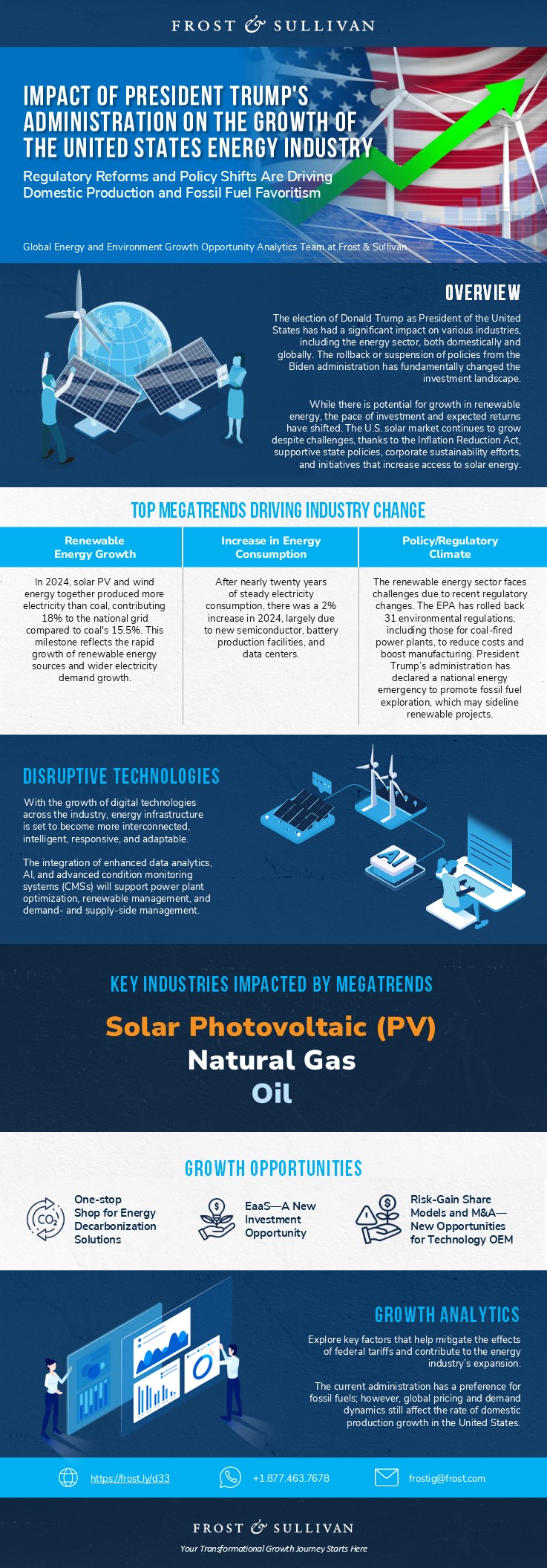
The election of Donald Trump as President of the United States has had a significant impact on various industries, including the energy sector, both domestically and globally. The rollback or suspension of policies from the Biden administration has fundamentally changed the investment landscape.
While there is potential for growth in renewable energy, the pace of investment and expected returns have shifted. The U.S. solar market continues to grow despite challenges, thanks to the Inflation Reduction Act, supportive state policies, corporate sustainability efforts, and initiatives that increase access to solar energy. These factors help mitigate the effects of federal tariffs and contribute to the industry’s expansion.
In contrast, the offshore wind industry has come to a standstill, facing challenges even before President Trump took office. The current administration has a preference for fossil fuels; however, global pricing and demand dynamics still affect the rate of domestic production growth in the United States.
Moreover, the imposition of tariffs has created considerable uncertainty in the market. Nonetheless, the temporary suspension of these tariffs for 90 days has raised hopes for a negotiated solution.
Author: Lucrecia Gomez
Why Is It Increasingly Difficult to Grow?
The Strategic Imperative 8
The Impact of the Top 3 Strategic Imperatives on the Energy Industry
Risk to Forecast Factors
Top Three Trends Driving Industry Change
Likely Influence of President Trump’s Administration will have on Individual Energy Segments
US Power Generation Investment Forecast
US Power Generation Installed Capacity
US Electricity Generated
Trend # 1: The Fundamentals of the Solar PV Market are Strong, but Trade Policies from the Administration Present New Challenges
Exploring the Dynamic Landscape of Solar PV Manufacturing
Why Solar Recycling Could Gain Traction Post-tariffs
Trend # 2: President Trump's Tariffs Threaten to Undermine his Goals for Energy Independence and a Strong Natural Gas Market
Unveiling the Dynamic Forces Shaping the LNG Market landscape
Natural Gas will Continue to Play a Pivotal Role in the Electricity System
Trend # 3: The Trump Administration Prioritizes Investment in Oil, but its Trade Policies Could Threaten How Much Can Be Achieved
Tariff Policies and their Immediate Effects on Oil Markets
Trend # 4: Challenges Persist, but Onshore Wind Energy Remains a Viable Generation Technology in the US
Larger Turbines will Increase Wind Generation Output
Trend # 5: The Offshore Wind Industry is Largely Dead for the Next Four Years
Innovations Shaping the Future Potential of the Wind Energy Market
Trend # 6: Challenging Conditions for Hydrogen as Funding Uncertain
Gaps and Pain Points Across the Hydrogen Value Chain
Trend # 7: Despite Supportive Policies for Nuclear energy, the Key Focus of Growth is Around Life Extensions, Services and Mining
Revitalized Commitment to Nuclear Energy
Trend # 8: Long-term Growth for BESS, but Tariffs Threaten Growth in the Short-term
Unpacking the Geopolitics of Batteries: Powering the Future of Global Tensions
Trend # 9: Tariffs Could Complicate Grid Investment Efforts, but the Need for Modernization is Clear. Congressional Permitting Reform would Accelerate Growth if Passed
Distribution Grids are at the Center of the Energy Transformation
The Future of Electric Utilities: A Vision to 2030
Trend # 10: Carbon Capture Poised for Strong Growth as the Administration Favors Fossil-based Technologies
CCUS will Reach a Much Wider Number of Industries by 2030
Growth Opportunity 1: One-stop Shop for Energy Decarbonization Solutions
Growth Opportunity 2: EaaS—A New Investment Opportunity
Growth Opportunity 3: Risk-Gain Share Models and M&A—New Opportunities for Technology OEMs
Benefits and Impacts of Growth Opportunities
Next Steps
List of Exhibits
Legal Disclaimer
Speak directly with our analytics experts for tailored recommendations.
Recent related Power Generation research
09 Oct 2026 | Global | Technology Research
Innovations in Enhanced Oil Recovery, Continuous Emission Monitoring, Infrared Gas Detection, and Reservoir Optimization
This edition of the Oil and Gas (O&G) Technology Opportunity Engines features information on enhanced oil recovery, crude oil separation, leak detection, distributed gas monitoring, real-time monitoring of distributed fuel operations, among others.The Oil and Gas TOE provides intelligence on innovat...
28 Sep 2026 | Global | Technology Research
CO₂ Gas Injection for Enhanced Oil Recovery and Carbon Utilization
CO₂ gas injection for enhanced oil recovery (CO₂-EOR) is a mature tertiary recovery technology that improves oil production from depleted reservoirs while enabling long-term geological carbon storage. This report provides a fundamental overview of oil recovery, covering primary, secondary, and terti...
28 Sep 2026 | Global | Technology Research
CO₂ Gas Injection for Enhanced Oil Recovery and Carbon Utilization
CO₂ gas injection for enhanced oil recovery (CO₂-EOR) is a mature tertiary recovery technology that improves oil production from depleted reservoirs while enabling long-term geological carbon storage. This report provides a fundamental overview of oil recovery, covering primary, secondary, and terti...
28 Sep 2026 | Global | Technology Research
Quasi-Solid-State Batteries: Key Innovations Transforming Electrochemical Energy Storage Systems
Quasi-solid-state batteries (QSSBs) are emerging as a promising next-generation lithium battery technology that bridges the gap between conventional lithium-ion batteries (LIBs) and all-solid-state batteries (ASSBs). By integrating a confined liquid electrolyte within a polymer, inorganic, or hybrid...
18 Sep 2026 | Global | Technology Research
Innovations in Electrolyzers, Process Heat Electrification, LDES, Thermal Energy Conversion, Tidal Energy, Superconducting Materials, and Solid Oxide Fuel Cells
This edition of the Energy & Power Systems (EPS) TOE features information about the innovations in AEM electrolyzer technology, data center power delivery, alkaline electrolyzer, process heat electrification, LDES, tidal energy, superconducting energy storage, among others.The Energy and Power Syste...
Purchase includes:
- Report download
- Growth Dialog™ with our experts
Growth Dialog™
A tailored session with you where we identify the:- Strategic Imperatives
- Growth Opportunities
- Best Practices
- Companies to Action
Impacting your company's future growth potential.
While there is potential for growth in renewable energy, the pace of investment and expected returns have shifted. The U.S. solar market continues to grow despite challenges, thanks to the Inflation Reduction Act, supportive state policies, corporate sustainability efforts, and initiatives that increase access to solar energy. These factors help mitigate the effects of federal tariffs and contribute to the industry’s expansion. In contrast, the offshore wind industry has come to a standstill, facing challenges even before President Trump took office. The current administration has a preference for fossil fuels; however, global pricing and demand dynamics still affect the rate of domestic production growth in the United States. Moreover, the imposition of tariffs has created considerable uncertainty in the market. Nonetheless, the temporary suspension of these tariffs for 90 days has raised hopes for a negotiated solution.
Author: Lucrecia Gomez
| Deliverable Type | Market Research |
|---|---|
| Industries | Energy |
| No Index | No |
| Is Prebook | No |
| Keyword 1 | U.S. energy policy analysis |
| Keyword 2 | Trump energy impact |
| Keyword 3 | Energy market regulation |
| Podcast | No |
| Predecessor | None |
| WIP Number | KB97-01-00-00-00 |
Impact of President Trump's Administration on the Energy Industry, United States, 2024–2030
$4,000.00
Special Price $3,600.00 save 10 %