 USD
 GBP
 CNY
 EUR
 INR
 JPY
 MYR
 ZAR
 KRW
 THB


Industrial Networking and Connectivity Market, Global, 2025–2032 Updated Research Available
Industrial Infrastructure is Experiencing Transformational Growth
11-Sep-2026
Global
Market Research
KCA2-01-00-00-00
IA_2026_34887
Key Takeaways: Industrial Networking and Connectivity Market
- The industrial networking and connectivity market is becoming a foundational layer for industrial digital transformation, supporting secure communication, interoperability, operational resilience, and enterprise-wide data access.
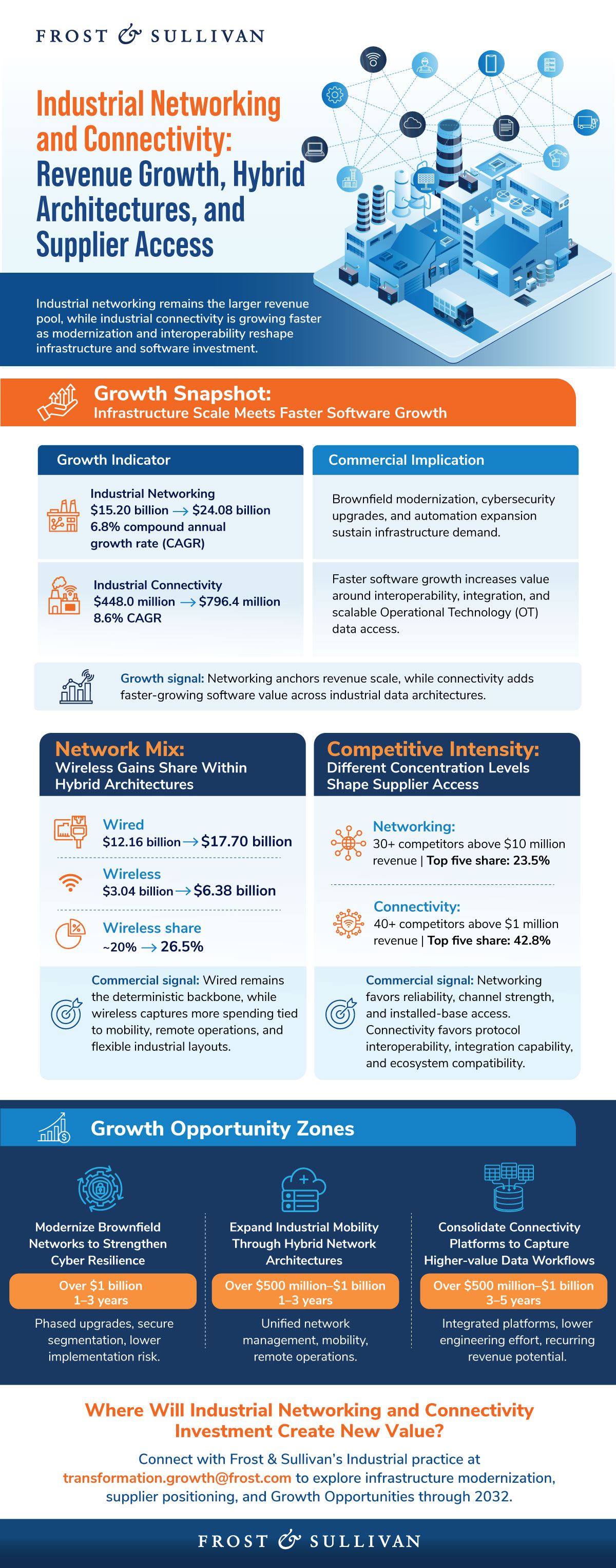
- The market is projected to increase from $15.20 billion in 2025 to $24.08 billion by 2032, representing a 6.8% CAGR.
- Industrial networking modernization is increasingly driven by cybersecurity, lifecycle management, deterministic communications, and operational resilience rather than bandwidth expansion alone.
- Hybrid wired-and-wireless architectures are gaining importance, with wired networks providing deterministic connectivity while wireless technologies support mobility and distributed operations.
- The industrial networking market is expanding as manufacturers modernize legacy infrastructure and connect operational technology (OT) environments with information technology (IT), edge, and cloud platforms.
- The industrial networking solutions market is increasingly incorporating AI-enabled network visibility, MQTT-based architectures, data integration, and software-centric capabilities.
- Process, hybrid, and discrete industries represent major end-user groups, spanning chemicals, oil and gas, power, food and beverage, automotive, machinery, electronics, pharmaceuticals, and other industrial sectors.
- The competitive environment includes more than 30 companies with revenue above $10 million, while the top five competitors account for approximately 23.5% of 2025 revenue.
Report Summary: Industrial Networking and Connectivity Market
The global industrial networking and connectivity market is undergoing structural transformation as manufacturers and industrial operators modernize infrastructure, improve operational resilience, and seek greater value from industrial data. Networking and connectivity technologies are increasingly viewed as essential infrastructure for secure communication between machines, systems, applications, and enterprise environments.
The industrial networking market is moving beyond traditional communication requirements toward architectures supporting cybersecurity, IT/OT convergence, edge computing, interoperability, and AI-enabled operations. At the same time, large installed bases of legacy infrastructure continue to influence purchasing decisions, creating demand for solutions that can integrate modern technologies without disrupting critical industrial operations.
The study evaluates networking and connectivity technologies, market participants, adoption trends, growth drivers, restraints, industry verticals, regional developments, and deployment models. The analysis covers the study period from 2022 to 2032, with 2025 as the base year and 2026–2032 as the forecast period.
The industrial networking solutions market encompasses hardware and software technologies used to enable, manage, secure, and optimize communication between industrial operational systems. The research separately analyzes networking and connectivity because the two technology areas have distinct value chains, business models, vendor ecosystems, and market dynamics.
Analyst Words: Industrial Networking and Connectivity Market
According to the supplied analyst perspective, the industrial networking and connectivity market is transitioning from isolated infrastructure layers toward strategic infrastructure supporting industrial resilience, interoperability, and scalable digital operations. The market is increasingly defined by the ability to integrate legacy assets, support hybrid network architectures, and enable reliable data movement across distributed OT and IT environments.
The analyst perspective also highlights a shift in modernization priorities. Cybersecurity, operational resilience, and lifecycle management are becoming increasingly important alongside conventional network performance requirements. Hybrid wired-and-wireless architectures are emerging as an important approach, with wired infrastructure providing deterministic communication while wireless technologies enable mobility and flexibility.
The industrial networking market is also becoming an important foundation for enterprise-wide digitalization. MQTT-based architectures, IT/OT integration, interoperability, and industrial data visibility are creating additional opportunities for networking and connectivity providers.
Market Overview & Trends: Industrial Networking and Connectivity Market
The industrial networking and connectivity market is increasingly central to industrial digital transformation. Manufacturers are deploying networking infrastructure to connect machines, controllers, sensors, edge systems, enterprise applications, and cloud environments. As industrial operations become more data-driven, reliable communication infrastructure is becoming necessary for machine-to-machine communication, system interoperability, operational visibility, and secure data transport.
One of the most important trends in the industrial networking market is the modernization of legacy infrastructure. Many industrial facilities continue to operate large installed bases of established networking technologies. Instead of replacing these systems entirely, operators increasingly require technologies that can bridge legacy infrastructure with modern applications, edge platforms, and cloud-based environments.
Cybersecurity is another major market trend. Industrial networks are becoming increasingly connected to enterprise and external environments, expanding the potential attack surface. Consequently, network segmentation, secure transport, monitoring, and industrial cybersecurity capabilities are becoming integral to modernization strategies.
The industrial networking solutions market is also moving toward hybrid architectures. Wired networking remains important where deterministic, reliable, and low-latency communication is required. Wireless networking is gaining adoption where mobility, flexible deployment, distributed operations, and difficult-to-wire environments create additional requirements.
IT/OT convergence is further expanding the role of industrial networks. Industrial organizations increasingly need to connect operational systems with enterprise IT infrastructure while maintaining security and operational reliability. This is supporting demand for interoperability technologies, data integration platforms, MQTT-based communication, and edge connectivity.
AI-enabled network visibility is an emerging trend. Industrial operators are increasingly interested in using data and analytics to understand network performance, identify anomalies, improve operational visibility, and support proactive network management. These developments are expanding the addressable scope of the industrial networking and connectivity market beyond physical communication infrastructure.
Scope of Analysis: Industrial Networking and Connectivity Market
The study defines the industrial networking and connectivity market as hardware and software technologies whose primary functions are to enable, manage, secure, and optimize communication between industrial operational systems. The analysis covers global markets and evaluates networking and connectivity as distinct technology markets.
The study period extends from 2022 to 2032, with 2025 as the base year and 2026–2032 as the forecast period. Monetary values are presented in US dollars. Market shares are calculated based on annual recurring revenues according to the supplied research methodology.
Technically, the market operates across the industrial communication stack. Networking infrastructure includes switches, routers, wireless systems, gateways, and network security appliances. Connectivity software layers support industrial communication protocols, data abstraction, and data transport mechanisms, including OPC UA servers and clients, MQTT brokers, and industrial data transport middleware.
The research excludes industrial devices and application-layer systems whose primary functions involve control, analytics, or business operations. Excluded areas include sensors, PLC hardware, SCADA core platforms, MES/ERP systems, digital twins, and industrial analytics applications.
The industrial networking solutions market therefore focuses specifically on the communication backbone that enables machine-to-machine communication, system interoperability, OT/IT data integration, and secure data transport across on-premises, edge, and cloud environments.
Market Segmentation Analysis: Industrial Networking and Connectivity Market
The industrial networking and connectivity market is segmented across networking and connectivity, with additional segmentation by industry vertical, region, technology, offering, and deployment.
For networking, the technology segmentation includes wired and wireless networking. Wired networking encompasses industrial Ethernet switches, industrial routers, and industrial hardware firewalls. Wireless networking includes industrial Wi-Fi access points, private LTE/5G networks, and industrial wireless deployments.
Connectivity is segmented into several technology categories. These include data connectivity and applications, protocol translation and interoperability, data integration, and broker and data transport. The data connectivity category includes OPC DA/OPC UA servers, OPC data clients, data acquisition software, and device communication drivers. Protocol translation and interoperability include protocol conversion and communication interfaces that allow different industrial systems to exchange information.
Data integration technologies include edge connectivity platforms, data integration software, OT data hubs, and industrial data orchestration. Broker and data transport technologies include MQTT brokers, publish/subscribe infrastructure, and data transport middleware.
By offering, the industrial networking solutions market includes hardware, software, and services. Hardware provides the physical networking infrastructure, while software supports communication, interoperability, data movement, management, and security. Services support implementation, integration, maintenance, and other lifecycle requirements.
By deployment, networking and connectivity technologies are segmented into on-premises, edge, and cloud environments. This reflects the transition from traditional centralized infrastructure toward distributed architectures supporting edge processing and cloud connectivity.
By industry vertical, the market is organized into process, hybrid, and discrete industries. Process industries include chemicals, oil and gas, power, and water and wastewater. Hybrid industries include battery manufacturing, consumer packaged goods, food and beverage, metals, pharmaceuticals, and pulp and paper. Discrete industries include aerospace and defense, automotive, machinery, medical devices, semiconductor and electronics, and solar and photovoltaics.
Regionally, the networking analysis covers North America and Latin America (NALA), Europe, Asia-Pacific (APAC), and the Middle East and Africa (MEA). Connectivity follows the same broad regional structure.
Revenue & Spending Forecast: Industrial Networking and Connectivity Market
The supplied forecast shows sustained expansion in the industrial networking and connectivity market. Revenue is estimated at $15.20 billion in 2025 and is projected to reach $24.08 billion by 2032, corresponding to a 6.8% CAGR from 2025 to 2032.
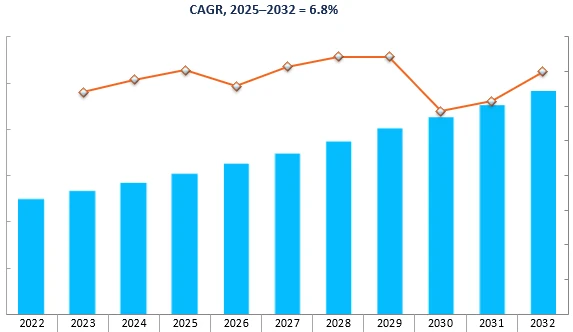
The forecast shows that annual growth varies during the period. The 2025 base-year growth rate is approximately 7.0%, while the forecast CAGR from 2025 to 2032 is 6.8%. Growth reaches approximately 7.4% in 2028 and 2029 before moderating and subsequently reaching approximately 7.0% in 2032.
The industrial networking market is therefore expected to expand steadily rather than through a single technology cycle. Revenue development is supported by infrastructure modernization, cybersecurity requirements, wireless adoption, IT/OT convergence, industrial automation, and increasing requirements for reliable data movement.
Growth Drivers: Industrial Networking and Connectivity Market
The industrial networking and connectivity market is supported by increasing cybersecurity requirements and network segmentation. As industrial systems become more connected, operators require stronger separation between network zones and improved visibility into communication flows. This is creating demand for industrial network infrastructure capable of supporting secure and resilient operations.
Ongoing modernization of legacy industrial infrastructure is another major driver. Many industrial organizations operate networks that were designed for earlier generations of automation. Modern applications require greater interoperability, visibility, scalability, and integration with edge and cloud environments, encouraging investment in updated networking architectures.
The need for deterministic, reliable, and low-latency communications is also supporting the industrial networking market. Manufacturing and other industrial environments often require predictable communication performance for connected equipment and operational systems. This requirement supports continued investment in industrial Ethernet and other specialized networking technologies.
Wireless infrastructure is expanding as industrial organizations seek greater mobility and flexibility. Wireless connectivity can support mobile assets, distributed operations, difficult-to-wire environments, and new industrial use cases. Private LTE and 5G deployments further expand the range of connectivity options.
IT/OT convergence is creating another structural growth opportunity. Industrial organizations increasingly need to integrate operational environments with enterprise IT systems while preserving security and operational continuity. This is increasing demand for networking, interoperability, and data integration capabilities.
Industrial automation and increasing device density are also contributing to market growth. As factories and industrial facilities connect more machines and systems, the requirement for scalable networking infrastructure increases.
Ethernet expansion and last-mile industrial connectivity provide additional opportunities. Meanwhile, AI-enabled network visibility and automation are emerging as longer-term growth areas within the industrial networking solutions market.
Growth Restraints: Industrial Networking and Connectivity Market
The industrial networking and connectivity market faces several adoption restraints, particularly around legacy infrastructure, cost justification, deployment complexity, and organizational change.
Installed-base inertia is a significant challenge. Industrial facilities often operate networks with long replacement cycles because infrastructure is closely connected to critical production systems. Replacing established systems can introduce operational risks and therefore delay adoption of newer industrial networking solutions.
Cost justification and the requirement for high return on investment can also slow investment. Industrial operators may require clear operational benefits before approving infrastructure modernization projects. This can make adoption dependent on measurable improvements in productivity, reliability, cybersecurity, or lifecycle costs.
Operational change risk is another restraint. Network modernization can affect live industrial environments, making organizations cautious about implementing major infrastructure changes during production operations. Deployment therefore requires careful planning, integration, validation, and lifecycle management.
Limited internal expertise can further constrain adoption. Industrial networking increasingly requires knowledge spanning networking, cybersecurity, OT systems, IT architecture, edge computing, and industrial protocols. Organizations without these capabilities may rely on system integrators and external service providers.
Resistance to software-centric models may also affect the industrial networking market. Traditional industrial organizations may be more accustomed to hardware-centric infrastructure, while modern architectures increasingly incorporate software, virtualization, cloud connectivity, and centralized management.
Finally, adoption of next-generation network architectures can remain gradual because organizations must balance modernization with existing infrastructure investments. These factors can extend technology replacement cycles and moderate the pace of market expansion.
Competitor Landscape: Industrial Networking and Connectivity Market
The competitive environment of the industrial networking and connectivity market includes more than 30 companies with revenue greater than $10 million. Competition is influenced by reliability, ruggedization, portfolio breadth, channel strength, regional distribution, IT/OT convergence capabilities, deployment flexibility, installed base, and brand reputation.
The supplied research identifies several leading participants, including Cisco, Belden, Moxa, Phoenix Contact, Siemens, HMS Networks, Digi International, Ericsson, Huawei, Weidmüller, Advantech, and Nokia.
Other notable competitors include Westermo, Palo Alto Networks, Mitsubishi Electric, Hitachi Energy, Juniper Networks (HPE), Lantronix, Teltonika Networks, Turck, WAGO, Pepperl+Fuchs, and Harting.
The market has a relatively distributed competitive structure. The top five competitors accounted for approximately 23.5% of 2025 revenue, while the top three companies represented approximately 20.5% of revenue, according to the supplied growth metrics. This indicates the presence of established market participants alongside a broader ecosystem of specialized industrial networking vendors.
Competition is increasingly extending beyond physical networking hardware. Vendors are differentiating through software, services, cybersecurity, interoperability, IT/OT integration, and lifecycle support. The industrial networking solutions market is consequently evolving toward broader technology portfolios rather than standalone network equipment.
Distribution structures include direct sales, system integrators, distributors, and channel or telecommunications partners. This allows vendors to address different industrial customer segments and geographic markets.
The supplied research also identifies notable M&A activity. Belden acquired Hirschmann and Tofino Security, strengthening its industrial networking and cybersecurity portfolio. HMS Networks acquired Red Lion Controls, while HPE acquired Juniper Networks and Ericsson acquired Cradlepoint. These transactions illustrate continuing consolidation and portfolio expansion across adjacent networking and connectivity technologies.
Competitive differentiation is increasingly tied to the ability to support legacy environments while enabling modern architectures. Vendors that address interoperability, cybersecurity, edge connectivity, wireless infrastructure, and cloud integration can participate across multiple layers of the industrial networking and connectivity market.
Scope of Analysis
Components Included/Excluded
Segmentation by Industry Vertical: Networking
Segmentation by Industry Vertical: Connectivity
Segmentation by Region: Networking
Segmentation by Region: Connectivity
Segmentation by Technology: Networking
Segmentation by Technology: Connectivity
Why is it Increasingly Difficult to Grow?
The Strategic Imperative 8™
The Impact of the Top 3 Strategic Imperatives on Industrial Networking and Connectivity
Global Megatrends: Industrial Networking & Connectivity
IT-OT Convergence Drives Unified Industrial Architectures
Industrial AI Amplifies Demand for Trusted Data and Higher-Performance Infrastructure
OT Cybersecurity Becomes a Core Infrastructure Design Principle
Layered Brownfield Modernization Replaces Rip-and-Replace Strategies
Hybrid Networks (Wired-Wireless) Become the Long-Term Operating Mode
TSN and Deterministic Ethernet Enable Network Convergence
Edge Architectures Move Compute and Connectivity Closer to Operations
Software-Defined Networking and Software-Centric Infrastructure Management Expand Gradually
IIoT Platforms Evolve Toward Open Ecosystems While Expanding into Connectivity Functions
Growth Metrics
Growth Environment
Value Chain
Value Chain Analysis
Value Chain
Value Chain Analysis
Competitive Environment
Key Competitors
Growth Drivers
Growth Driver Analysis
Growth Restraints
Growth Restraint Analysis
Forecast Considerations
Revenue Forecast
Revenue Forecast by Technology
Technological Analysis
Pricing Trends and Forecast Analysis
Revenue Forecast by Region
Regional Analysis
Revenue Forecast by Industry Type
Industry Analysis
Revenue Share by Offering and Deployment
Revenue Share
Revenue Share Analysis
Growth Metrics
Revenue Forecast
Revenue Forecast by End-User Industry
Forecast Analysis
Growth Metrics
Revenue Forecast
Revenue Forecast by End-User Industry
Forecast Analysis
Growth Metrics
Revenue Forecast
Revenue Forecast by End-User Industry
Forecast Analysis
Growth Metrics
Revenue Forecast
Revenue Forecast by Industry Type
Revenue Forecast by End-User Industry
Forecast Analysis
Growth Metrics
Revenue Forecast
Revenue Forecast by Industry Type
Revenue Forecast by End-User Industry
Forecast Analysis
Growth Metrics
Revenue Forecast
Revenue Forecast by Industry Type
Revenue Forecast by End-User Industry
Forecast Analysis
Growth Metrics
Revenue Forecast
Revenue Forecast by Industry Type
Revenue Forecast by End-User Industry
Forecast Analysis
Growth Metrics
Growth Environment
Distribution Channel
Distribution Channel Analysis
Competitive Environment
Key Competitors
Growth Drivers
Growth Driver Analysis
Growth Restraints
Growth Restraint Analysis
Forecast Considerations
Revenue Forecast
Revenue Forecast by Technology
Technological Analysis
Pricing Trends and Forecast Analysis
Revenue Forecast by Region
Regional Analysis
Revenue Forecast by Industry Type
Revenue Share by Offering and Deployment
Revenue Share
Revenue Share Analysis
Growth Metrics
Revenue Forecast
Revenue Forecast by End-User Industry
Forecast Analysis
Growth Metrics
Revenue Forecast
Revenue Forecast by End-User Industry
Forecast Analysis
Growth Metrics
Revenue Forecast
Revenue Forecast by End-User Industry
Frequently Asked Questions: Industrial Networking and Connectivity Market
1. What is the industrial networking and connectivity market?
The industrial networking and connectivity market comprises hardware and software technologies that enable, manage, secure, and optimize communication between industrial operational systems. It includes networking infrastructure, connectivity software, interoperability technologies, data integration, and data transport solutions used across industrial environments.
2. What is driving the industrial networking market?
The industrial networking market is being driven by cybersecurity requirements, legacy infrastructure modernization, demand for deterministic and low-latency communication, wireless adoption, industrial automation, IT/OT convergence, increasing device density, and the need for secure industrial data transport across on-premises, edge, and cloud environments.
3. What technologies are included in the industrial networking solutions market?
The industrial networking solutions market includes wired and wireless networking, industrial Ethernet switches, industrial routers, industrial hardware firewalls, industrial Wi-Fi access points, private LTE and 5G networks, connectivity software, protocol interoperability, data integration, MQTT brokers, and industrial data transport middleware.
4. How large is the industrial networking and connectivity market?
According to the supplied research, the global industrial networking and connectivity market generated approximately $15.20 billion in 2025. The market is projected to reach approximately $24.08 billion by 2032, representing a 6.8% CAGR during 2025–2032.
5. Which industries use industrial networking solutions?
The industrial networking solutions market serves process, hybrid, and discrete industries. Applications span chemicals, oil and gas, power, water and wastewater, battery manufacturing, food and beverage, metals, pharmaceuticals, pulp and paper, automotive, machinery, aerospace and defense, medical devices, semiconductor and electronics, and solar and photovoltaics.
6. Why is IT/OT convergence important to the industrial networking market?
IT/OT convergence is important because industrial organizations increasingly need to connect operational systems with enterprise IT, edge, and cloud environments. The industrial networking market provides the communication infrastructure required for interoperability, secure data transport, industrial visibility, and machine-to-machine communication.
7. What are the key growth opportunities in the industrial networking solutions market?
Key opportunities in the industrial networking solutions market include legacy network modernization, industrial wireless infrastructure, private LTE and 5G, cybersecurity and network segmentation, IT/OT convergence, edge connectivity, industrial data integration, MQTT-based architectures, Ethernet expansion, and AI-enabled network visibility and automation.
8. What are the major restraints affecting the industrial networking market?
Major restraints affecting the industrial networking market include installed-base inertia, long infrastructure replacement cycles, requirements for clear ROI, operational change risks, deployment complexity, limited internal expertise, resistance to software-centric models, and gradual adoption of next-generation network architectures.
9. Who are the major companies in the industrial networking and connectivity market?
The supplied research identifies Cisco, Belden, Moxa, Phoenix Contact, Siemens, HMS Networks, Digi International, Ericsson, Huawei, Weidmüller, Advantech, and Nokia among the leading participants. Other notable companies include Westermo, Palo Alto Networks, Mitsubishi Electric, Hitachi Energy, Juniper Networks, Lantronix, Teltonika Networks, Turck, WAGO, Pepperl+Fuchs, and Harting.
10. What is the forecast period for the industrial networking and connectivity market?
The study covers the global industrial networking and connectivity market from 2022 to 2032. The base year is 2025, while the forecast period is 2026–2032. The analysis evaluates networking and connectivity technologies, industry verticals, regions, deployment models, competitive dynamics, growth drivers, and market restraints.
Speak directly with our analytics experts for tailored recommendations.
Recent related Automation research
06 Nov 2026 | Global | Market Research
Pumps Market in Water Remediation, Global, 2024–2031
This study provides an understanding of opportunities for pumps in water remediation, a fast-growing application area across most regions. Utilities and remediation firms are increasingly using artificial intelligence, IoT sensors, and predictive analytics to monitor water quality in real time and d...
30 Oct 2026 | Global | Technology Research
Growth Opportunities in Intelligent Additive Manufacturing, Industrial Automation, Physical AI, Humanoid Robotics, and Advanced Materials Processing
The Advanced Manufacturing Technology Opportunity Engine provides profiles of innovations related to near-infrared in-situ quality assurance technologies enabling real-time monitoring and defect detection during metal additive manufacturing; AI-driven multi-sensor monitoring systems integrating proc...
30 Oct 2026 | Global | Megatrends
Advancements in Micro-Sensor Technologies for High-Performance Sensing Systems
Micro-sensors are no longer just components that capture data—they are becoming the intelligence behind connected products and autonomous systems. As industries demand faster decisions, greater reliability, and continuous monitoring, sensing platforms are evolving by combining embedded AI, advanced ...
29 Oct 2026 | Global | Market Research
AI-Driven Quality Control and Computer Vision in Smart Manufacturing, Global, 2026
AI maturity, implementation, and AI-enabled or AI-augmented operations are increasing year over year, moving from pilot to production. Because AI delivers the biggest business outcomes, it is a top outcome driver. The impact of AI can be seen in quality control and computer vision in smart manufactu...
07 Oct 2026 | South Asia, Middle East & North Africa | Market Research
Top 10 Growth Opportunities in Resource-Efficient Manufacturing to Optimize Industrial Water and Energy Across the Middle East, 2026
The Middle East is entering a new phase of industrial development in which water security, energy efficiency, and sustainability have become critical determinants of manufacturing competitiveness. Increasing industrial water demand, energy-intensive production processes, climate-related resource con...
Purchase includes:
- Report download
- Growth Dialog™ with our experts
Growth Dialog™
A tailored session with you where we identify the:- Strategic Imperatives
- Growth Opportunities
- Best Practices
- Companies to Action
Impacting your company's future growth potential.