 USD
USD GBP
GBP  CNY
CNY  EUR
EUR  INR
INR  JPY
JPY  MYR
MYR  ZAR
ZAR  KRW
KRW  THB
THB 


Industrial Robotics Growth Opportunities
Improved Robotic Dexterity Due to Advances in Materials Expand Applications - Industrial Robots, Manufacturing Robots, Robotics Industry Growth
06-Feb-2023
Global
Market Research
K6EB-01-00-00-00
IA01678-GL-MT_27354
Key Takeaways: Industrial Robotics Market
- The global Industrial Robotics Market generated approximately US$23.03 billion in revenue in 2021 and is projected to reach US$39.34 billion by 2026, expanding at a healthy compound annual growth rate (CAGR) of 11.3%.
- Rising investments in Industry 4.0, smart factories, AI-powered automation, and Industrial Internet of Things (IIoT) technologies continue to accelerate industrial robot adoption across manufacturing sectors.
- Articulated robots remain the dominant segment, while collaborative robots (cobots) are emerging as one of the fastest-growing categories due to their flexibility and ease of deployment.
- Automotive, electronics, metals, food & beverages, pharmaceuticals, and logistics industries are driving global demand for advanced robotic automation.
- Asia-Pacific, led by China, Japan, and South Korea, continues to dominate the Industrial Robotics Market, supported by expanding manufacturing capacity and government-backed automation initiatives.
Report Summary: Industrial Robotics Market
The global Industrial Robotics Market is experiencing robust expansion as manufacturers increasingly adopt intelligent automation to improve productivity, address labor shortages, and enhance operational resilience. The market generated approximately US$23.03 billion in revenue in 2021 and is forecast to reach nearly US$39.34 billion by 2026, representing a strong 11.3% CAGR during the forecast period. Growing investments in smart manufacturing, digital transformation, and AI-powered robotics continue to reshape industrial production worldwide.
The COVID-19 pandemic accelerated automation adoption by exposing vulnerabilities in manual production processes and global supply chains. As a result, manufacturers across automotive, electronics, healthcare, logistics, metals, food and beverages, and pharmaceutical industries are investing heavily in industrial robots capable of performing repetitive, hazardous, and precision-intensive tasks with greater consistency and efficiency.
Technological advancements in artificial intelligence (AI), machine learning (ML), computer vision, Industrial Internet of Things (IIoT), cloud connectivity, and collaborative robotics are expanding the capabilities of modern industrial robots. Beyond traditional assembly-line automation, robots are increasingly supporting quality inspection, warehouse automation, material handling, welding, packaging, machine tending, and predictive maintenance. As industries continue pursuing smart factory initiatives and sustainable manufacturing practices, the Industrial Robotics Market is expected to maintain strong long-term growth driven by innovation, operational efficiency, and global industrial modernization.
Market Overview & Trends: Industrial Robotics Market
The global Industrial Robotics Market is undergoing a significant transformation as manufacturers accelerate investments in automation technologies to improve productivity, operational efficiency, and supply chain resilience. Increasing labor shortages, rising production costs, and growing demand for consistent product quality are encouraging organizations to deploy advanced industrial robots across manufacturing operations. These trends are positioning robotics as a critical component of Industry 4.0 and next-generation smart factories.
One of the most influential trends shaping the Industrial Robotics Market is the integration of artificial intelligence, machine learning, and computer vision into robotic systems. Modern industrial robots are evolving beyond repetitive programmed movements to perform adaptive decision-making, predictive maintenance, autonomous navigation, and real-time quality inspection. AI-powered robots can continuously learn from operational data, improving manufacturing precision while reducing downtime and operational costs.
Collaborative robots (cobots) are also transforming industrial automation by enabling safe human-robot collaboration. Unlike conventional industrial robots that operate within isolated work cells, cobots can work alongside employees to support assembly, packaging, inspection, and material handling tasks. Their lower implementation costs, simplified programming, and flexible deployment make them particularly attractive for small and medium-sized manufacturers seeking gradual automation.
Another major trend is the convergence of robotics with the Industrial Internet of Things (IIoT), cloud computing, and digital twins. Connected robotic systems enable manufacturers to monitor equipment performance remotely, optimize production scheduling, collect operational analytics, and improve predictive maintenance strategies. Simultaneously, reshoring initiatives and supply chain diversification are increasing investments in highly automated production facilities capable of operating with minimal human intervention.
Asia-Pacific continues to lead global robot installations, driven by China's large-scale manufacturing expansion, Japan's advanced robotics ecosystem, and South Korea's automation leadership. Meanwhile, North America and Europe continue investing in advanced robotic technologies to enhance manufacturing competitiveness, workforce safety, and sustainable production. As AI, automation, and smart manufacturing continue to evolve, the Industrial Robotics Market is expected to remain one of the fastest-growing segments within the global industrial technology landscape.
Scope of Analysis: Industrial Robotics Market
This study provides a comprehensive evaluation of the global Industrial Robotics Market, analyzing the technological innovations, deployment trends, and investment opportunities shaping industrial automation across major manufacturing sectors. The report examines the increasing adoption of industrial robots as manufacturers accelerate digital transformation initiatives to improve production efficiency, workforce safety, operational flexibility, and long-term competitiveness. The research also assesses how artificial intelligence (AI), machine learning (ML), Industrial Internet of Things (IIoT), cloud computing, and advanced sensing technologies are expanding the capabilities of modern industrial robotic systems.
The scope covers six major industrial robot categories, including Linear (Cartesian and Gantry), SCARA, Articulated, Parallel/Delta, Cylindrical, and Collaborative Robots (Cobots). These robotic systems are evaluated across multiple end-user industries, including automotive, electronics, metals and machinery, food and beverages, pharmaceuticals, plastics and rubber, chemicals, construction, oil and gas, pulp and paper, and precision engineering. In addition to traditional industrial automation, the report highlights emerging applications such as warehouse automation, logistics, quality inspection, machine tending, packaging, and autonomous manufacturing systems.
Geographically, the research covers North America, Europe, Asia-Pacific (APAC), Latin America, and the Middle East & Africa (MEA). The study period spans 2018–2026, with 2021 serving as the base year and forecasts extending from 2022 to 2026. Revenue estimates are presented in US dollars and are supported by extensive primary interviews, secondary research, industry databases, company reports, and market validation. The report also evaluates competitive dynamics, regional investment patterns, technological advancements, and emerging automation opportunities that are expected to influence the future growth trajectory of the global Industrial Robotics Market.
Market Segmentation Analysis: Industrial Robotics Market
The global Industrial Robotics Market is segmented by robot type, end-user industry, application, and geographic region, enabling manufacturers and technology providers to identify high-growth opportunities across the industrial automation ecosystem. Increasing demand for flexible manufacturing, precision engineering, and intelligent production systems continues to expand adoption across nearly every major industrial sector.
By robot type, the Industrial Robotics Market comprises Linear (Cartesian and Gantry), SCARA, Articulated, Parallel/Delta, Cylindrical, and Collaborative Robots (Cobots). Articulated robots account for the largest market share due to their versatility in welding, painting, assembly, machine tending, and material handling applications. SCARA robots are widely deployed in electronics manufacturing and high-speed assembly operations because of their exceptional accuracy and speed. Linear and Cartesian robots remain popular for pick-and-place, packaging, and CNC automation tasks, while Parallel/Delta robots dominate high-speed sorting and packaging applications in food, pharmaceutical, and consumer goods industries. Collaborative robots (Cobots) represent the fastest-growing segment as manufacturers seek flexible automation solutions that safely operate alongside human workers without extensive safety barriers.
From an end-user perspective, the automotive industry remains the largest adopter of industrial robots, utilizing automation for welding, painting, assembly, inspection, and material handling. Electronics manufacturers continue investing heavily in robotic precision assembly and semiconductor production, while food and beverage companies increasingly automate packaging, palletizing, and quality inspection processes. Pharmaceutical manufacturers leverage robotics for sterile production, laboratory automation, and packaging, whereas metals, machinery, chemicals, plastics, logistics, and construction industries continue expanding robotic deployments to improve operational efficiency and reduce labor dependency.
Regionally, Asia-Pacific dominates the Industrial Robotics Market, driven by China, Japan, and South Korea's advanced manufacturing ecosystems and government-supported automation initiatives. North America continues to experience strong investment in smart factories, AI-enabled robotics, and reshoring strategies, while Europe emphasizes sustainable manufacturing, collaborative robotics, and Industry 4.0 adoption. Latin America and the Middle East & Africa are gradually increasing industrial robot adoption as manufacturing modernization, foreign direct investment, and digital industrialization initiatives gain momentum. Collectively, these segments illustrate the broad and expanding role of industrial robotics in transforming global manufacturing over the coming decade.
Revenue & Spending Forecast: Industrial Robotics Market
The global Industrial Robotics Market is poised for sustained expansion as manufacturers continue investing in intelligent automation to improve productivity, operational efficiency, and supply chain resilience. The market generated approximately US$23.03 billion in revenue in 2021 and is projected to reach US$39.34 billion by 2026, reflecting a healthy compound annual growth rate (CAGR) of 11.3% during the forecast period. Strong post-pandemic recovery in manufacturing, coupled with accelerating digital transformation initiatives, continues to stimulate capital expenditure on advanced robotic systems across multiple industries.
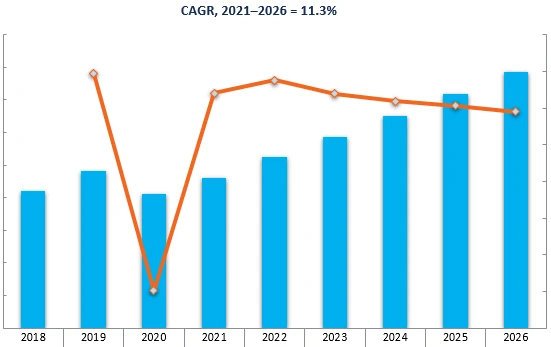
Industrial robot deployments are increasing as organizations automate repetitive, hazardous, and precision-intensive tasks to overcome labor shortages and rising operating costs. Revenue growth is expected to be supported by rising adoption of articulated robots, SCARA robots, collaborative robots (cobots), delta robots, and AI-enabled robotic platforms capable of performing increasingly complex manufacturing operations. Beyond automotive production, industries including electronics, pharmaceuticals, food and beverages, logistics, metals, chemicals, and consumer goods are significantly increasing investments in robotics-driven automation.
Spending within the Industrial Robotics Market is also expanding toward software-driven capabilities, including AI, machine vision, Industrial Internet of Things (IIoT), cloud-based monitoring, predictive maintenance, and digital twin technologies. Asia-Pacific remains the largest revenue-generating region due to rapid industrialization and large-scale factory automation, while North America and Europe continue investing in smart factories, reshoring initiatives, and sustainable manufacturing. As enterprises pursue greater manufacturing agility and operational resilience, long-term investment in industrial robotics is expected to remain strong throughout the forecast period.
Growth Drivers: Industrial Robotics Market
The Industrial Robotics Market is being propelled by increasing investments in factory automation, Industry 4.0, and intelligent manufacturing technologies. Following the COVID-19 pandemic, manufacturers accelerated automation strategies to minimize operational disruptions, improve workforce safety, and address persistent labor shortages. As production facilities become increasingly digitized, industrial robots have emerged as essential assets for improving efficiency, precision, and manufacturing flexibility.
Artificial intelligence (AI), machine learning (ML), deep learning, computer vision, and Industrial Internet of Things (IIoT) technologies are significantly enhancing robotic capabilities. Modern industrial robots are increasingly capable of adaptive decision-making, autonomous inspection, predictive maintenance, and real-time production optimization. These intelligent features improve productivity while reducing downtime, operational costs, and product defects.
Collaborative robots (cobots) represent another major growth catalyst within the Industrial Robotics Market. Their ability to safely operate alongside human workers without extensive safety fencing enables flexible automation across small and medium-sized enterprises (SMEs) as well as large manufacturing facilities. Simplified programming, shorter deployment cycles, and lower implementation costs continue driving rapid cobot adoption across automotive, electronics, logistics, pharmaceuticals, and food processing industries.
Digital transformation initiatives, reshoring strategies, and smart factory investments are further accelerating industrial robot deployment worldwide. Manufacturers are increasingly integrating robotics with cloud computing, digital twins, advanced analytics, and connected manufacturing platforms to create highly automated production environments. Additionally, sustainability initiatives encourage robotic automation by reducing material waste, improving energy efficiency, and optimizing resource utilization. These technological advancements position the Industrial Robotics Market for continued long-term expansion across diverse industrial sectors.
Growth Restraints: Industrial Robotics Market
Despite its favorable long-term outlook, the Industrial Robotics Market faces several challenges that may limit adoption across certain industries and regions. One of the most significant barriers remains the high initial capital investment required for robotic hardware, software integration, programming, installation, and workforce training. Small and medium-sized manufacturers often delay automation projects because of budget limitations and uncertain return on investment.
Another major restraint is the shortage of skilled professionals capable of designing, programming, operating, and maintaining sophisticated robotic systems. As industrial robots become increasingly intelligent through AI, machine learning, and advanced automation technologies, demand for specialized engineering talent continues to outpace supply. This skills gap can slow deployment timelines and increase implementation costs.
Interoperability and integration challenges also affect the Industrial Robotics Market. Many manufacturers operate legacy production systems that require significant upgrades before advanced robotics can be fully integrated. Achieving seamless communication between robots, manufacturing execution systems (MES), enterprise resource planning (ERP) platforms, and Industrial Internet of Things (IIoT) networks often requires substantial customization and technical expertise.
Supply chain disruptions, semiconductor shortages, and cybersecurity concerns present additional obstacles to market growth. Modern industrial robots rely heavily on sensors, processors, connectivity, and cloud-enabled software, making them vulnerable to component shortages and cyber threats. Furthermore, regulatory compliance, functional safety requirements, and evolving industrial standards can increase deployment complexity. Overcoming these challenges through workforce development, standardized automation platforms, and improved system interoperability will be essential to sustaining the long-term growth of the global Industrial Robotics Market.
Competitive Landscape: Industrial Robotics Market
The global Industrial Robotics Market is characterized by intense competition among established robotics manufacturers, automation technology providers, and emerging innovators that continuously invest in artificial intelligence (AI), machine vision, collaborative robotics, and smart factory technologies. As industrial automation becomes a strategic priority across manufacturing industries, competition has evolved beyond hardware performance to include software intelligence, digital connectivity, predictive analytics, and end-to-end automation solutions. Vendors are increasingly differentiating themselves through integrated robotics ecosystems that combine robots, sensors, cloud platforms, Industrial Internet of Things (IIoT) capabilities, and advanced automation software.
The Industrial Robotics Market remains moderately consolidated, with the top five vendors accounting for approximately 40.2% of global market revenue. Leading companies such as ABB, FANUC, Yaskawa Electric Corporation, KUKA, and Kawasaki Robotics maintain strong market positions through extensive global distribution networks, comprehensive product portfolios, continuous research and development investments, and strategic partnerships. Other prominent participants—including Mitsubishi Electric, Epson, Nachi-Fujikoshi, Omron, Comau, Universal Robots, Denso Robotics, Dürr, and Rockwell Automation—continue expanding their automation capabilities across automotive, electronics, logistics, food processing, pharmaceuticals, and warehouse automation applications.
Innovation remains the primary competitive differentiator within the Industrial Robotics Market. Manufacturers are introducing AI-powered robotic systems capable of autonomous decision-making, adaptive learning, predictive maintenance, intelligent machine vision, and human-robot collaboration. Collaborative robots (cobots), mobile robotic platforms, digital twin technologies, cloud-connected robotics, and edge computing solutions are reshaping manufacturing environments by enabling flexible production, shorter deployment times, and improved operational efficiency. Vendors are also increasingly offering robotics-as-a-service (RaaS), allowing manufacturers to reduce upfront capital expenditure while accelerating automation adoption.
Strategic mergers, acquisitions, and technology partnerships continue reshaping the competitive landscape. Companies are strengthening their portfolios through acquisitions in mobile robotics, AI software, industrial vision systems, and automation platforms while collaborating with software providers, industrial equipment manufacturers, and system integrators to deliver complete smart manufacturing solutions. Asia-Pacific remains the largest manufacturing hub and the primary battleground for competitive expansion, while North America and Europe continue investing in reshoring initiatives, Industry 4.0 technologies, and advanced manufacturing automation. Looking ahead, companies capable of delivering intelligent, connected, energy-efficient, and highly flexible robotic solutions will be best positioned to capitalize on the long-term growth opportunities within the global Industrial Robotics Market.
Why is it Increasingly Difficult to Grow?
The Strategic Imperative 8™
The Impact of the Top 3 Strategic Imperatives on the Industrial Robotics Industry
Growth Opportunities Fuel the Growth Pipeline Engine™
Scope of Analysis
Segmentation
Market Definitions
Competitors
Growth Metrics
Distribution Channels
Growth Drivers
Growth Restraints
Forecast Assumptions
Revenue Forecast
Revenue Forecast Analysis
Revenue Forecast by Product
Revenue Forecast Analysis by Product
Revenue Forecast by Region
Revenue Forecast Analysis by Region
Revenue Forecast by Industry Vertical
Revenue Forecast Analysis by Industry Vertical
Competitive Environment
Revenue Share
Revenue Share Analysis
Installations and Units Analysis—Asia
Installations and Units Analysis—Europe
Installations and Units Analysis—The Americas
Annual Installations of Top 10 Countries
Software and Digital Trends in Robotics
Sustainability and Carbon Capture with Industrial Robots
Growth Metrics
Revenue Forecast
Revenue Forecast by Industry Vertical
Forecast Analysis
Growth Metrics
Revenue Forecast
Revenue Forecast by Industry Vertical
Forecast Analysis
Growth Metrics
Revenue Forecast
Revenue Forecast by Industry Vertical
Forecast Analysis
Growth Metrics
Revenue Forecast
Revenue Forecast by Industry Vertical
Forecast Analysis
Growth Metrics
Revenue Forecast
Revenue Forecast by Industry Vertical
Forecast Analysis
Companies to Watch
Growth Opportunity 1: AI-based Robotics to Deliver Autonomous Robots for Industrial Applications
Growth Opportunity 2: The Emergence of RaaS to Boost Deployment Across Industries
Growth Opportunity 3: Advancements in Gripper Technology to Promote Workers' Safety
Growth Opportunity 4: Collaborative Robots Promote Efficiency and Innovation
Growth Opportunity 5: Industrial Robotics' Imperative to Drive Sustainability Efforts
Your Next Steps
Why Frost, Why Now?
List of Exhibits
Legal Disclaimer
 List of Figures
- Industrial Robotics: Growth Metrics, Global, 2021
- Industrial Robotics: Distribution Channel Analysis, Global, 2021
- Industrial Robotics: Growth Drivers, Global, 2022–2026
- Industrial Robotics: Growth Restraints, Global, 2022–2026
- Industrial Robotics: Revenue Forecast, Global, 2018–2026
- Industrial Robotics: Revenue Forecast by Product, Global, 2018–2026
- Industrial Robotics: Revenue Forecast by Region, 2018–2026
- Industrial Robotics: Revenue Forecast by Industry Vertical, Global, 2018–2026
- Industrial Robotics: Competitive Environment, Global, 2021
- Industrial Robotics: Revenue Share of Top Participants, Global, 2021
- Industrial Robots: Top 10 Countries by Annual Installations, Global, 2021
- Industrial Robots: Growth Metrics, North America, 2021
- Industrial Robots: Revenue Forecast, North America, 2018–2026
- Industrial Robots: Revenue Forecast by Industry Vertical, North America, 2018–2026
- Industrial Robots: Growth Metrics, Latin America, 2021
- Industrial Robots: Revenue Forecast, Latin America, 2018–2026
- Industrial Robots: Revenue Forecast by Industry Vertical, Latin America, 2018–2026
- Industrial Robots: Growth Metrics, Europe, 2021
- Industrial Robots: Revenue Forecast, Europe, 2018–2026
- Industrial Robots: Revenue Forecast by Industry Vertical, Europe, 2018–2026
- Industrial Robots: Growth Metrics, Middle East & Africa, 2021
- Industrial Robots: Revenue Forecast, Middle East & Africa, 2018–2026
- Industrial Robots: Revenue Forecast by Industry Vertical, Middle East & Africa, 2018–2026
- Industrial Robots: Growth Metrics, APAC, 2021
- Industrial Robots: Revenue Forecast, APAC, 2018–2026
- Industrial Robots: Revenue Forecast by Industry Vertical, APAC, 2018–2026
Frequently Asked Questions about the Industrial Robotics Market
1. What is the Industrial Robotics Market?
The Industrial Robotics Market comprises programmable robotic systems designed to automate manufacturing processes such as welding, assembly, packaging, material handling, painting, inspection, and machine tending across industrial facilities.
2. What is driving the growth of the Industrial Robotics Market?
Market growth is driven by Industry 4.0 adoption, labor shortages, AI-powered automation, smart factories, IIoT integration, rising manufacturing productivity requirements, and increasing investments in digital transformation.
3. What is the projected size of the Industrial Robotics Market?
The global Industrial Robotics Market is projected to grow from approximately US$23.03 billion in 2021 to US$39.34 billion by 2026, registering a CAGR of 11.3% during the forecast period.
4. Which industries use industrial robots the most?
Major end users include automotive, electronics, metals and machinery, food and beverages, pharmaceuticals, plastics and rubber, logistics, chemicals, construction, and precision engineering industries.
5. What are the major types of industrial robots?
The primary robot categories include articulated robots, SCARA robots, linear (Cartesian and gantry) robots, parallel/delta robots, cylindrical robots, and collaborative robots (cobots).
6. Which region leads the Industrial Robotics Market?
Asia-Pacific leads the Industrial Robotics Market, driven by large-scale manufacturing investments in China, Japan, South Korea, and other rapidly industrializing economies.
7. Who are the leading companies in the Industrial Robotics Market?
Key companies include ABB, FANUC, Yaskawa Electric Corporation, KUKA, Kawasaki Robotics, Mitsubishi Electric, Epson, Omron, Nachi-Fujikoshi, Comau, Universal Robots, and Denso Robotics.
8. How is artificial intelligence influencing industrial robotics?
Artificial intelligence enables robots to perform adaptive decision-making, predictive maintenance, computer vision, autonomous navigation, quality inspection, and real-time production optimization.
9. What challenges are limiting Industrial Robotics Market growth?
Key restraints include high implementation costs, shortages of skilled robotics professionals, integration complexity, cybersecurity concerns, semiconductor supply disruptions, and interoperability challenges with legacy manufacturing systems.
10. What is the future outlook for the Industrial Robotics Market?
The Industrial Robotics Market is expected to experience sustained long-term growth as manufacturers increase investments in AI, collaborative robots, smart factories, cloud-connected automation, digital twins, and Industry 4.0 technologies.
Frequently Asked Questions (FAQs) – Industrial Robotics Market
1. What is the Industrial Robotics Market?
The Industrial Robotics Market comprises programmable robotic systems designed to automate manufacturing processes such as welding, assembly, packaging, material handling, painting, inspection, and machine tending across industrial facilities.
2. What is driving the growth of the Industrial Robotics Market?
Market growth is driven by Industry 4.0 adoption, labor shortages, AI-powered automation, smart factories, IIoT integration, rising manufacturing productivity requirements, and increasing investments in digital transformation.
3. What is the projected size of the Industrial Robotics Market?
The global Industrial Robotics Market is projected to grow from approximately US$23.03 billion in 2021 to US$39.34 billion by 2026, registering a CAGR of 11.3% during the forecast period.
4. Which industries use industrial robots the most?
Major end users include automotive, electronics, metals and machinery, food and beverages, pharmaceuticals, plastics and rubber, logistics, chemicals, construction, and precision engineering industries.
5. What are the major types of industrial robots?
The primary robot categories include articulated robots, SCARA robots, linear (Cartesian and gantry) robots, parallel (delta) robots, cylindrical robots, and collaborative robots (cobots).
6. Which region leads the Industrial Robotics Market?
Asia-Pacific leads the Industrial Robotics Market, driven by large-scale manufacturing investments in China, Japan, South Korea, and other rapidly industrializing economies.
7. Who are the leading companies in the Industrial Robotics Market?
Key companies include ABB, FANUC, Yaskawa Electric Corporation, KUKA, Kawasaki Robotics, Mitsubishi Electric, Epson, Omron, Nachi-Fujikoshi, Comau, Universal Robots, and Denso Robotics.
8. How is artificial intelligence influencing industrial robotics?
Artificial intelligence enables robots to perform adaptive decision-making, predictive maintenance, computer vision, autonomous navigation, quality inspection, and real-time production optimization.
9. What challenges are limiting Industrial Robotics Market growth?
Key restraints include high implementation costs, shortages of skilled robotics professionals, integration complexity, cybersecurity concerns, semiconductor supply disruptions, and interoperability challenges with legacy manufacturing systems.
10. What is the future outlook for the Industrial Robotics Market?
The Industrial Robotics Market is expected to experience sustained long-term growth as manufacturers increase investments in AI, collaborative robots, smart factories, cloud-connected automation, digital twins, and Industry 4.0 technologies.
Speak directly with our analytics experts for tailored recommendations.
Recent related Automation research
07 Oct 2026 | South Asia, Middle East & North Africa | Market Research
Top 10 Growth Opportunities in Resource-Efficient Manufacturing to Optimize Industrial Water and Energy Across the Middle East, 2026
The Middle East is entering a new phase of industrial development in which water security, energy efficiency, and sustainability have become critical determinants of manufacturing competitiveness. Increasing industrial water demand, energy-intensive production processes, climate-related resource con...
06 Oct 2026 | Global | Market Research
Industrial Control Systems, Global, 2022–2032
The study examines the global industrial control systems market, structured around three core technology segments: distributed control systems (DCS), programmable logic controllers (PLCs), and SCADA. Using 2025 as the base year, the research provides market sizing and a seven-year forecast by region...
05 Oct 2026 | Global | Frost Radar
Frost Radar™: Cognitive Cobot Technology Ecosystem, 2026
Collaborative robotics is entering a new phase as advances in artificial intelligence, multimodal perception, force and tactile sensing, adaptive control, and robot learning enable cobots to move beyond fixed, pre-programmed tasks toward more context-aware and responsive automation. This Frost Radar...
02 Oct 2026 | Global | Technology Research
Growth Opportunities in Contact-Rich Robot Skill AI, High-Speed Photopolymer 3D Printing, Industrial Interoperability, Vision AI, Pallet Shuttle Automation, In-Situ AM Inspection, and Composite 3D Printing
The Advanced Manufacturing Technology Opportunity Engine provides profiles of innovations related to simulation-trained contact skills enabling industrial robots to perform complex physical interactions and manipulation tasks; hybrid laser-DLP 3D printing systems combining additive technologies for ...
01 Oct 2026 | Global | Frost Radar
Frost Radar™: SCADA for Industrial Control Environments, 2026
This Frost Radar™ benchmarks supervisory control and data acquisition (SCADA) platforms for industrial control environments, evaluating leading vendors on innovation and growth. The analysis examines how platforms are evolving to support brownfield modernization, secure remote access, multisite stan...
Purchase includes:
- Report download
- Growth Dialog™ with our experts
Growth Dialog™
A tailored session with you where we identify the:- Strategic Imperatives
- Growth Opportunities
- Best Practices
- Companies to Action
Impacting your company's future growth potential.
Where possible, we discuss country-level data on new installations and growth. The study also includes a section on sustainability and how robots contribute to a reduced carbon footprint. Notably, Frost & Sullivan offers organizations looking to improve their product portfolio and invest in robotics for manufacturing operations insights into trends and growth opportunities over the forecast period.
| New Subtitle | Improved Robotic Dexterity Due to Advances in Materials Expand Applications - Industrial Robots, Manufacturing Robots, Robotics Industry Growth |
|---|---|
| Deliverable Type | Market Research |
| Industries | Industrial Automation |
| No Index | No |
| Is Prebook | No |
| Keyword 1 | industrial robotics market |
| Keyword 2 | robotics industry growth |
| Keyword 3 | robots used in manufacturing |
| List of Charts and Figures | Industrial Robotics: Growth Metrics, Global, 2021~ Industrial Robotics: Distribution Channel Analysis, Global, 2021~ Industrial Robotics: Growth Drivers, Global, 2022–2026~ Industrial Robotics: Growth Restraints, Global, 2022–2026~ Industrial Robotics: Revenue Forecast, Global, 2018–2026~ Industrial Robotics: Revenue Forecast by Product, Global, 2018–2026~ Industrial Robotics: Revenue Forecast by Region, 2018–2026~ Industrial Robotics: Revenue Forecast by Industry Vertical, Global, 2018–2026~ Industrial Robotics: Competitive Environment, Global, 2021~ Industrial Robotics: Revenue Share of Top Participants, Global, 2021~ Industrial Robots: Top 10 Countries by Annual Installations, Global, 2021~ Industrial Robots: Growth Metrics, North America, 2021~ Industrial Robots: Revenue Forecast, North America, 2018–2026~ Industrial Robots: Revenue Forecast by Industry Vertical, North America, 2018–2026~ Industrial Robots: Growth Metrics, Latin America, 2021~ Industrial Robots: Revenue Forecast, Latin America, 2018–2026~ Industrial Robots: Revenue Forecast by Industry Vertical, Latin America, 2018–2026~ Industrial Robots: Growth Metrics, Europe, 2021~ Industrial Robots: Revenue Forecast, Europe, 2018–2026~ Industrial Robots: Revenue Forecast by Industry Vertical, Europe, 2018–2026~ Industrial Robots: Growth Metrics, Middle East & Africa, 2021~ Industrial Robots: Revenue Forecast, Middle East & Africa, 2018–2026~ Industrial Robots: Revenue Forecast by Industry Vertical, Middle East & Africa, 2018–2026~ Industrial Robots: Growth Metrics, APAC, 2021~ Industrial Robots: Revenue Forecast, APAC, 2018–2026~ Industrial Robots: Revenue Forecast by Industry Vertical, APAC, 2018–2026~ |
| Podcast | No |
| Predecessor | None |
| WIP Number | K6EB-01-00-00-00 |
Industrial Robotics Growth Opportunities
$4,950.00
Special Price $3,712.50 save 25 %