 USD
USD GBP
GBP  CNY
CNY  EUR
EUR  INR
INR  JPY
JPY  MYR
MYR  ZAR
ZAR  KRW
KRW  THB
THB 


Rise of 5G, IoT, and B2B Use Cases Boost Revenue Generation Potential
29-Aug-2024
Global
Market Research
KA7D-01-00-00-00
TE_2024_985
The mobile communications industry in LATAM is crucial for economic growth, social connectivity, and digital inclusion. As smartphone penetration increases and network coverage expands, 5G connectivity demands strive for market innovation, supporting businesses, and improving general access to an essential service. The analysis is segmented by prepaid and postpaid services, with a clear dominance of the prepaid segment in subscriptions and devices, including mobile phones and IoT devices, and business-to-business (B2B) and business-to-consumer (B2C) markets, with a narrow relation between B2B and IoT devices.
With this segmentation, the industry analysis showcases the dynamics and challenges within each geographical segment, focusing on Argentina, Brazil, Colombia, Chile, and Mexico. Although each country has unique characteristics, influenced by economic and political conditions, the analysis intends to provide a relevant understanding for stakeholders aiming to discover growth opportunities in the LATAM mobile communications market. Frost & Sullivan outlines insights about the competitive environment, market trends, and growth drivers and restraints for the period of 2024 to 2028.
Author: Paula Fenoglio
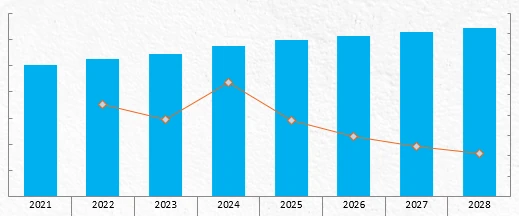
Revenue Forecast
Revenue Estimate of Base Year: $50,337.3 Million. CAGR for the Study Period: 3.4%
The Impact of the Top 3 Strategic Imperatives on the Latin American Mobile Communications Industry
Geopolitical Chaos
Why
-
Several external factors influence Latin America's mobile communications industry. Political instability in recent years, primarily in countries such as Argentina and Brazil (i.e., the shift from left to far-right government), has impacted the regulatory and economic landscape of the mobile communications industry, trade policies, technology availability, and data privacy issues.
- Instability in legal and regulatory requirements has hindered mobile communications operators’ ability to develop long-term investment projects.
Frost Perspective
- The regulatory environment in Latin America is expected to remain challenging until 2028, impeding the expansion of connectivity in the region. For instance, Colombia has experienced delays in legislation regarding 5G spectrum bidding, and Argentina's operators have been through a long process of negotiations over lower taxes for 5G spectrum. Therefore, service providers must deepen engagement with regulatory authorities by exchanging market expertise.
- At the same time, it will be critical for policymakers to understand that operators must be flexible enough to adjust to the fast-changing economic environment.
Competitive Intensity
Why
- With a mobile penetration rate of 116%, Latin America’s mobile communications industry is highly saturated and mature. Only 3 to 4 established players account for most of the market share.
- This makes it difficult for smaller players to compete, leading to fewer but stronger providers. The region’s markets are consolidated with major service providers leading the growth trajectory because of their substantial investment capacity and extensive client bases.
Frost Perspective
- The mobile communications industry is a significant contributor to the GDP of LATAM countries, accounting for 8% of Latin America’s GDP. However, market growth will likely remain subdued during the forecast period unless differences emerge in identifying new market opportunities, where consumption patterns, prices, and services will be adjusted.
- As 5G rolls out, service diversification will be critical for both operators and consumers, since the market segments for the B2C segment and enterprise segment will evolve.
Disruptive Technologies
Why
- Technology is a crucial industry influencer, enabling faster, more reliable connectivity and promoting competitiveness.
- Disruptive technologies, including 5G, artificial intelligence (AI), and the Internet of Things (IoT), will foster the development of new ways of delivering mobile services, prompting vendors to invest in advanced network infrastructure, cloud-native network IT systems, and expand service coverage.
Frost Perspective
- Until 2028, technological progress in the mobile communications industry will be slow but steady. 5G, for instance, enables fast connectivity and supports advanced applications and high data consumption activities, including streaming and online gaming. On the other hand, it creates significant new opportunities in industries such as healthcare, agriculture, and manufacturing.
- While specific technological challenges will drive innovation, these issues must be addressed to facilitate market innovation, ensure fair competition, and protect consumer rights.
Industry Segmentation
-
By Country: Mobile communications in Latin America, specifically Argentina, Brazil, Chile, Colombia, and Mexico.
- By Payment Plan:
- Prepaid Plan: Customers of prepaid plans pay in advance of using the services, resulting in upfront payments and recharges. Users have the flexibility to control how much they spend on communication services, which appeals to consumers with varying budgets and usage patterns.
- Postpaid Plan: Customers of postpaid services/plans are billed after the service is delivered. They pay monthly to use the selected service plan.
- By Device:
- Mobile Phones: Smartphones and feature phones are the primary communication tools for data, voice, and text services.
- IoT: Wearables, smart home gadgets, and industrial sensors monitor, collect, and exchange data on devices with diverse functions to facilitate personal or industrial activities.
- Others: Additional wireless devices include broadband access modems (BAM), wireless wide area network (WWAN) devices, and fixed wireless access (FWA) devices.
- By Type of Client:
- Business: Businesses require corporate mobile communications solutions, such as IoT connectivity, mobile voice services, mobile data plans, and mobile devices. For this deployment type, service providers focus on providing secure communications and customized solutions to meet the specific needs of businesses.
- Consumer: This segment represents end customers who demand individual or family plans that include data, voice, SMS texts, and additional services. Consumers can opt for a prepaid plan or a postpaid contract, depending on their preferences and budget. In this segment, communication service providers tailor user-friendly communication solutions for everyday personal use.
Growth Drivers
Rising Mobile Data Usage: Increased smartphone accessibility and affordable data plans offer Latin American consumers the flexibility to engage in online activities (e.g., streaming high-definition video content, eCommerce, and cloud computing) at any place and at any time. The exponential growth of internet bandwidth requires stronger and faster connectivity.
Demand for IoT Devices: The use of IoT devices in Latin America is equipping businesses with smarter, faster, and more efficient ways of operating, fueling the need for mobile communications networks. The emergence of 5G and its ability to connect more IoT devices will position the mobile communications industry as the cornerstone of Latin America’s technological and economic advances.
Rise of 5G: In contrast to 4G, 5G’s expansive range can deliver high-speed connectivity to regions with previously limited access to reliable internet. The ever-expanding reach of 5G encourages higher mobile data consumption, driving the growth of the mobile communications market.
Growth Restraints
-
Market Saturation: Latin America’s mobile communications penetration rate is estimated at 116% and is expected to keep surge, taking this industry into a mature and highly saturated stage. This makes it more challenging for mobile communications operators to acquire and retain customers.
-
Pricing Compression: CSPs must prioritize customer retention in the highly competitive LATAM mobile communications market. This often forces them to offer pricing discounts or include mobile value-added services at no additional cost to customers, impacting business margins. The lowering of prices has a direct influence on providers’ profit margins, and therefore, their investment capacity.
- Economic Instability: Several emerging economies in Latin America consistently have high inflation rates and volatile currencies, reducing customers’ purchasing power and increasing service providers’ operational costs. Economic instability in these countries could restrain foreign investments, hindering overall market growth.
Revenue Forecast
Why is it Increasingly Difficult to Grow?
The Strategic Imperative 8™
The Impact of the Top 3 Strategic Imperatives on the Latin American Mobile Communications Industry
Growth Opportunities Fuel the Growth Pipeline Engine™
Key Definitions
Industry Segmentation
Growth Metrics
Growth Drivers
Growth Drivers Analysis
Growth Restraints
Growth Restraints Analysis
Revenue Forecast
Subscription Forecast By Payment Plan
Subscription Forecast By Devices
Subscription Forecast by Type of Client
Market Overview and Trends Analysis—LATAM
Market Overview and Trends Analysis—LATAM (continued)
Market Overview and Trends Analysis—LATAM (continued)
Market Overview and Trends Analysis—Argentina
Subscription Forecast—Argentina
Market Share By Subscriptions—Argentina
Market Overview—Brazil
Subscription Forecast—Brazil
Market Share By Subscriptions—Brazil
Market Overview and Trends Analysis—Chile
Subscription Forecast—Chile
Market Share By Subscriptions—Chile
Market Overview and Trends Analysis—Colombia
Subscription Forecast—Colombia
Market Share By Subscriptions—Colombia
Market Overview and Trends Analysis: Mexico
Subscription Forecast—Mexico
Market Share By Subscriptions—Mexico
Growth Opportunity 1: IoT Connectivity for the B2B Segment
Growth Opportunity 1: IoT Connectivity for the B2B Segment (continued)
Growth Opportunity 2: Customized Private 5G Networks
Growth Opportunity 2: Customized Private 5G Networks (continued)
Growth Opportunity 3: Cross-sector Partnerships
Growth Opportunity 3: Cross-sector Partnerships (continued)
List of Exhibits
Legal Disclaimer
 List of Figures
- Mobile Communications: Growth Metrics, Latin America, 2023
- Mobile Communications: Growth Drivers, Latin America, 2024?2028
- Mobile Communications: Growth Restraints, Latin America, 2024–2028
- Mobile Communications: Revenue Forecast, Latin America, 2021–2028
- Mobile Communications: Subscription Forecast by Prepaid/Postpaid Segment, Latin America, 2021–2028
- Mobile Communications: Subscription Forecast by Device, Latin America, 2021–2028
- Mobile Communications: Subscription Forecast, B2B vs B2C Segment, Latin America, 2021–2028
- Mobile Communications: Subscription Forecast by Prepaid/Postpaid Segment, Argentina, 2021–2028
- Mobile Communications: Market Share Breakdown by Subscriptions, Argentina, 2023
- Mobile Communications: Subscriptions Forecast by Prepaid/Postpaid Segment, Brazil, 2021–2028
- Mobile Communications: Market Share Breakdown by Subscriptions, Brazil, 2023
- Mobile Communications: Subscriptions Forecast by Prepaid/Postpaid Segment, Chile, 2021–2028
- Mobile Communications: Market Share Breakdown by Subscriptions, Chile, 2023
- Mobile Communications: Subscription Forecast by Prepaid/Postpaid Segmentation, Colombia, 2021–2028
- Mobile Communications: Market Share Breakdown by Subscriptions, Colombia, 2023
- Mobile Communications: Subscription Forecast by Prepaid/Postpaid Segmentation, Mexico, 2021–2028
- Mobile Communications: Market Share Breakdown by Subscriptions, México, 2023
Speak directly with our analytics experts for tailored recommendations.
Recent related Mobile and Wireless Communications research
06 Oct 2026 | Global | Market Research
Apple Performance Tracker, Q2 2026
This Frost & Sullivan tracker provides metrics on Apple's quarterly performance (for both unit sales and revenues) for iPads, iPhones, Macs, and other products, such as iPods, Apple TVs, Beats Electronics, and Apple-branded and third-party accessories. It includes historical quarterly data for all t...
25 Sep 2026 | Global | Technology Research
Growth Opportunities in AI Robotics, GPU Cloud, Reinforcement Learning, Blockchain Intelligence & Developer API, Geospatial and Agentic Conversational AI
This edition of the IT, Computing and Communication Technology Opportunity Engine captures developments related to Unified AI robotics, Hybrid GPU cloud and MLOps, Production inference stack, Full-stack reinforcement-learning compute, AI Infrastructure, Computer Vision, Software-Defined Applications...
23 Sep 2026 | Global | Market Research
Growth Opportunities for Agentic AI in Telco Business Support Systems
AI has been embedded in telecommunications for over a decade, initially through rule-based automation and early machine learning applied to network optimization, fraud detection, and customer analytics. Even before 5G, CSPs used AI to enable self-optimizing networks (SON), predictive maintenance, an...
22 Sep 2026 | Global | Market Research
Cellular IoT and Low-Power Wide-Area Network (LPWAN) Market, Global, 2025–2031
This Frost & Sullivan study analyzes the global cellular IoT and LPWAN market between 2025 and 2031, covering traditional cellular IoT (2G/3G, 4G, and 5G), massive cellular IoT (NB-IoT, LTE-M, and 5G RedCap), and massive non-licensed LPWAN technologies (LoRaWAN, Sigfox, and other standards). The ana...
22 Sep 2026 | Global | Frost Radar
Frost Radar™: B2B Payments, 2026
The B2B payments market is evolving as businesses modernize financial operations and demand faster, more integrated, and automated payment experiences. This Frost Radar™ evaluates leading providers across a fragmented ecosystem that includes AP/AR automation, cross-border payments, treasury and liqu...
Purchase includes:
- Report download
- Growth Dialog™ with our experts
Growth Dialog™
A tailored session with you where we identify the:- Strategic Imperatives
- Growth Opportunities
- Best Practices
- Companies to Action
Impacting your company's future growth potential.
| Deliverable Type | Market Research |
|---|---|
| Author | Paula Fenoglio |
| Industries | Telecom |
| No Index | No |
| Is Prebook | No |
| Keyword 1 | Latin American Mobile Market |
| Keyword 2 | 5G Growth Latin America |
| Keyword 3 | Mobile Communications Trends |
| List of Charts and Figures | Mobile Communications: Growth Metrics, Latin America, 2023~ Mobile Communications: Growth Drivers, Latin America, 2024?2028~ Mobile Communications: Growth Restraints, Latin America, 2024–2028~ Mobile Communications: Revenue Forecast, Latin America, 2021–2028~ Mobile Communications: Subscription Forecast by Prepaid/Postpaid Segment, Latin America, 2021–2028~ Mobile Communications: Subscription Forecast by Device, Latin America, 2021–2028~ Mobile Communications: Subscription Forecast, B2B vs B2C Segment, Latin America, 2021–2028~ Mobile Communications: Subscription Forecast by Prepaid/Postpaid Segment, Argentina, 2021–2028~ Mobile Communications: Market Share Breakdown by Subscriptions, Argentina, 2023~ Mobile Communications: Subscriptions Forecast by Prepaid/Postpaid Segment, Brazil, 2021–2028~ Mobile Communications: Market Share Breakdown by Subscriptions, Brazil, 2023~ Mobile Communications: Subscriptions Forecast by Prepaid/Postpaid Segment, Chile, 2021–2028~ Mobile Communications: Market Share Breakdown by Subscriptions, Chile, 2023~ Mobile Communications: Subscription Forecast by Prepaid/Postpaid Segmentation, Colombia, 2021–2028~ Mobile Communications: Market Share Breakdown by Subscriptions, Colombia, 2023~ Mobile Communications: Subscription Forecast by Prepaid/Postpaid Segmentation, Mexico, 2021–2028~ Mobile Communications: Market Share Breakdown by Subscriptions, México, 2023~ |
| Podcast | No |
| WIP Number | KA7D-01-00-00-00 |
Latin American Mobile Communications Growth Opportunities
$2,450.00
Special Price $2,082.50 save 15 %