 USD
USD GBP
GBP  CNY
CNY  EUR
EUR  INR
INR  JPY
JPY  MYR
MYR  ZAR
ZAR  KRW
KRW  THB
THB 


Satellite Communications are Experiencing Transformational Growth due to Disruptive Technologies and Innovative Business Models
30-Dec-2025
Global
Market Research
KC02-01-00-00-00
TE_2026_34246
Report Summary: Mobile Satellite Services (MSS) Market in Latin America
The mobile satellite services market in Latin America was valued at USD 683.9 million in 2024 and is projected to reach USD 1,746.1 million by 2030, growing at a CAGR of 16.9% from 2025 to 2030. Market growth is driven by rising demand for reliable connectivity across remote, mobile, and mission-critical environments, supported by the rapid deployment of low Earth orbit (LEO) satellite constellations and the integration of satellite networks with terrestrial mobile infrastructure.
Key Market Trends & Insights
- Brazil accounted for the largest revenue share of the mobile satellite services market in Latin America in 2024, supported by strong demand from energy, maritime, government, and agribusiness sectors.
- The commercialization of 3GPP non-terrestrial networks (NTN) is accelerating convergence between satellite and cellular ecosystems, expanding the addressable market for MSS solutions.
- Low Earth orbit (LEO) satellites are gaining traction due to their lower latency and higher throughput compared to traditional geostationary systems.
- The Mobile Satellite Services (MSS) Market is witnessing increased adoption across aviation and maritime applications, where uninterrupted connectivity is critical for safety and operations.
- Asia-Pacific-style deployment models are influencing the mobile satellite industry in Latin America, with growing emphasis on scalable, hybrid satellite–terrestrial architectures.
Market Size & Forecast
- 2024 Market Size: USD 683.9 Million
- 2030 Projected Market Size: USD 1,746.1 Million
- CAGR (2025–2030): 16.9%
- Largest Market in 2024: Brazil
- Fastest-Growing Markets: Mexico and Argentina
The increasing reliance on satellite connectivity to bridge digital divides across rural regions, offshore operations, and mobility corridors is reshaping the regional communications landscape. As terrestrial networks remain economically unviable in large parts of Latin America, mobile satellite services are emerging as a critical enabler of digital inclusion, public safety, and industrial productivity. Continued advancements in satellite technology, declining launch costs, and expanding partnerships between satellite operators and mobile network providers are expected to sustain strong growth in the mobile satellite services market over the remainder of the decade.
Market Overview & Trends: Mobile Satellite Services Market in Latin America
The mobile satellite services market in Latin America is being reshaped by rapid technological convergence and evolving connectivity requirements across mobility-driven and mission-critical environments. Historically limited to specialized applications such as maritime safety and aviation communications, the Mobile Satellite Services (MSS) Market is now expanding into broader commercial, governmental, and industrial use cases.
One of the most significant trends is the accelerated deployment of LEO satellite constellations, which offer lower latency, higher throughput, and improved service reliability compared to traditional geostationary systems. This shift is enabling MSS providers to compete more effectively with terrestrial alternatives in latency-sensitive applications. At the same time, advances in satellite miniaturization, software-defined payloads, and very-high-throughput satellites (VHTS) are reducing cost per bit and improving service economics across the mobile satellite industry in Latin America.
Another key trend is the integration of satellite connectivity with 5G networks through non-terrestrial network standards. This convergence allows mobile network operators to extend coverage into rural, offshore, and disaster-prone areas without replicating costly ground infrastructure. Direct-to-device services, although still in early deployment stages, are emerging as a long-term growth catalyst for the mobile satellite services market.
Together, these trends are transforming MSS from a supplemental connectivity option into a strategic enabler of regional digital resilience and economic inclusion.
Scope of Analysis: Mobile Satellite Services Market in Latin America
This analysis examines the mobile satellite services market in Latin America across a defined study period from 2023 to 2030, with 2024 as the base year. The scope focuses on revenue generated from MSS offerings delivered directly to mobile users, assets, and platforms operating beyond the reach of reliable terrestrial networks.
The Mobile Satellite Services (MSS) Market is defined to include satellite-enabled voice, data, tracking, emergency, and broadcast services supporting land, sea, and air mobility. The study evaluates service adoption across major Latin American markets, with primary emphasis on Brazil, Mexico, Argentina, and the rest of the region.
Geographic analysis considers regulatory frameworks, spectrum availability, and infrastructure maturity, while market dynamics are assessed through technology evolution, competitive intensity, and ecosystem partnerships. Revenue estimates are presented in US dollars, reflecting provider-level service revenues.
Methodologically, the study integrates primary interviews, secondary research, and industry benchmarking to evaluate growth drivers, restraints, and long-term opportunity areas. To maintain strategic clarity, segmentation-level and industry-specific revenue figures are intentionally excluded from this overview of the mobile satellite services market in Latin America.
Revenue Forecast: Mobile Satellite Services Market in Latin America
The mobile satellite services market in Latin America is projected to register strong and sustained revenue growth over the forecast period, supported by rising demand for reliable connectivity across remote, mobile, and mission-critical environments. According to Frost & Sullivan estimates, the Mobile Satellite Services (MSS) Market generated approximately USD 683.9 million in 2024 and is expected to reach nearly USD 1,746.1 million by 2030, reflecting a compound annual growth rate (CAGR) of 16.9% between 2025 and 2030.
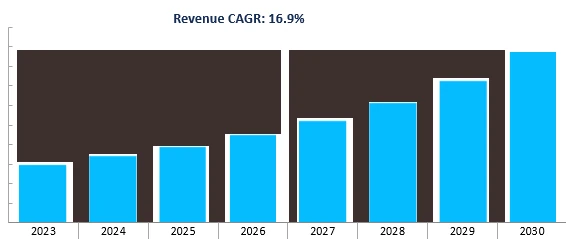
Revenue expansion is primarily driven by the increasing adoption of satellite-based connectivity in aviation, maritime, government, and energy sectors, where terrestrial networks remain limited or economically unviable. The commercialization of 3GPP non-terrestrial networks (NTN) and the rapid deployment of low Earth orbit (LEO) satellite constellations are significantly improving service latency, throughput, and affordability across the mobile satellite services market.
In addition, declining launch costs and advancements in satellite miniaturization are lowering barriers to network expansion, enabling service providers to scale operations across Latin America more efficiently. As connectivity requirements intensify across rural regions, offshore operations, and mobility corridors, spending on MSS solutions is expected to increase steadily.
Overall, the revenue outlook highlights the mobile satellite industry in Latin America as a high-growth connectivity segment, transitioning from niche applications toward a broader role in regional digital infrastructure over the remainder of the decade.
Market Segmentation Analysis: Mobile Satellite Services Market in Latin America
The mobile satellite services market in Latin America is structured around service delivery models, satellite architectures, and end-user application requirements. From a service perspective, MSS offerings broadly address voice and data connectivity, asset tracking, emergency communications, and broadcast-oriented use cases. These services are designed to operate reliably in environments where terrestrial coverage is limited, intermittent, or non-existent.
From a technology standpoint, the Mobile Satellite Services (MSS) Market is transitioning toward multi-orbit configurations that combine LEO, MEO, and GEO assets. This hybrid approach allows providers in the mobile satellite industry in Latin America to balance latency, coverage, and cost efficiency while supporting diverse use cases across vast geographies.
End-user demand is strongest in industries characterized by geographic dispersion and operational criticality. Government, aviation, maritime, energy, and agriculture sectors continue to anchor demand, although new applications are emerging in logistics, emergency response, and remote healthcare.
Regionally, market maturity varies widely. Larger economies benefit from stronger regulatory frameworks and higher adoption readiness, while smaller markets contribute incremental growth through export-driven and resource-intensive activities. These segmentation dynamics collectively define the evolving structure of the mobile satellite services market in Latin America.
Growth Drivers: Mobile Satellite Services Market in Latin America
Growth in the mobile satellite services market in Latin America is driven by multiple structural and technological factors. First, persistent gaps in terrestrial network coverage across rural, offshore, and remote regions create sustained demand for satellite-based connectivity.
Second, advancements in satellite capabilities—including higher throughput, lower latency, and software-defined architectures—are improving service quality and reducing operating costs within the Mobile Satellite Services (MSS) Market.
Third, falling launch costs and increased satellite production efficiency are lowering barriers to network expansion. Fourth, integration with 5G non-terrestrial networks is expanding addressable use cases and accelerating adoption across the mobile satellite industry in Latin America.
Finally, rising demand for secure, resilient communication in government, defense, and emergency response applications continues to provide a stable demand foundation.
Growth Restraints: Mobile Satellite Services Market in Latin America
Despite strong growth prospects, the mobile satellite services market faces notable challenges. High initial capital expenditure remains a significant barrier, particularly for LEO constellations requiring dense satellite deployments and extensive ground infrastructure.
Intensifying competition from both new satellite entrants and terrestrial alternatives is exerting pricing pressure across the Mobile Satellite Services (MSS) Market. Cybersecurity risks, spectrum coordination challenges, and concerns related to orbital congestion and space debris further constrain market expansion.
In addition, regulatory fragmentation across Latin America increases compliance complexity for providers operating across multiple jurisdictions, moderating the pace of growth in the mobile satellite industry in Latin America.
Competitive Environment: Mobile Satellite Services Market in Latin America
The mobile satellite services market in Latin America is characterized by a moderately concentrated yet highly competitive landscape, with more than 30 active participants generating annual revenues exceeding USD 680 million. Competition is intensifying as legacy satellite operators, emerging LEO constellation providers, and hybrid network players expand their presence across the region.
Competitive differentiation within the Mobile Satellite Services (MSS) Market is primarily driven by cost efficiency, network performance, service reliability, flexibility of offerings, and ecosystem relationships. Vendors are increasingly competing on innovative business models, including capacity-based pricing, bundled service offerings, and partnerships with mobile network operators. Product innovation—particularly in LEO-enabled broadband, direct-to-device connectivity, and hybrid satellite–terrestrial solutions—has become a critical factor shaping market leadership.
Demand is anchored by aviation, corporate, government, and maritime end-user segments, where uninterrupted connectivity is mission-critical and terrestrial alternatives are limited. These industries favor providers with proven service reliability, global coverage, and strong regulatory compliance capabilities.
The market is led by a group of global satellite operators, including OneWeb, Intelsat, Iridium, Starlink, Viasat, Globalstar, Orbcomm, and Telesat, among others. Collectively, the top five competitors accounted for approximately 80.6% of total market revenue in the base year, highlighting a high level of market concentration.
Distribution follows a multi-tier structure involving MSS vendors, regional distributors, local partners, value-added resellers, regulatory entities, and end users. Strategic consolidation has further reshaped the competitive landscape. Notable transactions include Viasat’s acquisition of Inmarsat in 2023, Eutelsat’s merger with OneWeb in 2024, and SES’s USD 3.1 billion acquisition of Intelsat, each strengthening portfolio depth, orbital diversity, and enterprise service capabilities. These developments are accelerating scale advantages and redefining competitive positioning across the Latin American MSS ecosystem.
Scope of Analysis
Satellite Type by Orbit
Satellite Frequency Bands
D2D Technology
Technology Trends
Segmentation
Why is it Increasingly Difficult to Grow?
The Strategic Imperative 8™
The Impact of the Top 3 Strategic Imperatives on the LATAM MSS Industry
Competitive Environment
MSS Ecosystem
Key Competitors By Type of Vendor
Partnerships, Mergers, and Acquisitions
Regulatory Environment
Use Cases by Industry
Use Case: Agriculture
Use Case: Aviation
Use Case: Energy and Utilities
Use Case: Government and Military
Use Case: Maritime
Use Case: Others
Growth Metrics
Growth Drivers
Growth Driver Analysis
Growth Restraints
Growth Restraint Analysis
Forecast Considerations
Revenue Forecast
Revenue Forecast by Country
Revenue Forecast Analysis by Country
Revenue Forecast by Industry Vertical
Revenue Forecast Analysis by Industry Vertical
Revenue Forecast by Service
Revenue Share by Country
Revenue Share by Industry
Revenue Share by Top 5 Participants
Pricing Trends
MSS Connectivity Pricing Models
Growth Metrics
Revenue Forecast: Argentina
Forecast Analysis: Argentina
Growth Metrics
Revenue Forecast: Brazil
Forecast Analysis: Brazil
Growth Metrics
Revenue Forecast: Mexico
Forecast Analysis: Mexico
Growth Metrics
Revenue Forecast: Rest of LATAM
Forecast Analysis: Rest of LATAM
Growth Opportunity 1: Analytics and Insights Services Derived from Satellite Data
Growth Opportunity 2: Cellular Backhaul Solutions with MNOs
Growth Opportunity 3: Hybrid and Multi-Orbit Networks
Benefits and Impacts of Growth Opportunities
Next Steps
List of Exhibits
Legal Disclaimer
Frequently Asked Questions (FAQ) – Mobile Satellite Services Market in Latin America
1. What is the Mobile Satellite Services (MSS) Market in Latin America?
2. What is driving the growth of the mobile satellite services market in Latin America?
3. What was the market size in 2024?
4. What is the projected market size by 2030?
5. What is the expected CAGR during the forecast period?
6. Which industries are the primary users of mobile satellite services?
7. Why are LEO satellites important for the MSS market?
8. Which country leads the mobile satellite industry in Latin America?
9. What challenges limit the growth of the MSS market?
10. What is the future outlook for the mobile satellite services market in Latin America?
Speak directly with our analytics experts for tailored recommendations.
Recent related Mobile and Wireless Communications research
06 Oct 2026 | Global | Market Research
Apple Performance Tracker, Q2 2026
This Frost & Sullivan tracker provides metrics on Apple's quarterly performance (for both unit sales and revenues) for iPads, iPhones, Macs, and other products, such as iPods, Apple TVs, Beats Electronics, and Apple-branded and third-party accessories. It includes historical quarterly data for all t...
25 Sep 2026 | Global | Technology Research
Growth Opportunities in AI Robotics, GPU Cloud, Reinforcement Learning, Blockchain Intelligence & Developer API, Geospatial and Agentic Conversational AI
This edition of the IT, Computing and Communication Technology Opportunity Engine captures developments related to Unified AI robotics, Hybrid GPU cloud and MLOps, Production inference stack, Full-stack reinforcement-learning compute, AI Infrastructure, Computer Vision, Software-Defined Applications...
23 Sep 2026 | Global | Market Research
Growth Opportunities for Agentic AI in Telco Business Support Systems
AI has been embedded in telecommunications for over a decade, initially through rule-based automation and early machine learning applied to network optimization, fraud detection, and customer analytics. Even before 5G, CSPs used AI to enable self-optimizing networks (SON), predictive maintenance, an...
22 Sep 2026 | Global | Market Research
Cellular IoT and Low-Power Wide-Area Network (LPWAN) Market, Global, 2025–2031
This Frost & Sullivan study analyzes the global cellular IoT and LPWAN market between 2025 and 2031, covering traditional cellular IoT (2G/3G, 4G, and 5G), massive cellular IoT (NB-IoT, LTE-M, and 5G RedCap), and massive non-licensed LPWAN technologies (LoRaWAN, Sigfox, and other standards). The ana...
22 Sep 2026 | Global | Frost Radar
Frost Radar™: B2B Payments, 2026
The B2B payments market is evolving as businesses modernize financial operations and demand faster, more integrated, and automated payment experiences. This Frost Radar™ evaluates leading providers across a fragmented ecosystem that includes AP/AR automation, cross-border payments, treasury and liqu...
Purchase includes:
- Report download
- Growth Dialog™ with our experts
Growth Dialog™
A tailored session with you where we identify the:- Strategic Imperatives
- Growth Opportunities
- Best Practices
- Companies to Action
Impacting your company's future growth potential.
The study is segmented into three categories: by type of service (with a clear dominance of the voice and data), by industry (including agriculture, aviation, energy and utilities, government, maritime, and others), and by country (including Argentina, Brazil, and Mexico). Although each country has unique characteristics shaped by economic and political conditions, the study aims to provide stakeholders with a relevant understanding of growth opportunities in the LATAM mobile communications market as a whole. To obtain this information, Frost & Sullivan conducted comprehensive market research in this sector, presenting essential insights into the competitive environment, market trends, and growth drivers and restraints for 2023 to 2030.
| Deliverable Type | Market Research |
|---|---|
| Industries | Telecom |
| No Index | No |
| Is Prebook | No |
| Keyword 1 | mobile satellite services market |
| Keyword 2 | satellite connectivity LATAM |
| Keyword 3 | MSS providers |
| Podcast | No |
| Predecessor | KB72-01-00-00-00 |
| WIP Number | KC02-01-00-00-00 |