 USD
USD GBP
GBP  CNY
CNY  EUR
EUR  INR
INR  JPY
JPY  MYR
MYR  ZAR
ZAR  KRW
KRW  THB
THB 


Materials for Compact Chargers are Experiencing Transformational Growth Due to Rising Penetration in High-growth Markets
16-Jun-2025
Global
Market Research
PFQJ-01-00-00-00
CM_2025_33574
Report Summary: Polymers for EV Charging Infrastructure Market
The global Polymers for EV Charging Infrastructure Market size was valued at USD 62.85 million in 2024 and is projected to reach USD 403.81 million by 2031, growing at a CAGR of 30.4% from 2024 to 2031. The rapid expansion of the EV Charging Infrastructure Market and increasing electric vehicle adoption are significantly driving demand for high-performance polymer materials used in charging systems.
Key Market Trends & Insights
- Asia-Pacific dominates the market due to large-scale EV infrastructure deployment, particularly in China, Japan, and South Korea.
- In Europe, stringent environmental regulations are accelerating the shift toward recyclable and low-toxicity polymer materials.
- By charger type, the 1.6 kW–22 kW segment holds the largest share due to rising residential and workplace charger installations.
- By material type, polymers such as TPU, XLPE, ABS, and PC blends are widely adopted for insulation, durability, and thermal resistance.
- The increasing integration of smart charging technologies is boosting demand for advanced materials across the Electric Vehicle Polymers Market.
Market Size & Forecast
- 2024 Market Size: USD 62.85 Million
- 2031 Projected Market Size: USD 403.81 Million
- CAGR (2024–2031): 30.4%
- Asia-Pacific: Largest Market
- Europe & North America: Fastest-growing regions driven by incentives and regulations
The market growth is further supported by rising investments in EV infrastructure, government subsidies, and the need for lightweight, durable, and heat-resistant materials. As the EV Charging Infrastructure Market continues to expand, polymer innovation will play a critical role in enhancing safety, efficiency, and sustainability across charging applications.
Market Overview & Trends: Polymers for EV Charging Infrastructure Market
The Polymers for EV Charging Infrastructure Market is evolving as a critical enabler within the global EV ecosystem. As the EV Charging Infrastructure Market scales rapidly, polymer demand is increasing across charger components such as cables, connectors, housings, and insulation systems. The shift toward electrification is pushing manufacturers to adopt advanced materials that offer superior thermal stability, electrical insulation, and durability under high-voltage conditions.
A key structural trend is the transition toward compact and high-efficiency chargers, especially in urban environments where space constraints demand lightweight and flexible materials. This trend is boosting demand for polymers like TPU, TPE-S, and XLPE, which provide enhanced flexibility and safety. Simultaneously, ultra-fast charging infrastructure (47+ kW) is driving the need for high-performance polymers capable of withstanding extreme heat and electrical stress.
Sustainability is becoming a defining factor across the Electric Vehicle Polymers Market. Regulatory bodies, particularly in Europe, are imposing restrictions on materials such as PVC, encouraging the adoption of recyclable and low-toxicity alternatives. This shift is accelerating innovation in bio-based and recyclable polymers.
Another major trend is government-driven expansion of EV charging networks. Subsidies, tax credits, and infrastructure funding programs in North America and Europe are increasing charger installations, directly boosting polymer consumption. Additionally, digitalization and smart charging technologies are influencing material requirements, as connected systems demand higher reliability and performance.
Overall, the market is transitioning toward high-performance, sustainable, and application-specific polymer solutions that align with the evolving needs of EV charging infrastructure.
Scope of Analysis: Polymers for EV Charging Infrastructure Market
The Polymers for EV Charging Infrastructure Market analysis covers a comprehensive evaluation of material demand across global EV charging applications. The study period spans 2021 to 2031, with 2024 as the base year and forecasts extending from 2025 to 2031. The analysis is conducted on a global scale, including key regions such as the Americas, Europe, Asia-Pacific, and the Middle East, South Asia, and Africa.
The scope includes detailed assessment across charger types, categorized into 1.6 kW–22 kW, 23 kW–46 kW, and 47+ kW segments. It also evaluates a wide range of polymer materials, including TPU, TPE-S, TPO(V), XLPE, ABS, PC blends, PP, PA, PBT, POM, HPP, EPDM, and silicone. These materials are analyzed based on performance characteristics such as thermal resistance, electrical insulation, durability, and recyclability.
The study further examines technical requirements, regulatory frameworks, and regional policy impacts influencing material adoption. It integrates both qualitative and quantitative insights, focusing on demand drivers, innovation trends, and sustainability considerations shaping the Electric Vehicle Polymers Market.
Revenue & Spending Forecast: Polymers for EV Charging Infrastructure Market
The Polymers for EV Charging Infrastructure Market is projected to witness exponential growth, driven by rapid expansion of the EV Charging Infrastructure Market. Market revenue is expected to increase from approximately USD 62.85 million in 2024 to around USD 403.81 million by 2031, reflecting a strong CAGR of 30.4% during the forecast period.
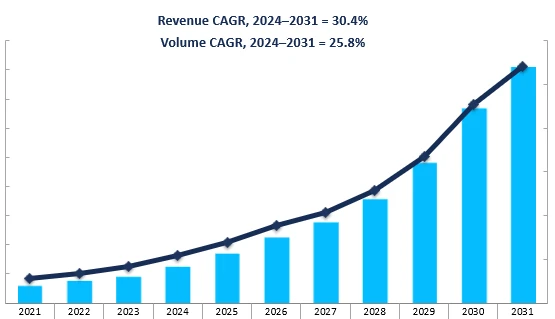
This growth trajectory is supported by increasing EV adoption, government incentives for charging infrastructure, and rising demand for high-performance materials. Volume growth is also significant, indicating expanding deployment of charging systems across residential, commercial, and public sectors.
Investment trends highlight increased spending on advanced materials that improve efficiency, safety, and sustainability. Manufacturers are focusing on developing recyclable and flame-retardant polymers to meet regulatory requirements, particularly in Europe. The integration of smart charging technologies further drives demand for durable and high-quality polymer components.
Market Segmentation Analysis: Polymers for EV Charging Infrastructure Market
The Polymers for EV Charging Infrastructure Market is segmented based on charger types, polymer categories, and application requirements. By charger type, the market is divided into 1.6 kW–22 kW (residential and light commercial), 23 kW–46 kW (commercial), and 47+ kW (ultra-fast public charging). The 1.6 kW–22 kW segment dominates due to widespread adoption of home and workplace charging solutions, particularly in Europe and North America.
From a materials perspective, the Electric Vehicle Polymers Market includes a diverse portfolio of high-performance polymers. TPU and XLPE are widely used for cable insulation due to flexibility and heat resistance, while ABS and PC blends are preferred for charger housings because of their durability and impact strength. Engineering plastics such as PBT, PA, and POM are utilized in high-performance components requiring mechanical stability and thermal endurance.
Application-wise, polymers are used across cables, connectors, enclosures, and internal components of EV chargers. The increasing complexity of charging systems is driving demand for specialized materials that can withstand high voltages and environmental stress.
Regionally, Asia-Pacific leads due to large-scale infrastructure deployment, while Europe emphasizes sustainability and regulatory compliance. North America is witnessing strong growth driven by government incentives and private investments in charging networks.
Growth Drivers: Polymers for EV Charging Infrastructure Market
The Polymers for EV Charging Infrastructure Market is driven by several high-impact factors shaping the broader Electric Vehicle Polymers Market.
One of the primary drivers is the rapid expansion of EV charging infrastructure, supported by government incentives and policy frameworks. Subsidies for home and workplace chargers, especially in Europe and North America, are significantly increasing demand for polymer-based components.
Another key driver is the rising demand for compact chargers in urban environments. These chargers require lightweight, flexible, and high-performance materials, boosting the adoption of polymers such as TPU, XLPE, and ABS.
Stringent regulatory standards are also influencing market growth. Regulations promoting fire safety, recyclability, and reduced environmental impact are driving innovation in advanced polymer formulations.
Additionally, the shift toward high-power and ultra-fast charging systems is increasing the need for materials that can withstand high ???eratures and electrical loads. This is encouraging the use of engineering plastics and specialty polymers.
Finally, technological advancements and material innovation are enabling improved performance, durability, and sustainability, positioning polymers as critical components in next-generation EV charging solutions.
Growth Restraints: Polymers for EV Charging Infrastructure Market
Despite strong growth potential, the Polymers for EV Charging Infrastructure Market faces several challenges. One of the major restraints is regulatory restrictions on PVC usage, particularly in Europe, due to environmental and health concerns. This limits the use of conventional materials and increases the need for alternative solutions.
Another significant challenge is the non-recyclability of widely used materials, especially mixed polymers and flame-retardant components. Limited recycling infrastructure creates sustainability concerns and increases pressure on manufacturers to develop eco-friendly alternatives.
Cost is also a critical factor. High-performance polymers required for advanced EV charging systems can be expensive, impacting overall system costs. Additionally, fluctuating raw material prices may affect profitability and supply chain stability.
Technical complexity in designing materials that meet performance, safety, and regulatory requirements simultaneously further adds to market constraints. These challenges necessitate continuous innovation and investment in sustainable material development.
Competitive Landscape: Polymers for EV Charging Infrastructure Market
The Polymers for EV Charging Infrastructure Market is highly competitive, with major global chemical companies playing a dominant role. Key players include Dow Chemical Company, LyondellBasell Industries, Exxon Mobil Corporation, Covestro, Borealis AG, SABIC, BASF SE, Mitsubishi Chemical, LG Chem, and Huntsman Corporation.
These companies compete based on product innovation, material performance, and sustainability initiatives. Strategic focus areas include development of recyclable polymers, high temperature-resistant materials, and advanced insulation solutions tailored for EV charging applications.
Mergers, acquisitions, and partnerships are common strategies to expand product portfolios and strengthen market presence. Companies are also investing heavily in R&D to develop next-generation materials that meet evolving regulatory and performance requirements.
The competitive landscape is further shaped by regional players and specialized manufacturers focusing on niche applications within the Electric Vehicle Polymers Market. As demand grows, competition is expected to intensify, with innovation and sustainability emerging as key differentiators.
Scope of Analysis
Segmentation
Geographic Scope
Why Is It Increasingly Difficult to Grow?
The Strategic Imperative 8
The Impact of the Top 3 Strategic Imperatives on Polymers for EV Infrastructure
Key Competitors
Value Chain, Polymers for the EV Infrastructure Market
BValue Chain Analysis
Growth Metrics
Forecast Considerations
Forecast Assumptions
Revenue and Volume Forecast
Revenue and Volume Forecast Analysis
Average Price Forecast
Price Forecast Analysis
Volume Forecast by Polymer Type
Revenue Forecast by Polymer Type
Forecast Analysis by Polymer Type
Volume Forecast by Region
Revenue Forecast by Region
Volume Forecast by Polymer Type in Europe
Volume Forecast by Polymer Type in Americas
Volume Forecast by Polymer Type in APAC
Volume Forecast by Polymer Type in MEASA
Volume and Revenue Forecast Analysis by Region
Growth Metrics
Growth Drivers
Growth Driver Analysis
Growth Restraints
Growth Restraint Analysis
Revenue and Volume Forecast
Revenue and Volume Forecast Analysis
Average Price Forecast
Price Forecast Analysis
Volume Forecast by Polymer Type
Revenue Forecast by Polymer Type
Forecast Analysis by Polymer Type
Volume Forecast by Region
Revenue Forecast by Region
Growth Metrics
Growth Drivers
Growth Driver Analysis
Growth Restraints
Growth Restraint Analysis
Revenue and Volume Forecast
Revenue and Volume Forecast Analysis
Average Price Forecast
Price Forecast Analysis
Volume Forecast by Polymer Type
Revenue Forecast by Polymer Type
Forecast Analysis by Polymer Type
Volume Forecast by Region
Revenue Forecast by Region
Volume Forecast by Polymer Type in Europe
Volume Forecast by Polymer Type in Americas
Volume Forecast by Polymer Type in APAC
Volume Forecast by Polymer Type in MEASA
Volume and Revenue Forecast Analysis by Region
Growth Metrics
Growth Drivers
Growth Driver Analysis
Growth Restraints
Growth Restraint Analysis
Revenue and Volume Forecast
Revenue and Volume Forecast Analysis
Average Price Forecast
Price Forecast Analysis
Volume Forecast by Polymer Type
Revenue Forecast by Polymer Type
Forecast Analysis by Polymer Type
Volume Forecast by Region
Revenue Forecast by Region
Volume Forecast by Polymer Type in Europe
Volume Forecast by Polymer Type in Americas
Volume Forecast by Polymer Type in APAC
Volume Forecast by Polymer Type in MEASA
Volume and Revenue Forecast Analysis by Region
Growth Opportunity 1: Recyclable and Sustainable Materials
Growth Opportunity 2: Expansion in MEASA
Growth Opportunity 3: Customization for High-power Charging Systems
Acronyms
Benefits and Impacts of Growth Opportunities
Next Steps
List of Exhibits
Legal Disclaimer
Frequently Asked Questions (FAQ) – Polymers for EV Charging Infrastructure Market
1. What is the market size and forecast of the Polymers for EV Charging Infrastructure Market?
The Polymers for EV Charging Infrastructure Market was valued at approximately USD 62.85 million in 2024 and is projected to reach around USD 403.81 million by 2031, growing at a CAGR of 30.4%.
2. What is driving growth in the EV Charging Infrastructure Market?
Growth is driven by increasing electric vehicle adoption, government incentives, expansion of public and residential charging networks, and demand for efficient and safe charging systems.
3. How do polymers contribute to EV charging infrastructure?
Polymers are used in cables, connectors, insulation, and housings of EV chargers. They provide thermal resistance, electrical insulation, durability, and lightweight properties essential for efficient operation.
4. Which polymer types are widely used in the Electric Vehicle Polymers Market?
Common polymers include TPU, XLPE, ABS, PC blends, PBT, PA, and silicone, each offering specific benefits such as flexibility, heat resistance, and mechanical strength.
5. Which charger segment dominates the market?
The 1.6 kW–22 kW charger segment dominates the market due to widespread adoption of residential and workplace EV charging solutions.
6. What role do regulations play in this market?
Regulations, especially in Europe, promote the use of recyclable and low-toxicity materials while restricting harmful substances like PVC, driving innovation in sustainable polymers.
7. Which region leads the Polymers for EV Charging Infrastructure Market?
Asia-Pacific leads the market due to rapid EV adoption and large-scale charging infrastructure development, particularly in China, Japan, and South Korea.
8. What challenges are faced by the market?
Key challenges include regulatory restrictions on certain materials, limited recyclability of polymers, high material costs, and the need for advanced performance under high ???erature conditions.
9. Why are high temperature-resistant materials important in EV charging?
High temperature-resistant materials ensure safety and durability by maintaining performance under heat generated during fast and ultra-fast EV charging operations.
10. Who are the key players in the Electric Vehicle Polymers Market?
Major players include Dow Chemical Company, LyondellBasell Industries, Exxon Mobil Corporation, Covestro, BASF SE, SABIC, Mitsubishi Chemical, LG Chem, and Huntsman Corporation.
Speak directly with our analytics experts for tailored recommendations.
Recent related Performance Materials research
09 Oct 2026 | Global | Technology Research
Innovations in Transparent Ceramics, Biomaterials, Compostable Bioplastics, Graphite, Silica Foam, Aerogels, and Other Advanced Materials for Diverse Applications
This issue of High-Tech Materials Technology Opportunity Engine (TOE) profiles significant advances in high-tech materials for various industrial applications. The featured innovations include Large-sized Transparent and Bonded Ceramics for High-Power Laser Systems, High-Strength Transparent Alumina...
02 Oct 2026 | Global | Technology Research
Innovations in Nanotechnology Including Nanocoatings, Nanolithography, Carbon Nanotubes, Nanofluids, Graphene, Ceramic Aerogels, Nanocatalysts, and Nanocomposites
This issue of the Nanotechnology Opportunity Engine profiles significant advances in nanotechnology for various industrial applications. The featured innovations include Sulfate-Free CNCs for Versatile Applications, Contact-Active Antimicrobial Nanocoating With Broad-Spectrum Protection, Nanoimprint...
21 Sep 2026 | Global | Strategic Imperatives
Top 10 Strategic Imperatives in the Composites Market, 2026
The composites industry is undergoing a significant transformation as demand for lightweight, high-performance, and sustainable materials accelerates across transportation, aerospace, marine, construction, renewable energy, and industrial applications. Advances in material science, automation, digit...
18 Sep 2026 | Global | Technology Research
Innovations in Surface Technologies for Automotive Coatings, Protective Coatings, Oleophobic Coatings, Plasma Coatings, Icephobic Coatings, and Others
This edition of the Advanced Coating & Surface Technology Opportunity Engine profiles significant advances in advanced coatings and surface treatments for various industrial applications. The featured innovations include Ultra-Black Nanocarbon Coatings for Next-Generation Automotive Surface Finishes...
11 Sep 2026 | Global | Technology Research
Innovations in Advanced Materials, Sustainable Polymerics, Functional Composites, Bio-based Materials, Quantum Materials, Photonics, and Clean Energy Technologies
This issue of High-Tech Materials Technology Opportunity Engine (TOE) profiles significant advances in high-tech materials for various industrial applications. The featured innovations include Recyclable Liquid Thermoplastic Resins for Advanced Composite Manufacturing, Thermoplastic Polyurethane for...
Purchase includes:
- Report download
- Growth Dialog™ with our experts
Growth Dialog™
A tailored session with you where we identify the:- Strategic Imperatives
- Growth Opportunities
- Best Practices
- Companies to Action
Impacting your company's future growth potential.
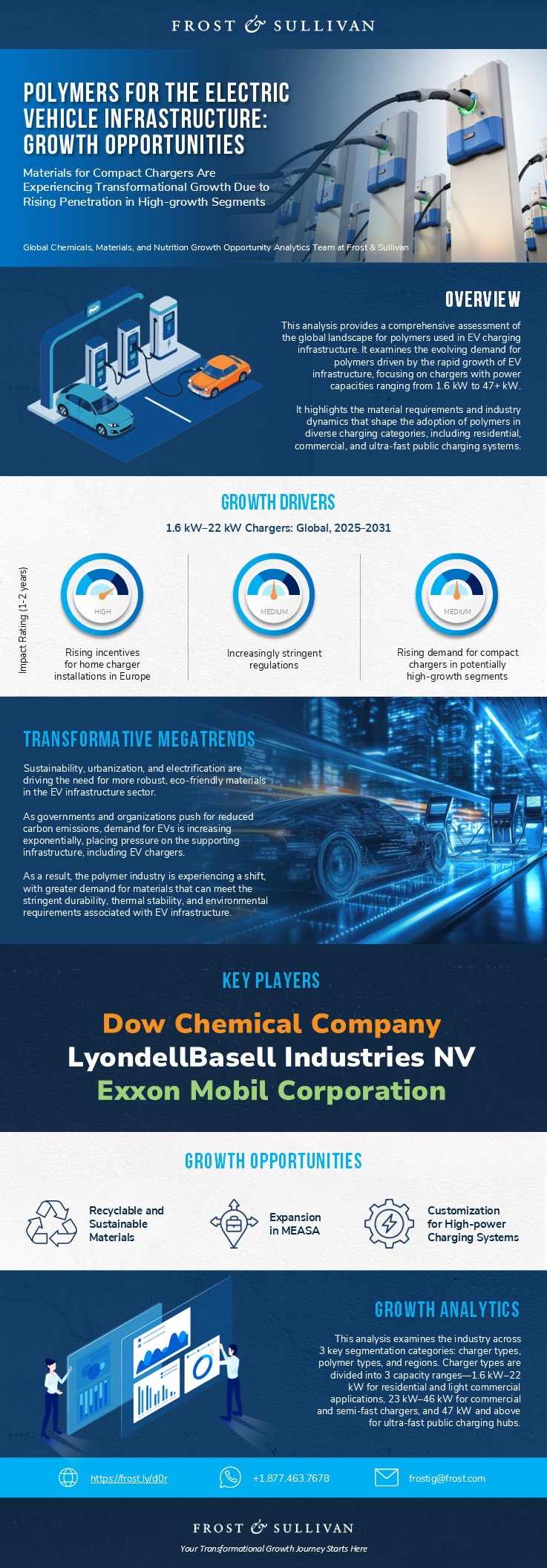
The study analyzes the market across 3 key segmentation categories: charger types, polymer types, and regions. Charger types are divided into 3 capacity ranges—1.6 kW–22 kW for residential and light commercial applications, 23 kW–46 kW for commercial and semi-fast chargers, and 47 kW and above for ultra-fast public charging hubs. Polymers included in the analysis span a wide range, including TPU, TPE-S, TPO(V), XLPE, ABS, PC+ blends, PP, PA, PBT, POM, HPP, EPDM, and silicone. Geographically, the market is segmented into the Americas, Europe, Asia-Pacific (APAC), and the Middle East, South Asia, and Africa (MEASA).
The Americas, led by the United States, is a significant market for polymers in EV infrastructure, driven by federal incentives for EV adoption and the deployment of high-power charging networks. Europe remains a mature market while APAC dominates the global market for EV charging infrastructure, with China, Japan, and South Korea leading in EV charger installations.
The study's methodology encompasses an in-depth analysis of both technical and operational requirements for polymers used in various EV charger categories, as well as broader market dynamics influenced by regulatory frameworks, technological advancements, and regional factors. It identifies key demand drivers, such as increasing EV adoption rates, and assesses the impact of regional policies and environmental considerations. Technical evaluations focus on polymer performance under high-voltage conditions and environmental stress, offering insights into material selection and innovation. By analyzing historical trends from 2021 to 2023 and projecting future growth through 2031, the study provides a strategic view of the global market's evolution. It highlights opportunities for stakeholders across the polymer and EV charging infrastructure sectors, delivering a detailed understanding of the market's growth potential, challenges, and transformative impact on the EV ecosystem.
| Deliverable Type | Market Research |
|---|---|
| Industries | Chemicals and Materials |
| No Index | No |
| Is Prebook | No |
| Keyword 1 | EV infrastructure polymers |
| Keyword 2 | Thermoplastics in EV charging |
| Keyword 3 | Electric vehicle infrastructure trends |
| Podcast | No |
| Predecessor | None |
| WIP Number | PFQJ-01-00-00-00 |
Polymers for the EV Infrastructure Sector, Global, 2024–2031
$4,950.00
Special Price $4,455.00 save 10 %