 USD
 GBP
 CNY
 EUR
 INR
 JPY
 MYR
 ZAR
 KRW
 THB


Pump Services Market, Global, 2023–2030
The Pump Services Market is Driving Transformational Growth due to the Adoption of Life Cycle Service Agreements and Outcome-Based Contracts
10-Sep-2026
Global
Market Research
KA52-01-00-00-00
IA_2026_34881
Key Takeaways: Pump Services Market
- The Pump Services Market is transitioning from reactive repair toward comprehensive life-cycle management focused on reliability, efficiency, uptime, and asset performance.
- The market is projected to increase from $21.28 billion in 2025 to $25.00 billion by 2030, representing a 3.3% CAGR during 2025–2030.
- Aging installed pump bases are creating sustained demand for maintenance, refurbishment, repair, condition monitoring, and end-of-life services.
- End users are increasingly adopting preventive and condition-based maintenance supported by vibration, temperature, pressure, flow, and power-consumption monitoring.
- Long-term service agreements and outcome-based contracts are becoming increasingly important sources of recurring revenue for pump vendors and service providers.
- Water and wastewater remains an important contributor to pump service demand, alongside oil and gas, power generation, chemicals, mining, pulp and paper, and general manufacturing.
- The Industrial pump services market is benefiting from the economic advantage of extending the useful life of existing equipment compared with replacing pumps with new capital equipment.
- The market remains highly fragmented, with approximately 10,000–15,000 competitors, while the top five companies account for 15.9% of revenue.
Report Summary: Pump Services Market
The global Pump Services Market is evolving from a reactive repair-oriented business into a broader life-cycle management industry centered on equipment reliability, efficiency, uptime, and asset performance. Pump vendors and independent service providers increasingly offer services spanning the operating life of pumping systems, including installation, commissioning, performance testing, preventive maintenance, repair, overhaul, refurbishment, condition monitoring, optimization, and end-of-life support.
The pumps market is experiencing a shift toward planned and predictive service models. End users increasingly expect service providers to deploy digital monitoring technologies capable of tracking vibration, temperature, pressure, flow, and power consumption to identify potential faults at an early stage. This trend is creating opportunities for service providers to combine traditional mechanical expertise with digital monitoring and diagnostics.
Repair and overhaul remain important revenue streams, including impeller refurbishment, shaft restoration, mechanical seal replacement, motor repairs, balancing, and hydraulic re-rating. Field services such as emergency troubleshooting, on-site maintenance, outage support, equipment removal, and reinstallation also remain important components of the service ecosystem.
The Industrial pump services market is increasingly supported by multi-year service agreements covering inspection, maintenance, emergency support, spare-parts availability, and performance guarantees. Asset life-cycle management contracts can provide service providers with recurring revenue while allowing customers to focus on reliability and operational outcomes.
The study covers the global market from 2023 to 2030, with 2025 as the base year and 2026–2030 as the forecast period. The geographic scope includes North America, Latin America, Europe, the Middle East and Africa, and Asia-Pacific.
In the Analyst's Words
“The need for faster troubleshooting and efficient maintenance planning has always been vital for clients. This is now possible through cloud-based asset management platforms and AI-powered diagnostics. Pump servicing focuses on improving pump efficiency through performance testing and condition-based maintenance, thereby resulting in significant opportunities for all stakeholders in the ecosystem.”
Krishnan Ramanathan, Lead Analyst, Industrial Machines Market
Top 3 Growth Perspectives
- Pump refurbishment and end-of-life services: Overhauling existing pumps is often more economical than purchasing new equipment. Savings on capital expenditure are particularly important in process industries such as oil and gas, power generation, water treatment, and chemicals.
- Infrastructure development and legacy fleet upgrades: Investments in large-scale infrastructure projects and the upgrading of existing pump fleets are creating opportunities. Water and wastewater treatment is expected to remain the largest contributing end-user industry to pump services revenue.
- Long-term service agreements and reliability partnerships: Pump vendors and solution providers are increasingly focused on securing longer service contracts. Multi-year maintenance agreements offer predictable recurring revenue while helping customers improve equipment reliability and operational performance.
Market Overview & Trends: Pump Services Market
The global Pump Services Market is undergoing a structural transition as industrial customers increasingly prioritize equipment uptime, energy efficiency, reliability, and total life-cycle costs. Historically, pump services were often triggered by equipment failure, with service providers supplying emergency repairs or replacement parts. The market is now expanding toward planned maintenance, condition monitoring, optimization, and longer-term asset-management relationships.
One of the most important trends in the pumps market is the growing adoption of preventive and condition-based maintenance. Industrial customers are increasingly using scheduled inspections, vibration analysis, lubrication management, alignment checks, seal and bearing replacement, and equipment-health monitoring to reduce unexpected failures.
Digitalization is adding another layer to pump services. Monitoring of vibration, temperature, pressure, flow, and power consumption can provide information for early fault detection and maintenance planning. Cloud-based asset-management platforms and AI-powered diagnostics are also emerging as tools for improving troubleshooting and maintenance efficiency.
Pump refurbishment is another significant trend. For many industrial applications, extending the operating life of an existing pump can be more economical than purchasing a new unit. This is particularly relevant for capital-intensive industries where replacement involves substantial equipment, installation, and downtime costs.
The Industrial pump services market is also moving toward recurring contractual models. Multi-year agreements can combine inspection, preventive maintenance, repairs, emergency support, spare-parts management, and performance guarantees. Asset life-cycle management contracts extend this model by placing greater responsibility for equipment performance with the service provider.
The market is supported by demand across water and wastewater, power generation, oil and gas, chemicals, mining, pulp and paper, and general manufacturing. Aging installed bases and infrastructure upgrades are expected to sustain demand throughout the forecast period.
Scope of Analysis: Pump Services Market
The study analyzes the global Pump Services Market by examining key trends across manufacturing and process industries and evaluating growth prospects for pump vendors and solution providers. The study period is 2023–2030, with 2025 as the base year and 2026–2030 as the forecast period. The monetary unit is US dollars.
Revenue included in the study covers a broad range of pump-related services. These include commissioning, installation, engineering and consulting, training, maintenance, repair, overhaul, spares, retrofitting, replacement, condition monitoring, end-of-life services, and digital services.
The scope covers five major geographic markets: North America, Latin America, Europe, the Middle East and Africa, and Asia-Pacific. The regional analysis evaluates the development of pump service demand across these markets.
The research focuses on industrial pump service activities rather than the sale of new pumping equipment alone. This distinction is important because the Industrial pump services market is increasingly being driven by the installed base of pumps already operating across industrial facilities.
The analysis also considers service-provider strategies, including preventive maintenance, field services, refurbishment, reliability engineering, optimization, spare-parts management, digital monitoring, and long-term service agreements.
Revenue & Spending Forecast: Pump Services Market
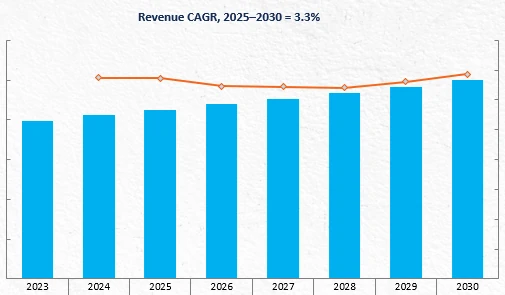
The supplied forecast indicates steady expansion in the global Pump Services Market. Revenue increases from approximately $19.92 billion in 2023 to $25.00 billion in 2030.
The research identifies $21,278.3 million in 2025 revenue and $25,002.1 million in revenue for 2030. The resulting 2025–2030 CAGR is 3.3%.
The growth profile is relatively steady, with annual growth remaining around 3.2% to 3.4% throughout most of the forecast period. This reflects the recurring nature of maintenance and service requirements across installed pump fleets.
The pumps market is supported by both planned and reactive service expenditure. Aging equipment creates recurring requirements for repairs, refurbishment, spare parts, condition monitoring, and maintenance. Meanwhile, multi-year service contracts and life-cycle agreements can shift spending toward recurring contractual models.
Market Segmentation Analysis: Pump Services Market
The Pump Services Market can be understood through the range of services delivered across the life cycle of industrial pumping equipment. The research identifies installation and commissioning, engineering and consulting, training, maintenance, repair, overhaul, spares, retrofitting, replacement, condition monitoring, end-of-life services, and digital services as key components of the market.
Installation and commissioning services support the initial deployment of pumping systems. These activities can include equipment installation, commissioning assistance, system verification, and performance testing. Engineering and consulting services address system design, pump optimization, efficiency studies, root-cause analysis, and other technical requirements.
Maintenance services represent an important recurring component of the market. Planned inspections, lubrication, alignment checks, vibration analysis, seal and bearing replacement, and other preventive activities help customers maintain equipment availability. The increasing focus on condition-based maintenance is expanding the role of diagnostic technologies within maintenance programs.
Repair and overhaul services include mechanical and hydraulic restoration activities. These can involve impeller refurbishment, shaft restoration, mechanical seal replacement, motor repairs, balancing, and hydraulic re-rating. Such services are particularly relevant when extending equipment life is more economical than purchasing replacement equipment.
Spares and replacement services support the availability of critical components. Service providers increasingly manage spare-parts inventories and use long-term agreements to improve parts availability. Reverse engineering and 3D printing can also be used to manufacture components for obsolete equipment, according to the supplied research.
Retrofitting and modernization enable older pump systems to remain operational while improving performance or adapting equipment to changing operating requirements. These services are relevant to customers managing aging installed bases.
Condition monitoring and digital services represent a growing area within the Industrial pump services market. Monitoring parameters such as vibration, temperature, pressure, flow, and power consumption can support early fault identification and maintenance planning. Cloud-based asset-management systems and AI-powered diagnostics further support remote monitoring and troubleshooting.
End-of-life services address pump refurbishment, decommissioning, equipment removal, and related activities. The research highlights pump refurbishment and end-of-life services as continuing opportunity areas because extending the life of existing equipment can reduce capital expenditure.
By geography, the market covers North America, Latin America, Europe, Middle East and Africa, and Asia-Pacific. The Asia-Pacific scope includes countries across the Indian subcontinent, China, Japan, Australia, New Zealand, and Southeast Asian markets such as Singapore, Malaysia, Indonesia, Thailand, and the Philippines.
Growth Drivers: Pump Services Market
Aging installed pump bases are a major driver of the Pump Services Market. Industrial facilities in developed and developing regions continue to operate established equipment fleets that require maintenance, refurbishment, replacement parts, and modernization. The need to maintain these assets supports sustained aftermarket service demand.
Infrastructure investment is another important growth factor. Investments in water infrastructure, industrial facilities, power generation, and other infrastructure projects create demand for pump installation, commissioning, maintenance, and service support. The research identifies water and wastewater as a major contributor to pump services revenue.
The economics of extending equipment life also support the pumps market. Industrial customers increasingly compare the cost of servicing existing pumps with the cost of purchasing new equipment. Refurbishment and overhaul can provide an alternative to full equipment replacement, particularly where the existing asset remains suitable for continued operation.
Industrial pumps can also represent significant energy consumption. The supplied research notes that industrial pumps account for approximately 25% of plant energy use, increasing the importance of efficiency optimization. This creates opportunities for service providers offering performance testing, system efficiency studies, energy audits, and optimization.
The increasing focus on key performance indicators such as mean time between failures (MTBF), availability, and continuous production is encouraging customers to adopt more structured maintenance programs. On-site spares and recurring maintenance contracts can therefore become increasingly important.
A shortage of skilled technicians is another factor supporting outsourcing. Complex rotating equipment requires specialized knowledge in balancing, alignment, pump hydraulics, and seal systems. Customers facing limited internal expertise may increasingly rely on specialist service providers.
Digital monitoring is also contributing to the Industrial pump services market by enabling condition-based maintenance and more efficient troubleshooting.
Growth Restraints: Pump Services Market
Commodity-price volatility can affect customer spending in the Pump Services Market, particularly in oil and gas, chemicals, and petrochemicals. Mining cycles and infrastructure spending can also influence service budgets. When industrial customers face lower commodity prices or tighter capital expenditure constraints, spending on advanced service programs can be delayed.
The benefits of AI and remote monitoring technologies may not be immediate. Effective implementation requires technicians and engineers capable of interpreting digital information alongside mechanical and operational conditions. The research identifies a skills gap because the workforce is not being replaced or upgraded rapidly enough to meet evolving requirements.
The pumps market also faces pricing pressure from fragmented service competition. Customers can view maintenance and repair as commodity services, particularly where multiple vendors can perform similar activities. This can increase price competition and constrain margins for providers offering higher-value engineering, diagnostics, and reliability services.
The research specifically highlights oversupply of vendors in parts of the Middle East, India, and Southeast Asia. Customers may compare OEM service teams, local repair contractors, and machining vendors for similar projects. This procurement environment can create pressure on larger service organizations that require higher margins to support specialized capabilities.
Another restraint is the challenge of demonstrating the financial value of advanced services. Condition monitoring, AI-enabled diagnostics, and life-cycle management require investment before their full benefits become visible. Service providers therefore need to demonstrate measurable improvements in reliability, energy efficiency, downtime reduction, or asset life.
Competitor Landscape: Pump Services Market
The global Pump Services Market is highly fragmented, with approximately 10,000–15,000 competitors identified in the supplied research. Competition includes major pump manufacturers, specialist service providers, independent repair companies, regional businesses, machining providers, and digital solution companies.
The leading competitors identified in the research are Grundfos, KSB Pumps, Flowserve, Dover Corporation, and IDEX Corporation. These companies operate across different segments of the pump ecosystem and compete through equipment expertise, service capabilities, installed bases, geographic coverage, and technical support.
Other notable competitors include Sulzer, Xylem, Hydro Inc., Verder, Weir Pumps, Wilo, as well as digital solution providers such as Emerson, Siemens, Honeywell, and IBM Corporation. Regional and smaller service providers also form an important part of the competitive landscape.
Competition is shaped by several factors. Availability of pump spares is particularly important because customers require access to critical components to minimize downtime. Pricing, experience with different pump types, condition-monitoring capabilities, and on-site servicing are also key competitive factors.
The end-user industries identified by the research include oil and gas, chemicals and petrochemicals, general manufacturing, and food and beverage. Other industries such as water and wastewater, power generation, mining, pulp and paper, and related process industries also contribute to service demand.
The market has a relatively low concentration compared with highly consolidated industrial technology markets. The top five competitors account for 15.9% of revenue, indicating a substantial long tail of regional and specialist providers.
Distribution is largely direct for major projects, although large solution providers operate across multiple geographies. Service providers can combine direct field teams, regional operations, distributors, and specialized repair capabilities.
The supplied research also identifies notable M&A activity. DXP Enterprises announced the acquisition of Moore Pump & Services, strengthening its industrial water-treatment capabilities. Svanehøj acquired H&K Services BV, a Netherlands-based marine gas pump specialist, while Grundfos acquired Waterreo to strengthen its capabilities in the water-treatment sector. These transactions illustrate continued portfolio expansion and capability building across the Industrial pump services market.
Overall, competition is increasingly moving beyond conventional repair toward reliability partnerships, digital monitoring, performance optimization, spare-parts management, and multi-year service agreements. This creates opportunities for providers capable of combining mechanical expertise, field service coverage, digital diagnostics, and life-cycle management.
Scope of Analysis
Definition of Services
Definition of End Users
Segmentation by Region
Why is it Increasingly Difficult to Grow?
The Strategic Imperative 8™
The Impact of the Top 3 Strategic Imperatives on the Pump Services Industry
Growth Metrics
Growth Environment
Competitive Environment
Key Competitors
Growth Drivers
Growth Restraints
Forecast Considerations
Revenue Forecast
Revenue Forecast by Product
Revenue Forecast by Region
Revenue Forecast Analysis
Pricing Trends and Forecast Analysis
Revenue Share
Revenue Share Analysis
Service Providers Enabling End Users to Achieve Sustainability
Savings through Effective Pump Servicing
Growth Metrics
Revenue Forecast
Revenue Forecast by End User
Forecast Analysis
Growth Metrics
Revenue Forecast
Revenue Forecast by End User
Forecast Analysis
Growth Metrics
Revenue Forecast
Revenue Forecast by End User
Forecast Analysis
Growth Metrics
Revenue Forecast
Revenue Forecast by End User
Forecast Analysis
Growth Metrics
Revenue Forecast
Revenue Forecast by End User
Forecast Analysis
Growth Opportunity 1: Focus on Long-Term Service Agreements (LTSA) and Life Cycle Contracts
Growth Opportunity 2: Advanced Services to Help Expand the Addressable Market
Growth Opportunity 3: Water Treatment, Mining, and Data Centers to Offer Significant Opportunities in Pump Servicing
Benefits and Impacts of Growth Opportunities
Next Steps
List of Exhibits
Legal Disclaimer
Frequently Asked Questions: Pump Services Market
1. What is the Pump Services Market?
The Pump Services Market comprises services supporting the installation, operation, maintenance, repair, refurbishment, modernization, monitoring, optimization, and end-of-life management of industrial pumping equipment. Services include commissioning, engineering and consulting, maintenance, repair, overhaul, spare parts, retrofitting, condition monitoring, digital services, and equipment replacement.
2. What is driving the pumps market?
The pumps market is being supported by aging installed pump bases, infrastructure investments, equipment life-extension requirements, increasing focus on reliability and uptime, demand for energy efficiency, growing adoption of condition-based maintenance, and shortages of skilled technicians.
3. How large is the Pump Services Market?
According to the supplied research, the global Pump Services Market generated approximately $21.28 billion in 2025. Revenue is projected to reach approximately $25.00 billion by 2030, representing a 3.3% CAGR during 2025–2030.
4. What services are included in the Industrial pump services market?
The Industrial pump services market includes installation, commissioning, engineering and consulting, training, preventive maintenance, repair, overhaul, spare parts, retrofitting, replacement, condition monitoring, digital services, reliability engineering, optimization, and end-of-life services.
5. Why is pump refurbishment important?
Pump refurbishment is important because extending the useful life of existing equipment can be more economical than purchasing new pumps. Refurbishment can include impeller restoration, shaft repair, mechanical seal replacement, balancing, motor repair, and hydraulic re-rating, helping industrial customers reduce capital expenditure and equipment downtime.
6. How is digital technology changing the Pump Services Market?
Digital technologies are enabling more proactive maintenance in the Pump Services Market. Service providers can use monitoring technologies to track vibration, temperature, pressure, flow, and power consumption. Cloud-based asset-management platforms and AI-powered diagnostics can support troubleshooting, condition-based maintenance, and early fault detection.
7. Which industries generate demand for pump services?
Demand for the Industrial pump services market comes from industries including water and wastewater, oil and gas, chemicals and petrochemicals, power generation, mining, pulp and paper, general manufacturing, and food and beverage. The supplied research identifies water and wastewater as an important contributor to pump service revenue.
8. What are the major restraints affecting the pumps market?
Major restraints affecting the pumps market include commodity-price volatility, fluctuating industrial spending, skills shortages, challenges in realizing immediate benefits from AI and remote monitoring, and intense price competition among OEM service teams, local repair companies, machining vendors, and independent service providers.
9. Who are the major companies in the Pump Services Market?
The supplied research identifies Grundfos, KSB Pumps, Flowserve, Dover Corporation, and IDEX Corporation as leading competitors. Other notable participants include Sulzer, Xylem, Hydro Inc., Verder, Weir Pumps, Wilo, Emerson, Siemens, Honeywell, IBM Corporation, and regional and specialist service providers.
10. What is the forecast period for the Pump Services Market?
The study covers the global Pump Services Market from 2023 to 2030. The base year is 2025, while the forecast period is 2026–2030. The analysis covers service categories, regional markets, growth drivers, restraints, competitive dynamics, and emerging opportunities in industrial pump services.
Speak directly with our analytics experts for tailored recommendations.
Recent related Automation research
06 Nov 2026 | Global | Market Research
Pumps Market in Water Remediation, Global, 2024–2031
This study provides an understanding of opportunities for pumps in water remediation, a fast-growing application area across most regions. Utilities and remediation firms are increasingly using artificial intelligence, IoT sensors, and predictive analytics to monitor water quality in real time and d...
30 Oct 2026 | Global | Technology Research
Growth Opportunities in Intelligent Additive Manufacturing, Industrial Automation, Physical AI, Humanoid Robotics, and Advanced Materials Processing
The Advanced Manufacturing Technology Opportunity Engine provides profiles of innovations related to near-infrared in-situ quality assurance technologies enabling real-time monitoring and defect detection during metal additive manufacturing; AI-driven multi-sensor monitoring systems integrating proc...
30 Oct 2026 | Global | Megatrends
Advancements in Micro-Sensor Technologies for High-Performance Sensing Systems
Micro-sensors are no longer just components that capture data—they are becoming the intelligence behind connected products and autonomous systems. As industries demand faster decisions, greater reliability, and continuous monitoring, sensing platforms are evolving by combining embedded AI, advanced ...
29 Oct 2026 | Global | Market Research
AI-Driven Quality Control and Computer Vision in Smart Manufacturing, Global, 2026
AI maturity, implementation, and AI-enabled or AI-augmented operations are increasing year over year, moving from pilot to production. Because AI delivers the biggest business outcomes, it is a top outcome driver. The impact of AI can be seen in quality control and computer vision in smart manufactu...
07 Oct 2026 | South Asia, Middle East & North Africa | Market Research
Top 10 Growth Opportunities in Resource-Efficient Manufacturing to Optimize Industrial Water and Energy Across the Middle East, 2026
The Middle East is entering a new phase of industrial development in which water security, energy efficiency, and sustainability have become critical determinants of manufacturing competitiveness. Increasing industrial water demand, energy-intensive production processes, climate-related resource con...
Purchase includes:
- Report download
- Growth Dialog™ with our experts
Growth Dialog™
A tailored session with you where we identify the:- Strategic Imperatives
- Growth Opportunities
- Best Practices
- Companies to Action
Impacting your company's future growth potential.