 USD
USD GBP
GBP  CNY
CNY  EUR
EUR  INR
INR  JPY
JPY  MYR
MYR  ZAR
ZAR  KRW
KRW  THB
THB 


Institutional Support from Cities Amid Multiple Localized Challenges Is Driving Transformational Growth
22-Jun-2026
Global
Market Research
M1H0-01-00-00-00
AU_2026_34673
Key Takeaways: Robotaxi Market
- The global robotaxi market is expected to experience transformational growth, with revenue projected to increase from approximately USD 1 billion in 2026 to USD 145 billion by 2035, representing a remarkable CAGR of 80.4%.
- Global robotaxi fleet size is forecast to expand from approximately 18,000 vehicles in 2026 to more than 1.84 million vehicles by 2035, achieving a fleet CAGR of 71.7%.
- Regulatory reforms in major cities are accelerating commercial deployment by removing legal barriers and enabling operator liability frameworks for autonomous mobility services.
- Declining autonomous vehicle hardware costs are improving unit economics and supporting the commercial viability of robotaxi operations.
- Integration with existing ride-hailing platforms such as Uber, Grab, and WeChat is helping robotaxi providers rapidly scale customer adoption.
- Cities with strong regulatory support, advanced digital infrastructure, and mature mobility ecosystems are emerging as early leaders in robotaxi deployment.
- Public-private collaboration is becoming a critical success factor in autonomous mobility implementation.
- North America, China, Singapore, Japan, South Korea, and selected European cities are expected to lead commercial adoption.
- The market ecosystem includes operators, autonomous technology developers, hardware providers, semiconductor companies, and automotive OEMs.
- Mobility, transportation, automotive, and technology industries are expected to benefit significantly from the commercialization of robotaxi services.
- Growing labor shortages in transportation sectors are increasing interest in autonomous mobility solutions.
- Challenges remain regarding public acceptance, regulatory consistency, infrastructure funding, and labor union opposition.
Report Summary: Robotaxi Market
The global robotaxi market is entering a critical phase of commercialization as cities, technology providers, mobility platforms, and automotive manufacturers work together to accelerate autonomous transportation deployment. Frost & Sullivan's Robotaxi Benchmark in 20 Cities evaluates the readiness of major cities worldwide for commercial robotaxi operations by examining regulatory frameworks, infrastructure investments, technology ecosystems, and market conditions.
The study assesses cities across North America, Europe, China, Japan, South Korea, Singapore, and the Middle East to identify where commercial robotaxi deployment is likely to achieve scale first. The report highlights significant differences between cities that have embedded autonomous mobility into public policy and those that remain in early planning stages.
The research demonstrates that robotaxi adoption is increasingly influenced by municipal strategy, fiscal priorities, and regulatory support alongside advancements in autonomous vehicle technology. Cities investing in smart mobility infrastructure, digital connectivity, and supportive legislation are expected to gain a competitive advantage in attracting autonomous mobility investments.
The Robotaxi Benchmark in 20 Cities also highlights the growing role of ride-hailing platforms as the primary distribution channel for robotaxi services, creating opportunities for rapid market expansion and consumer adoption.
Market Overview & Trends: Robotaxi Market
The global robotaxi market is evolving from pilot testing toward commercial deployment as advancements in artificial intelligence, sensor technologies, high-definition mapping, vehicle connectivity, and regulatory frameworks continue to mature. Autonomous mobility is increasingly viewed as a long-term solution for urban transportation challenges, including congestion, driver shortages, transportation accessibility, and operational efficiency.
One of the most significant market trends is the growing involvement of cities in autonomous mobility planning. Municipal governments are developing dedicated frameworks that support testing, deployment, and operation of Level 4 autonomous vehicles. This proactive approach is helping reduce uncertainty for investors and technology developers.
Another major trend is the integration of robotaxi services into existing ride-hailing applications. Instead of building entirely new consumer platforms, robotaxi operators are leveraging established mobility ecosystems to accelerate adoption and reduce customer acquisition costs. This approach enables autonomous fleets to scale more efficiently while improving consumer accessibility.
Hardware cost reductions are also driving market growth. Advances in LiDAR, radar, cameras, compute platforms, and AI processing capabilities are significantly reducing the overall cost of autonomous vehicle systems. As unit economics improve, operators can move closer to profitability in major metropolitan markets.
The market is also benefiting from increased collaboration among automotive OEMs, autonomous technology companies, semiconductor providers, and mobility service platforms. Strategic partnerships are helping accelerate deployment timelines while reducing commercialization risks.
The Robotaxi Benchmark in 20 Cities indicates that future success will depend heavily on localized factors such as regulatory readiness, infrastructure maturity, public acceptance, and economic viability, creating distinct competitive advantages for leading cities.
Scope of Analysis: Robotaxi Market
This study evaluates the commercial readiness of major global cities for robotaxi deployment and measures their preparedness across regulatory, infrastructure, technology ecosystem, and market dimensions.
The research focuses exclusively on Level 4 autonomous robotaxi services, including both pilot programs and commercial operations. Autonomous freight vehicles, logistics vehicles, Level 2 and Level 3 driver assistance systems, and closed-environment autonomous shuttles are excluded from the analysis.
The report covers cities located in the United States, Europe, China, the Middle East, Japan, South Korea, Singapore, and other key regions actively pursuing autonomous mobility initiatives.
Each city is assessed using a structured scoring methodology designed to evaluate the regulatory environment, infrastructure readiness, technology ecosystem maturity, and market attractiveness for robotaxi deployment.
The study period spans 2025–2035, with 2025 serving as the base year and 2026–2035 representing the forecast period. Revenue figures are reported in U.S. dollars.
Market Segmentation Analysis: Robotaxi Market
The robotaxi market consists of a diverse ecosystem of participants collaborating to deliver autonomous mobility services.
By Operators
Robotaxi operators represent the consumer-facing segment of the ecosystem. Key participants include Waymo, Uber, Tesla, Zoox, Baidu, WeRide, Pony.ai, and DiDi. These companies manage fleet operations, service deployment, customer experience, and mobility platform integration.
By Technology Companies
Technology providers develop autonomous driving software, perception systems, AI models, and decision-making algorithms. Leading participants include Waymo and Baidu, both of which have extensive autonomous driving technology portfolios.
By Technology Providers
Supporting technology vendors provide critical hardware and software components. Major participants include NVIDIA, Qualcomm, Mobileye, BYD, Hesai, and Wayve. These companies supply processors, sensors, mapping technologies, and AI infrastructure.
By Original Equipment Manufacturers (OEMs)
Automotive manufacturers play a vital role in supplying robotaxi-ready vehicles. Major OEM participants include Volkswagen, Hyundai, XPENG, Stellantis, General Motors, Mercedes-Benz, BMW, Toyota, Lucid, Honda, Zeekr, and Rimac.
This ecosystem-based segmentation highlights the collaborative nature of autonomous mobility deployment.
Revenue & Spending Forecast: Robotaxi Market
The global robotaxi market is forecast to achieve extraordinary growth between 2025 and 2035. Revenue is expected to rise from approximately USD 1 billion in 2026 to USD 145 billion by 2035, representing a CAGR of 80.4% over the forecast period.
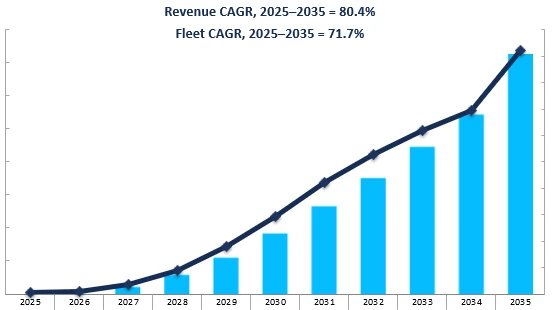
Meanwhile, fleet size is expected to grow from approximately 18,000 vehicles in 2026 to over 1.84 million vehicles by 2035, reflecting increasing commercial adoption and operational scale.
This rapid expansion will be supported by declining hardware costs, favorable regulations, strategic partnerships, and growing consumer acceptance of autonomous transportation services.
Growth Drivers: Robotaxi Market
Several powerful factors are driving growth within the global robotaxi market.
Regulatory reforms are creating a more favorable environment for commercial deployment. Cities adopting operator-liability laws and autonomous vehicle frameworks are reducing legal barriers that previously limited commercialization.
Declining autonomous vehicle hardware costs are significantly improving business economics. New-generation robotaxi systems are becoming more affordable, enabling fleet operators to move closer to sustainable profitability.
The integration of robotaxi booking directly into ride-hailing applications is expanding market reach and reducing consumer adoption friction. Existing mobility platforms provide access to millions of users without requiring separate customer acquisition strategies.
Driver shortages in transportation sectors are also creating demand for autonomous mobility services. Governments and transit authorities increasingly view robotaxis as a potential solution to long-term labor constraints.
Investments in smart city infrastructure and digital transportation ecosystems further support the deployment and scaling of autonomous vehicle operations.
Growth Restraints: Robotaxi Market
Despite strong growth potential, several challenges continue to affect the robotaxi market.
Labor unions and traditional taxi organizations remain significant sources of political opposition. These groups frequently advocate for restrictions on fleet sizes and operational permits.
Funding challenges also present obstacles. Public investments in autonomous mobility infrastructure often compete with traditional transportation priorities, creating uncertainty regarding long-term support.
Regulatory fragmentation across jurisdictions creates deployment complexity. Cities frequently depend on national governments for legal authorization, limiting local flexibility.
Public perception remains another important challenge. Accidents involving autonomous vehicles can significantly influence public trust and regulatory decisions, potentially slowing deployment timelines.
Infrastructure readiness and cybersecurity concerns may also impact future commercialization efforts.
Competitive Landscape: Robotaxi Market
The global robotaxi market remains highly competitive, with approximately 15 major participants competing across technology development, fleet deployment, and mobility services.
Key competitive factors include technological capabilities, operating costs, scalability, fleet performance, safety records, and regulatory readiness.
Leading competitors include Waymo, Baidu, Pony.ai, WeRide, Uber, and Zoox, all of which are actively pursuing large-scale robotaxi deployment strategies.
Other notable participants include Lyft, Bolt, Avride, Motional, Wayve, Momenta, and Lucid Motors. Strategic partnerships between technology providers, automotive manufacturers, and mobility platforms continue shaping the competitive landscape.
One notable partnership involves Uber and Lucid Motors, where Uber plans to deploy approximately 20,000 Lucid Air vehicles within its robotaxi ecosystem.
Competition is expected to intensify as commercialization accelerates and cities compete to become leading autonomous mobility hubs.
Scope of Analysis
Segmentation
Why Is It Increasingly Difficult to Grow?
The Strategic Imperative 8™
The Impact of the Top 3 Strategic Imperatives on the Robotaxi Industry
Competitive Environment
Key Competitors
Growth Metrics
Growth Drivers
Growth Restraints
Forecast Considerations
Revenue and Fleet Size Forecast
Revenue Forecast by Region
Fleet Forecast by Region
Pricing Trends and Forecast Analysis
Global Ride-Hailing Market Size
City Scoring Methodology
City Initiatives and Trends
Robotaxi Fleet by City
City Rankings: Autonomous Readiness Index
Market Size vs. Regulatory Readiness
City Robotaxi Readiness: Five Factors
San Francisco: Overview
San Francisco: Scoring
San Francisco: Evaluation Matrix
San Francisco: Key Takeaways
Los Angeles: Overview
Los Angeles: Scoring
Los Angeles: Evaluation Matrix
Los Angeles: Key Takeaways
Austin: Overview
Austin: Scoring
Austin: Evaluation Matrix
Austin: Key Takeaways
Miami: Overview
Miami: Scoring
Miami: Evaluation Matrix
Miami: Key Takeaways
Dallas: Overview
Dallas: Scoring
Dallas: Evaluation Matrix
Dallas: Key Takeaways
New York: Overview
New York City: Scoring
New York City: Evaluation Matrix
New York City: Key Takeaways
London: Overview
London: Scoring
London: Evaluation Matrix
London: Key Takeaways
Dubai: Overview
Dubai: Scoring
Dubai: Evaluation Matrix
Dubai: Key Takeaways
Tokyo: Overview
Tokyo: Scoring
Tokyo: Evaluation Matrix
Tokyo: Key Takeaways
Singapore: Overview
Singapore: Scoring
Singapore: Evaluation Matrix
Singapore: Key Takeaways
Seoul: Overview
Seoul: Scoring
Seoul: Evaluation Matrix
Seoul: Key Takeaways
Beijing: Overview
Beijing: Scoring
Beijing: Evaluation Matrix
Beijing: Key Takeaways
Shanghai: Overview
Shanghai: Scoring
Shanghai: Evaluation Matrix
Shanghai: Key Takeaways
Guangzhou: Overview
Guangzhou: Scoring
Guangzhou: Evaluation Matrix
Guangzhou: Key Takeaways
Wuhan: Overview
Wuhan: Scoring
Wuhan: Evaluation Matrix
Wuhan: Key Takeaways
Berlin: Overview
Berlin: Scoring
Berlin: Evaluation Matrix
Berlin: Key Takeaways
Zurich: Overview
Zurich: Scoring
Zurich: Evaluation Matrix
Zurich: Key Takeaways
Shenzhen: Overview
Shenzhen: Scoring
Shenzhen: Evaluation Matrix
Shenzhen: Key Takeaways
Sydney: Overview
Growth Opportunity 1: Robotaxi Outsourced Management Facility
Growth Opportunity 2: City AV System Control Systems
Growth Opportunity 3: Robotaxi Data Monetization
Benefits and Impacts of Growth Opportunities
Next Steps
List of Exhibits
Legal Disclaimer
Frequently Asked Questions (FAQs) – Robotaxi Market
1. What is the robotaxi market?
The robotaxi market consists of autonomous ride-hailing services that use Level 4 self-driving vehicles to transport passengers without human drivers. These services combine autonomous driving technologies, mobility platforms, digital infrastructure, and connected vehicle ecosystems to provide commercial transportation solutions.
2. What is driving growth in the robotaxi market?
The primary growth drivers include supportive regulatory reforms, declining autonomous vehicle hardware costs, increasing investments in smart city infrastructure, integration with ride-hailing platforms, and growing demand for efficient urban mobility solutions. Cities are also actively supporting autonomous transportation initiatives through policy and infrastructure development.
3. How large is the robotaxi market expected to become by 2035?
The global robotaxi market is projected to grow from approximately USD 1 billion in 2026 to nearly USD 145 billion by 2035, reflecting a remarkable CAGR of 80.4%. During the same period, the global robotaxi fleet is expected to exceed 1.84 million vehicles.
4. What is the Robotaxi Benchmark in 20 Cities?
The Robotaxi Benchmark in 20 Cities is a comparative assessment that evaluates city readiness for commercial robotaxi deployment. The study analyzes regulations, infrastructure, technology ecosystems, and market attractiveness to determine which cities are best positioned to lead autonomous mobility adoption.
5. Which companies are leading the robotaxi market?
Leading companies in the robotaxi market include Waymo, Baidu, Pony.ai, WeRide, Uber, and Zoox. Other notable participants include Lyft, Bolt, Avride, Motional, Wayve, Momenta, and Lucid Motors, all of which are contributing to the advancement of autonomous mobility services.
6. How do ride-hailing platforms contribute to robotaxi adoption?
Ride-hailing platforms such as Uber, Grab, and WeChat are integrating robotaxi booking capabilities directly into their existing applications. This approach allows autonomous mobility providers to leverage established customer bases, reducing adoption barriers and accelerating commercialization.
7. What role do cities play in robotaxi deployment?
Cities play a critical role by establishing regulatory frameworks, investing in smart infrastructure, enabling autonomous vehicle testing programs, and supporting public-private partnerships. Municipal readiness significantly influences the speed and scale of robotaxi commercialization.
8. What challenges are affecting the robotaxi market?
Key challenges include labor union opposition, public concerns regarding autonomous vehicle safety, inconsistent regulations across regions, funding limitations for smart infrastructure projects, and difficulties in achieving widespread public acceptance following autonomous vehicle incidents.
9. Which industries benefit from robotaxi adoption?
The robotaxi market benefits multiple industries, including mobility services, public transportation, automotive manufacturing, autonomous driving technology, semiconductor providers, mapping services, telecommunications, and smart city infrastructure developers.
10. What is the future outlook for the robotaxi market?
The future outlook for the robotaxi market is highly positive. Continued improvements in autonomous driving technology, favorable regulatory developments, expanding smart city initiatives, and growing consumer acceptance are expected to support rapid market expansion. By 2035, robotaxis are expected to become an integral component of urban transportation ecosystems worldwide.
Speak directly with our analytics experts for tailored recommendations.
Recent related Autonomous Vehicles research
25 Sep 2026 | Global | Technology Research
Growth Opportunities in Next-Gen Wireless EV charging, Automotive Grade IoT module, Autonomous driving, E-bike Platform, UAVs, and 4D Radars
The Mobility Technology Opportunity Engine (TOE) covers innovations pertaining to EV charging, Automotive Grade IoT module, Autonomous driving, E-bike Platform, UAVs, and 4D Radars.The purpose of the Mobility Technology TOE is to raise awareness of global technology innovations in self-propelled gro...
22 Sep 2026 | Global | Market Research
Growth Opportunities in the Global EV Power Electronics Market, 2025–2032
The rapid push toward e-mobility is accelerating adoption of advanced power electronics by major OEMs. Power electronics underpin electric vehicle reliability, efficiency, and performance. Core systems, including traction inverters, onboard chargers, and DC-DC converters, are gaining strategic impor...
31 Aug 2026 | Global | Market Outlook
Off-Highway Equipment Market Predictions and Growth Opportunities, Global, 2026
The global off-highway (OHW) equipment industry enters 2026 amid a complex and evolving macroeconomic environment characterized by geopolitical uncertainty, energy price volatility, and shifting trade dynamics. While the baseline outlook suggests moderate global GDP growth of about 3%, downside scen...
27 Aug 2026 | Global | Market Outlook
Global EV Charging Infrastructure, 2026: Growth Trajectory and Emerging Opportunities
The rapid rise of electric vehicles (EVs) is intensifying the need for a robust, accessible charging infrastructure. Enabled by IoT integration, EVs are becoming a smarter alternative to conventional ICE vehicles. Expanding fast-charging stations along highways and at key destinations is critical to...
21 Aug 2026 | South Asia, Middle East & North Africa | Market Research
High-Traffic Truck Charging Infrastructure Revenue Opportunities, India, 2026–2041
India’s electric truck charging ecosystem is entering a critical phase of commercialization, with revenue generation and investment returns emerging as key focus areas alongside infrastructure deployment. As medium- and heavy-duty electric trucks scale up, charging infrastructure development across ...
Purchase includes:
- Report download
- Growth Dialog™ with our experts
Growth Dialog™
A tailored session with you where we identify the:- Strategic Imperatives
- Growth Opportunities
- Best Practices
- Companies to Action
Impacting your company's future growth potential.
The report analyzes 20 cities across the United States, Europe, the Middle East, Singapore, China, Japan, and South Korea, assessing each through a structured scoring methodology that identifies the conditions under which commercial robotaxi operations become viable, scalable, and profitable. It examines the divergence between cities that have embedded autonomous vehicles into formal mobility policy and those where regulatory intent remains absent, exploring how that gap is widening the competitive distance between markets.
It highlights the accelerating trend of cities building shared digital infrastructure as a public asset, and the growing role of ride-hailing platforms as the distribution layer through which robotaxi services reach consumers at scale.
This report explains how the robotaxi transition is being driven as much by city policy, demographic pressure, and fiscal necessity as by technology maturity, and identifies the regulatory, infrastructure, and market conditions that will determine which cities become the defining commercial battlegrounds of autonomous mobility over the next five years.
| Deliverable Type | Market Research |
|---|---|
| Industries | Automotive |
| No Index | No |
| Is Prebook | No |
| Podcast | No |
| Predecessor | PF9F-01-00-00-00 |
| WIP Number | M1H0-01-00-00-00 |