 USD
USD GBP
GBP  CNY
CNY  EUR
EUR  INR
INR  JPY
JPY  MYR
MYR  ZAR
ZAR  KRW
KRW  THB
THB 


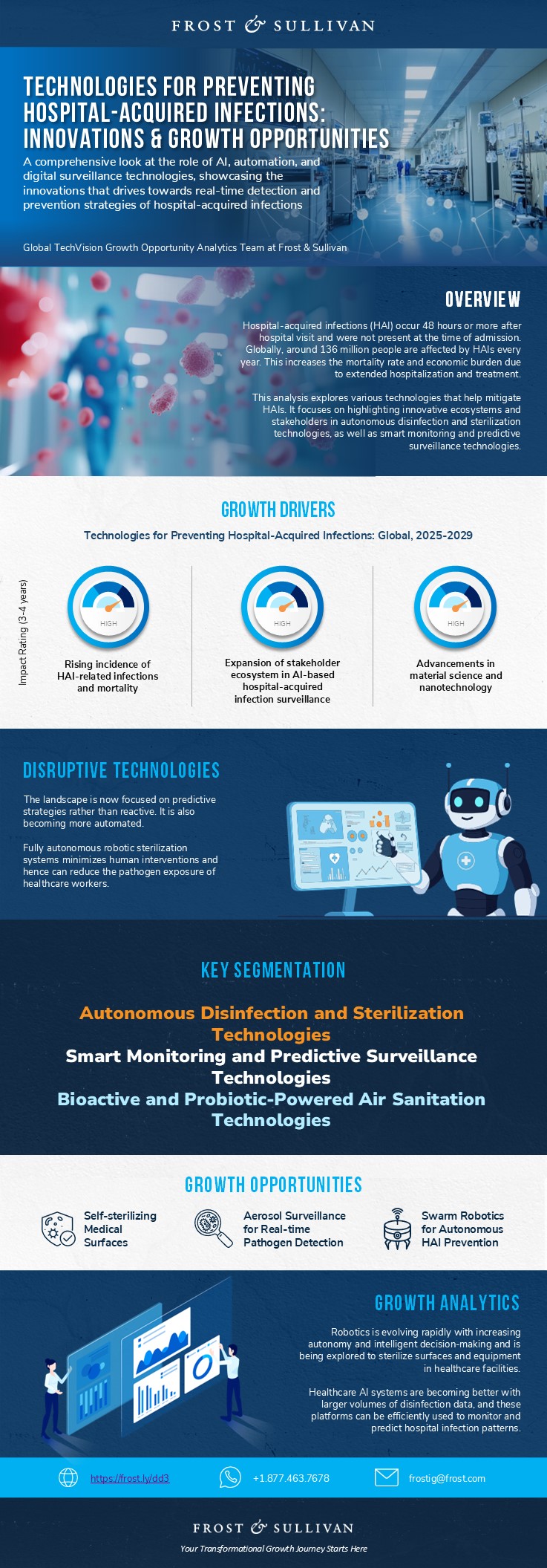
A comprehensive look at the role of AI, automation, and digital surveillance technologies, showcasing the innovations that drives towards real-time detection and prevention strategies of hospital-acquired infections
10-Jul-2025
Global
Technology Research
DB27-01-00-00-00
HC_2025_33650
Hospital-acquired infections (HAI) occur 48 hours or more after hospital visit and were not present at the time of admission. Globally, around 136 million people are affected by HAIs every year. This increases the mortality rate and economic burden due to extended hospitalization and treatment. This report provides a comprehensive overview of various technologies that help mitigate HAIs. The report focuses on highlighting innovative ecosystems and stakeholders in autonomous disinfection and sterilization technologies, as well as smart monitoring and predictive surveillance technologies. Robotics is evolving rapidly with increasing autonomy and intelligent decision-making, and is being explored to sterilize surfaces and equipment in healthcare facilities. Healthcare AI systems are becoming better with larger volumes of disinfection data, and these platforms can be efficiently used to monitor and predict hospital infection patterns. The report will delve into the innovation landscape and the strategic developments (like partnerships, investments, and funding initiatives) within the autonomous disinfection and the smart monitoring and predictive surveillance technologies landscapes. It also identifies the potential growth areas within the different HAI prevention technologies landscape, which are poised to disrupt the market by 2030.
Hospital-acquired infections (HAI) continue to pose a silent but serious threat across healthcare systems, increasing morbidity, costs, and operational strains. Our latest report on “Technologies for Preventing Hospital-acquired Infections- Innovations and Growth Opportunities” explains how leveraging robotic technology and AI would minimize the incidence of HAI and transform the reactive infection control measures to proactive practice, minimizing human errors, avoiding human contact with hazardous disinfection modalities, and targeting contamination risks before they outbreak in the healthcare environment.
Take the next step forward towards safer healthcare! Download the report to get the latest insights to reduce HAIs and improve patient outcomes.
Why Is It Increasingly Difficult to Grow?
The Strategic Imperative 8
The Impact of the Top 3 Strategic Imperatives on the Technologies for Preventing HAIs Industry
Growth Opportunities Fuel the Growth Pipeline Engine
Research Methodology
Scope of Analysis
Segmentation
Hospital-Acquired Infections or Nosocomial Infections
Key Challenges in Controlling HAIs
Growth Drivers
Growth Restraints
Autonomous Disinfection & Sterilization Technologies—Overview
Insights Into Autonomous Disinfection & Sterilization Technologies
Key Companies Involved in Autonomous Disinfection & Sterilization Technologies to Prevent HAIs
Key Academic Players Involved in Autonomous Disinfection & Sterilization Technologies to Prevent HAIs
Technology and Stakeholder Analysis for Autonomous Disinfection & Sterilization to Prevent HAIs
Funding Ecosystem for Autonomous Disinfection & Sterilization Technologies to Prevent HAIs
Patent Analysis for Autonomous Disinfection & Sterilization Technologies to Prevent HAIs
Mergers, Acquisitions, & Collaborations Shaping the Autonomous Disinfection & Sterilization Technologies to Prevent HAIs
Autonomous Disinfection & Sterilization Technologies to Prevent HAIs—A Technology Road Map
Smart Monitoring and Predictive Surveillance Technologies—Overview
Insights Into Smart Monitoring and Predictive Surveillance Technologies to Prevent HAIs
Key Companies Involved in Smart Monitoring and Predictive Surveillance Technologies to Prevent HAIs
Key Academic Players Involved in Smart Monitoring and Predictive Surveillance Technologies to Prevent HAIs
Technology and Stakeholder Analysis: Smart Monitoring and Predictive Surveillance Technologies to Prevent HAIs
Funding Ecosystem for Smart Monitoring and Predictive Surveillance Technologies to Prevent HAIs
Patent Analysis for Smart Monitoring and Predictive Surveillance Technologies to Prevent HAIs
Mergers, Acquisitions, & Collaborations Shaping the Smart Monitoring and Predictive Surveillance Technologies to Prevent HAIs
Smart Monitoring and Predictive Surveillance Technologies to Prevent HAIs: A Technology Road Map
Emerging Companies and Academic Institutes Actively Develop Innovative Solutions
Strategic Recommendations for Advancing HAIs Prevention Technologies
Growth Opportunity 1: Self-Sterilizing Medical Surfaces
Growth Opportunity 2: Aerosol Surveillance for Real-Time Pathogen Detection
Growth Opportunity 3: Swarm Robotics for Autonomous HAI Prevention
Technology Readiness Levels TRL: Explanation
Benefits and Impacts of Growth Opportunities
Next Steps
Legal Disclaimer
Speak directly with our analytics experts for tailored recommendations.
Recent related Medical Devices research
08 Oct 2026 | Global | Frost Radar
Frost Radar: Endoscopy Device Technology Ecosystem, 2026
The endoscopy device market is advancing toward higher-quality visualization and improved clinical decision-making, with innovation across 4K ultrahigh-definition display systems, image-enhanced endoscopy, and computer-aided detection systems. Advanced visualization is evolving through improvements ...
07 Oct 2026 | Global | Technology Research
Growth Opportunities in Image-Guided Cancer Ablation Systems
Image-guided cancer ablation systems are minimally invasive medical technologies that use real-time imaging to accurately guide the placement of an ablation device into a tumor, enabling localized destruction of cancerous tissue while minimizing damage to surrounding healthy structures.The increasin...
25 Sep 2026 | Global | Technology Research
Innovations and Growth Opportunities in Advanced Medical Devices, Diagnostic Solutions, and Implantables
The latest issue of Advanced MedTech Technology Opportunity Engine (TOE) spotlights a diverse slate of innovations across advanced medical devices, diagnostic solutions, and implantables.The issue features advanced medical devices such as peritoneal dialysis fluid system, cold sterilization-based au...
15 Sep 2026 | Global | Market Research
Vendor Profiles: Advanced Wound Care Management Market, Global, 2025
The wound care market is being transformed by advanced technologies and evolving care models that focus on improving patient outcomes and reducing healthcare costs. Innovations such as smart sensor-embedded dressings, artificial intelligence (AI)-based wound imaging systems, enhanced negative pressu...
28 Aug 2026 | Global | Technology Research
Innovations and Growth Opportunities in Advanced Medical Devices, Artificial Intelligence Solutions, Digital Solutions, and Medical Imaging Solutions
The latest issue of Advanced MedTech Technology Opportunity Engine (TOE) spotlights a diverse slate of innovations across advanced medical devices, artificial intelligence solutions, digital solutions, and medical imaging solutions.The issue features advanced medical devices such as active bioelectr...
Purchase includes:
- Report download
- Growth Dialog™ with our experts
Growth Dialog™
A tailored session with you where we identify the:- Strategic Imperatives
- Growth Opportunities
- Best Practices
- Companies to Action
Impacting your company's future growth potential.
| Deliverable Type | Technology Research |
|---|---|
| Industries | Healthcare |
| No Index | No |
| Is Prebook | No |
| Keyword 1 | hospital-acquired infections market |
| Keyword 2 | AI hospital disinfection solutions |
| Keyword 3 | hospital infection prevention solutions |
| Podcast | No |
| Predecessor | None |
| WIP Number | DB27-01-00-00-00 |
Technologies for Preventing Hospital-Acquired Infections—Innovations and Growth Opportunities
$4,950.00
Special Price $4,455.00 save 10 %