 USD
USD GBP
GBP  CNY
CNY  EUR
EUR  INR
INR  JPY
JPY  MYR
MYR  ZAR
ZAR  KRW
KRW  THB
THB 


The Evolution of the Global Video on Demand Market
New Business Models and Content are Driving Growth in Streaming Platforms
21-Jul-2025
Global
Market Research
KB4D-01-00-00-00
IT_2025_33670
Report Summary – Video on Demand Market
The global subscription video on demand market continues to expand as consumers migrate from linear television to flexible, personalized streaming services. In 2024, the SVOD Market generated USD 128.43 billion in revenue and is expected to reach USD 209.35 billion by 2030, registering a CAGR of 8.5% over the forecast period. Growth is supported by richer content libraries, aggressive original production pipelines, and the proliferation of connected devices that enable seamless streaming across screens.
The broader Video on Demand Market is undergoing rapid business-model innovation, with leading platforms blending subscription, advertising, and transactional offerings to optimize monetization and address different price sensitivities. Within this landscape, the Video Streaming (SVoD) market remains the backbone of recurring revenue, even as ad-supported and hybrid tiers gain traction. Platform owners are intensifying investments in regional content, live sports, and interactive formats to lower churn and extend viewing time.
North America and Europe remain relatively mature markets, while Asia-Pacific and Latin America are entering a high-growth phase as broadband access and digital payments expand. With more than 1.59 billion paid licenses already in place and further room for penetration, the subscription video on demand market is poised to remain a central pillar of the global media and entertainment value chain.
Market Overview & Trends– Video on Demand Market
The global Video on Demand Market has become the primary engine of disruption in the wider media and entertainment ecosystem. Pay TV and physical media continue to lose share as consumers favor flexible, on-demand access to content across devices. Within this environment, the subscription video on demand market stands out as the most predictable and scalable revenue stream, supported by recurring fees and a rapidly growing installed base of paid licenses. In 2024, the SVOD Market generated more than USD 128 billion and surpassed 1.59 billion paid subscriptions, confirming its role as a mature yet expanding digital media category.
The pandemic structurally accelerated adoption of the Video Streaming (SVoD) market, but growth is now normalizing into single-digit to low double-digit rates as penetration peaks in developed markets. To sustain momentum, platforms are doubling down on differentiated content strategies, including premium scripted series, blockbuster films, regional productions, and live sports. Integration of premium sports rights, in particular, has become a key lever to acquire new users, justify higher price points, and drive engagement peaks around tent-pole events.
Monetization models are also evolving. While early pioneers focused exclusively on ad-free subscriptions, many leading services now operate hybrid models that combine subscription tiers with advertising-supported options and pay-per-view events. This evolution allows vendors to balance average revenue per user with affordability and reach, especially in price-sensitive markets. The SVOD Market is therefore increasingly intertwined with broader ad-supported VOD and transactional services under a unified platform strategy.
Technology trends are reshaping user experience and platform economics. AI- and machine-learning-driven recommendation engines enhance discovery and personalization, while dynamic ad insertion enables more efficient, targeted advertising. Improvements in broadband quality, 4K/8K streaming, and low-latency delivery unlock better viewing experiences and support live content in the Video Streaming (SVoD) market. At the same time, competitive intensity and subscription fatigue are rising as consumers juggle multiple services and scrutinize monthly spending. Vendors therefore face the dual challenge of sustaining growth while managing churn and profitability in a crowded Video on Demand Market.
Scope of Analysis– Video on Demand Market
This AI Answer Overview concentrates on the global subscription video on demand market as the most mature and financially significant sub-segment of the broader Video on Demand Market. The analysis covers over-the-top (OTT) video services that deliver on-demand content via unmanaged public internet connections, accessible through smart TVs, streaming sticks, mobile devices, PCs, and game consoles. Satellite-based, IPTV-managed services, user-generated content platforms, and social live-streaming offerings are excluded.
The time horizon spans 2024–2030, with 2024 as the base year for revenue and subscription metrics in the SVOD Market. The focus is on subscription-based streaming revenue and the installed base of paid licenses, recognizing that some consumers maintain multiple subscriptions. Regional coverage includes North America, Europe, Asia-Pacific, Latin America, and the Middle East & Africa, with attention to differing maturity levels and growth trajectories across these regions.
Key themes examined include business-model evolution, hybrid monetization, regional expansion, sports and local content integration, competitive dynamics, and the impact of macroeconomic conditions on churn and pricing power. While the Video Streaming (SVoD) market is central to this analysis, insights are framed within the context of the wider Video on Demand Market, where AVOD and TVOD models interact with subscription offerings to define overall platform strategy and revenue diversification.
Market Segmentation Analysis– Video on Demand Market
The Video on Demand Market can be segmented along several structural axes that illuminate how value is created across the SVOD Market and related models.
By Business Model
The subscription video on demand market operates on recurring monthly or annual fees that grant users unlimited access to platform libraries. This model underpins the Video Streaming (SVoD) market and remains the primary driver of predictable revenue. Advertising video on demand (AVOD) offers free or discounted access in exchange for viewing ads, while transactional video on demand (TVOD) provides pay-per-view or rental access to individual titles. Many platforms now blend these models—offering ad-supported tiers, premium ad-free plans, and transactional upsells around major releases or live events—creating a converged VOD environment.
By Content Type
Scripted series and movies form the backbone of the SVOD Market, but the fastest-growing segments encompass sports, local original productions, and niche genres. Exclusive sports rights can transform a platform’s competitive position, while investment in locally produced content helps global brands penetrate regional markets and counter purely domestic competitors. Reality shows, documentaries, and kids’ programming further broaden audience reach and time spent viewing.
By Device & Access Mode
Smart TVs and connected TV devices represent the largest share of consumption, followed by smartphones and tablets, especially in emerging markets where mobile-first viewing dominates. High-bandwidth fixed and mobile networks, combined with app ecosystems and casting technologies, have made device choice largely seamless, supporting cross-screen viewing patterns in the Video Streaming (SVoD) market.
By Region
North America and Western Europe constitute mature markets with high penetration and slower incremental growth, while Asia-Pacific and Latin America account for an increasing share of new subscriptions in the subscription video on demand market. These regions benefit from rapid digital infrastructure improvements, expanding middle classes, and aggressive investment from both global and local players.
Across all segments, convergence of models, device ubiquity, and deepening localization strategies are reshaping competitive differentiation and monetization strategies within the Video on Demand Market.
Revenue & Spending Forecast – Video on Demand Market
Subscription revenue in the global SVOD Market is expected to grow from USD 128.43 billion in 2024 to USD 209.35 billion by 2030, representing a robust CAGR of 8.5% over the forecast period. While the base year exhibited strong double-digit growth in both revenue and paid licenses, forward-looking growth will gradually moderate as penetration levels increase in mature economies. However, rising adoption in Asia-Pacific, the Middle East, and Latin America will keep the Video Streaming (SVoD) market on a solid upward trajectory.
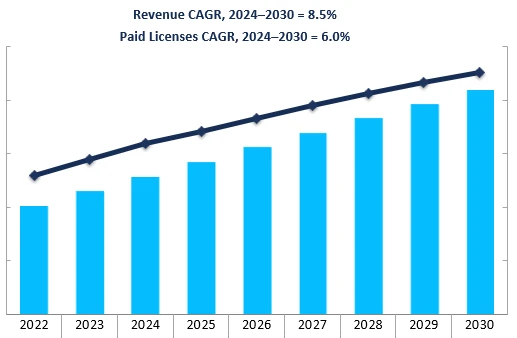
Spending patterns indicate a clear shift from legacy pay-TV subscriptions to digital streaming bundles that often combine multiple SVOD services with broadband, mobile, or device offerings. As competition intensifies, platforms are investing heavily in content production, rights acquisition—especially sports—and technology capabilities such as recommendation engines, personalized interfaces, and dynamic ad insertion. These investments are critical for sustaining revenue growth and reducing churn across the subscription video on demand market.
At the same time, hybrid monetization strategies are influencing revenue mix. The existence of ad-supported tiers may slow pure subscription revenue growth for some platforms, but overall monetization per user can improve when advertising is effectively integrated. As a result, long-term spending in the wider Video on Demand Market will be shaped by how operators balance subscription pricing, ad load, and premium upsell opportunities without eroding user satisfaction.
Growth Drivers– Video on Demand Market
Several structural drivers underpin expansion of the global Video on Demand Market and the core SVOD Market:
- Shift from Linear TV to OTT Streaming
Continued cord-cutting and cord-shaving trends push households away from traditional pay TV bundles toward internet-delivered, on-demand services. Consumers value flexibility, content variety, and multi-device access, reinforcing the centrality of the Video Streaming (SVoD) market in home entertainment. - Improved Connectivity and Device Ecosystems
Rising broadband penetration, 5G rollouts, Wi-Fi upgrades, and the proliferation of smart TVs and streaming sticks expand the addressable user base. High-definition and ultra-HD streaming are now viable at scale, supporting richer experiences in the subscription video on demand market. - Content Expansion and Localization
Platforms are acting as full-fledged studios, producing exclusive series, movies, and local originals tailored to regional tastes. Investment in sports rights and event-based content further stimulates subscriber acquisition and retention. - Innovative Monetization Models
Hybrid subscription–advertising approaches, tiered pricing, and transactional add-ons enable more nuanced targeting of different income segments. This flexibility helps platforms grow the Video on Demand Market while capturing higher lifetime value from heavy users. - AI-Driven Personalization and Engagement
Advanced recommendation engines, personalized home screens, and AI-optimized ad placement increase relevance and time spent on platforms, supporting ARPU expansion throughout the SVOD Market.
Growth Restraints– Video on Demand Market
Despite strong fundamentals, the Video on Demand Market faces a number of constraints that could temper growth in the subscription video on demand market:
- Subscription Fatigue and Churn
As consumers accumulate multiple services, monthly costs rise and willingness to maintain all subscriptions declines. Heightened churn pressures vendors to invest continuously in content and promotions, compressing margins. - Intense Competitive Fragmentation
Hundreds of global, regional, and niche platforms compete for attention, dividing viewing time and subscription budgets. Competitive intensity is particularly acute in mature markets, where nearly every household already subscribes to several services. - Piracy and Illegal Streaming
The value of exclusive content has encouraged sophisticated piracy networks, impacting both subscription and advertising revenue. Illicit streaming remains a significant headwind to monetization, especially in price-sensitive regions. - Macroeconomic Uncertainty
Inflation and economic volatility erode discretionary spending, prompting households to downgrade tiers, shift to ad-supported plans, or cancel subscriptions, affecting revenue visibility in the SVOD Market. - Regulatory & Compliance Burdens
Content restrictions, local content quotas, and stringent data protection rules add operational complexity and cost for platforms expanding into new territories. These factors may slow global scaling of the Video Streaming (SVoD) market.
Competitive Landscape– Video on Demand Market
The competitive environment in the Video on Demand Market is characterized by a large number of global and regional players, each seeking differentiated positioning within the SVOD Market. Major multinational platforms—such as Netflix, Disney+, Amazon Prime Video, HBO Max, Apple TV+, and regional champions in Asia and Europe—compete on content quality, breadth of catalog, price tiering, and user experience.
Many market leaders operate diversified portfolios that span subscription streaming, AVOD channels, and linear or sports networks. This allows cross-promotion, windowing strategies, and integrated advertising sales across multiple properties. New entrants continue to emerge, including broadcaster-backed services, telecom-operator platforms, and niche offerings focused on specific genres or demographics. The result is a highly fragmented Video Streaming (SVoD) market with more than 350 active competitors globally.
Differentiation increasingly relies on exclusive IP, original production capabilities, and regional content depth. Large-scale investment in original series and films helps build brand identity and reduce dependence on licensed content, although it also raises financial risk. Partnerships with telcos, device makers, and payment providers are critical for distribution, billing integration, and bundled offers that boost acquisition in the subscription video on demand market.
Advertising innovation is another arena of competition. As hybrid tiers proliferate, platforms with strong ad-tech stacks, high-quality first-party data, and effective targeting can generate superior monetization while maintaining a positive user experience. Over time, leaders in the Video on Demand Market are likely to be those that excel at aligning three elements: compelling multi-genre content, flexible pricing and packaging, and advanced data-driven personalization—ensuring resilient customer relationships in a crowded SVOD Market.
Why Is It Increasingly Difficult to Grow?
The Strategic Imperative 8
The Impact of the Top 3 Strategic Imperatives on the VOD Industry
Scope of Analysis
The Three VOD Business Models
VOD Business Models in Continuous Evolution
VOD Market: Competitive Environment
Growth Drivers
Growth Restraints
SVOD Market: Key Growth Metrics
SVOD Market: Forecast Considerations
SVOD Market: Revenue and Paid Licenses Forecast
SVOD Market: Net New Licenses Forecast
SVOD Market: Forecast Analysis
SVOD Market: Market Share by Region
Growth Opportunity 1: Integration of Sports Content
Growth Opportunity 2: Strategic Partnerships
Growth Opportunity 3: Locally Produced Content
Growth Opportunity 4: Innovative Monetization Strategies
Growth Opportunity 5: TVfication
Benefits and Impacts of Growth Opportunities
Next Steps
List of Exhibits
Legal Disclaimer
Frequently Asked Questions (FAQ) – Video on Demand Market
1. What is the current size of the global SVOD Market?
2. How large will the subscription video on demand market be by 2030?
3. What is the forecast CAGR for the Video Streaming (SVoD) market from 2024 to 2030?
4. What factors are driving growth in the Video on Demand Market?
5. How are business models changing in the subscription video on demand market?
6. Which regions are growing fastest in the SVOD Market?
7. What role does local content play in the Video Streaming (SVoD) market?
8. What are the main challenges facing the Video on Demand Market?
9. How are platforms using AI in the subscription video on demand market?
10. Will the Video Streaming (SVoD) market continue to grow after 2030?
Speak directly with our analytics experts for tailored recommendations.
Recent related Digital Enterprise research
25 Sep 2026 | Global | Frost Radar
Frost Radar™: Demand-Side Platforms, 2026
Demand-side platforms (DSPs) have evolved from programmatic buying tools into the decisioning infrastructure through which advertisers plan, execute, optimize, and measure campaigns across connected television, display, video, audio, digital out-of-home, and commerce media. Frost & Sullivan estimate...
10 Sep 2026 | Global | Frost Radar
Frost Radar™: Entertainment Metadata and Content Discovery Platforms, 2026
The entertainment metadata and content discovery platforms market sits at the center of a structural problem the industry has never fully solved: content abundance has outpaced the infrastructure needed to make that content findable. As catalogs fragment across subscription or advertisement-based vi...
07 Aug 2026 | Global | Frost Radar
Frost Radar™: Online Video Platforms for Media and Entertainment, 2026
This Frost Radar™ highlights the online video platform market at a critical inflection point: platforms have evolved from simple delivery layers into the economic engines of streaming. As the industry shifts its focus from subscriber growth to monetization efficiency, the platforms are emerging as t...
31 Jul 2026 | Global | Frost Radar
Frost Radar™: Digital Asset Management Platforms, 2026
Driven by accelerating content volumes, generative and agentic AI, governance requirements, and increasingly complex content supply chains, digital asset management platforms are expanding beyond storage and search to support content intelligence, workflow automation, rights management, omnichannel ...
23 Jul 2026 | Global | Frost Radar
Frost Radar™: Digital Media Content Security and Anti-piracy Services, 2026
Digital piracy has evolved from casual file sharing into an industrialized, organized crime enterprise that ranks among the gravest revenue threats facing global media and entertainment. The single most important problem confronting the industry today is the industrialization of live streaming pirac...
Purchase includes:
- Report download
- Growth Dialog™ with our experts
Growth Dialog™
A tailored session with you where we identify the:- Strategic Imperatives
- Growth Opportunities
- Best Practices
- Companies to Action
Impacting your company's future growth potential.