 USD
 GBP
 CNY
 EUR
 INR
 JPY
 MYR
 ZAR
 KRW
 THB


Wood Coatings Market, Global, 2026–2032
Wood Coatings are Driving Transformational Growth Due to Sustainability, Coatings Performance, and Design-Led Innovations
14-Aug-2026
Global
Market Research
PLX8-01-00-00-00
CM_2026_34821
Key Takeaways: Wood Coatings Market
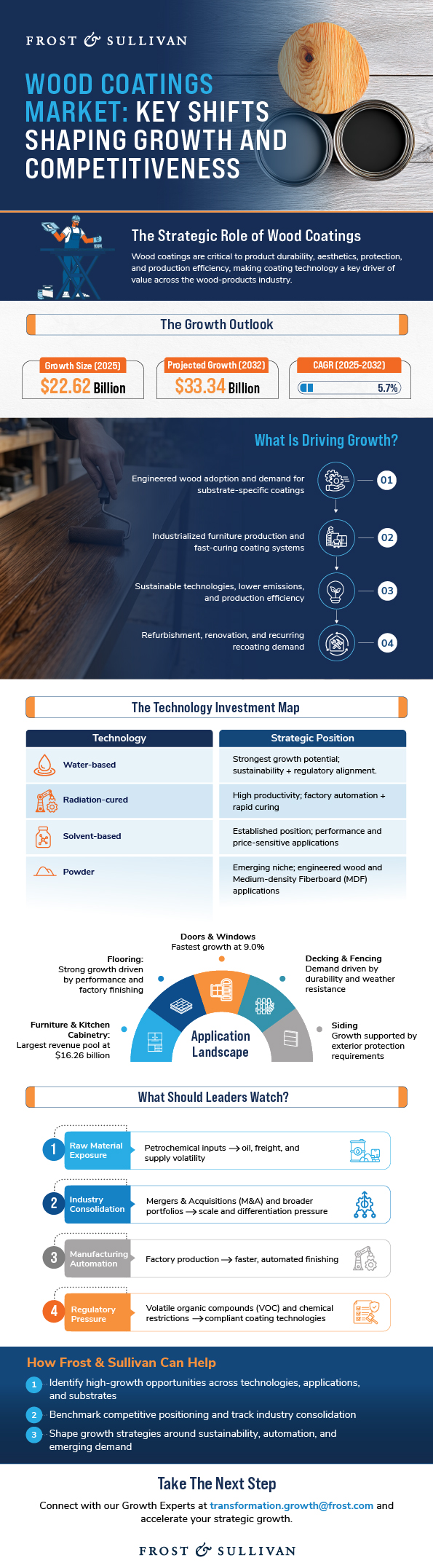
- The Wood Coatings Market generated approximately $22.62 billion in revenue in 2025 and is forecast to reach $33.34 billion by 2032.
- The Wood Coatings Market is projected to expand at a 5.7% CAGR from 2025 to 2032, while volume is expected to grow at approximately 4.0% CAGR.
- Sustainability is reshaping the Wood Coatings Market, with increasing adoption of water-based, low-VOC, and UV-curable coating technologies.
- Furniture and kitchen cabinetry remain important demand areas, supported by construction, renovation, modular kitchens, and premium interior design.
- Acrylics are expected to remain the largest chemistry segment, followed by polyurethane, while water-based formulations are positioned for faster growth.
- APAC is the largest production and consumption region, while Europe and North America are characterized by stronger sustainability requirements and premium coating adoption.
- Factory-applied coatings are gaining importance as engineered wood, prefabricated construction, and industrialized furniture manufacturing expand.
- The Wood Coatings Market remains moderately consolidated, with the top four competitors accounting for approximately 28.7% of revenue in 2025.
Report Summary: Wood Coatings Market
The Wood Coatings Market comprises specialized protective and decorative finishes applied to wooden surfaces to improve durability, appearance, and resistance to environmental and mechanical damage. According to the provided Frost & Sullivan research, the Wood Coatings Market is supported by construction activity, furniture production, renovation, engineered wood adoption, and demand for aesthetically enhanced wood products across residential, commercial, and industrial applications.
The study evaluates the Wood Coatings Market across chemistry, application, formulation technology, application location, and geographic regions. Chemistry segments include polyurethanes, nitrocellulose, polyesters, acrylics, oil and wax, and other chemistries such as epoxy, epoxy-polyester hybrids, thermoplastics, polyolefins, fluoropolymers, urea, and melamine systems. Formulation technologies include solvent-based, water-based, radiation-cured, and powder coatings.
The Wood Coatings Market generated $22.62 billion in revenue and 4,447.5 kilotonnes of volume in 2025. Revenue is projected to reach $33.34 billion by 2032, representing a 5.7% CAGR. Volume is expected to reach 5,864.3 kilotonnes during the same period. Sustainability, regulatory pressure, product performance, factory-applied coating adoption, and premiumization are key themes shaping the market through 2032.
Analyst's Words: Wood Coatings Market
Simran Tamboli, Lead Analyst, Global Wood Coatings Market
“The global Wood Coatings Market is evolving from conventional protective finishes toward advanced coating systems that combine aesthetics, durability, sustainability, and lifecycle performance. While construction activity, housing starts, and furniture demand continue to support market growth, the strongest opportunities are emerging in premium, sustainable, and performance-driven coating technologies. Increasing adoption of waterborne and low-VOC formulations, renovation activity, and the expansion of engineered wood and prefabricated construction are further reshaping the competitive landscape.”
Top 3 Growth Perspectives
- Sustainable coating adoption is accelerating as environmental regulations and changing customer preferences increase demand for waterborne and low-VOC systems. Premium coating solutions are gaining particular traction in Europe and North America, while APAC continues to support volume-led demand.
- Renovation and outdoor wood applications are supporting recurring demand, driven by maintenance cycles, refurbishment activity, and consumer interest in improving the appearance and durability of existing wood products.
- Engineered wood and prefabricated construction are expanding factory-applied coating opportunities, increasing demand for high-throughput systems that provide consistent finishes, production efficiency, and scalable manufacturing.
Market Overview & Trends: Wood Coatings Market
The Wood Coatings Market is evolving through the interaction of construction activity, furniture manufacturing, renovation, sustainability requirements, and advances in coating chemistry. Wood coatings serve both functional and decorative purposes, protecting surfaces from moisture, UV exposure, abrasion, and other forms of environmental or mechanical degradation while improving visual appeal. The research indicates that demand spans furniture and kitchen cabinetry, doors and windows, flooring, siding, decking, and fencing.
A major trend in the Wood Coatings Market is the transition toward sustainable formulations. Water-based and low-VOC coatings are gaining momentum as manufacturers and end users respond to environmental regulations and changing sustainability expectations. UV-curable systems are also gaining relevance where rapid curing and high-performance finishes are required. The market is therefore moving beyond simply reducing VOC content toward coating systems designed around broader sustainability and performance requirements.
Renovation and refurbishment are additional demand drivers. Existing furniture, flooring, doors, windows, siding, and outdoor wood products require periodic maintenance and refinishing, creating recurring demand independent of new construction cycles. At the same time, engineered wood products and prefabricated construction are supporting factory-applied coating systems because manufacturers require consistent finish quality and efficient production processes.
Regional dynamics are also important. APAC leads production and consumption, particularly because China functions as both a major manufacturing hub and consumption center. The Americas benefit from established furniture, flooring, and exterior wood applications, while Europe has strong environmental requirements and adoption of sustainable coating technologies.
Scope of Analysis: Wood Coatings Market
The Wood Coatings Market study provides a global assessment of specialized protective and decorative coatings used on wooden surfaces. The research covers the period from 2022 to 2032, with 2025 as the base year and 2026–2032 as the forecast period. Market measurements are presented in US dollars for revenue and kilotonnes for volume shipments. The study evaluates the market across chemistry, application, formulation technology, application location, and region.
The scope of the Wood Coatings Market includes polyurethane, nitrocellulose, polyester, acrylic, oil and wax, and other chemistry categories such as epoxy, epoxy-polyester hybrid, thermoplastic, polyamide, polyolefin, fluoropolymer, urea, and melamine systems. Application segments include furniture and kitchen cabinetry, doors and windows, flooring, siding, decking, and fencing. Formulation technologies cover solvent-based, water-based, radiation-cured, and powder coatings. The study also distinguishes between factory-applied and on-site-applied coatings and provides regional market analysis.
The research focuses specifically on wood coating applications and excludes decorative paints such as masonry and architectural paints. The analysis also considers both revenue and volume development, providing a broader view of pricing, consumption, technology adoption, and market evolution.
Market Segmentation Analysis: Wood Coatings Market
The Wood Coatings Market is segmented primarily by chemistry, application, formulation technology, and location of application. This segmentation demonstrates how different coating technologies serve different performance, aesthetic, manufacturing, and environmental requirements.
By chemistry, the Wood Coatings Market includes polyurethanes (PUs), nitrocellulose (NC), polyesters, acrylics, oil and wax, and other chemistries. Acrylic coatings are expected to remain the largest chemistry segment because of their versatility and ability to address diverse application requirements. Polyurethane coatings remain important because of their durability and performance characteristics, while polyester coatings maintain relevance in high-gloss and premium furniture applications. Nitrocellulose remains relevant in selected fast-drying furniture applications, although the research indicates continued competitive pressure from polyurethane and UV-curable systems.
By application, the Wood Coatings Market covers furniture and kitchen cabinetry, doors and windows, flooring, siding, and decking and fencing. Furniture and kitchen cabinetry represent a major volume driver, supported by new construction, renovation, modular kitchen adoption, and premium interior design. Doors and windows have a mixed demand outlook, with renovation and replacement activity supporting demand while competing materials such as aluminum and steel can constrain wood usage. Flooring demand is influenced by renovation and replacement activity, particularly in mature markets.
Siding represents a functionally important application because coatings provide durability, UV resistance, and moisture protection. However, vinyl, fiber cement, and stucco create competitive pressure. Decking and fencing benefit from outdoor living trends and maintenance cycles, while wood-plastic composites can reduce demand for traditional natural-wood coatings in some applications.
By formulation technology, the Wood Coatings Market consists of solvent-based, water-based, radiation-cured, and powder coatings. Solvent-based coatings continue to hold a significant position in performance-sensitive and price-sensitive applications. Water-based systems are expected to experience faster growth because of tightening VOC regulations, sustainability objectives, and increasing consumer awareness. Radiation-cured coatings are relevant to industrial and factory-applied applications, while powder coatings remain a niche technology for wood applications.
By location of application, the market is divided into factory-applied and on-site-applied coatings. Factory-applied coatings benefit from industrialized furniture manufacturing, engineered wood, prefabricated construction, and the need for consistent quality and production efficiency. On-site application remains relevant for renovation, repair, decking, fencing, siding, and selected exterior applications.
Revenue & Spending Forecast: Wood Coatings Market
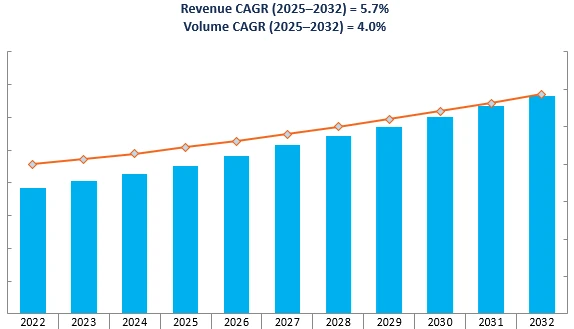
The Wood Coatings Market generated approximately $22.62 billion in revenue in 2025, compared with $19.23 billion in 2022. The provided forecast indicates that revenue will increase to $33.34 billion by 2032, representing a 5.7% CAGR from 2025 to 2032.
Volume is forecast to grow at approximately 4.0% CAGR between 2025 and 2032, slower than revenue growth. This difference indicates that market expansion is supported not only by greater coating consumption but also by changes in product mix, premiumization, technology, and average pricing. The average price was approximately $5.1 per kilogram in 2025.
Growth Environment: Wood Coatings Market
The Wood Coatings Market is being shaped by a combination of construction activity, refurbishment, sustainability requirements, material innovation, and changes in wood-product manufacturing. Residential construction remains an important demand foundation because new homes require coatings across furniture, cabinetry, doors, flooring, siding, and other wood applications. Renovation and refurbishment provide an additional recurring demand base because existing wood products require maintenance and refinishing.
Furniture and kitchen cabinetry represent an important growth environment within the Wood Coatings Market. Modular kitchens, new furniture production, renovation activity, and demand for premium aesthetics are supporting coating consumption. However, design trends toward matte finishes, natural wood appearances, and prefinished surfaces can reduce coating consumption per unit.
Flooring demand is increasingly connected to renovation and replacement activity in North America, Europe, Japan, and South Korea. Emerging markets such as China, India, Latin America, and the Middle East are experiencing increasing adoption of wood and wood-look flooring. At the same time, alternative flooring materials such as luxury vinyl tile, laminates, ceramics, carpet, and marble can limit demand for traditional wood coatings.
The Wood Coatings Market is also benefiting from engineered wood and prefabricated construction. Factory-controlled environments enable manufacturers to apply coatings consistently while improving throughput and finish quality. This supports higher adoption of industrial coating systems.
Sustainability is another major market influence. Water-based and low-VOC systems are gaining momentum as manufacturers address environmental regulations and customer preferences. UV-curable technologies can provide rapid curing and production advantages in selected applications. Resin, binder, pigment, and additive innovation will continue to influence coating performance, cost, sustainability, and competitive differentiation.
Competitive Landscape: Wood Coatings Market
The Wood Coatings Market has a moderately consolidated competitive structure, with fewer than 100 competitors identified in the provided research. The top four competitors collectively accounted for approximately 28.7% of market revenue in 2025, indicating that a substantial portion of demand remains distributed across regional and specialized suppliers.
The leading competitors identified in the study are Sherwin-Williams, AkzoNobel, PPG, and RPM International. Other notable participants include Axalta, Nippon, Kansai, Milesi Wood Coatings, Jotun, Teknos, Renner Wood Coatings, Remmers Gruppe, Centurion Wood Coatings, Sirca Paints, Chemilac, Berger Paints, Indigo Paints, Taralac, Hempel, MRF Vapocure Paints, and General Finishes.
Competitive differentiation in the Wood Coatings Market is influenced by customized product formulations, color and shade diversity, aesthetics, bio-based product chemistry, and price. Technical support and formulation capabilities are also important because coating requirements vary considerably by wood species, application, curing process, end use, and desired finish.
Distribution operates through distributors, retailers, and direct sales. This creates a hybrid competitive environment in which global manufacturers can leverage scale and technology while regional suppliers compete through customer relationships, local availability, customized formulations, and technical support.
The competitive environment has also experienced consolidation and strategic partnerships. The research highlights Sherwin-Williams' acquisition of Industria Chimica Adriatica, RPM International's acquisitions of Tremco and Ready Seal, Gemini Industries' acquisition of Diamond Vogel's industrial wood business, and the announced AkzoNobel–Axalta merger. The research also identifies a 2026 partnership between Remmers and Teknos to establish a wood coatings hub in India.
Scope of Analysis
Segmentation
Geographic Coverage
Why is it Increasingly Difficult to Grow?
The Strategic Imperative 8™
The Impact of the Top 3 Strategic Imperatives on the Global Wood Coatings Market
Growth Metrics
Growth Environment
Value Chain
Value Chain Analysis
Competitive Environment
Key Competitors
Customer Ecosystem in Wood Coatings Industry
Regulations
Summary of Key Regulations in Wood Coatings
Growth Analysis—Macroeconomics
Forecast Considerations
Revenue and Volume Forecast
Volume Forecast Under Different Scenarios
Revenue Forecast Under Different Scenarios
Wood Coatings Demand Outlook Under Various Economic Scenarios
Revenue Forecast by Application
Volume Forecast by Application
Revenue Forecast by Chemistry
Volume Forecast by Chemistry
Revenue and Volume Forecast Analysis
Revenue Forecast by Region
Volume Forecast by Region
Analysis by Region—Americas
Analysis by Region—Europe
Analysis by Region—APAC
Analysis by Region—MEASA
Revenue Forecast by Formulation Technology
Volume Forecast by Formulation Technology
Analysis by Formulation Technology
Revenue Forecast by Location of Application
Volume Forecast by Location of Application
Analysis by Location of Application
Average Price Forecast
Pricing Trends and Forecast Analysis
Revenue Share
Revenue Share Analysis
Segment Characteristics and Overview
Key Insights and Trends
Growth Metrics
Growth Drivers
Growth Drivers Analysis
Growth Restraints
Growth Restraints Analysis
Forecast Assumptions
Revenue and Volume Forecast
Revenue Forecast by Sub-Application
Volume Forecast by Sub-Application
Forecast Analysis
Revenue Forecast by Region
Volume Forecast by Region
Market Trend Analysis by Region
Revenue Forecast by Chemistry
Volume Forecast by Chemistry
Revenue and Volume Forecast Analysis by Chemistry
Revenue Forecast by Formulation Technology
Volume Forecast by Formulation Technology
Analysis by Formulation Technology
Revenue Forecast by Location of Application
Volume Forecast by Location of Application
Analysis by Location of Application
Segment Characteristics and Overview
Key Insights and Trends
Growth Metrics
Growth Drivers
Growth Drivers Analysis
Growth Restraints
Growth Restraints Analysis
Forecast Assumptions
Revenue and Volume Forecast
Revenue Forecast by Sub-Application
Volume Forecast by Sub-Application
Forecast Analysis
Revenue Forecast by Region
Volume Forecast by Region
Market Trend Analysis by Region
Revenue Forecast by Chemistry
Volume Forecast by Chemistry
Revenue and Volume Forecast Analysis
Revenue Forecast by Formulation Technology
Volume Forecast by Formulation Technology
Analysis by Formulation Technology
Revenue Forecast by Location of Application
Volume Forecast by Location of Application
Analysis by Location of Application
Flooring Applications—Segment Characteristics and Overview
Key Insights and Trends
Growth Metrics
Growth Drivers
Growth Drivers Analysis
Growth Restraints
Growth Restraints Analysis
Forecast Assumptions
Revenue and Volume Forecast
Forecast Analysis
Revenue Forecast by Region
Volume Forecast by Region
Market Trend Analysis by Region
Revenue Forecast by Chemistry
Volume Forecast by Chemistry
Revenue and Volume Forecast Analysis
Revenue Forecast by Formulation Technology
Volume Forecast by Formulation Technology
Analysis by Formulation Technology
Revenue Forecast by Location of Application
Volume Forecast by Location of Application
Analysis by Location of Application
Segment Characteristics and Overview
Key Insights and Trends
Growth Metrics
Growth Drivers
Growth Drivers Analysis
Growth Restraints
Growth Restraints Analysis
Frequently Asked Questions: Wood Coatings Market
1. What is the global Wood Coatings Market?
The Wood Coatings Market comprises protective and decorative coating products applied to wooden surfaces to improve durability, aesthetics, and resistance to environmental and mechanical damage. It includes acrylic, polyurethane, nitrocellulose, polyester, epoxy, and other specialized coating chemistries.
2. What is the global Wood Coatings Market size in 2025?
The global Wood Coatings Market was valued at approximately $22.62 billion in 2025. It is projected to reach $33.34 billion by 2032, registering a compound annual growth rate (CAGR) of 5.7% during 2025–2032.
3. What are the major segments of the Wood Coatings Market?
The Wood Coatings Market is segmented by chemistry, application, formulation technology, and application location. Key categories include acrylics, polyurethane, furniture and kitchen cabinetry, flooring, doors and windows, water-based coatings, solvent-based coatings, radiation-cured coatings, and factory-applied and on-site-applied finishes.
4. What are the key growth drivers of the wood coating market?
Major growth drivers include residential construction, furniture manufacturing, renovation activities, engineered wood adoption, prefabricated construction, and demand for premium protective finishes. Increasing adoption of sustainable formulations and factory-applied coating technologies is also supporting the wood coating market.
5. Which coating technologies are gaining popularity?
Water-based and radiation-cured coatings are gaining popularity because of their lower VOC emissions, faster curing capabilities, and manufacturing efficiency. These technologies are helping manufacturers meet environmental requirements while improving coating performance and production productivity.
6. Who are the leading companies in the global Wood Coatings Market?
Leading companies include Sherwin-Williams, AkzoNobel, PPG Industries, and RPM International. Other notable participants include Axalta, Nippon Paint, Kansai Paint, Jotun, Teknos, Renner Wood Coatings, and Remmers Gruppe. Competition is driven by formulation innovation, product customization, pricing, and sustainable coating solutions.
7. What is the forecast for the Wood Coatings Market through 2032?
The global Wood Coatings Market is forecast to reach approximately $33.34 billion by 2032, growing at a CAGR of 5.7% from its 2025 valuation of $22.62 billion. Sustainable formulations, furniture demand, renovation activity, and industrial wood finishing are expected to support future market expansion.
Speak directly with our analytics experts for tailored recommendations.
Recent related Performance Materials research
30 Oct 2026 | Global | Technology Research
Innovations in Nanotechnology Spanning Functional, Sustainable Nanomaterials, Nanoscale Energy Storage, Molecular Sensing, Catalysis, and Nanofiber Engineering
This issue of the Nanotechnology Opportunity Engine profiles significant advances in nanotechnology for various industrial applications. The featured innovations include Nanolayered Polymer Films for High-Performance Functional Applications, Graphene Dispersions for High-performance Protective Coati...
29 Oct 2026 | Global | Market Research
Materials for Data Centers, Global, 2026–2032
The rapid expansion of AI, cloud computing, and high-performance computing is changing the way data centers are designed and operated. Higher computing power and increasing rack densities are creating greater requirements for heat management, power efficiency, reliability, and infrastructure perform...
26 Oct 2026 | Global | Market Research
Polymeric Membrane Market, Global, 2025–2032
Polymeric membranes play a critical role in modern filtration and separation processes, enabling efficient contaminant removal in water treatment, wastewater management, industrial processing, and medical applications. These materials act as selective barriers that ensure purity, safety, and process...
16 Oct 2026 | Global | Technology Research
Innovations in Surface Technologies for Medical Devices, Battery Components, Sustainable Packaging, Self-Cleaning Facades, Thermal Sprays, and others
This edition of the Advanced Coating & Surface Technology Opportunity Engine profiles significant advances in advanced coatings and surface treatments for various industrial applications. The featured innovations include Automated High-speed Coating and UV-cure Solutions, Water-based Functional Alum...
12 Oct 2026 | Global | Market Research
High-Performance Polymers Industry, Global, 2025–2032
High-performance polymers (HPPs) represent the most advanced class of engineering plastics. They are designed to deliver exceptional performance in environments where conventional plastics and metals are unable to meet stringent operating requirements. These materials exhibit outstanding thermal sta...
Purchase includes:
- Report download
- Growth Dialog™ with our experts
Growth Dialog™
A tailored session with you where we identify the:- Strategic Imperatives
- Growth Opportunities
- Best Practices
- Companies to Action
Impacting your company's future growth potential.