 USD
 GBP
 CNY
 EUR
 INR
 JPY
 MYR
 ZAR
 KRW
 THB


Antibody Drug Conjugate (ADC) Therapeutics Market, Global, 2026–2031
ADC Therapeutics Market is Driving Transformational Growth Due to Earlier-Line Expansion and a Next-Generation Pipeline
06-Nov-2026
Global
Market Research
PLSB-01-00-00-00
HC_2026_35089
Key takeaways: Antibody-Drug Conjugate (ADC) Therapeutics Market
- The global Antibody-Drug Conjugate (ADC) Therapeutics Market generated $16.46 billion in 2025 and is projected to reach $44.03 billion by 2031, growing at a CAGR of 17.8%.
- Increasing adoption of topoisomerase-I inhibitor-based ADCs and expansion into earlier-line oncology treatments are accelerating commercial market growth.
- Solid tumors represent the major growth opportunity, supported by expanding ADC applications in breast, lung, urothelial, gastric, and gynecological cancers.
- More than 1,000 ADC programs are in development, with China-originated assets contributing a substantial share of the global clinical pipeline.
- Bispecific ADCs, dual-payload formats, site-specific conjugation, and advanced linker technologies are emerging as key innovation and differentiation opportunities.
- Strategic licensing agreements, particularly involving China-originated developers, are reshaping global partnerships and competitive positioning.
- Manufacturing capacity constraints, high-potency containment requirements, payload resistance, treatment-related toxicity, and reimbursement pressures remain major market challenges.
- Leading companies, including Daiichi Sankyo/AstraZeneca, Roche/Genentech, Pfizer/Astellas, Gilead Sciences, and Takeda, collectively contribute to a highly concentrated competitive landscape.
Report Summary: Antibody-Drug Conjugate (ADC) Therapeutics Market
The global Antibody-Drug Conjugate (ADC) Therapeutics Market is transitioning from a specialized oncology segment into a rapidly expanding therapeutic category. Commercial success of topoisomerase-I inhibitor-based products, expanding indications, and increasing adoption of ADCs in earlier treatment settings are reshaping market dynamics. With more than 1,000 ADC programs in development, the industry is witnessing significant investment in clinical innovation, licensing agreements, and next-generation therapeutic platforms. China-originated assets account for a substantial share of the development pipeline, particularly among Phase III and registration-stage candidates.
The Antibody Drug Conjugates Market is projected to grow at a CAGR of 17.8% between 2025 and 2031, with global revenue increasing from $16.46 billion to $44.03 billion. Solid tumors are expected to drive significant expansion, supported by increasing applications in breast, lung, urothelial, and other cancers. Meanwhile, bispecific ADCs, dual-payload technologies, site-specific conjugation, and advanced linker chemistry are creating new competitive opportunities. Despite strong growth prospects, manufacturers face challenges related to payload resistance, clinical toxicity, high manufacturing costs, and specialized fill-finish capacity. Strategic investments in technology differentiation, manufacturing infrastructure, and clinical partnerships will influence competitive positioning through 2031.
Analyst Words: Antibody-Drug Conjugate (ADC) Therapeutics Market
Analyst: Surbhi Gupta, Lead Analyst – Biopharmaceutical Market
According to Surbhi Gupta, the ADC market is shifting toward technology-driven competition, with innovation and manufacturing capabilities becoming critical success factors.
- Technology Innovation: Payload engineering, advanced linkers, and conjugation chemistry are driving market differentiation.
- Next-Generation ADCs: Bispecific and dual-payload technologies are creating new growth opportunities.
- Clinical Differentiation: Strong clinical evidence and earlier-line treatment adoption will determine commercial success.
- Manufacturing Capabilities: Specialized production capacity and high-potency containment are becoming strategic advantages.
- Strategic Partnerships: Licensing agreements and CDMO collaborations will strengthen competitive positioning.
Market Overview & Trends: Antibody-Drug Conjugate (ADC) Therapeutics Market
The global Antibody-Drug Conjugate (ADC) Therapeutics Market is experiencing substantial growth as pharmaceutical companies increasingly adopt targeted drug delivery technologies to improve cancer treatment outcomes. ADCs combine monoclonal antibodies with highly potent cytotoxic payloads through specialized chemical linkers, enabling targeted delivery to tumor cells expressing specific antigens. This approach offers the potential to improve therapeutic selectivity compared with conventional chemotherapy, although clinical effectiveness depends on target expression, internalization, linker stability, and payload activity.
The market generated approximately $16.46 billion in revenue in 2025 and is forecast to reach $44.03 billion by 2031, representing a CAGR of 17.8%. Increasing commercial adoption of topoisomerase-I inhibitor-based ADCs is a major contributor to revenue expansion. Established products are progressing into earlier treatment settings, while additional clinical indications are broadening their addressable patient populations. The growing use of ADCs in combination with immune checkpoint inhibitors is also creating new treatment opportunities.
A major trend is the expansion of ADC development beyond traditional single-target and single-payload technologies. Bispecific ADCs, dual-payload formats, and site-specific conjugation platforms are attracting investment because they offer opportunities to improve tumor targeting, address resistance, and differentiate clinical performance. Developers are also exploring alternative payload classes and advanced linker technologies to overcome limitations associated with existing topoisomerase-I inhibitor-based products.
Geographically, China has emerged as an important source of clinical innovation and licensing opportunities. China-originated assets represent a significant proportion of the global development pipeline, supported by increasing cross-border partnerships and licensing transactions. Meanwhile, North America and Europe remain important commercial markets because of established biotechnology ecosystems, clinical research infrastructure, and oncology treatment capabilities.
Manufacturing innovation is another defining trend in the ADC market. Specialized CDMO capacity, high-potency containment facilities, and advanced bioconjugation capabilities are becoming critical requirements for commercialization. Overall, technological differentiation, earlier-line adoption, clinical evidence, and manufacturing scalability will shape the Antibody Drug Conjugates Market through 2031.
Scope of Analysis: Antibody-Drug Conjugate (ADC) Therapeutics Market
The study evaluates the global Antibody-Drug Conjugate (ADC) Therapeutics Market, focusing on commercially launched products and late-stage pipeline assets across solid tumors and hematological cancers. The analysis covers the competitive environment, technology developments, clinical pipeline expansion, revenue performance, and growth opportunities influencing the industry.
The geographic scope includes North America, Europe, Asia-Pacific (APAC), and the Rest of World (RoW). The study period extends from 2023 to 2031, with 2025 identified as the base year and 2026–2031 representing the forecast period. Market revenue is quantified at the manufacturer level using company-reported ex-factory net product sales rather than distributor, pharmacy, or infusion-center revenues.
The market is segmented by therapeutic indication into:
- Solid Tumors: Includes ADCs developed for breast, lung, urothelial/bladder, gastric, and gynecological cancers, targeting antigens such as HER2, TROP2, Nectin-4, folate receptor-alpha, and other tumor-associated targets.
- Hematological Cancers: Includes ADCs targeting blood and lymphatic malignancies, including Hodgkin and non-Hodgkin lymphoma, acute myeloid leukemia, acute lymphoblastic leukemia, and multiple myeloma.
The analysis also considers commercial and late-stage pipeline developments, competitive intensity, clinical differentiation, licensing activity, manufacturing infrastructure, and reimbursement dynamics. Both approved products and selected late-stage development candidates are considered to assess the industry's growth potential.
All monetary values are expressed in US dollars, with market revenue reported in millions or billions as appropriate. The study evaluates the competitive and technological factors influencing commercialization, including payload innovation, linker chemistry, antibody engineering, drug-to-antibody ratio (DAR), and manufacturing capacity.
Market Segmentation Analysis: Antibody-Drug Conjugate (ADC) Therapeutics Market
The Antibody-Drug Conjugate (ADC) Therapeutics Market is primarily segmented into solid tumors and hematological cancers based on therapeutic indication. These segments represent different clinical requirements, target populations, development opportunities, and competitive dynamics. Solid tumors currently represent the major growth opportunity, supported by expanding treatment applications and increasing clinical adoption of next-generation ADCs. Hematological cancers remain an established segment, although competition from alternative therapeutic modalities influences its growth trajectory.
Solid Tumors: The solid tumor segment includes ADC therapies developed for breast, lung, urothelial/bladder, gastric, and gynecological cancers. Important therapeutic targets include HER2, TROP2, Nectin-4, folate receptor-alpha, and other tumor-associated antigens. The commercial expansion of topoisomerase-I inhibitor-based ADCs has significantly strengthened this segment by enabling treatment opportunities in patient populations with varying levels of target expression. Developers are increasingly moving validated ADC products from later-line treatment settings into earlier-line, perioperative, and curative-intent applications. Combination strategies involving immune checkpoint inhibitors are also expanding clinical research opportunities. The segment benefits from a substantial commercial portfolio and an extensive late-stage development pipeline. However, competition around validated targets, overlapping mechanisms of resistance, and treatment-related toxicity remain important challenges. Differentiation through alternative payloads, bispecific targeting, and improved conjugation chemistry will be essential for sustained growth.
Hematological Cancers: The hematological cancer segment covers ADC therapies targeting malignancies of the blood and lymphatic system, including Hodgkin lymphoma, non-Hodgkin lymphoma, acute myeloid leukemia, acute lymphoblastic leukemia, and multiple myeloma. Important targets include CD30, CD79b, CD22, CD33, CD19, and BCMA. ADCs have an established clinical and commercial presence in selected hematological indications, supported by their ability to deliver cytotoxic payloads to antigen-expressing cancer cells. However, the segment faces increasing competition from CAR-T cell therapies and bispecific antibodies, particularly in indications involving overlapping lineage-restricted targets. These alternative treatment modalities are influencing clinical development strategies and treatment sequencing. Although commercially approved ADC products and late-stage candidates continue to support the segment, pipeline activity is comparatively less extensive than in solid tumors. Future growth will depend on improved therapeutic differentiation, expanded indications, and the development of ADCs capable of addressing treatment resistance and unmet clinical needs.
Technology and Product Development Segmentation: Beyond therapeutic indications, the Antibody Drug Conjugates Market is increasingly differentiated by payload class, linker chemistry, and conjugation technologies. Topoisomerase-I inhibitors currently represent a significant commercial and clinical development category. However, increasing competition and cross-resistance concerns are encouraging developers to explore alternative payload mechanisms. Site-specific conjugation and hydrophilic linkers are gaining attention for their potential to improve product consistency, stability, and therapeutic performance. Bispecific and dual-payload ADCs represent emerging development categories that could provide differentiated treatment options. These technologies remain at varying stages of clinical and commercial maturity, but their development highlights the industry's transition toward more sophisticated therapeutic platforms.
Revenue Forecast Analysis: Antibody-Drug Conjugate (ADC) Therapeutics Market
The global Antibody-Drug Conjugate (ADC) Therapeutics Market is projected to experience substantial revenue growth between 2025 and 2031, supported by expanding oncology indications, increasing treatment adoption, and continued commercial launches. The market generated approximately $16.46 billion in 2025 and is forecast to reach $44.03 billion by 2031, representing a base-case CAGR of 17.8%.
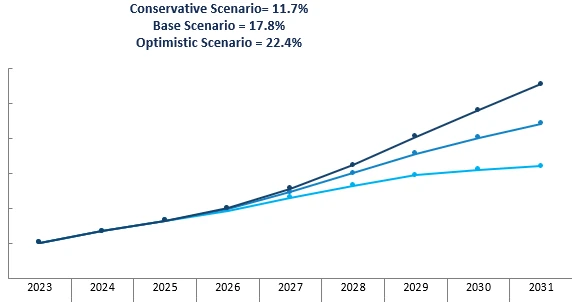
Under the base-case scenario, market revenue is expected to increase from $19.80 billion in 2026 to $24.60 billion in 2027, $29.91 billion in 2028, and $35.47 billion in 2029. Revenue is subsequently projected to reach $40.04 billion in 2030 before achieving $44.03 billion in 2031. This trajectory reflects increasing commercial adoption of established ADC products, expansion into earlier treatment lines, and additional indications across solid tumors.
The conservative scenario estimates a CAGR of 11.7%, with revenue reaching $32.01 billion by 2031. The optimistic scenario projects a CAGR of 22.4%, potentially increasing market revenue to $55.32 billion during the same period. These scenarios reflect differences in clinical success rates, regulatory approvals, market adoption, pricing conditions, and manufacturing scalability.
Solid tumors are expected to contribute significantly to incremental revenue growth because of their broader patient populations and expanding clinical applications. However, pricing pressure, reimbursement restrictions, and competitive treatment modalities may influence revenue realization. Overall, the ADC market is positioned for strong expansion, with clinical differentiation and manufacturing capacity emerging as critical factors supporting forecast growth.
Growth Drivers: Antibody-Drug Conjugate (ADC) Therapeutics Market
The Antibody-Drug Conjugate (ADC) Therapeutics Market is supported by several significant growth drivers:
- Earlier-Line Treatment Adoption: Expansion of validated ADC products into earlier-line and curative-intent treatment settings is increasing eligible patient populations and commercial opportunities.
- China-Originated Pipeline Expansion: Cross-border licensing agreements and partnerships are strengthening global development pipelines, with China emerging as an important source of innovative ADC assets.
- ADC CDMO Capacity Development: Increasing demand for specialized bioconjugation, high-potency containment, and sterile fill-finish services is creating opportunities for dedicated CDMOs.
- Immunotherapy Combination Strategies: Combining ADCs with PD-1 and PD-L1 checkpoint inhibitors is expanding clinical development opportunities across multiple cancer indications.
- Advanced Conjugation Technologies: Site-specific conjugation, linker-payload innovation, bispecific ADCs, and dual-payload technologies are creating opportunities for differentiated therapeutic products.
These drivers are expected to support market expansion throughout the 2026–2031 forecast period.
Growth Restraints: Antibody-Drug Conjugate (ADC) Therapeutics Market
Despite strong commercial prospects, the Antibody-Drug Conjugate (ADC) Therapeutics Market faces several structural, clinical, and operational restraints that could influence its growth trajectory through 2031.
Conjugation and Fill-Finish Bottlenecks: ADC manufacturing requires specialized bioconjugation infrastructure, high-potency containment systems, and sterile fill-finish capabilities. These facilities involve significant capital expenditure, complex operational requirements, and stringent quality controls. Commercial ADC manufacturing can require substantial investment, with some facilities costing hundreds of millions of dollars. Limited availability of qualified manufacturing partners creates capacity constraints, potentially increasing production costs and delaying commercialization. Access to specialized OEB-5/OEB-6 containment infrastructure is particularly important for handling highly potent payloads.
Payload-Class Concentration and Cross-Resistance: The growing dependence on topoisomerase-I inhibitor payloads creates clinical and commercial concentration risks. More than 100 topoisomerase-I inhibitor ADCs have entered clinical trials, increasing competition around a relatively narrow set of therapeutic mechanisms. Emerging resistance mechanisms may reduce treatment effectiveness, particularly when multiple products rely on similar payload technologies. This situation increases the need for alternative payload classes and differentiated therapeutic approaches.
Pricing and Reimbursement Compression: Healthcare payer restrictions and evolving reimbursement policies may influence the commercial performance of ADC products. Pricing negotiations, cost-containment initiatives, and changes in reimbursement frameworks can limit revenue growth. In the United States, policy changes involving Medicare drug pricing may create additional pressure on manufacturers over time. Companies must demonstrate meaningful clinical and economic value to support premium pricing and market access.
Narrow Therapeutic Windows and Class Toxicity: ADCs can produce clinically significant adverse effects, including interstitial lung disease, ocular toxicity, and hematological toxicity, depending on the antibody, linker, payload, and target. Toxicity risks may restrict patient eligibility, complicate treatment combinations, and require additional monitoring. These challenges are particularly important when developers pursue earlier-line treatment settings involving potentially curable patient populations.
Competition from Adjacent Modalities: Radioligand therapy, CAR-T cell therapies, and bispecific antibodies are competing with ADCs across selected oncology indications. Although these modalities do not directly replace ADCs across all treatment settings, they influence clinical development priorities, investment allocation, and treatment sequencing. Their increasing adoption could intensify competitive pressure in specific therapeutic categories.
Competitive Landscape: Antibody-Drug Conjugate (ADC) Therapeutics Market
The global Antibody-Drug Conjugate (ADC) Therapeutics Market is highly concentrated, with the top five competitors accounting for approximately 93.7% of total market revenue in 2025. The study identifies 14 marketing-authorization holders reporting ADC product revenue above $1 million during the year. Leading competitors include Daiichi Sankyo/AstraZeneca, Roche/Genentech, Pfizer/Astellas (with Genmab), Gilead Sciences, and Takeda. Other notable participants include AbbVie, GSK, Merck & Co., ADC Therapeutics, Genmab, and China-originated developers such as Jiangsu Hengrui, Kelun-Biotech, Remegen, and Lepu Biopharma.
Competition is increasingly influenced by payload innovation, linker chemistry, drug-to-antibody ratio consistency, clinical efficacy, treatment positioning, and manufacturing capacity. Strategic licensing agreements and acquisitions are important routes for accessing differentiated technologies and strengthening development pipelines. As the ADC market evolves, companies with proprietary conjugation platforms, strong clinical evidence, established CDMO partnerships, and scalable manufacturing infrastructure are expected to maintain competitive advantages.
Scope of Analysis
Segmentation
Why is it Increasingly Difficult to Grow?
The Strategic Imperative 8™
The Impact of the Top 3 Strategic Imperatives on the ADC Industry
Growth Metrics
Growth Environment—Key Trends Impacting ADC Market Growth
Key Trends Impacting ADC Market Growth
Value Chain
Competitive Environment
Key Competitors
ADCs—Value Chain Key Stakeholders
Epidemiology—ADC-Approved Tumor Types
Pipeline Analysis—Global ADC Pipeline Landscape
Pipeline Analysis—Clinical-Stage ADC Assets by Tumor Type
Pipeline Analysis—Topoisomerase-I Tops the Target Chart
Pipeline Analysis—By Company
Pipeline Analysis—Payload Chemistry Concentration
Pipeline Analysis—Bispecific ADCs Are 17% of the Pipeline
Pipeline Analysis—Late-Stage Watch List
Pipeline Analysis—Implications by Stakeholder
Notable ADC Venture Financing Deals
Notable ADC Partnerships—Key Takeaways
Notable ADC Partnerships 2025–2026
Growth Drivers
Growth Restraints
Forecast Considerations
Revenue Forecast
Revenue Forecast by Cancer Type
Revenue Forecast by Region
Revenue Forecast Analysis
Recently Launched ADCs to Watch
Late-Stage ADCs to Watch
Pricing Trends and Forecast Analysis
Revenue Share
Revenue Share Analysis
Growth Metrics
Revenue Forecast
Revenue Forecast Analysis
Growth Metrics
Revenue Forecast
Revenue Forecast Analysis
Growth Opportunity 1: Develop ADCs Against Newer Cancer Targets
Growth Opportunity 2: Own the Next ADC Payload Class Beyond Topo-I
Growth Opportunity 3: Develop Bispecific and Dual-Payload ADCs
Growth Opportunity 4: Move ADCs into First-Line Treatment by Combining Them with Immunotherapy
Growth Opportunity 5: Build High-Potency Fill-Finish, Payload Handling, and Regional Payload Supply
Benefits and Impacts of Growth Opportunities
Next Steps
List of Exhibits
Legal Disclaimer
Frequently Asked Questions: Antibody-Drug Conjugate (ADC) Therapeutics Market
1. What is the Antibody-Drug Conjugate (ADC) Therapeutics Market?
The Antibody-Drug Conjugate (ADC) Therapeutics Market covers targeted cancer therapies that combine monoclonal antibodies with potent cytotoxic payloads to selectively deliver drugs to tumor cells expressing specific antigens.
2. What is the global ADC market size in 2025?
The global ADC market generated approximately $16.46 billion in revenue in 2025.
3. What is the projected ADC market size by 2031?
The global Antibody Drug Conjugates Market is projected to reach $44.03 billion by 2031, registering a CAGR of 17.8% between 2025 and 2031.
4. What are the major factors driving the ADC therapeutics market?
Major growth drivers include earlier-line treatment adoption, expanding oncology indications, China-originated pipeline development, immunotherapy combinations, and innovations in payloads, linkers, and conjugation technologies.
5. Which segment dominates the ADC therapeutics market?
Solid tumors represent the major growth opportunity, supported by expanding ADC applications in breast, lung, urothelial, gastric, and gynecological cancers. Hematological cancers remain an established therapeutic segment.
6. Who are the leading companies in the global ADC market?
Leading companies include Daiichi Sankyo, AstraZeneca, Roche, Genentech, Pfizer, Astellas, Gilead Sciences, and Takeda. Other notable participants include AbbVie, GSK, Merck & Co., Genmab, and ADC Therapeutics.
7. What are the major technologies shaping the Antibody-Drug Conjugates Market?
Key technologies include topoisomerase-I inhibitor payloads, site-specific conjugation, hydrophilic linkers, bispecific ADCs, dual-payload formats, and advanced drug-to-antibody ratio optimization.
8. What are the major challenges facing the ADC market?
Major challenges include manufacturing capacity limitations, high-potency containment costs, payload resistance, treatment-related toxicity, pricing pressure, and reimbursement restrictions.
Speak directly with our analytics experts for tailored recommendations.
Recent related In Vitro Diagnostics (IVD) research
20 Nov 2026 | Global | Technology Research
Innovations and Growth Opportunities in Precision Therapeutics, Advanced Delivery Systems, AI-Enabled Discovery and Bioengineering, and Next-Generation Immunotherapies and Vaccines
This edition of the Life Science, Health & Wellness Technology Opportunity Engine (TOE) provides a comprehensive overview of translational innovations advancing precision therapeutics, advanced delivery systems, AI-enabled discovery, genetic medicine, cell therapy, and next-generation vaccines acros...
17 Nov 2026 | Global | Frost Radar
Frost Radar™: Quantum-Grade Sensor Technology Ecosystem for Healthcare Applications, 2026
Quantum-grade sensors are advancing healthcare by leveraging quantum phenomena to enable highly sensitive, precise, and non-invasive measurements of biological signals and physiological parameters. These innovations enhance diagnostic accuracy, disease monitoring, brain activity measurement, and ear...
16 Oct 2026 | Global | Technology Research
Innovations and Growth Opportunities in Precision Therapeutics, AI-Enabled Discovery and Bioengineering, Regenerative Medicine, and Next-Generation Vaccine Platforms
This edition of the Life Science, Health & Wellness Technology Opportunity Engine (TOE) provides a comprehensive overview of breakthrough innovations transforming precision therapeutics, regenerative medicine, AI-enabled discovery, laboratory automation, targeted delivery, vaccines, and biomanufactu...
18 Sep 2026 | Global | Frost Radar
Frost Radar™: Life Sciences Laboratory Information Management Systems, 2026
Laboratory information management systems (LIMS) have been used in life sciences since laboratories began digitizing sample tracking and data management in the 1970s. Modern LIMS solutions enhance efficiency by automating workflows, improving data accuracy, and enabling seamless integration and offe...
18 Sep 2026 | Global | Technology Research
Innovations and Growth Opportunities in AI-Enabled Discovery and Diagnostics, Precision Therapeutics, and Next-Generation Vaccine Platforms
This edition of the Life Science, Health & Wellness Technology Opportunity Engine (TOE) provides a comprehensive overview of breakthrough innovations transforming AI-enabled discovery, precision diagnostics, cell engineering, targeted therapeutics, vaccines, and skin health across oncology, metaboli...
Purchase includes:
- Report download
- Growth Dialog™ with our experts
Growth Dialog™
A tailored session with you where we identify the:- Strategic Imperatives
- Growth Opportunities
- Best Practices
- Companies to Action
Impacting your company's future growth potential.