 USD
USD GBP
GBP  CNY
CNY  EUR
EUR  INR
INR  JPY
JPY  MYR
MYR  ZAR
ZAR  KRW
KRW  THB
THB 


Unprecedented Scale of Australia Bushfires Necessitates Disruptive Technologies and Alignment of Regulatory Policies to Improve Outcomes
16-Jun-2021
Asia Pacific
Market Research
PB86-01-00-00-00
EN01248-AP-MT_25500
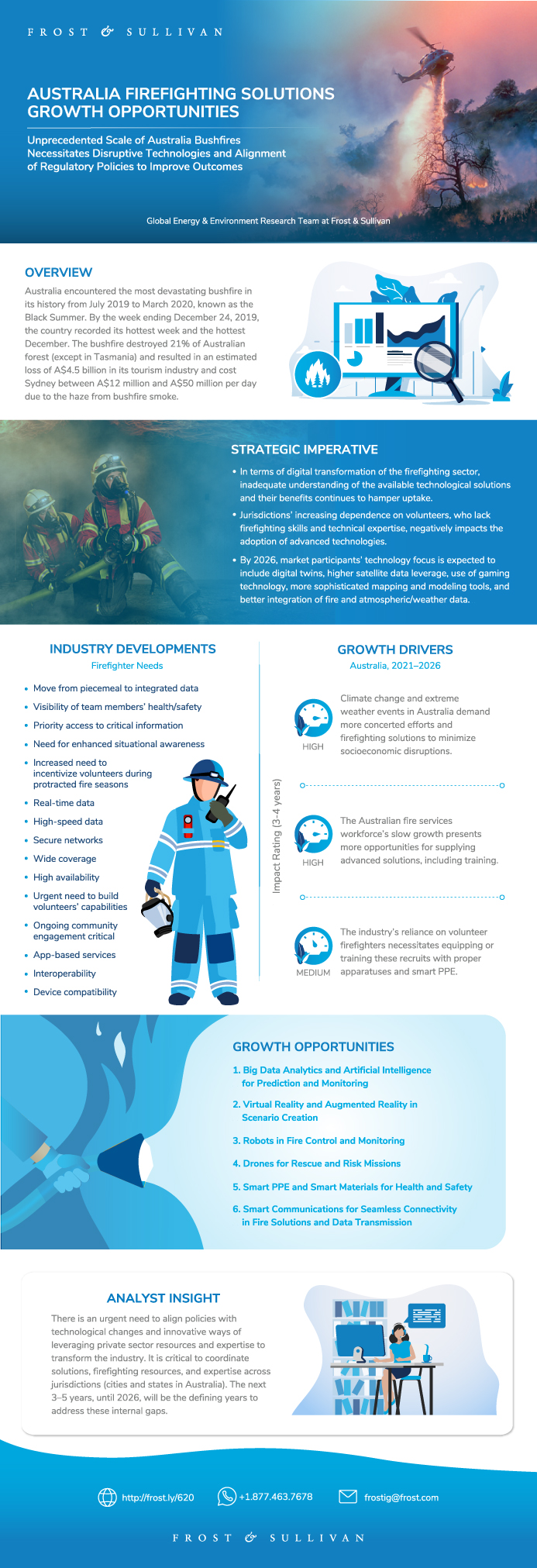
Australia encountered the most devastating bushfire in its history from July 2019 to March 2020, known as the Black Summer. By the week ending December 24, 2019, the country recorded its hottest week and the hottest December. The bushfire destroyed 21% of Australian forest (except in Tasmania) and resulted in an estimated loss of A$4.5 billion in its tourism industry and cost Sydney between A$12 million and A$50 million per day due to the haze from bushfire smoke.
The unprecedented event necessitates ongoing collaboration among various stakeholders in the value chain, including researchers, government agencies, and technology providers, which is imperative for any participant to thrive in Australia’s firefighting solutions market. With several solutions needed and no single vendor capable of delivering total solutions, creating synergies through strategic partnerships within the technology ecosystem and with fire departments and research organizations is vital. Such collaborations will lead to technology focus that includes digital twins, higher use of satellite data, gaming technology, more sophisticated mapping and modeling tools, and improved integration of fire and atmospheric/weather data.
There is an urgent need to align policies with technological changes and innovative ways of leveraging private sector resources and expertise to transform the industry. It is critical to coordinate solutions, firefighting resources, and expertise across jurisdictions (cities and states in Australia). The next 3–5 years, until 2026, will be the defining years to address these internal gaps.
The firefighting solutions market must respond to the current COVID-19 pandemic with comprehensive scenario-based planning and risk mitigation strategies to address the unprecedented changes in social behavior, business activity, and human resource management.
Research Highlights
This study focuses on firefighting solutions for bushfires. Bushfires (also known as forest fires, wildfires or brushfires) are fires that spread rapidly and uncontrollably in woodlands/grasslands. Disruptive technologies that impact the future of firefighting discussed in this study include Big Data analytics (BDA), artificial intelligence (AI), virtual reality (VR), augmented reality (AR), robots, drones, smart personal protective equipment (PPE), smart materials, and smart communications.
The research excludes the passive fire protection market (such as fire-resistance-rated walls/floors, fire/smoke dampers, fire doors), fire detectors, alarms, and sprinklers in buildings. It defines end users as solutions buyers, such as Australian fire departments and state emergency services.
The study presents main market challenges, disruptive technologies that improve firefighting outcomes, key critical successful factors, and examples of innovative companies.
Author: Ivan Fernandez
Why Is It Increasingly Difficult to Grow?
The Strategic Imperative 8™
The Impact of the Top Three Strategic Imperatives on the Australia Firefighting Solutions Industry
Growth Opportunities Fuel the Growth Pipeline Engine™
Firefighting Solutions Scope of Analysis
Black Summer Bushfires, 2019–2020
Australia’s Black Summer Bushfires, 2019–2020
Growth Drivers for the Firefighting Solutions Market
Growth Restraints for the Firefighting Solutions Market
Growth Driver Analysis for the Firefighting Solutions Market
Growth Driver Analysis for the Firefighting Solutions Market (continued)
Growth Driver Analysis for the Firefighting Solutions Market (continued)
Growth Restraint Analysis for the Firefighting Solutions Market
Growth Restraint Analysis for the Firefighting Solutions Market (continued)
Growth Restraint Analysis for the Firefighting Solutions Market (continued)
Market Trends—Firefighter Needs that Impact Technologies Uptake
Industry Structure
Types of Competitors
Solutions Case Study—Motorola Solutions
Growth Opportunity 1: Big Data Analytics and Artificial Intelligence for Prediction and Monitoring
Growth Opportunity 1: Big Data Analytics and Artificial Intelligence for Prediction and Monitoring (continued)
Growth Opportunity 2: Virtual Reality and Augmented Reality in Scenario Creation
Growth Opportunity 2: Virtual Reality and Augmented Reality in Scenario Creation (continued)
Growth Opportunity 3: Robots in Fire Control and Monitoring
Growth Opportunity 3: Robots in Fire Control and Monitoring (continued)
Growth Opportunity 4: Drones for Rescue and Risk Missions
Growth Opportunity 4: Drones for Rescue and Risk Missions (continued)
Growth Opportunity 5: Smart PPE and Smart Materials for Health and Safety
Growth Opportunity 5: Smart PPE and Smart Materials for Health and Safety (continued)
Growth Opportunity 6: Smart Communications for Seamless Connectivity in Fire Solutions and Data Transmission
Growth Opportunity 6: Smart Communications for Seamless Connectivity in Fire Solutions and Data Transmission (continued)
Innovation Examples—BDA and AI
Innovation Examples—AR/VR
Innovation Examples—Robots and Drones
Innovation Examples—Smart PPE and Smart Materials
Innovation Examples—Smart Communications
Key Success Factors
Future Directions—Policy and Funding
Future Directions—Enabling Technology
Future Directions—Responding to Pandemics
List of Exhibits
Legal Disclaimer
Speak directly with our analytics experts for tailored recommendations.
Recent related Environment research
02 Oct 2026 | Global | Technology Research
Innovations in Carbon Capture, Waste Conversion, Wastewater Treatment, Bioreactors, Artificial Protein and Plastic Recycling
This edition of the Industrial Bioprocessing TOE features information on carbon capture, waste conversion, wastewater treatment, bioreactors, artificial protein and plastic recycling among others.The Industrial Bioprocessing TOE provides intelligence on technologies, processes and strategic insights...
25 Sep 2026 | South Asia, Middle East & North Africa | Market Research
Circular Economy for Used Electrical and Electronic Equipment (Used EEE) and ITAD Services Market, India, 2025–2032
The circular economy for used electrical and electronic equipment (used EEE) in India is experiencing transformational growth as an expanding domestic electronics manufacturing industry, rapid digitalization, and shorter electronics replacement cycles intersect with a stricter policy environment and...
22 Sep 2026 | Europe | Strategic Imperatives
Top 8 Strategic Imperatives for the Membrane-Based Water & Wastewater Treatment Systems Market, Europe, 2026
Europe has been faced with unprecedented heatwaves and droughts triggered by climate change. This has affected surface and groundwater availability across regions, leading to water use restrictions and investment in water reuse infrastructure.Southern European countries such as Spain, Cyprus, Malta,...
17 Sep 2026 | Asia Pacific | Frost Radar
Frost Radar™: Facility Management in Malaysia, 2026
Malaysia's facility management (FM) market is transitioning from labor-intensive, compliance-driven service delivery to technology-enabled, outcome-oriented, and sustainability-integrated operating models. Competitive differentiation increasingly depends on providers’ ability to combine integrated F...
16 Sep 2026 | Europe | Frost Radar
Frost Radar™: European Membrane-Based Water and Wastewater Treatment Systems, 2026
Most parts of Europe face recurring droughts as below-average rainfall combined with heatwaves exacerbate water stress. The latest revision of European Union wastewater directives has driven nations to invest in tertiary treatment of wastewater and proactively encouraged water reuse to meet agricult...
Purchase includes:
- Report download
- Growth Dialog™ with our experts
Growth Dialog™
A tailored session with you where we identify the:- Strategic Imperatives
- Growth Opportunities
- Best Practices
- Companies to Action
Impacting your company's future growth potential.
Research Highlights
This study focuses on firefighting solutions for bushfires. Bushfires (also known as forest fires, wildfires or brushfires) are fires that spread rapidly and uncontrollably in woodlands/grasslands. Disruptive technologies that impact the future of firefighting discussed in this study include Big Data analytics (BDA), artificial intelligence (AI), virtual reality (VR), augmented reality (AR), robots, drones, smart personal protective equipment (PPE), smart materials, and smart communications.
The research excludes the passive fire protection market (such as fire-resistance-rated walls/floors, fire/smoke dampers, fire doors), fire detectors, alarms, and sprinklers in buildings. It defines end users as solutions buyers, such as Australian fire departments and state emergency services.
The study presents main market challenges, disruptive technologies that improve firefighting outcomes, key critical successful factors, and examples of innovative companies.
Author: Ivan Fernandez
| Deliverable Type | Market Research |
|---|---|
| No Index | No |
| Podcast | No |
| Predecessor | NA |
| Author | Ivan Fernandez |
| Industries | Environment |
| WIP Number | PB86-01-00-00-00 |
| Is Prebook | No |
| GPS Codes | 9343-A4 |
Australia Firefighting Solutions Growth Opportunities
$2,450.00
Special Price $1,837.50 save 25 %