 USD
USD GBP
GBP  CNY
CNY  EUR
EUR  INR
INR  JPY
JPY  MYR
MYR  ZAR
ZAR  KRW
KRW  THB
THB 


Automotive OEMs Passenger Car and Light Duty Truck Lightweighting Strategies, Forecast to 2025
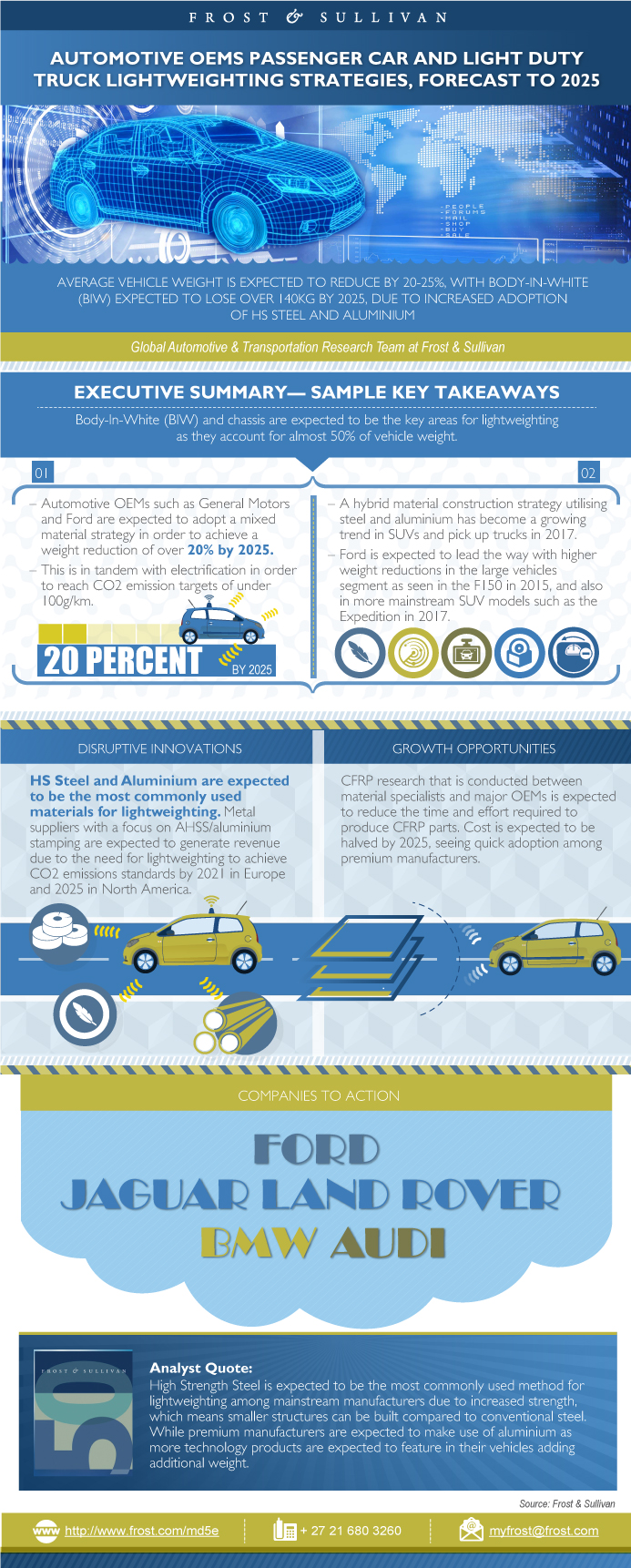
Average Vehicle Weight is Expected to Reduce by 20-25%, with Body-In-White (BIW) Expected to Lose Over 140kg by 2025, Due to Increased Adoption of HS Steel and Aluminium
02-Jan-2018
Global
Market Research
MD5E-01-00-00-00
AU01625-GL-MR_21406
The carbon emissions target for North America and Europe is to achieve below 100 g/km (97 in North America by 2025 and 95 in Europe by 2021). Advances in powertrain technology are expected to significantly reduce CO2 emissions, but alternate methods must be employed in order to assist a fuel-efficient powertrain. Lightweighting strategy is expected to help reduce CO2 emissions. In 2016, the average vehicle weight in Europe was around 1,380 kg and the average vehicle weight in North America around 1,800 kg. Increasing SUV sales implies the need to reduce weight in order to achieve the CO2 emissions target before the deadlines.
Research Scope
This study provides a strategic overview of the lightweighting strategies of major global automotive OEMs and the advanced materials expected to be implemented in future models of their current lineup. The research delves into the CO2 emissions standards that are expected to be met by 2021 in Europe and 2025 in North America, and the weight reduction goals manufacturers have to set for the next few years. The research also deals with material trends and areas on the vehicle where such materials are expected to be implemented between 2017 and 2025, while also highlighting the different strategies employed in passenger vehicles and light duty trucks. The research extends to discussing the various trends major that OEMs are likely to follow, based on body styles and segments.
Research Highlights
This research identifies the weight reduction that can be achieved in key areas:
- Body Chassis including components such as body panels, liftgates and doors.
- Interiors including parts such as dashboard, seats and inner frames.
- Powertrain including components on the engine such as cylinder block, oil pan, pistons. Within the powertrain segment, the research elaborates on the impact of various alternate powertrains on the weight of the vehicle, while also evaluating the advantages of future battery chemistries.
Key Features
The study lists the strategies used by major OEMs for recent vehicle releases and the weight reduction achieved when compared to previous generation models. It also talks about anticipated lightweighting strategies likely to be used in future vehicles to be launched by these OEMs. The research includes information on major material suppliers and their OEM partners, in addition to a snapshot of lightweighting suppliers and their key focus areas.
Key Conclusion
In conclusion, the research predicts the weight of an average vehicle in the future, highlighting the weight reductions in key areas.
Key Takeaways
Key Predictions
North American Vehicle Weight Trends
European Vehicle Weight Trends
OEM Carbon Emissions
Current and Future Outlook
Research Scope, Aims and Objectives
Research Aims and Objectives
Research Methodology
Key Questions this Study Will Answer
OEM Lightweighting Strategies
Recent OEM Launches—Lightweighting
Recent OEM Launches—Lightweighting (continued)
Future Vehicles—Lightweighting Strategy
Future Vehicles—Lightweighting Strategy (continued)
Snapshot of Current Lightweighting Materials Suppliers
Lightweighting Strategies—Approach
Lightweighting Strategies—Standard Approach
Lightweighting Strategies—Customised Approach
Lightweighting Strategies—Performance Approach
Lightweighting Approach—Materials
Lightweighting Strategies—Hatchbacks
Lightweighting Strategies—Sedans
Lightweighting Strategies—SUVs/MPVs
Lightweighting Strategies—Pickup Trucks
Lightweighting Strategies—Sports Vehicles
Lightweighting Strategies for Electric Vehicles
Body Styles—Future Scenario
Material Strategy—Highlights
Material Strategy—2017 and 2025 Vehicle Material Composition
Material Strategy—High Strength Steel
Materials Strategy—Aluminium
Materials Strategy—Magnesium
Materials Strategy—CFRP
Materials Strategy—Plastics
Material Strategy—Future Scenario
Materials—Weight Distribution
Lightweighting Strategies—Chassis and Exterior: Key Components
Lightweighting Strategies—Interior: Key Components
Lightweighting Strategies—Powertrain: Key Components
Lightweighting Strategies—Powertrain: Comparison
Lightweighting Strategies—Battery Technology and Weight
Lightweighting Strategies—Future Scenario
Automotive Lightweighting Growth Opportunities
Strategic Imperatives for Success and Growth
Key Conclusions
Legal Disclaimer
Key Abbreviations used
List of Exhibits
List of Exhibits (continued)
The Frost & Sullivan Story
Value Proposition—Future of Your Company & Career
Global Perspective
Industry Convergence
360º Research Perspective
Implementation Excellence
Our Blue Ocean Strategy
Speak directly with our analytics experts for tailored recommendations.
Recent related Business Strategy and Innovation research
06 Jun 2023 | Global | Market Outlook
Automotive Outlook, 2023
Global light vehicle (LV) sales reached 79.9 million units in 2022, registering 1.3% lower sales than in 2021. China was the top-selling market with 25.7 million units, ahead of the United States at 13.9 million and Japan at 4.1 million. The Russo-Ukrainian War resulted in production delays owing to...
30 May 2023 | North America | Market Research
Global Autonomous Shuttle Growth Opportunities
This research service provides a broad view of the autonomous shuttle market. It analyzes recent developments and key challenges and offers the latest updates on market size, forecasts, and regional trends. The study provides a detailed analysis of the autonomous shuttle markets in North America, Eu...
10 May 2023 | North America | Market Outlook
Global Shared Mobility Outlook, 2023
The pandemic has definitely brought about a lot of positive changes in the way people are moving. In this research analytics, we look at some key factors that we think will drive the demand for shared mobility. First is the pandemic-induced digital acceleration. People are now more open to using mob...
26 Apr 2023 | Latin America | Market Outlook
LATAM Automotive Growth Outlook 2023
The Latin American automotive industry continues to grow, despite COVID-19, scarcity of resources and auto parts, the Russo-Ukrainian War, inflation, and exchange rates affecting vehicles’ availability and prices. With 4.4 million units sold and a slow recovery from the pandemic, Latin American a...
26 Apr 2023 | Asia Pacific | Market Outlook
China Automotive Outlook 2023
This study assesses the automotive market in China, focusing on the passenger vehicle (PV) market. Within this, Frost & Sullivan will also discuss electric vehicles (EVs), charging, and battery swapping. China’s automotive market has proliferated, particularly after the 2008 Beijing Olympics. T...
Purchase includes:
- Report download
- Growth Dialog™ with our experts
Growth Dialog™
A tailored session with you where we identify the:- Strategic Imperatives
- Growth Opportunities
- Best Practices
- Companies to Action
Impacting your company's future growth potential.
Research Scope
This study provides a strategic overview of the lightweighting strategies of major global automotive OEMs and the advanced materials expected to be implemented in future models of their current lineup. The research delves into the CO2 emissions standards that are expected to be met by 2021 in Europe and 2025 in North America, and the weight reduction goals manufacturers have to set for the next few years. The research also deals with material trends and areas on the vehicle where such materials are expected to be implemented between 2017 and 2025, while also highlighting the different strategies employed in passenger vehicles and light duty trucks. The research extends to discussing the various trends major that OEMs are likely to follow, based on body styles and segments.
Research Highlights
This research identifies the weight reduction that can be achieved in key areas:
- Body Chassis including components such as body panels, liftgates and doors.
- Interiors including parts such as dashboard, seats and inner frames.
- Powertrain including components on the engine such as cylinder block, oil pan, pistons. Within the powertrain segment, the research elaborates on the impact of various alternate powertrains on the weight o
| Deliverable Type | Market Research |
|---|---|
| No Index | No |
| Podcast | No |
| Author | Venkata Balakrishnan |
| Industries | Automotive |
| WIP Number | MD5E-01-00-00-00 |
| Is Prebook | No |
Automotive OEMs Passenger Car and Light Duty Truck Lightweighting Strategies, Forecast to 2025
$4,950.00
Special Price $3,712.50 save 25 %