 USD
USD GBP
GBP  CNY
CNY  EUR
EUR  INR
INR  JPY
JPY  MYR
MYR  ZAR
ZAR  KRW
KRW  THB
THB 


OEM Supply Chain Diversification and Demand for Zero-Defect Manufacturing to Drive Growth By 2030
29-Dec-2025
Global
Market Research
PG5Y-01-00-00-00
TM_2026_34259
Report Summary: Body in White (BIW) Market
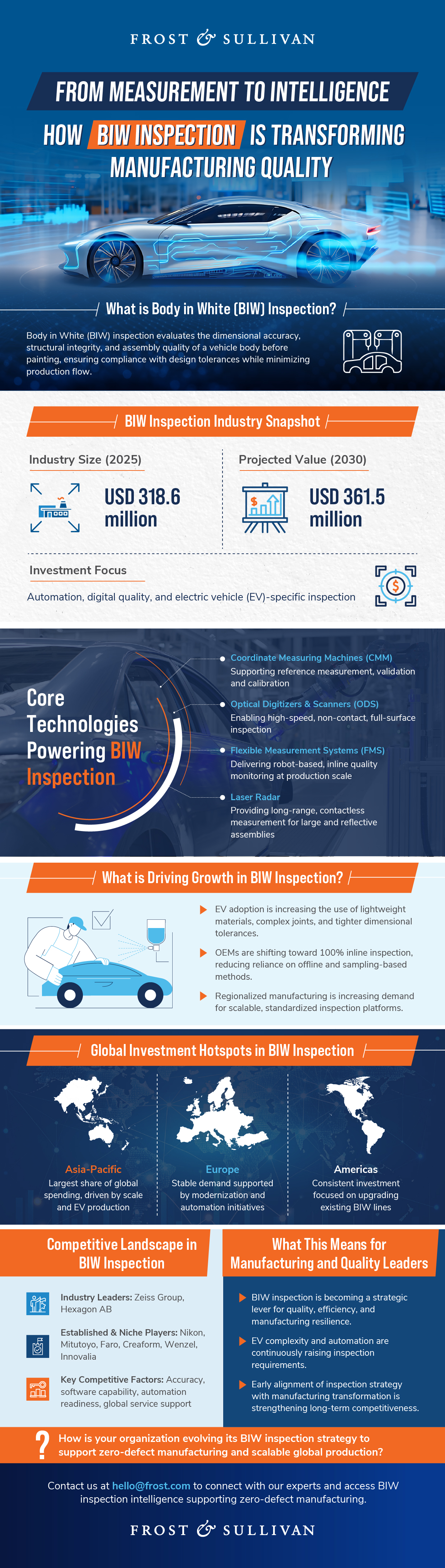
The global automotive body-in-white market, focused on Body in White (BIW) inspection systems, was valued at USD 318.6 million in 2025 and is projected to reach USD 361.5 million by 2030, growing at a CAGR of 2.6% from 2025 to 2030. Market growth is supported by increasing adoption of automated inspection technologies, rising electric vehicle (EV) manufacturing complexity, and OEM focus on zero-defect production and dimensional accuracy.
Key Market Trends & Insights
- Asia-Pacific accounted for the largest share of the global body in white market, driven by high vehicle production volumes and expanding EV manufacturing capacity.
- In automotive manufacturing plants, increasing deployment of inline and automated BIW inspection systems is improving first-time quality and reducing rework rates.
- By inspection technology, optical digitizers and scanners held the largest share due to their speed, flexibility, and suitability for complex BIW geometries.
- The automotive body-in-white market is transitioning from traditional coordinate measuring machines toward flexible measurement systems and laser radar solutions.
- Growing use of lightweight materials and mixed-material structures is increasing inspection requirements within the Body in White (BIW) market.
Market Size & Forecast
- 2025 Market Size: USD 318.6 Million
- 2030 Projected Market Size: USD 361.5 Million
- CAGR (2025–2030): 2.6%
- Asia-Pacific: Largest Market
- Americas & Europe: Mature, technology-upgrade–driven markets
The continued modernization of automotive manufacturing facilities and the shift toward data-driven quality assurance are expected to support steady growth in the automotive body-in-white market through the forecast period.
Market Overview & Trends: Body in White (BIW) Market
The automotive body-in-white market plays a foundational role in vehicle manufacturing, encompassing the stage where sheet-metal components are welded to form the vehicle structure prior to painting. Inspection at this stage is essential to ensure dimensional accuracy, structural integrity, and compliance with increasingly stringent quality standards. As a result, the Body in White (BIW) market has become a focal point for OEM investments in automation and smart manufacturing.
A key structural trend shaping the body in white market is the shift from offline, sampling-based inspection toward 100% inline inspection. Traditional inspection approaches are increasingly inadequate due to higher production speeds, reduced takt times, and the growing use of lightweight materials. Inline inspection systems enable continuous monitoring of dimensional accuracy, allowing OEMs to detect deviations in real time and reduce rework and scrap.
Another major trend in the automotive body-in-white market is the rapid adoption of optical and non-contact inspection technologies. Optical digitizers and scanners offer high-speed measurement and flexibility, making them well suited for EV platforms that use aluminum, mixed materials, and complex geometries. Flexible measurement systems, often robot-based, are increasingly integrated directly into production lines to support automated quality control.
Software and analytics capabilities are also becoming central to the Body in White (BIW) market. OEMs are deploying inspection software that supports digital twins, statistical process control, and predictive quality analytics. These capabilities enable closed-loop manufacturing, where inspection data feeds directly back into process optimization.
Regionally, Asia-Pacific leads demand due to large-scale vehicle production and rapid EV capacity expansion. In contrast, Europe and the Americas are characterized by stable demand driven by regulatory compliance, precision manufacturing requirements, and modernization of existing inspection infrastructure. Collectively, these trends are reshaping the body in white market into a technology-driven, data-centric segment of automotive manufacturing.
Scope of Analysis: Body in White (BIW) Market
This analysis examines the global automotive body-in-white market with a specific focus on inspection systems used during BIW manufacturing and assembly. The study period spans 2022–2030, with 2025 as the base year and 2026–2030 as the forecast period. All market values are presented in US dollars.
The scope of the Body in White (BIW) market includes inspection equipment and associated software used for dimensional measurement and quality assurance. Covered technologies include coordinate measuring machines, optical digitizers and scanners, flexible measurement systems, and laser radar solutions. Revenues from installation, maintenance services, and aftermarket support are excluded.
Geographic coverage includes Asia-Pacific, the Americas, Europe, and Rest of the World. The analysis focuses on OEM and Tier-1 supplier adoption patterns within the body in white market, reflecting demand across both internal combustion engine and electric vehicle platforms.
Methodologically, the study integrates secondary research, OEM production data, technology adoption trends, and expert interviews. Forecasts are developed using historical market performance, technology transition rates, and regional automotive production outlooks. Segment-level revenue splits are intentionally excluded to maintain consistency with the defined analytical scope of the automotive body-in-white market.
Revenue & Spending Forecast: Body in White (BIW) Market
The global automotive body-in-white market demonstrates moderate but stable revenue growth, reflecting its mature industry structure and critical role in automotive manufacturing. According to the study, the Body in White (BIW) market generated USD 318.6 million in 2025 and is forecast to reach USD 361.5 million by 2030, growing at a CAGR of 2.6% over the forecast period.

Spending growth in the body in white market is primarily driven by OEM investments in automation, digital quality control, and EV-specific inspection requirements rather than expansion in production volumes. As vehicle architectures become more complex, manufacturers are allocating capital toward advanced inspection technologies to maintain dimensional accuracy and reduce defect rates.
Although overall revenue growth remains modest, sustained investment in optical digitizers, flexible measurement systems, and software platforms supports consistent spending across regions. Asia-Pacific continues to account for the largest share of global spending, while Europe and the Americas maintain stable demand through modernization initiatives.
Market Segmentation Analysis: Body in White Market
The Body in White (BIW) market is segmented primarily by inspection technology type, reflecting varying levels of automation, flexibility, and integration within automotive production lines.
Coordinate Measuring Machines (CMMs) represent the most traditional inspection technology in the automotive body-in-white market. These systems are widely used for reference measurement and calibration but are increasingly limited by slower throughput and offline operation. As production speeds increase, CMMs are gradually being supplemented or replaced.
Optical Digitizers and Scanners (ODS) constitute the largest segment within the body in white market. These systems provide non-contact, high-speed measurement and are well suited for full-surface inspection. Their flexibility and accuracy make them particularly attractive for EV platforms with complex geometries and lightweight materials.
Flexible Measurement Systems (FMS) are gaining traction as OEMs pursue higher levels of automation. Typically robot-based, FMS solutions enable inline inspection directly on the production line, supporting continuous quality monitoring and reduced human intervention in the Body in White (BIW) market.
Laser Radar represents an emerging segment, offering long-range, absolute measurement capabilities. These systems are increasingly adopted for reflective surfaces and large BIW assemblies where traditional optical systems face limitations.
From an application perspective, BIW inspection systems are deployed across mass-production plants, EV-focused facilities, and prototype or low-volume manufacturing environments. Segmentation trends indicate a clear shift toward automated, inline, and software-enabled inspection solutions across the automotive body-in-white market.
Growth Drivers: Body in White Market
Key growth drivers shaping the automotive body-in-white market include increasing demand for zero-defect manufacturing and first-time quality optimization. OEMs are under pressure to reduce rework, scrap, and warranty costs, elevating the importance of advanced BIW inspection.
The transition toward electric vehicles is another major driver. EV platforms introduce new materials, tighter tolerances, and complex structural designs, increasing inspection requirements across the Body in White (BIW) market.
Rising adoption of automation and smart factory concepts further supports growth. Inline inspection systems enable real-time quality feedback, improving production efficiency and reducing downtime.
Finally, regulatory and traceability requirements are driving OEMs to implement comprehensive inspection and data-logging systems, reinforcing long-term demand in the body in white market.
Growth Restraints: Body in White Market
Despite its strategic importance, the automotive body-in-white market faces several constraints. High capital costs associated with advanced inspection systems limit adoption, particularly among smaller manufacturers and suppliers.
System complexity and the need for skilled operators also pose challenges, as OEMs struggle to align workforce capabilities with increasingly sophisticated inspection technologies. Additionally, the mature nature of the Body in White (BIW) market constrains growth, as demand is largely driven by replacement and upgrades rather than new capacity expansion.
Macroeconomic uncertainty and fluctuations in vehicle production volumes can further impact short-term investment decisions.
Competitive Landscape: Body in White (BIW) Market
The automotive body-in-white market exhibits a moderately fragmented competitive environment, with more than 20 companies generating annual revenues exceeding USD 1 million. Competition within the Body in White (BIW) market is shaped by long-standing technology expertise, established customer relationships with automotive OEMs, and the ability to deliver consistent performance across high-volume manufacturing environments.
Key competitive differentiation in the body in white market is primarily driven by cost efficiency, system performance, and customer relationships. Vendors compete on their ability to deliver accurate, reliable inspection solutions while maintaining competitive pricing and long-term support capabilities. Strong relationships with automotive OEMs and Tier-1 suppliers play a critical role in securing repeat business and long-term contracts, given the integration complexity of BIW inspection systems.
The primary end-user vertical for the automotive body-in-white market is the automotive industry, encompassing both internal combustion engine and electric vehicle manufacturing facilities. Demand is closely tied to OEM production strategies, automation investments, and quality control requirements at the BIW stage.
The competitive landscape is led by Zeiss Group and Hexagon AB, which together accounted for 50.5% of total market revenue in 2025, highlighting a degree of market concentration at the top end. These companies benefit from broad product portfolios, advanced software ecosystems, and strong global presence.
Other notable participants in the Body in White (BIW) market include Atlas Copco, Nikon, API Metrology, Inos Automation, LK Metrology, Wenzel Group, Mitutoyo Corporation, Creaform, Faro, ASF Metrology, Innovalia Metrology, and Scantech, many of which maintain strong niche or regional positions.
Distribution within the automotive body-in-white market is conducted through a mix of direct sales, distributors, resellers, and system integrators, reflecting the customized and project-driven nature of BIW inspection system deployment.
Scope of Analysis
Segmentation
Why is it Increasingly Difficult to Grow?
The Strategic Imperative 8™
The Impact of the Top 3 Strategic Imperatives on the BIW Inspection Industry
Value Chain
Competitive Environment
Key Competitors
Market Trends
Growth Metrics
Growth Drivers
Growth Driver Analysis
Growth Restraints
Growth Restraint Analysis
Forecast Considerations
Revenue Forecast
Revenue Forecast by Product
Revenue Forecast by Region
Revenue Forecast by Country
Revenue Forecast by Country
Revenue Forecast by Country
Revenue Forecast Analysis
Revenue Share
Growth Metrics
Revenue Forecast
Revenue Forecast by Region
Forecast Analysis—CMM
Growth Metrics
Revenue Forecast
Revenue Forecast by Region
Forecast Analysis—ODS
Growth Metrics
Revenue Forecast
Revenue Forecast by Region
Forecast Analysis—FMS
Growth Metrics
Revenue Forecast
Revenue Forecast by Region
Forecast Analysis—Laser Radar
Growth Opportunity 1: Electric Vehicles
Growth Opportunity 2: OEM Supply Chain Diversification
Growth Opportunity 3: Artificial Intelligence
Benefits and Impacts of Growth Opportunities
Next Steps
List of Exhibits
Legal Disclaimer
Frequently Asked Questions (FAQ) – Body in White (BIW) Market
1. What is the Body in White (BIW) market?
2. What was the market size of the automotive body-in-white market in 2025?
3. What is the projected market size by 2030?
4. What is the growth rate of the Body in White (BIW) market?
5. Which region dominates the automotive body-in-white market?
6. What are the key inspection technologies used in the BIW market?
7. Why is inline inspection gaining importance in the body in white market?
8. How is electric vehicle production influencing the BIW market?
9. Who are the leading participants in the Body in White (BIW) market?
10. What is the future outlook for the automotive body-in-white market?
Speak directly with our analytics experts for tailored recommendations.
Recent related Electronic Measurement research
05 Oct 2026 | Global | Market Research
Calibration and Repair Services Market, Global, 2025–2030
The global calibration and repair services market reached $4,096.8 million in 2025, driven by the increasing digitalization of calibration and repair services, integration with existing connected systems, real-time monitoring capabilities, and predictive analytics. Third-party service companies are ...
02 Oct 2026 | Global | Technology Research
Growth Opportunities in Contact-Rich Robot Skill AI, High-Speed Photopolymer 3D Printing, Industrial Interoperability, Vision AI, Pallet Shuttle Automation, In-Situ AM Inspection, and Composite 3D Printing
The Advanced Manufacturing Technology Opportunity Engine provides profiles of innovations related to simulation-trained contact skills enabling industrial robots to perform complex physical interactions and manipulation tasks; hybrid laser-DLP 3D printing systems combining additive technologies for ...
18 Sep 2026 | Global | Frost Radar
Frost Radar™: Laboratory Information Management Systems in Industrial Applications, 2026
Digitalization is transforming laboratory operations, resulting in a demand for cloud-based and AI-integrated laboratory information management systems (LIMS) to manage complex data and high volumes from automated systems. By combining these tools with software-as-a-service (SaaS) models, providers ...
11 Sep 2026 | Global | Market Research
Growth Impact of AI on the Communication Test Equipment Market, 2025–2030
Artificial intelligence (AI) is reshaping the global communication test equipment market by transforming product development, enabling intelligent and automated testing, and driving demand through next-generation communication infrastructure. This Frost & Sullivan analysis examines AI's impact acros...
04 Sep 2026 | Global | Technology Research
Growth Opportunities in Intralogistics Automation, Embodied Robotic Arms, Physical AI Training, Industrial AI, Service Robotics, Precision Farming Robots, and Laboratory Automation
The Advanced Manufacturing Technology Opportunity Engine provides profiles of innovations related to autonomous mobile robots (AMRs) enabling pallet and trolley transportation across dynamic intralogistics environments; compact 6-axis robotic systems supporting modular and flexible laboratory automa...
Purchase includes:
- Report download
- Growth Dialog™ with our experts
Growth Dialog™
A tailored session with you where we identify the:- Strategic Imperatives
- Growth Opportunities
- Best Practices
- Companies to Action
Impacting your company's future growth potential.
Using 2025 as the base year, this in-depth analysis covers BIW inspection products, including coordinate measuring machines (CMMs), optical digitizers and scanners (ODSs), flexible measurement systems (FMSs), and laser radar. The forecast period runs from 2026 to 2030. A regional perspective of demand patterns in the Americas, Europe, Asia-Pacific, and the Middle East and Africa. The study concludes with growth opportunities emerging from the BIW inspection space that market participants and stakeholders can leverage.
| Deliverable Type | Market Research |
|---|---|
| Industries | Test and Measurement Instrumentation |
| No Index | No |
| Is Prebook | No |
| Podcast | No |
| Predecessor | K793-01-00-00-00 |
| WIP Number | PG5Y-01-00-00-00 |