 USD
USD GBP
GBP  CNY
CNY  EUR
EUR  INR
INR  JPY
JPY  MYR
MYR  ZAR
ZAR  KRW
KRW  THB
THB 


Profilers Market, Global, 2025–2030
Increasing Inclination Toward Metrology 4.0 Solutions to Drive Transformational Growth by 2030
20-Feb-2026
Global
Market Research
PG1Q-01-00-00-00
TM_2026_34396
Report Summary: Profilers Market
The global profilers market was estimated at USD 387.3 million in 2025 and is projected to reach USD 593.3 million by 2030, expanding to a compound annual growth rate (CAGR) of 8.9% during the forecast period. Growth is primarily driven by the increasing penetration of Industry 4.0 solutions, rising demand for high-precision dimensional metrology, and the accelerating transition toward automated and data-driven manufacturing environments.
The integration of advanced 2D and 3D profiling systems within smart factories is enabling real-time inspection, predictive analytics, and closed-loop quality control. As manufacturers prioritize operational efficiency, product reliability, and regulatory compliance, profilers are increasingly being deployed as intelligent edge devices capable of seamless integration with enterprise systems such as ERP and QMS platforms.
Key Market Trends & Insights
- Europe accounted for the largest revenue share of the global profilers market in 2025.
- Growing adoption of automated production lines and digital inspection systems is accelerating demand for non-contact, high-speed profiling technologies.
- AI-driven analytics, machine learning integration, and cloud-connected metrology solutions are transforming profilers into intelligent quality monitoring systems.
- Rising emphasis on micron-level accuracy, repeatability, and inline inspection is strengthening demand across automotive, aerospace, and rail industries.
- Expansion of smart manufacturing investments globally is reinforcing long-term demand for integrated and robot-mounted profiling solutions.
Market Size & Forecast
- 2025 Market Size: USD 387.3 Million
- 2030 Projected Market Size: USD 593.3 Million
- CAGR (2025–2030): 8.9%
- Europe: Largest market in 2025
- Asia Pacific: Fastest-growing regional market
Increasing manufacturing complexity, stricter quality regulations, and the need for real-time inspection are accelerating the shift from mechanical gauges toward advanced profiling technologies. Manufacturers are embedding 2D/3D profilers into automated production systems to reduce defects, optimize throughput, and enhance traceability.
As digital transformation continues across industrial sectors, the profilers market is expected to play a critical role in enabling precision-driven, data-centric production ecosystems through 2030.
Market Overview: Profilers Market
The Profilers Market operates at the intersection of industrial automation, precision engineering, and digital manufacturing. Profilers measure surface dimensions, geometry, alignment, and structural integrity of components, enabling manufacturers to detect deviations and defects during production processes. As manufacturing complexity increases, demand for highly accurate and automated inspection solutions continues to rise.
Industrial transformation is a primary structural driver. Manufacturers are shifting toward smart factories characterized by interconnected machines, data-driven operations, and automated quality control. Profilers play a critical role in these environments by enabling real-time dimensional measurement and feedback-based process control. Their integration into robotic systems and automated inspection lines supports continuous production monitoring without human intervention.
Industry 4.0 adoption is reshaping product capabilities. Profilers are evolving from measurement tools into intelligent sensing platforms capable of generating operational data used for predictive maintenance, process optimization, and digital twin validation. This shift is expanding their value beyond inspection into operational analytics and manufacturing intelligence.
Technology innovation is accelerating adoption across sectors requiring micron-level measurement accuracy. Advanced sensors, compact designs, high-speed scanning, and plug-and-play integration are enabling deployment across diverse industrial applications. Integration with AI and machine learning systems allows automated defect classification and performance monitoring.
Manufacturing complexity is also increasing due to advanced materials, additive manufacturing, and miniaturized components. These developments require non-contact measurement solutions capable of handling complex geometries and high-precision tolerances. Profilers provide the measurement resolution required to support these advanced production techniques.
Global supply chain volatility and regulatory requirements are reinforcing quality control investments. Manufacturers must maintain consistent product standards while managing operational efficiency. Automated measurement systems help ensure compliance and reduce production variability.
Overall, the Profilers Market reflects broader industrial transformation trends. As production systems become more automated and data-driven, precision measurement is transitioning from a demonstrate-quality function to a core operational requirement supporting modern manufacturing performance.
Scope of Analysis: Profilers Market
This analysis evaluates the global Profilers Market across industrial measurement technologies used to assess surface geometry, alignment, thickness, and dimensional accuracy. Profilers are applied across manufacturing and maintenance environments to support inspection, quality assurance, and process optimization.
The study covers global market dynamics across major industrial regions including the Americas, Europe, Asia Pacific, and the Rest of the World. Geographic analysis considers variations in industrial automation maturity, manufacturing investment, and technological adoption patterns influencing profiler deployment.
The study period spans 2022 to 2030, with 2025 serving as the base year and 2026–2030 representing the primary forecast period. Market evaluation incorporates macroeconomic conditions, industrial digitalization trends, and evolving manufacturing requirements affecting measurement technology adoption.
The analysis examines profilers used across production lines, robotic inspection systems, maintenance operations, and research environments. Applications include dimensional verification, defect detection, alignment measurement, and surface characterization across multiple industrial contexts.
Economic conditions such as geopolitical uncertainty, supply chain restructuring, and industrial investment cycles are considered within forecasting assumptions. These factors influence capital equipment purchasing and automation deployment strategies.
The study also evaluates technological innovation including AI-enabled measurement, cloud-connected inspection systems, and edge-processing capabilities. These developments are transforming profiler functionality and expanding their role within digital manufacturing architectures.
Overall, the scope reflects the positioning of profilers as critical infrastructure within automated production environments and data-driven industrial ecosystems.
Revenue & Spending Forecast: Profilers Market
The global Profilers Market generated USD 387.3 million in 2025 and is projected to reach USD 593.3 million by 2030, expanding at a compound annual growth rate (CAGR) of 8.9% during the forecast period. This growth trajectory reflects accelerating adoption across automated and digitally integrated manufacturing environments.
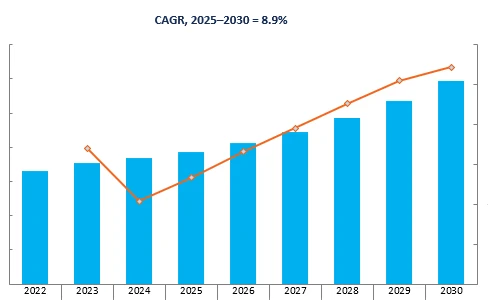
Revenue expansion is being driven by increasing industrial automation, rising demand for real-time quality control, and the deeper integration of precision measurement technologies into smart factory architectures. Manufacturers are allocating higher capital expenditure toward advanced inspection systems to enhance throughput, minimize defect-related losses, and strengthen compliance with quality standards.
Spending patterns indicate long-term structural demand rather than short-term cyclical purchasing behavior. Profilers are progressively being embedded as permanent infrastructure within production lines, supporting continuous monitoring and data-driven decision-making. This transition is stabilizing revenue streams across automotive, aerospace, rail, and other industrial sectors.
Technological modernization is further reinforcing market growth. Industrial operators are replacing conventional mechanical gauges and legacy metrology systems with non-contact, AI-enabled, and high-speed profiling platforms capable of operating within fully automated environments. Integration with robotics, edge analytics, and cloud-based monitoring systems is elevating profilers from standalone inspection tools to intelligent quality assurance assets.
Overall, the sustained revenue growth and 8.9% CAGR underscore the strategic importance of precision measurement in modern manufacturing competitiveness. As production ecosystems become increasingly complex, digital, and automation-driven, investment in advanced profiling technologies is expected to remain robust through 2030.
Market Segmentation Analysis: Profilers Market
The Profilers Market is structured across multiple technology and application dimensions reflecting the diversity of industrial measurement requirements. Product configuration represents a primary segmentation layer, distinguishing measurement capabilities and operational functionality. Systems vary in dimensional measurement capability and deployment architecture depending on production environment requirements.
Application segmentation reflects operational deployment within manufacturing workflows. Profilers are used across inspection stations, automated production lines, and maintenance environments. Deployment requirements differ based on production speed, measurement precision, and system integration complexity.
Industry application represents another key segmentation dimension. Different industrial environments require varying levels of measurement accuracy, automation integration, and operational robustness. High-precision industries emphasize advanced measurement capabilities, while high-volume manufacturing prioritizes speed and automation compatibility.
Operational deployment structure also shapes segmentation. Some systems operate as portable inspection tools for maintenance or research applications, while others are permanently integrated into automated production systems for continuous monitoring.
Measurement methodology represents an additional segmentation dimension. Non-contact measurement technologies are increasingly preferred due to their ability to operate at high speed without affecting component integrity. Measurement accuracy, scanning speed, and system integration flexibility define product differentiation.
Regional segmentation reflects industrial development levels, automation investment, and regulatory environments influencing adoption patterns. Developed manufacturing economies emphasize advanced automation integration, while emerging markets focus on incremental modernization and production efficiency.
Segmentation complexity reflects the wide range of industrial measurement requirements addressed by profiler technologies. As manufacturing processes evolve, segmentation boundaries continue to shift toward integrated and multifunctional measurement platforms.
Growth Drivers: Profilers Market
Industry 4.0 adoption is the most significant growth driver. Smart factories require continuous measurement, real-time feedback, and automated quality assurance, all of which depend on advanced profiling technologies.
Technological advancement is accelerating adoption. Compact sensors, high-speed scanning, and AI integration are expanding operational capabilities and reducing deployment complexity.
Increasing manufacturing precision requirements are also driving demand. Advanced materials, miniaturized components, and complex geometries require highly accurate measurement systems.
Regulatory compliance and product quality standards are strengthening inspection requirements across industrial sectors.
Growing demand for inline high-speed inspection in automated production environments is further supporting market expansion.
Growth Restraints: Profilers Market
High system cost remains a major adoption barrier, particularly in emerging manufacturing markets.
Limited availability of skilled technicians capable of system integration and calibration can delay deployment.
Economic uncertainty and geopolitical tensions may influence capital investment cycles.
Conventional measurement tools remain widely used in some regions, slowing technology transition.
Competitive Landscape: Profilers Market
The global profilers market is moderately fragmented, with approximately 40–50 active competitors operating across regional and global industrial measurement segments. Market competition is primarily shaped by technological capability, measurement precision, system reliability, cost efficiency, and the ability to provide integrated automation and long-term technical support. Strong customer relationships, responsive service networks, and application-specific customization also play a critical role in vendor differentiation.
Competition is most intense in advanced manufacturing sectors such as automotive, aerospace, and rail, where high-precision dimensional measurement and real-time inspection are essential for maintaining production quality and regulatory compliance. Vendors serving these industries focus on delivering high-performance measurement systems capable of operating within automated production environments.
Key market participants include Hexagon, LAP GmbH, Micro-Epsilon, and Starrett, which maintain strong technological capabilities and global market presence. These companies emphasize continuous product innovation, sensor accuracy, automation integration, and advanced software functionality to strengthen competitive positioning.
Additional notable competitors such as MERMEC Group, Perceptron, and Greenwood Engineering contribute to market diversity through specialized measurement solutions and industry-focused applications. These firms often compete through niche expertise, customized system development, and regional market strength.
The market distribution structure includes direct sales channels, manufacturing representatives, and reseller networks, enabling vendors to reach both large industrial enterprises and specialized manufacturing facilities. Strategic partnerships with automation providers, system integrators, and industrial equipment manufacturers are increasingly important for expanding market reach and delivering end-to-end measurement solutions.
Overall, competition in the profilers market is driven by technological innovation, system performance, and the ability to support evolving smart manufacturing environments. Vendors that combine high measurement accuracy with seamless automation integration and strong service infrastructure are positioned to maintain long-term competitive advantage.
Scope of Analysis
Segmentation
Why is it Increasingly Difficult to Grow?
The Strategic Imperative 8™
The Impact of the Top 3 Strategic Imperatives on the Profilers Industry
Distribution Channel
Competitive Environment
Key Competitors
Growth Metrics
Growth Drivers
Growth Driver Analysis
Growth Restraints
Growth Restraint Analysis
Technological Trends
Market Trends
Forecast Considerations
Revenue Forecast
Revenue Forecast by Product Type
Revenue Forecast by Application
Revenue Forecast by End-Use Industry
Revenue Forecast by Region
Revenue Forecast by Country—NALA
Revenue Forecast by Country—Europe
Revenue Forecast by Country—APAC
Revenue Forecast Analysis
Pricing Trends and Forecast Analysis
Revenue Share
Growth Metrics
Revenue Forecast
Revenue Forecast by Product Type
Revenue Forecast by Application
Revenue Forecast by Region
Forecast Analysis
Growth Metrics
Revenue Forecast
Revenue Forecast by Product Type
Revenue Forecast by Application
Revenue Forecast by Region
Forecast Analysis
Growth Metrics
Revenue Forecast
Revenue Forecast by Product Type
Revenue Forecast by Application
Revenue Forecast by Region
Forecast Analysis
Growth Metrics
Revenue Forecast
Revenue Forecast by Product Type
Revenue Forecast by Application
Revenue Forecast by Region
Forecast Analysis
Growth Opportunity 1: Inline Profilers for Smart Factories
Growth Opportunity 2: Electric Vehicles
Growth Opportunity 3: Aerospace
Benefits and Impacts of Growth Opportunities
Next Steps
List of Exhibits
Legal Disclaimer
Frequently Asked Questions (FAQ) – Profilers Market
1. What is the profilers market?
2. How large is the global profilers market?
3. What are profilers used for?
4. What is driving growth in the profilers market?
5. Which industries use profiler systems?
6. Which region leads the profilers market?
7. What technologies are shaping the future of profiler systems?
8. What are the main challenges in the profilers market?
9. Who are the major companies in the profilers market?
10. What is the future outlook for the profilers market?
Speak directly with our analytics experts for tailored recommendations.
Recent related Electronic Measurement research
05 Oct 2026 | Global | Market Research
Calibration and Repair Services Market, Global, 2025–2030
The global calibration and repair services market reached $4,096.8 million in 2025, driven by the increasing digitalization of calibration and repair services, integration with existing connected systems, real-time monitoring capabilities, and predictive analytics. Third-party service companies are ...
02 Oct 2026 | Global | Technology Research
Growth Opportunities in Contact-Rich Robot Skill AI, High-Speed Photopolymer 3D Printing, Industrial Interoperability, Vision AI, Pallet Shuttle Automation, In-Situ AM Inspection, and Composite 3D Printing
The Advanced Manufacturing Technology Opportunity Engine provides profiles of innovations related to simulation-trained contact skills enabling industrial robots to perform complex physical interactions and manipulation tasks; hybrid laser-DLP 3D printing systems combining additive technologies for ...
18 Sep 2026 | Global | Frost Radar
Frost Radar™: Laboratory Information Management Systems in Industrial Applications, 2026
Digitalization is transforming laboratory operations, resulting in a demand for cloud-based and AI-integrated laboratory information management systems (LIMS) to manage complex data and high volumes from automated systems. By combining these tools with software-as-a-service (SaaS) models, providers ...
11 Sep 2026 | Global | Market Research
Growth Impact of AI on the Communication Test Equipment Market, 2025–2030
Artificial intelligence (AI) is reshaping the global communication test equipment market by transforming product development, enabling intelligent and automated testing, and driving demand through next-generation communication infrastructure. This Frost & Sullivan analysis examines AI's impact acros...
04 Sep 2026 | Global | Technology Research
Growth Opportunities in Intralogistics Automation, Embodied Robotic Arms, Physical AI Training, Industrial AI, Service Robotics, Precision Farming Robots, and Laboratory Automation
The Advanced Manufacturing Technology Opportunity Engine provides profiles of innovations related to autonomous mobile robots (AMRs) enabling pallet and trolley transportation across dynamic intralogistics environments; compact 6-axis robotic systems supporting modular and flexible laboratory automa...
Purchase includes:
- Report download
- Growth Dialog™ with our experts
Growth Dialog™
A tailored session with you where we identify the:- Strategic Imperatives
- Growth Opportunities
- Best Practices
- Companies to Action
Impacting your company's future growth potential.