 USD
USD GBP
GBP  CNY
CNY  EUR
EUR  INR
INR  JPY
JPY  MYR
MYR  ZAR
ZAR  KRW
KRW  THB
THB 


Building Construction Market, Global, 2025–2030
Building Construction is Experiencing Transformational Growth Due to Sustainability Practices and Digital Solutions Amidst Geopolitical Tensions
19-Aug-2025
Global
Market Research
PFS2-01-00-00-00
EN_2025_33737
Report Summary: Building Construction Market
The global Building Construction Market is undergoing significant transformation, driven by sustainability initiatives, rapid urbanization, and increasing adoption of digital construction technologies. The market is projected to grow at a CAGR of approximately 4.4% from 2024 to 2030, supported by rising investments in residential and non-residential infrastructure worldwide. As a core segment of the broader Building and Construction Market, this industry plays a critical role in economic development, urban planning, and infrastructure modernization.
Key Market Trends & Insights
- Strong demand for sustainable and green building practices across global markets.
- Increasing adoption of smart building technologies and IoT-enabled systems.
- Rising infrastructure investments in developing economies driving construction activity.
- Growing use of eco-friendly materials and energy-efficient building designs.
- Digital transformation through project management software and automation tools.
Market Size & Forecast
- 2024 Market Size: USD 8,861 Billion
- 2030 Projected Market Size: USD 11,456 Billion
- CAGR (2024–2030): 4.4%
- Asia-Pacific: Fastest-growing region
- North America & Europe: Mature markets with steady growth
The Building Construction Market continues to expand as governments and private investors focus on infrastructure development and modernization. Increasing demand for housing, commercial spaces, and industrial facilities is further supporting growth across the Building and Construction Market.
Market Overview & Trends: Building Construction Market
The Building Construction Market is evolving rapidly due to structural shifts in sustainability, digitalization, and global infrastructure demand. Governments and private sector players are prioritizing green building practices to reduce carbon emissions and improve energy efficiency. This trend is reshaping the Building and Construction Market, where eco-friendly materials, renewable energy integration, and net-zero building designs are becoming standard.
A key trend is the adoption of digital technologies such as Building Information Modeling (BIM), IoT sensors, and advanced project management platforms. These tools enhance efficiency, reduce project timelines, and improve cost control. Smart building systems are enabling real-time monitoring of energy usage, further driving operational efficiency.
Urbanization, particularly in emerging economies, is another major growth factor. Rapid population growth is increasing demand for residential housing, commercial infrastructure, and industrial facilities. Governments are investing heavily in public infrastructure, including transportation and utilities, which is boosting activity in the Building Construction Market.
Geopolitical tensions and supply chain disruptions remain critical challenges, influencing material costs and project timelines. However, the industry is adapting through localized sourcing strategies and digital supply chain management solutions.
Additionally, startups and technology providers are introducing innovative solutions that streamline construction processes and improve sustainability outcomes. The convergence of digital tools and sustainable practices is expected to redefine the future of the Building and Construction Market.
Revenue & Spending Forecast: Building Construction Market
The Building Construction Market is expected to witness steady growth, supported by rising investments in infrastructure and urban development.
The market size is estimated at approximately USD 8,861 billion in 2024 and is projected to reach around USD 11,456 billion by 2030, growing at a CAGR of 4.4%. This growth reflects consistent demand across residential and non-residential construction activities within the broader Building and Construction Market.

Spending trends indicate a strong focus on sustainable construction practices and digital transformation. Governments and private sector players are investing in green building initiatives, energy-efficient designs, and smart infrastructure.
Additionally, increasing urbanization and population growth are driving demand for housing and commercial spaces. Investments in public infrastructure, including schools, hospitals, and government buildings, are further contributing to market expansion.
The adoption of advanced construction technologies, such as automation and digital project management tools, is improving efficiency and reducing costs, supporting long-term growth in the Building Construction Market.
Scope of Analysis: Building Construction Market
The Building Construction Market analysis provides a comprehensive overview of global industry dynamics, covering key trends, market drivers, and technological advancements. The study period spans from 2021 to 2030, with 2024 as the base year and forecasts extending through 2030.
The scope includes construction activities related to residential and non-residential buildings. Residential construction covers housing units such as apartments, villas, and condominiums, while non-residential construction includes commercial, industrial, institutional, and public infrastructure projects. This segmentation reflects the diverse applications within the Building and Construction Market.
Geographically, the study covers major regions including North America, Europe, Asia-Pacific, Latin America, and the Middle East & Africa. Each region is analyzed based on economic growth, urbanization rates, and infrastructure investments.
The report excludes small-scale renovations, unorganized construction activities, and non-building infrastructure projects such as roads, bridges, and power plants. Revenue calculations focus on the value of services and activities related to building construction, including design, engineering, and installation.
Additionally, the study incorporates both primary and secondary research methodologies, including industry interviews and data analysis, to provide accurate market insights.
Market Segmentation Analysis: Building Construction Market
The Building Construction Market is segmented primarily by building type and end-use applications, reflecting the broad scope of construction activities.
By building type, the market is divided into residential and non-residential segments. The residential segment includes housing developments such as apartments, townhouses, and villas, driven by population growth and urban expansion. The non-residential segment encompasses commercial buildings, industrial facilities, institutional structures, and public infrastructure, representing a significant share of the Building and Construction Market.
Non-residential construction includes offices, retail spaces, manufacturing plants, warehouses, educational institutions, healthcare facilities, and entertainment venues. This segment is supported by economic growth, business expansion, and government investments in infrastructure development.
From an end-user perspective, the market serves residential consumers, businesses, and government entities. Commercial and industrial sectors are major contributors, driven by demand for office spaces, logistics hubs, and manufacturing facilities.
Regional segmentation highlights Asia-Pacific as a high-growth region due to rapid urbanization and infrastructure investments. North America and Europe represent mature markets with a focus on modernization and sustainability.
This segmentation underscores the diverse demand drivers and applications within the Building Construction Market, highlighting its integral role in the global Building and Construction Market ecosystem.
Growth Drivers: Building Construction Market
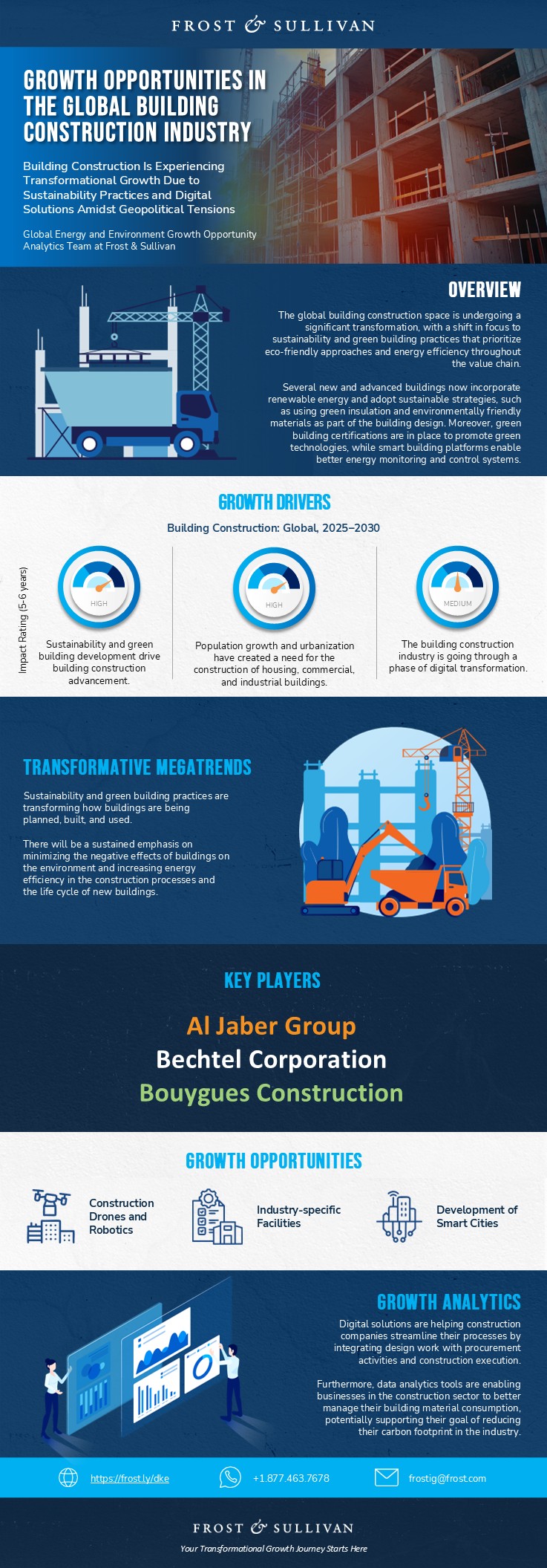
The Building Construction Market is driven by several key factors that are shaping its growth trajectory. Rapid urbanization and population growth are increasing demand for residential and commercial infrastructure, particularly in developing economies.
Government investments in infrastructure development are another major driver. Public spending on housing, transportation, and utilities is boosting construction activity across the Building and Construction Market.
Sustainability and green building initiatives are also playing a crucial role. The adoption of renewable energy systems, energy-efficient designs, and eco-friendly materials is driving innovation and growth.
Digital transformation is further accelerating market expansion. Technologies such as IoT, BIM, and project management software are improving efficiency, reducing costs, and enhancing project outcomes.
Growth Restraints: Building Construction Market
The Building Construction Market faces several challenges that may impact its growth. Supply chain disruptions and material shortages are major concerns, leading to project delays and increased costs.
A shortage of skilled labor is another significant restraint. The lack of qualified workers can affect project timelines and quality, posing challenges for the Building and Construction Market.
Economic uncertainties, including inflation and fluctuating interest rates, can impact investment in construction projects. These factors may lead to reduced funding and project cancellations.
Additionally, the high cost of implementing sustainable construction practices can be a barrier, particularly for small and medium-sized enterprises.
Competitive Landscape: Building Construction Market
The Building Construction Market is highly fragmented, with numerous global and regional players competing across different segments. The competitive landscape is characterized by strong competition based on technology, cost efficiency, project execution capabilities, and sustainability practices.
Leading companies such as AECOM, Bechtel Corporation, Bouygues Construction, China State Construction Engineering Corporation, and Larsen & Toubro play a significant role in shaping the Building and Construction Market. These companies leverage large-scale project capabilities and global presence to maintain their competitive advantage.
Other notable players include Skanska, Vinci, Kiewit Corporation, and Turner Construction, which focus on specialized construction services and regional markets. Strategic partnerships, mergers, and acquisitions are common strategies for expanding market presence.
The market is also witnessing increasing adoption of digital technologies and sustainable practices as key differentiators. Companies are investing in innovation to improve efficiency, reduce costs, and meet evolving customer demands within the Building Construction Market.
Scope of Analysis
Segmentation by Building Type
Segmentation by Region
Why is it Increasingly Difficult to Grow?
The Strategic Imperative 8™
The Impact of the Top 3 Strategic Imperatives on the Global Building Construction Industry
Competitive Environment
Key Competitors
Growth Metrics
Growth Drivers
Growth Restraints
Forecast Considerations
Revenue Forecast
Revenue Forecast by Building Type
Revenue Share by Building Type
Revenue Forecast by Region
Revenue Share by Region
Revenue Forecast Analysis
Growth Metrics
Revenue Forecast
Revenue Forecast by Building Type
Revenue Share by Building Type
Revenue Forecast by Region
Revenue Share by Region
Revenue Forecast Analysis—North America
Market Snapshot—United States
Market Snapshot—Canada
Growth Metrics
Revenue Forecast
Revenue Forecast by Building Type
Revenue Share by Building Type
Revenue Forecast by Region
Revenue Share by Region
Revenue Forecast Analysis—Europe
Market Snapshot—Germany
Market Snapshot—United Kingdom
Market Snapshot—France
Market Snapshot—Italy
Market Snapshot—Spain
Market Snapshot—Benelux
Market Snapshot—The Nordics
Market Snapshot—Rest of Europe
Growth Metrics
Revenue Forecast
Revenue Forecast by Building Type
Revenue Share by Building Type
Revenue Forecast by Region
Revenue Share by Region
Revenue Forecast Analysis—APAC
Market Snapshot—China
Market Snapshot—India
Market Snapshot—Japan
Market Snapshot—South Korea
Market Snapshot—ANZ
Market Snapshot—Indonesia
Market Snapshot—Thailand
Market Snapshot—Vietnam
Market Snapshot—Rest of Southeast Asia
Growth Metrics
Revenue Forecast
Revenue Forecast by Building Type
Revenue Share by Building Type
Revenue Forecast by Region
Revenue Share by Region
Revenue Forecast Analysis—MEA
Market Snapshot—UAE
Market Snapshot—Saudi Arabia
Market Snapshot—Qatar
Market Snapshot—South Africa
Market Snapshot—Egypt
Market Snapshot—Nigeria
Market Snapshot—Rest of MEA
Growth Metrics
Revenue Forecast
Revenue Forecast by Building Type
Revenue Share by Building Type
Revenue Forecast by Region
Revenue Share by Region
Revenue Forecast Analysis—LATAM
Market Snapshot—Brazil
Market Snapshot—Mexico
Market Snapshot—Argentina
Market Snapshot—Chile
Market Snapshot—Colombia
Growth Opportunity 1: Construction Drones and Robotics
Growth Opportunity 2: Industry-specific Facilities
Growth Opportunity 3: Development of Smart Cities
Benefits and Impacts of Growth Opportunities
Next Steps
List of Exhibits
Legal Disclaimer
Frequently Asked Questions (FAQ) – Building Construction Market
1. What is the market size and growth forecast of the Building Construction Market?
The Building Construction Market was valued at USD 8,861 billion in 2024 and is projected to reach USD 11,456 billion by 2030, growing at a CAGR of 4.4%, driven by urbanization and infrastructure investments.
2. What is the Building Construction Market?
The Building Construction Market includes activities related to designing, engineering, and constructing residential and non-residential buildings, forming a key part of the broader Building and Construction Market.
3. What are the key drivers of the Building and Construction Market?
Key drivers include rapid urbanization, population growth, government infrastructure investments, sustainability initiatives, and adoption of digital construction technologies.
4. What are the main segments in the Building Construction Market?
The market is segmented into residential and non-residential construction, including commercial, industrial, institutional, and public infrastructure buildings.
5. Which regions are leading the Building Construction Market?
Asia-Pacific is the fastest-growing region due to urban expansion and infrastructure investments, while North America and Europe are mature markets focused on modernization and sustainability.
6. How is sustainability impacting the Building and Construction Market?
Sustainability is driving the adoption of green building materials, energy-efficient designs, and renewable energy integration, reshaping construction practices globally.
7. What challenges does the Building Construction Market face?
Major challenges include supply chain disruptions, rising material costs, labor shortages, economic uncertainties, and high costs of implementing sustainable construction practices.
8. Who are the key players in the Building and Construction Market?
Leading companies include AECOM, Bechtel Corporation, Bouygues Construction, China State Construction Engineering Corporation, Larsen & Toubro, and Vinci.
9. How is digitalization transforming the Building Construction Market?
Digital technologies such as BIM, IoT, and project management software are improving efficiency, reducing costs, and enabling better project planning and execution.
10. What is the future outlook for the Building Construction Market?
The Building Construction Market is expected to grow steadily, supported by infrastructure investments, urbanization, sustainability initiatives, and technological advancements.
Speak directly with our analytics experts for tailored recommendations.
Recent related Homes and Buildings research
09 Oct 2026 | Global | Frost Radar
Frost Radar™: Smart Building Solutions in Healthcare, 2026
Healthcare facilities are some of the most complex and mission-critical environments in the smart buildings market, and investment priorities now extend beyond energy management to indoor environmental quality, critical infrastructure monitoring, asset visibility, and workflow optimization. Revenue ...
17 Sep 2026 | Asia Pacific | Frost Radar
Frost Radar™: Facility Management in Malaysia, 2026
Malaysia's facility management (FM) market is transitioning from labor-intensive, compliance-driven service delivery to technology-enabled, outcome-oriented, and sustainability-integrated operating models. Competitive differentiation increasingly depends on providers’ ability to combine integrated F...
27 Aug 2026 | Global | Market Research
Smart Building Solutions, Global, 2025–2031
Smart building solutions encompass the integrated suite of hardware, software, and digital services that enable the automation, optimization, and intelligent management of commercial, educational, healthcare, industrial, datacenters and other buildings.The scope includes: Hardware: Automation contro...
07 Aug 2026 | Asia Pacific | Frost Radar
Frost Radar™: Facility Management in Thailand, 2026
Thailand's facility management (FM) market is transitioning from labor-intensive, task-based service delivery to integrated, technology-enabled, and outcome-driven operating models. Customer expectations for operational efficiency, sustainability, resilience, digital visibility, and business outcome...
28 Jul 2026 | Global | Market Research
Building Construction Robotics, Global, 2025–2031
The global building construction robotics market is transitioning from proof of concept to selective deployment, shifting focus from technological feasibility to execution at the project and contractor level. Growth is influenced by the ability of firms to redesign workflows, manage human robot coor...
Purchase includes:
- Report download
- Growth Dialog™ with our experts
Growth Dialog™
A tailored session with you where we identify the:- Strategic Imperatives
- Growth Opportunities
- Best Practices
- Companies to Action
Impacting your company's future growth potential.
However, the US-China geopolitical tension presents a key challenge, with trade wars likely to create supply chain disruptions, which could drive up costs and impact the development of construction projects. Nevertheless, as the building construction value chain continues to evolve, emerging start-ups are providing digital solutions that facilitate more efficient and sustainable project execution, thereby reducing project durations and costs. Digital solutions are helping construction companies streamline their processes by integrating design work with procurement activities and construction execution. Furthermore, data analytics tools are enabling businesses in the construction sector to better manage their building material consumption, potentially supporting their goal of reducing their carbon footprint in the market.
This Frost & Sullivan report takes a comprehensive look at the factors shaping the transformation of the global building construction market. It analyzes the trends driving and restraining growth, provides relevant market figures and forecasts, and identifies the opportunities emerging from the changes in this space for market players and stakeholders to leverage. The base year is 2024, and the forecast period is from 2025 to 2030.
Author: Melvin Leong
| Deliverable Type | Market Research |
|---|---|
| Industries | Environment |
| No Index | No |
| Is Prebook | No |
| Keyword 1 | sustainable construction practices |
| Keyword 2 | smart building technologies |
| Keyword 3 | digital twin construction |
| Podcast | No |
| Predecessor | PEB5-01-00-00-00 |
| WIP Number | PFS2-01-00-00-00 |