 USD
USD GBP
GBP  CNY
CNY  EUR
EUR  INR
INR  JPY
JPY  MYR
MYR  ZAR
ZAR  KRW
KRW  THB
THB 


Increasing Drone Attacks are Driving Transformational Growth in C-UAS Adoption
13-Jun-2025
Global
Market Research
KB30-01-00-00-00
AE_2025_33567
Report Summary: Global C-UAS Market
The global C-UAS Market is expanding rapidly as governments and critical infrastructure operators increase investments to counter evolving drone threats. The Counter Unmanned Aerial System (UAS) Market is projected to grow from USD 1.47 billion in 2023 to approximately USD 8.38 billion by 2029, registering a strong CAGR of 33.7% during the forecast period. Rising adoption of AI-enabled detection systems, electronic countermeasures, and integrated command-and-control platforms is accelerating deployment across defense and civilian environments, positioning the Counter UAS Market as a key pillar of modern airspace security.
Key Market Trends & Insights
- North America remains a leading innovation hub within the Global C-UAS Market, driven by strong defense spending and advanced technological ecosystems.
- The Counter Unmanned Aerial System (UAS) Market is shifting toward multi-layered defense architectures that combine radar, RF detection, and directed energy countermeasures.
- Increasing geopolitical tensions and modernization of military capabilities are strengthening long-term demand across the Counter UAS Market.
- Expansion into civilian applications such as airports, utilities, and public events is diversifying revenue streams within the Global C-UAS Market.
- Ongoing mergers and acquisitions are reshaping competition and accelerating innovation across the Counter Unmanned Aerial System (UAS) Market.
Market Size & Forecast
- 2023 Market Size: USD 1.47 Billion
- 2029 Projected Market Size: USD 8.38 Billion
- CAGR (2023–2029): 33.7%
- Largest Market: North America
- High-Growth Regions: Asia-Pacific and Middle East
The rapid evolution of drone technologies, including AI-powered swarming and stealth capabilities, is driving demand for scalable counter-drone solutions worldwide. As organizations prioritize airspace security and operational resilience, the Counter UAS Market is expected to witness sustained innovation and long-term strategic investment across global defense and security ecosystems.
Market Overview: Global C-UAS Market
The Global C-UAS Market is transitioning from reactive security solutions toward proactive airspace defense strategies, driven by the rapid proliferation of commercial and military drones. Governments and enterprises are investing heavily in integrated counter-drone platforms that combine detection, tracking, and mitigation capabilities. The Counter Unmanned Aerial System (UAS) Market is increasingly shaped by advancements in AI, sensor fusion, and autonomous response systems, enabling more efficient threat neutralization across complex operational environments.
One of the defining trends in the Counter UAS Market is the shift toward multi-layered defense architectures. Modern platforms combine radar, electro-optical sensors, RF detection, and electronic warfare capabilities, allowing organizations to address both high-altitude and low-flying drone threats. As threats evolve, the Global C-UAS Market is seeing increased demand for scalable solutions that integrate seamlessly with existing command-and-control infrastructure.
The expansion of civilian applications is also influencing the Counter Unmanned Aerial System (UAS) Market. Airports, utilities, and large public venues are deploying counter-drone systems to ensure operational continuity and public safety. This diversification is broadening the revenue base of the Counter UAS Market, which was previously dominated by defense procurement programs. Additionally, regulatory developments across Europe and Asia are encouraging standardized deployment frameworks, further accelerating adoption within the Global C-UAS Market.
Innovation in directed energy systems, advanced jamming technologies, and AI-powered analytics is transforming the competitive landscape of the Counter Unmanned Aerial System (UAS) Market. Vendors are focusing on interoperability and real-time data processing to deliver comprehensive airspace awareness solutions. As drone swarm threats and stealth UAV capabilities continue to evolve, the Counter UAS Market is expected to prioritize autonomous threat mitigation and predictive defense capabilities.
Scope of Analysis: Global C-UAS Market
The Global C-UAS Market analysis evaluates counter-drone technologies across geographic regions, applications, and operational capabilities within the broader Counter Unmanned Aerial System (UAS) Market ecosystem. The study period spans 2023–2029, with 2023 as the base year and 2024–2029 as the forecast period. The research assesses evolving threat landscapes, technological advancements, and procurement trends influencing the Counter UAS Market.
Geographic coverage includes North America, Europe, the Middle East & Africa (MEA), Asia-Pacific (APAC), and Latin America, reflecting diverse adoption patterns across the Global C-UAS Market. North America leads in technological innovation and defense spending, while Europe demonstrates strong regulatory alignment supporting the Counter Unmanned Aerial System (UAS) Market. Meanwhile, APAC and MEA are emerging as high-growth regions due to increasing border security challenges and infrastructure protection initiatives within the Counter UAS Market.
The analysis focuses on hardware and software components such as detection systems, electronic countermeasures, command-and-control platforms, and autonomous response technologies. Both defense and civilian applications are assessed to provide a comprehensive view of the Global C-UAS Market, highlighting evolving use cases across aerospace, homeland security, utilities, and public infrastructure. By integrating primary and secondary research insights, the study delivers strategic intelligence for stakeholders operating in the Counter Unmanned Aerial System (UAS) Market.
Revenue & Spending Forecast: Global C-UAS Market
The Global C-UAS Market is expected to experience strong growth momentum, driven by increasing investments in counter-drone technologies across defense, homeland security, and critical infrastructure sectors. Spending within the Counter Unmanned Aerial System (UAS) Market is projected to rise from approximately USD 1.47 billion in 2023 to about USD 8.38 billion by 2029, reflecting a robust CAGR of 33.7% during the forecast period. This rapid expansion highlights the growing urgency among governments and enterprises to deploy advanced detection, tracking, and mitigation solutions across the Counter UAS Market.
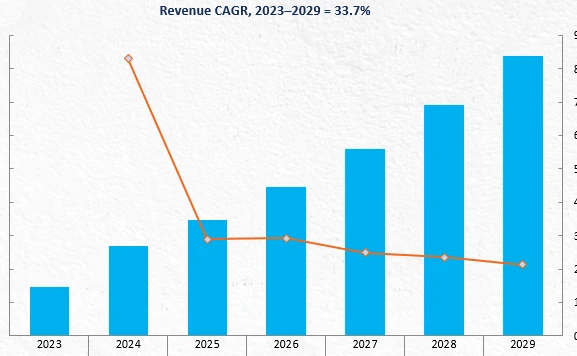
Rising geopolitical tensions and the proliferation of autonomous drone technologies are accelerating procurement activities within the Global C-UAS Market, particularly as organizations shift toward integrated and scalable counter-drone ecosystems. The adoption of AI-enabled analytics, electronic countermeasures, and multi-layered defense architecture is reinforcing revenue growth across the Counter Unmanned Aerial System (UAS) Market. As defense modernization programs expand globally, vendors in the Counter UAS Market are strengthening investments in advanced sensor fusion and autonomous response capabilities to maintain competitive differentiation.
Although early growth rates remain high due to rapid deployment cycles, the Global C-UAS Market is expected to gradually stabilize as the industry matures and standardization increases. Expanding civilian use cases, including airport security, public event protection, and infrastructure defense, will continue to drive spending growth within the Counter Unmanned Aerial System (UAS) Market, reinforcing the long-term strategic importance of the Counter UAS Market worldwide.
Market Segmentation Analysis: Global C-UAS Market
The Global C-UAS Market is broadly segmented into defense and civilian applications, reflecting the expanding scope of counter-drone technologies. Defense applications continue to dominate the Counter Unmanned Aerial System (UAS) Market, as military agencies invest heavily in advanced detection and neutralization systems to address evolving aerial threats. Modern defense-focused platforms within the Counter UAS Market integrate radar, electronic warfare, and directed energy solutions to counter swarm attacks and stealth UAV operations.
Civilian applications are rapidly gaining traction within the Global C-UAS Market, particularly across airports, utilities, and critical infrastructure. Organizations are deploying integrated counter-drone systems to enhance situational awareness and comply with evolving regulatory requirements. The expansion of civilian use cases is reshaping demand patterns in the Counter Unmanned Aerial System (UAS) Market, driving innovation in scalable and cost-efficient solutions.
Technology-driven segmentation highlights the increasing importance of AI-enabled analytics and autonomous response capabilities within the Counter UAS Market. Vendors are prioritizing modular platforms that allow seamless integration with existing security architectures, ensuring flexibility and operational efficiency across the Global C-UAS Market. As threats become more sophisticated, the adoption of hybrid defense models combining kinetic and non-kinetic countermeasures is expected to accelerate.
Growth Drivers: Global C-UAS Market
The Global C-UAS Market is witnessing sustained momentum as defense agencies and homeland security organizations prioritize advanced counter-drone capabilities to address escalating aerial threats. Increasing defense modernization programs and heightened geopolitical tensions are driving consistent investments across the Counter Unmanned Aerial System (UAS) Market, with large defense contractors leveraging scale and technological expertise to accelerate deployment. The industry’s growth trajectory remains strong as governments seek integrated solutions that combine detection, tracking, and neutralization capabilities within unified command-and-control frameworks.
Industry maturation is another major driver shaping the Counter UAS Market. Rising operational demands and expanding procurement budgets are pushing vendors to deliver more advanced, scalable platforms that can adapt to evolving threat environments. As adoption grows, economies of scale and standardization are improving pricing structures and encouraging wider deployment across both military and civilian sectors within the Global C-UAS Market.
Emerging trends such as strategic mergers and acquisitions are also transforming the Counter Unmanned Aerial System (UAS) Market. Increased consolidation among OEMs and technology providers is accelerating innovation cycles and introducing new capabilities into the Counter UAS Market ecosystem. Strategic partnerships and acquisitions are enabling vendors to expand product portfolios, enhance AI-driven analytics, and strengthen interoperability, supporting long-term expansion across the Global C-UAS Market.
Growth Restraints: Global C-UAS Market
Despite strong growth prospects, the Global C-UAS Market faces several technological and regulatory challenges that may slow adoption. Current system limitations remain a key restraint within the Counter Unmanned Aerial System (UAS) Market, particularly when detecting small, low-altitude, or stealth drones capable of rapid maneuvering. False alarm rates and operational reliability concerns continue to present obstacles for widespread deployment across the Counter UAS Market.
Regulatory complexity represents another significant barrier impacting the Global C-UAS Market. Stringent airspace and spectrum regulations in certain regions limit the deployment of electronic countermeasures and kinetic mitigation solutions, affecting adoption in civilian environments. Vendors operating in the Counter Unmanned Aerial System (UAS) Market must balance innovation with compliance, which can increase development timelines and operational costs.
Integration challenges also remain a notable restraint within the Counter UAS Market. Incorporating new counter-drone technologies into existing defense and security infrastructures often requires extensive system upgrades and coordination across multiple platforms. Legacy system compatibility issues and operational disruptions during implementation can slow market expansion, highlighting the need for modular and interoperable solutions across the Global C-UAS Market.
Competitive Landscape: Global C-UAS Market
The Global C-UAS Market is characterized by a mature yet highly fragmented competitive environment, with more than 250 companies ranging from major defense OEMs to specialized technology providers and emerging start-ups. Competition within the Counter Unmanned Aerial System (UAS) Market is driven by factors such as system performance, pricing strategies, technological innovation, interoperability, and after-sales support capabilities. Vendors are increasingly focusing on integrated platforms that combine detection, identification, and mitigation technologies to strengthen differentiation in the Counter UAS Market.
Leading participants in the Global C-UAS Market include RTX, Honeywell, Leonardo, BAE Systems, ELTA, and Anduril, alongside notable competitors such as Lockheed Martin, MBDA, Rafael, Indra, Dedrone, and Hanwha Defense. These companies are investing heavily in advanced sensor fusion, AI-driven analytics, and electronic countermeasure technologies to enhance operational effectiveness across the Counter Unmanned Aerial System (UAS) Market. Strategic collaborations with defense agencies and homeland security organizations continue to shape procurement dynamics and accelerate innovation within the Counter UAS Market.
Distribution strategies across the Global C-UAS Market typically involve direct government contracts, OEM partnerships, foreign military sales (FMS), and government-to-government agreements (G2G). Recent merger and acquisition activities highlight increasing consolidation within the Counter Unmanned Aerial System (UAS) Market, including Axon’s acquisition of Dedrone and AeroVironment’s acquisition of BlueHalo in 2024. As competitive intensity grows, vendors in the Counter UAS Market are prioritizing scalable architectures, multi-layered defense capabilities, and long-term service contracts to maintain market leadership.
Scope of Analysis
C-UAS Priority Level by Industry
Segmentation
Segmentation—Region
Why is it Increasingly Difficult to Grow?
The Strategic Imperative 8™
The Impact of the Top 3 Strategic Imperatives on the C-UAS Industry
Competitive Environment
Key Competitors
Growth Metrics
Growth Drivers
Growth Driver Analysis
Growth Restraints
Growth Restraint Analysis
Forecast Considerations
Spending Forecast
Spending Forecast by Region
Spending Forecast by Application
Revenue Forecast Analysis
Growth Metrics
Spending Forecast
Spending Forecast by Application
Market Snapshot—United States
Market Snapshot—Canada
Growth Metrics
Spending Forecast
Spending Forecast by Application
Market Snapshot—Germany
Market Snapshot—UK
Market Snapshot—France
Market Snapshot—Italy
Market Snapshot—Ukraine
NATO and EU C-UAS Highlighted Frameworks and Contracts
Growth Metrics
Spending Forecast
Spending Forecast by Application
Market Snapshot—UAE
Market Snapshot—Saudi Arabia KSA
Market Snapshot—Israel
Market Snapshot—Egypt and Morocco
Growth Metrics
Spending Forecast
Spending Forecast by Application
Market Snapshot—India
Market Snapshot—Japan and South Korea
Market Snapshot—Australia
Growth Opportunity 1: Defense and Public Safety Expansion
Growth Opportunity 2: Critical Infrastructure and Commercial Protection
Growth Opportunity 3: Technology Innovation
Growth Opportunity 4: Regulatory Integration
Partial List of Abbreviations
Benefits and Impacts of Growth Opportunities
Next Steps
List of Exhibits
Legal Disclaimer
Frequently Asked Questions (FAQ) – Global C-UAS Market
1. What is the Global C-UAS Market?
2. What is driving growth in the Counter Unmanned Aerial System (UAS) Market?
3. What is the projected size of the Counter UAS Market?
4. What industries use solutions in the Global C-UAS Market?
5. Which regions lead the Counter Unmanned Aerial System (UAS) Market?
6. What technologies are used in the Counter UAS Market?
7. What challenges affect the Global C-UAS Market?
8. Who are the leading companies in the Counter Unmanned Aerial System (UAS) Market?
9. How are mergers and acquisitions influencing the Counter UAS Market?
10. What is the future outlook for the Global C-UAS Market?
Speak directly with our analytics experts for tailored recommendations.
Recent related Defense research
30 Sep 2026 | Global | Market Research
Total Airport Management (TAM) Market, Global, 2025–2034
Total airport management (TAM) represents a high-potential convergence market that integrates enterprise architecture, data management, resource and capacity planning, collaborative decision-making, passenger management, and airport simulation/digital twin into a unified operational framework. TAM r...
24 Sep 2026 | North America | Market Research
Military Aviation Maintenance, Repair, and Overhaul Industry, US, 2025–2030
This research service provides a comprehensive overview of the US military aviation maintenance, repair, and overhaul (MRO) industry. The study segments the industry into six platform categories: 1. Fighter, Attack, & Bomber 2. Rotorcraft 3. Transport & Tanker 4. Training & Utility 5. Intelligence, ...
03 Sep 2026 | Global | Technology Research
Photonic and Optical Computing Chips for AI and Data Center Acceleration
The study evaluates photonic and optical computing technologies as critical enablers of next-generation AI infrastructure, addressing growing bandwidth, latency, power consumption, and scalability constraints associated with copper-based interconnects. The analysis covers photonic integrated circuit...
25 Aug 2026 | North America | Market Research
US Military Intelligence Analytics Industry Growth Opportunities, 2025–2028
The US military intelligence (MILINT) analytics market is undergoing rapid transformation driven by the convergence of AI, big data analytics, and next-generation sensing. As the DoW and the wider intelligence community (IC) face increasingly complex multi-domain threats, the demand for scalable, re...
31 Jul 2026 | Global | Market Research
UAV Navigation Systems and Solutions, Global, 2025–2035
This study provides a comprehensive assessment of the global UAV navigation systems and solutions market through a multidimensional framework encompassing geographies, technologies, and applications. The market sizing and competitive assessment use a triangulated methodology that combines demand-sid...
Purchase includes:
- Report download
- Growth Dialog™ with our experts
Growth Dialog™
A tailored session with you where we identify the:- Strategic Imperatives
- Growth Opportunities
- Best Practices
- Companies to Action
Impacting your company's future growth potential.
As drone threats escalate in complexity, traditional security measures are no longer enough. The rapid evolution of AI-driven, swarm-capable, and stealth UAVs demands that governments and enterprises invest in adaptive, autonomous C-UAS solutions. Organizations that fail to act now risk leaving critical infrastructure, public safety, and national security vulnerable to next-generation drone incursions. The time to deploy intelligent, scalable counter-drone defenses is now—before the threat outpaces the solution.
The drone threat landscape is evolving at an unprecedented pace, with AI-powered UAVs, swarm tactics, and stealth drones redefining modern security risks. For CEOs, investors, and government leaders, the message is clear: passive defenses are no longer an option. The demand for scalable, autonomous C-UAS solutions is surging, fueled by geopolitical tensions and critical infrastructure vulnerabilities. Organizations that prioritize investment in cutting-edge C-UAS today will lead the future of airspace security—those that do not risk falling behind in an era where drone threats are no longer a possibility but an inevitability.
Authored by: Tara Semon
| Deliverable Type | Market Research |
|---|---|
| Industries | Aerospace, Defence and Security |
| No Index | No |
| Is Prebook | No |
| Keyword 1 | Counter-UAS market |
| Keyword 2 | UAV threat mitigation |
| Keyword 3 | C-UAS |
| Podcast | No |
| Predecessor | K848-01-00-00-00 |
| WIP Number | KB30-01-00-00-00 |
C-UAS Market, Global, 2024–2029
$4,950.00
Special Price $4,455.00 save 10 %