 USD
 GBP
 CNY
 EUR
 INR
 JPY
 MYR
 ZAR
 KRW
 THB


Total Airport Management (TAM) Market, Global, 2025–2034
TAM is Driving Transformational Growth Through Data Integration
30-Sep-2026
Global
Market Research
KCA3-01-00-00-00
AE_2026_34935
Key takeaways: Total Airport Management (TAM) Market
- The Total Airport Management (TAM) Market is transitioning from a conceptual framework into an operational approach for integrating airport data, resources, capacity, passenger flows, and decision-making.
- Global TAM revenue is projected to increase from $4.80 billion in 2025 to $10.36 billion by 2034, representing an 8.9% CAGR.
- AI, digital twins, airport simulation, cybersecurity, and integrated data architectures are becoming central to total airport management system (TAMS) market development.
- Rising passenger traffic and increasing pressure on airport capacity are encouraging airports to adopt integrated management approaches.
- Legacy airports face greater implementation complexity because they must integrate TAM capabilities with existing systems, while born-digital airports can adopt broader TAM architectures from the outset.
- Cybersecurity, privacy, standards fragmentation, capital requirements, and legacy-system integration remain important constraints for the Total Airport Management (TAM) Market.
- The competitive environment includes approximately 60 active competitors, with the top five companies accounting for 55% of 2025 revenue.
- SITA, Amadeus IT Group, Honeywell International, Siemens AG, Thales Group, and Indra Sistemas are among the leading companies supporting the evolving total airport management system (TAMS) market.
Report Summary: Total Airport Management (TAM) Market
The Total Airport Management (TAM) Market represents an emerging convergence opportunity focused on integrating airport enterprise architecture, data management, resource and capacity planning, collaborative decision-making, passenger management, and airport simulation into a unified operating framework. The study characterizes TAM as both a conceptual framework and an operational approach, with implementation varying according to geography, airport maturity, existing infrastructure, and digital readiness.
The Total Airport Management (TAM) Market is gaining momentum as airports face rising passenger volumes, increasingly complex operational requirements, cybersecurity threats, and demand for seamless passenger experiences. Artificial intelligence, digital twins, simulation, cloud integration, and data integration are expanding the capabilities of total airport management systems.
The market is projected to grow from $4.80 billion in 2025 to $10.36 billion by 2034, at a CAGR of 8.9%. The study identifies AI-enabled autonomous orchestration, increasing air traffic, digital acceptance, cybersecurity requirements, and counter-UAS capabilities as major growth factors. At the same time, fragmented standards, privacy concerns, cybersecurity exposure, legacy-system integration, and high implementation costs may moderate adoption.
Analyst Words: Total Airport Management (TAM) Market
According to Jason Buster, Industry Principal, A&D Market, “A complete understanding of the entire airport enterprise, whether legacy upgrade or born digital, is crucial to the successful implementation of total airport management.”
The Total Airport Management (TAM) Market is entering an important stage of development as airports increasingly recognize that operational transformation cannot be achieved by implementing isolated technologies alone. The successful adoption of TAM requires airports to understand how people, processes, technology, data, and existing infrastructure interact across the entire airport enterprise.
A key consideration for the total airport management system (TAMS) market is the difference between legacy and born-digital airports. Existing airports often need to integrate TAM capabilities with established systems, creating greater complexity and requiring phased modernization. Newer airports have an opportunity to establish integrated architectures from the beginning, allowing them to incorporate AI, digital twins, cloud technologies, cybersecurity, and data integration more systematically.
The analyst perspective also emphasizes looking beyond the traditional Internet of Things (IoT) mindset toward the broader integration of people, processes, and technology. Airports should focus on the business purpose and operational outcomes of TAM rather than adopting technology simply because it is available. Establishing a strong foundation across organizational readiness, processes, and technology will be critical to achieving sustainable TAM implementation.
As the Total Airport Management (TAM) Market grows toward $10.36 billion by 2034, airport operators and technology providers will increasingly need to prioritize interoperability, integration depth, operational value, and long-term scalability.
Market Overview & Trends: Total Airport Management (TAM) Market
The Total Airport Management (TAM) Market is developing around the convergence of airport operations, enterprise systems, data platforms, artificial intelligence, simulation, cybersecurity, and passenger-management technologies. Rather than treating individual airport functions as independent systems, TAM seeks to create a coordinated operational environment in which information can move across organizational and functional boundaries.
One of the most important trends shaping the Total Airport Management (TAM) Market is the increasing use of AI for operational orchestration. The study indicates that AI can enable TAM to progress from dashboard-based monitoring toward autonomous orchestration, where intelligent agents can monitor conditions, anticipate events, and support operational responses. This creates opportunities to improve airport efficiency while reducing response times.
Digital twins and airport simulation are also emerging as important areas of development. These capabilities can help airports model operational scenarios, assess capacity constraints, and support planning decisions. The report identifies digital twin and airport simulation as the fastest-growing sector within TAM, followed closely by cybersecurity and AI.
The total airport management system (TAMS) market is also influenced by increasing passenger traffic. The study notes that global air traffic is expected to rise substantially, increasing pressure on major airports to improve resource and capacity planning. Integrated TAM architectures can help airports coordinate passenger movement, infrastructure utilization, operational resources, and other airport activities.
Another important trend is the shift from IoT toward broader integration of people, processes, and technology. Digital acceptance among younger passenger groups is increasing expectations for seamless, app-driven experiences. Consequently, TAM capabilities are increasingly connected with passenger-facing digital services.
Cybersecurity is becoming an integral component of the Total Airport Management (TAM) Market because greater data integration also expands the potential attack surface. Airport operators therefore need secure architectures capable of protecting operational and passenger information while maintaining interoperability across multiple systems.
Scope of Analysis: Total Airport Management (TAM) Market
The scope of the Total Airport Management (TAM) Market covers the global development, implementation, and vendor ecosystem surrounding total airport management. The study period is 2025–2034, with 2025 as the base year and 2026–2034 as the forecast period. The monetary unit used in the analysis is US dollars.
TAM remains a conceptual framework and operational approach rather than a universally standardized technology category. Consequently, implementation differs according to airport maturity and geographic environment. Mature and legacy airports generally move toward TAM through piecemeal adoption and integration of existing systems, whereas newer or born-digital airports can implement a broader technology architecture.
The Total Airport Management (TAM) Market scope covers two primary areas. The first is the vendor ecosystem, which identifies and profiles companies delivering capabilities and services required for TAM implementation and integration. The second is the implementation landscape, which assesses adoption across the Americas, including North America, South America, and Latin America, Europe, Asia-Pacific, and MENA.
The analysis also considers the relationship between TAM adoption and adjacent technology areas, including cybersecurity, cloud integration, artificial intelligence, and digital twin or airport simulation capabilities. These technologies collectively contribute to the development of the total airport management system (TAMS) market.
Revenue Forecast: Total Airport Management (TAM) Market
The Total Airport Management (TAM) Market is forecast to expand steadily from $4.80 billion in 2025 to $10.36 billion by 2034, representing a compound annual growth rate (CAGR) of 8.9% during the 2025–2034 forecast period. The revenue trajectory reflects increasing airport investments in integrated operational management, data-driven decision-making, artificial intelligence, digital twins, cybersecurity, and capacity optimization.
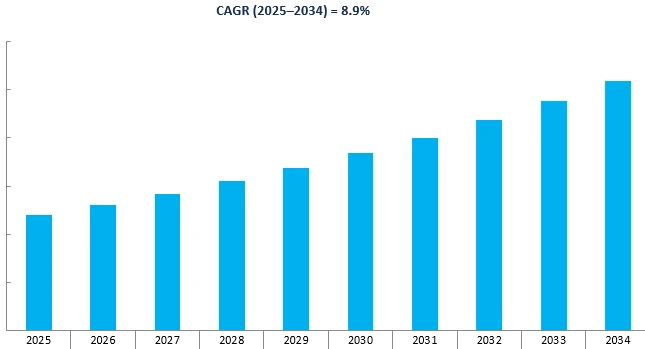
The total airport management system (TAMS) market is also benefiting from increasing passenger volumes and the need to improve airport throughput without relying exclusively on physical infrastructure expansion. AI-enabled operational orchestration, digital twin and simulation capabilities, cybersecurity, and counter-UAS integration are expected to create additional opportunities. Overall, the forecast indicates that TAM is progressing from an emerging framework toward an increasingly important component of digitally enabled airport operations.
Market Segmentation Analysis: Total Airport Management (TAM) Market
The Total Airport Management (TAM) Market can be understood through its functional components, implementation maturity, geographic coverage, and vendor ecosystem. The source material identifies several core functional areas that collectively form the TAM framework: enterprise architecture, data management, resource and capacity planning, collaborative decision-making, passenger management, and airport simulation or digital twin capabilities.
Enterprise architecture and data integration represent foundational elements of the Total Airport Management (TAM) Market. Integrated architectures allow airport organizations to connect operational information across different systems and departments. Data management becomes particularly important because TAM depends on the availability, accessibility, and secure exchange of information between stakeholders.
Resource and capacity planning is another major functional component. Increasing passenger volumes and infrastructure limitations are creating pressure to optimize airport resources. TAM can support coordinated planning of capacity and resources, helping airports respond to fluctuations in passenger demand and operational conditions.
Collaborative decision-making enables different airport stakeholders to work from integrated operational information. This is increasingly important as airport operations involve airlines, airport authorities, security organizations, ground handlers, technology providers, and other participants. A coordinated approach can improve situational awareness and operational response.
Passenger management is becoming increasingly significant within the Total Airport Management (TAM) Market. Younger passengers increasingly expect seamless and app-driven experiences, encouraging airports to connect passenger-facing services with broader operational systems. This trend supports greater integration between passenger flows, airport resources, and digital services.
Airport simulation and digital twins represent one of the fastest-growing areas within the market. Digital twin capabilities allow airports to model scenarios and assess operational conditions in a digital environment. The source identifies digital twin and airport simulation as the fastest-growing TAM sector, making this segment particularly important for future technology investments.
Geographically, the Total Airport Management (TAM) Market covers the Americas, Europe, Asia-Pacific, and MENA. Adoption maturity varies considerably between regions and airports. Mature airports are more likely to undertake incremental integration, while newer airports, particularly born-digital facilities, can implement more comprehensive TAM architectures.
The market can also be viewed according to implementation maturity, including complete, in-progress, and planned adoption. This approach reflects the developing nature of TAM and recognizes that airports may introduce individual capabilities before establishing a fully integrated environment.
The total airport management system (TAMS) market therefore encompasses both comprehensive platforms and component-level technologies. Vendors may compete by providing complete integration capabilities or by specializing in specific areas such as AI, cybersecurity, digital twins, passenger management, data integration, or resource optimization.
Growth Drivers: Total Airport Management (TAM) Market
Several structural and technology-related factors are supporting expansion of the Total Airport Management (TAM) Market.
AI-enabled operational orchestration is a major growth driver. The study indicates that AI can allow TAM to move beyond traditional dashboards toward systems capable of anticipating events and supporting autonomous operational responses. AI can therefore strengthen airport decision-making while improving the ability to manage increasingly complex operational environments.
Rising air traffic and passenger volumes are another important driver. The source notes that air traffic increased from 9.8 billion in 2025 to an estimated 10.2 billion in 2026 and is projected to reach 18.8 billion by 2045. This increase places greater pressure on airport infrastructure and strengthens the business case for integrated capacity and resource planning.
Digital acceptance is accelerating demand for integrated airport technologies. Millennials and Gen Z passengers increasingly expect seamless and app-driven experiences. The Total Airport Management (TAM) Market can address these expectations by connecting passenger management with broader airport operational systems.
Cybersecurity requirements are also becoming a major market catalyst. Greater IoT deployment, sensor proliferation, and multi-stakeholder data exchange increase the need for secure integrated architectures. As cybersecurity becomes fundamental to airport operations, TAM can increasingly serve as a coordination layer between operational systems and security capabilities.
Legacy-to-digital transformation provides another long-term opportunity. Existing airports need to modernize infrastructure while maintaining continuity of operations. TAM can provide a framework for integrating legacy environments with newer technologies, while born-digital airports can use TAM as part of their foundational architecture.
Finally, counter-UAS integration is expected to contribute to market growth. The integration of counter-UAS capabilities into TAM can support faster responses to airspace and ground-traffic disruptions while helping maintain passenger safety.
Growth Restraints: Total Airport Management (TAM) Market
Despite strong growth prospects, the Total Airport Management (TAM) Market faces several adoption barriers.
Cybersecurity risk is one of the most significant restraints. TAM increases connectivity and expands the number of systems and stakeholders participating in the operational environment. A cybersecurity incident affecting an integrated TAM environment could potentially have consequences beyond a single system, increasing the importance of secure architecture, monitoring, and response capabilities.
Privacy concerns can also restrict adoption. TAM may involve the collection and exchange of passenger and operational information. Concerns surrounding personally identifiable information, biometric data, and continuous tracking can influence passenger trust and regulatory requirements.
Lack of globally agreed standards remains another important challenge. The source emphasizes that TAM does not yet have established and universally agreed standards. Fragmented governance models can make cross-border interoperability more difficult while increasing customization and integration costs.
Legacy-system integration presents a practical barrier for mature airports. Existing infrastructure may have been developed over many years using different technologies and architectures. Connecting these environments with modern TAM platforms can require substantial investment, technical expertise, and phased implementation.
High capital requirements may further slow adoption. Airports must balance TAM investments against other infrastructure priorities. Airlines may also be reluctant to share proprietary operational information without clearly demonstrated benefits.
Passenger acceptance can represent another challenge. While digital technologies can improve convenience, some passengers may remain concerned about privacy, biometrics, and continuous data collection. The ability of the total airport management system (TAMS) market to demonstrate measurable operational and passenger benefits will therefore remain important to adoption.
Competitor Landscape: Total Airport Management (TAM) Market
The competitive environment of the Total Airport Management (TAM) Market consists of approximately 60 active competitors, with the market increasingly consolidating around approximately 10 major integrators supported by strong specialist contenders. The competitive structure reflects the multidisciplinary nature of TAM, where vendors compete not only on individual technologies but also on integration depth and the ability to connect multiple airport functions.
The leading companies identified in the study include SITA, Amadeus IT Group, Honeywell International, Siemens AG, Thales Group, and Indra Sistemas. Other notable participants include TAV, RESA, Dassault Systemes, InControl, Veovo, IBM, CAST, EUROCONTROL, ADB SAFEGATE, and other specialized technology providers.
Competitive differentiation in the Total Airport Management (TAM) Market is based on several factors. These include integration depth, AI and digital twin maturity, regulatory and standards alignment, geographic presence, cybersecurity, privacy, deployment flexibility, passenger-flow capabilities, and resource and capacity optimization.
The market demonstrates relatively high concentration. The top five companies accounted for 55% of 2025 revenue, indicating that leading integrators hold a substantial portion of the market. However, the presence of approximately 60 competitors indicates continued opportunities for specialist technology companies and component providers.
SITA, Amadeus, Indra, and Siemens are highlighted as companies appearing across multiple TAM components and participating in proof-of-concept deployments. Pure-play specialists, including companies such as TAV Technologies and RESA, complement broader system integrators by providing specific TAM-suite components.
The distribution structure primarily involves RFP-based direct contract awards and Prime/Sub B2B SaaS relationships. This structure reflects the complexity and strategic importance of TAM implementations, where airports generally require coordinated integration across multiple technology components.
The study does not identify notable mergers or acquisitions as a defining feature of the current competitive environment. Instead, partnerships between larger companies with integration expertise and smaller companies offering specialized TAM components are described as common.
The competitive outlook for the Total Airport Management (TAM) Market is therefore likely to remain integration-led. Vendors that can combine AI, digital twins, cybersecurity, data integration, passenger management, and capacity optimization into interoperable architectures are positioned to compete strongly as airports move from isolated technology deployments toward unified operational frameworks.
Scope of Analysis
Total Airport Management Components
Why is it Increasingly Difficult to Grow?
The Strategic Imperative 8™
The Impact of the Top 3 Strategic Imperatives on the Total Airport Management Industry
Competitive Environment
Vendor Landscape: Component Mapping
Vendor Landscape: Component Mapping by Geography (Europe)
Vendor Landscape: Component Mapping by Geography (Americas)
Vendor Landscape: Component Mapping by Geography (APAC)
Vendor Landscape: Component Mapping by Geography (MENA)
Vendor Landscape: Component Mapping by Geography (Summary)
Growth Metrics
Growth Drivers
Growth Restraints
Forecast Considerations
Revenue Forecast
Revenue Forecast by Region
Revenue Forecast by Industry Vertical
Revenue Forecast Analysis
Pricing Trends and Forecast Analysis
Revenue Share
Revenue Share Analysis
Forecast Analysis: Enterprise Architecture
Forecast Analysis: Data Management and Planning
Forecast Analysis: Resource Management and Planning
Forecast Analysis: Capacity Management and Planning
Forecast Analysis: Collaborative Decision-Making Support
Forecast Analysis: Passenger Management and Planning
Forecast Analysis: Airport Simulation/Digital Twin
Growth Opportunity 1: Airport Simulation/Digital Twins
Growth Opportunity 2: Capacity Management and Planning
Growth Opportunity 3: Collaborative Decision-Making Support
Growth Opportunity 4: Data Management and Planning
Growth Opportunity 5: Resource Management and Planning
Growth Opportunity 6: Passenger Management and Planning
Growth Opportunity 7: Enterprise Architecture
Benefits and Impacts of Growth Opportunities
Next Steps
List of Exhibits
Legal Disclaimer
Frequently Asked Questions: Total Airport Management (TAM) Market
1. What is the Total Airport Management (TAM) Market?
The Total Airport Management (TAM) Market represents the market for integrated airport management frameworks and technologies that connect enterprise architecture, data management, resource and capacity planning, collaborative decision-making, passenger management, and airport simulation or digital twin capabilities within a unified operational environment.
2. What is the projected growth of the Total Airport Management (TAM) Market?
The Total Airport Management (TAM) Market is projected to grow from approximately $4.80 billion in 2025 to $10.36 billion by 2034, representing a compound annual growth rate of 8.9% during the 2025–2034 period.
3. What are the major technologies driving the Total Airport Management (TAM) Market?
Major technologies supporting the Total Airport Management (TAM) Market include artificial intelligence, digital twins, airport simulation, cloud integration, cybersecurity, data integration, passenger-management technologies, and resource and capacity optimization. AI-enabled operational orchestration and digital twin capabilities are particularly important areas of development.
4. What are the key growth drivers for the Total Airport Management (TAM) Market?
Key growth drivers for the Total Airport Management (TAM) Market include increasing air traffic and passenger volumes, greater digital acceptance, AI maturity, rising cybersecurity requirements, modernization of legacy airport systems, demand for integrated resource and capacity planning, and the incorporation of counter-UAS capabilities.
5. What are the major restraints affecting the Total Airport Management (TAM) Market?
Major restraints affecting the Total Airport Management (TAM) Market include cybersecurity risks, privacy concerns, fragmented standards and governance frameworks, high capital requirements, legacy-system integration challenges, and reluctance among some stakeholders to share proprietary operational data. Passenger concerns regarding biometric information and continuous tracking may also affect adoption.
6. What is the total airport management system (TAMS) market?
The total airport management system (TAMS) market refers to the ecosystem of integrated platforms, technologies, and services that support coordinated airport operations. TAMS can connect data management, enterprise architecture, passenger management, capacity planning, cybersecurity, AI, simulation, and digital twin capabilities to improve airport-wide decision-making and operational coordination.
7. Who are the leading companies in the Total Airport Management (TAM) Market?
Leading companies in the Total Airport Management (TAM) Market include SITA, Amadeus IT Group, Honeywell International, Siemens AG, Thales Group, and Indra Sistemas. Other notable participants include TAV, RESA, Dassault Systemes, InControl, Veovo, IBM, CAST, EUROCONTROL, and ADB SAFEGATE.
8. Which regions are covered by the Total Airport Management (TAM) Market?
The global Total Airport Management (TAM) Market covers the Americas, including North America, South America, and Latin America, as well as Europe, Asia-Pacific, and MENA. Adoption varies by region and airport maturity, with legacy airports generally following phased implementation approaches and newer, born-digital airports adopting broader integrated architectures.
9. Why are digital twins important to the Total Airport Management (TAM) Market?
Digital twins are important to the Total Airport Management (TAM) Market because they support airport simulation, scenario analysis, operational planning, and decision-making. The study identifies digital twin and airport simulation capabilities as the fastest-growing TAM sector, making them an important area of future airport technology investment.
Speak directly with our analytics experts for tailored recommendations.
Recent related Aerospace Systems research
28 Sep 2026 | South Asia, Middle East & North Africa | Market Research
Aerospace Engineering Services, India, 2025–2030
India's aerospace engineering services market is evolving from cost-led engineering delivery to higher-value, strategic aerospace engineering participation. The market comprises outsourced engineering services delivered from India by third-party engineering and digital service providers that support...
24 Sep 2026 | North America | Market Research
Military Aviation Maintenance, Repair, and Overhaul Industry, US, 2025–2030
This research service provides a comprehensive overview of the US military aviation maintenance, repair, and overhaul (MRO) industry. The study segments the industry into six platform categories: 1. Fighter, Attack, & Bomber 2. Rotorcraft 3. Transport & Tanker 4. Training & Utility 5. Intelligence, ...
03 Sep 2026 | Global | Technology Research
Photonic and Optical Computing Chips for AI and Data Center Acceleration
The study evaluates photonic and optical computing technologies as critical enablers of next-generation AI infrastructure, addressing growing bandwidth, latency, power consumption, and scalability constraints associated with copper-based interconnects. The analysis covers photonic integrated circuit...
31 Jul 2026 | Global | Market Research
UAV Navigation Systems and Solutions, Global, 2025–2035
This study provides a comprehensive assessment of the global UAV navigation systems and solutions market through a multidimensional framework encompassing geographies, technologies, and applications. The market sizing and competitive assessment use a triangulated methodology that combines demand-sid...
27 Jul 2026 | Global | Technology Research
Advancements in Wide-Bandgap Materials (GaN, SiC, Ga₂O₃) for Power and RF Electronics
This study examines the technology landscape, commercialization progress, and future growth opportunities of wide-bandgap (WBG) semiconductor materials, with a primary focus on silicon carbide (SiC), gallium nitride (GaN), and gallium oxide (Ga₂O₃) for power and RF electronics. It evaluates how thes...
Purchase includes:
- Report download
- Growth Dialog™ with our experts
Growth Dialog™
A tailored session with you where we identify the:- Strategic Imperatives
- Growth Opportunities
- Best Practices
- Companies to Action
Impacting your company's future growth potential.
Author: Jason Buster
| Deliverable Type | Market Research |
|---|---|
| Industries | Aerospace, Defence and Security |
| No Index | No |
| Is Prebook | No |
| Podcast | No |
| Predecessor | None |
| WIP Number | KCA3-01-00-00-00 |