 USD
 GBP
 CNY
 EUR
 INR
 JPY
 MYR
 ZAR
 KRW
 THB


Aerospace Engineering Services, India, 2025–2030
Digital Engineering and India’s Aerospace Localization Efforts Drive Transformational Growth
28-Sep-2026
South Asia, Middle East & North Africa
Market Research
KCC9-01-00-00-00
AE_2026_34928
Key Takeaways: India's Aerospace Engineering Services Market
- India's aerospace engineering services market is transitioning from cost-led engineering delivery toward higher-value, strategic engineering partnerships.
- Revenue is projected to increase from $4.60 billion in 2025 to $7.67 billion by 2030, representing a strong 10.8% CAGR.
- OEM and Tier I Global Capability Center expansion is increasing outsourced engineering demand across commercial aviation, defense, space, and emerging aviation.
- Digital engineering, including MBSE, digital twins, AI/ML, cloud PLM, and virtual validation, is shifting demand toward higher-value engineering services.
- India's defense-indigenization programs, Make in India initiatives, NewSpace activity, UAVs, eVTOLs, and autonomous aviation are creating additional engineering opportunities.
- The India's aerospace engineering services outsourcing market is increasingly focused on specialized engineering, certification, qualification, digital engineering, and lifecycle support.
- The market includes 21 active competitors, with leading participants including Cyient, Quest Global, HCLTech, L&T Technology Services, and Capgemini Engineering.
- Key restraints include OEM/Tier I captive engineering expansion, security and export-control restrictions, certification complexity, specialized talent shortages, and long development cycles.
- Competitive advantage is increasingly shifting toward providers that combine aerospace domain expertise with digital engineering capabilities, compliance maturity, and trusted delivery models.
Report Summary: India's Aerospace Engineering Services Market
India's aerospace engineering services market is evolving from a primarily cost-oriented outsourcing model toward higher-value and strategically integrated engineering participation. The market encompasses third-party engineering service providers and digital service providers delivering aerospace engineering and digital services from India to domestic and international customers.
The research evaluates demand across commercial aviation, defense aviation, space, and emerging aviation. It examines how OEM and Tier I Global Capability Center expansion, Make in India and Aatmanirbhar Bharat initiatives, defense indigenization, NewSpace activity, and increasing software intensity are shaping the industry.
The market was estimated using a top-down triangulation approach for 2025, with forecasts developed according to market maturity, outsourcing dynamics, engineering intensity, and key growth drivers. Revenue is expected to rise from $4.60 billion in 2025 to $7.67 billion by 2030, resulting in a 10.8% CAGR.
The India's aerospace engineering services outsourcing market is increasingly moving toward software-intensive and specialized services. These include digital engineering, model-based systems engineering, certification and qualification support, and lifecycle engineering. Providers that combine traditional aerospace expertise with digital capabilities, compliance maturity, and trusted delivery models are positioned to capture future opportunities.
Analyst Words: India's Aerospace Engineering Services Market
Jahnavi Raghavaraju, Lead Analyst, India's AES Market, highlights that the next stage of India's aerospace engineering services market will depend on more than engineering scale alone. Providers need to combine aerospace domain expertise with digital engineering capabilities, regulatory and compliance maturity, and dependable delivery models to capture higher-value partnerships.
The analyst perspective points to a structural shift in the India's aerospace engineering services outsourcing market. Customers are increasingly looking for capabilities that extend beyond traditional engineering execution into software-defined systems, digital engineering, certification readiness, and secure work-package delivery.
India's position as a strategic aerospace engineering hub is being strengthened by Make in India initiatives, OEM and Tier I GCC expansion, defense indigenization, NewSpace activity, and emerging aviation programs. These developments are expanding the ecosystem for engineering service providers while increasing opportunities for specialist suppliers and technology companies.
The competitive environment is also becoming more ecosystem-led. OEMs, engineering service providers, Indian manufacturers, and specialist suppliers are increasingly collaborating across the aerospace lifecycle. Providers that successfully combine engineering depth, digital capabilities, compliance, and trusted customer relationships are likely to gain a stronger position in the market.
Market Overview & Trends: India's Aerospace Engineering Services Market
India's aerospace engineering services market is undergoing a significant transition as aerospace programs become increasingly software-intensive and engineering organizations seek scalable external capabilities. Historically, India has been positioned as a cost-effective engineering delivery location, but the market is now moving toward higher-value engineering participation involving systems engineering, digital engineering, certification support, and lifecycle services.
One of the most important trends is the expansion of OEM and Tier I Global Capability Centers (GCCs) in India. International aerospace companies are increasing their engineering presence and developing deeper technical capabilities within the country. This creates demand for engineering talent and also influences the addressable outsourcing opportunity for independent engineering service providers.
Commercial aviation is another important source of growth. Indian airlines have placed more than 1,500 aircraft orders, while Boeing forecasts demand for approximately 2,835 new aircraft across India and South Asia over the next 20 years. The expansion of the commercial aviation fleet creates sustained engineering requirements across design modifications, manufacturing engineering, certification, and aftermarket-related engineering support.
Digital transformation is reshaping the service mix. Aerospace OEMs are adopting model-based systems engineering (MBSE), digital twins, AI/ML, cloud PLM, and virtual validation to improve engineering productivity and program execution. Consequently, the market is moving toward higher-value digital engineering rather than conventional CAD-focused services.
Defense indigenization is another major trend. India's defense spending and localization initiatives are supporting indigenous aerospace programs, increasing engineering demand across systems integration, avionics, testing, manufacturing engineering, and sustainment.
The emerging aviation ecosystem, including UAVs, eVTOL aircraft, advanced air mobility, autonomous aviation, and NewSpace programs, is creating additional opportunities for simulation, software, certification, autonomy, and digital engineering capabilities.
Scope of Analysis: India's Aerospace Engineering Services Market
The scope of India's aerospace engineering services market covers revenue generated by third-party engineering service providers (ESPs) and digital service providers delivering aerospace engineering and digital services from India to domestic and international customers.
The research covers the 2025–2030 study period, with 2025 as the base year and 2026–2030 representing the forecast period. The monetary unit used in the analysis is the US dollar.
The market is segmented by four major end markets: commercial aviation, defense aviation, space, and emerging aviation. Commercial aviation includes commercial aircraft, regional aircraft, business jets, civil helicopters, and aircraft engines. Defense aviation includes military aircraft, military helicopters, and defense propulsion systems.
The space segment includes satellites, launch vehicles, ground systems, and spacecraft. Emerging aviation covers unmanned aerial systems, electric vertical takeoff and landing aircraft, advanced air mobility, autonomous aviation, and airspace integration platforms.
The ecosystem analysis considers GCCs, OEMs, defense primes, Tier I/Tier II/Tier III suppliers, government agencies, space and emerging aviation startups, and MRO providers as ecosystem participants and sources of demand, although they are not all counted directly as market revenue contributors.
The study excludes manufacturing revenue, physical MRO execution, airline operations, software licensing, general IT services, and non-engineering digital services.
Revenue Forecast Analysis: India's Aerospace Engineering Services Market
India's aerospace engineering services market is forecast to expand strongly from $4.60 billion in 2025 to $7.67 billion by 2030, representing a 10.8% CAGR between 2025 and 2030. The forecast indicates an absolute revenue increase of approximately $3.07 billion, equivalent to roughly 66.7% growth over the five-year period.
Revenue is expected to rise progressively from $4.60 billion in 2025 to $5.09 billion in 2026, followed by $5.63 billion in 2027 and $6.24 billion in 2028. The market is then projected to reach $6.92 billion in 2029 before reaching $7.67 billion in 2030.
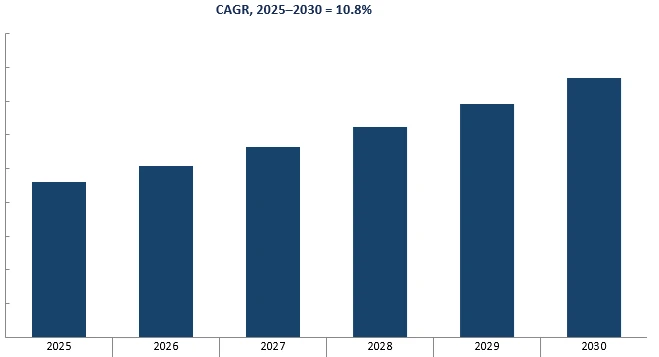
The consistent year-on-year expansion reflects increasing outsourcing demand from aerospace OEMs and Tier I companies, expansion of engineering ecosystems, commercial aircraft program growth, digital engineering adoption, defense indigenization, and emerging space and aviation programs.
The India's aerospace engineering services outsourcing market is also benefiting from a shift toward higher-value engineering services. MBSE, digital twins, AI/ML, cloud PLM, virtual validation, certification support, and lifecycle engineering can support stronger revenue realization compared with traditional engineering delivery.
The forecast therefore indicates that growth will not depend solely on increasing engineering headcount or conventional outsourcing. Increasing engineering complexity and software intensity are expected to create opportunities for specialized providers capable of delivering integrated engineering and digital capabilities.
Market Segmentation Analysis: India's Aerospace Engineering Services Market
The India's aerospace engineering services market is segmented into commercial aviation, defense aviation, space, and emerging aviation, each representing distinct engineering requirements and growth opportunities.
Commercial Aviation: This segment includes commercial aircraft, regional aircraft, business jets, civil helicopters, and aircraft engines. Growth is supported by India's expanding aviation ecosystem and increasing aircraft requirements across India and South Asia. Engineering opportunities extend across design, manufacturing engineering, digital engineering, certification, modifications, and lifecycle support.
Defense Aviation: Defense aviation includes military aircraft, military helicopters, and defense propulsion systems. India's defense-indigenization agenda is increasing the importance of domestic engineering capabilities. Engineering demand is expanding across systems integration, avionics, testing, manufacturing engineering, propulsion, certification, and sustainment.
Space: The space segment covers satellites, launch vehicles, ground systems, and spacecraft. India's growing space economy and NewSpace ecosystem are creating opportunities for engineering providers supporting spacecraft design, software, simulation, systems engineering, testing, certification, and related digital capabilities.
Emerging Aviation: This segment includes unmanned aerial systems (UAS), eVTOL aircraft, advanced air mobility, autonomous aviation, and airspace integration platforms. These technologies require multidisciplinary capabilities covering embedded software, autonomy, simulation, digital engineering, certification, and systems integration.
From a service perspective, the market is increasingly moving toward digital and software-intensive engineering. Traditional engineering capabilities remain important, but customers are increasingly demanding MBSE, digital twins, AI/ML, cloud PLM, virtual validation, certification readiness, and secure work-package delivery.
The India's aerospace engineering services outsourcing market therefore has opportunities across both established aerospace programs and emerging technology platforms. Providers with strong aerospace domain expertise and digital engineering capabilities are positioned to address a broader range of customer requirements.
Growth Drivers: India's Aerospace Engineering Services Market
The India's aerospace engineering services market is supported by multiple structural growth drivers.
Increase in Engineering Outsourcing by OEMs and Tier Is: Boeing and Airbus are cited as sourcing approximately $2.9 billion annually from India, while continuing to expand their engineering ecosystems. This is increasing outsourced requirements for design, manufacturing engineering, digital engineering, verification and validation, and lifecycle support.
Commercial Aircraft Program Expansion: India's airlines have placed more than 1,500 aircraft orders, while Boeing forecasts approximately 2,835 new aircraft for India and South Asia over the next 20 years. Larger fleets create sustained engineering requirements across design modifications, production support, certification, and aftermarket services.
Digital Engineering Adoption: Aerospace OEMs are accelerating adoption of MBSE, digital twins, AI/ML, cloud PLM, and virtual validation. This shift is creating demand for higher-value engineering services and enabling providers to participate in more complex program activities.
Defense Indigenization: India's defense budget and localization initiatives are supporting indigenous aerospace programs. This is increasing engineering demand across systems integration, avionics, testing, manufacturing engineering, and sustainment.
Space and Emerging Aviation Growth: India's space economy is targeted to reach $44 billion by 2033, while UAV and eVTOL activity continues to expand. These platforms require engineering capabilities in software, autonomy, simulation, certification, and digital engineering, supporting longer-term market opportunities.
Growth Restraints: India's Aerospace Engineering Services Market
Despite strong growth prospects, the India's aerospace engineering services market faces several structural restraints.
OEM and Tier I GCC Expansion: Global OEMs and Tier I companies continue to expand captive engineering centers in India while retaining architecture ownership and safety-critical development internally. This can limit the addressable outsourcing opportunity available to independent engineering service providers.
Security, IP, and Export-Control Restrictions: Defense and space programs are subject to security and export-control regulations that can restrict external participation. Sensitive engineering work may therefore need to remain within government organizations or strategically approved partners.
Certification and Compliance Complexity: Aerospace engineering requires strict certification, verification, validation, quality, and regulatory compliance. Providers without mature compliance and certification capabilities can face significant barriers to entering high-value programs.
Shortage of Specialized Aerospace Talent: India has a large engineering workforce, but experienced professionals in MBSE, avionics, certification, propulsion, safety-critical software, and specialized aerospace engineering remain relatively limited. Talent shortages can constrain delivery capacity as demand increases.
Long Development and Qualification Cycles: Defense aircraft, launch systems, and emerging aviation platforms require extensive testing, certification, and qualification before commercialization. Long program cycles can delay revenue realization and increase execution and investment risks for service providers.
Competitor Landscape: India's Aerospace Engineering Services Market
The India's aerospace engineering services market has 21 active competitors, creating a relatively specialized competitive environment compared with broader engineering services markets. Competitive differentiation is based on aerospace domain depth, India delivery scale, OEM and Tier I relationships, and digital engineering maturity.
Leading competitors identified in the research include Cyient, Quest Global, HCLTech, L&T Technology Services, and Capgemini Engineering. Other notable competitors include Infosys, Wipro, TCS, Tata Technologies, ALTEN, Accenture, and Expleo.
Cyient and Quest Global are positioned around deep aerospace engineering capabilities and relationships with global aerospace customers. HCLTech, L&T Technology Services, and Capgemini Engineering bring broader engineering and digital capabilities to aerospace programs. The competitive environment increasingly rewards providers that can combine aerospace expertise with digital transformation capabilities.
Competitive factors include aerospace domain depth, India delivery scale, OEM/Tier I relationships, and digital engineering maturity. As aerospace programs become more software-intensive, digital engineering capabilities are becoming increasingly important in determining supplier differentiation.
The market's distribution structure is based on a hybrid offshore-onsite model, dedicated engineering pods, master service agreements, work packages, and direct enterprise sales. This structure allows providers to combine India's engineering talent base with customer-facing technical teams and program-specific delivery models.
The market is also becoming more ecosystem-oriented. OEMs, engineering service providers, Indian manufacturers, and specialist suppliers are collaborating across the aerospace lifecycle. This creates opportunities for both large engineering service companies and specialized providers with niche aerospace capabilities.
The competitive landscape is also being influenced by M&A. The research notes that Cognizant completed its acquisition of Belcan in 2024, strengthening its ER&D and aerospace engineering capabilities. Such transactions demonstrate the strategic importance of aerospace engineering within the broader engineering, research, and digital services ecosystem.
Future competitive advantage is likely to depend increasingly on the ability to deliver secure, certified, software-intensive engineering programs rather than simply providing cost-effective engineering manpower. Providers that combine domain expertise, digital engineering, certification readiness, compliance maturity, and trusted delivery are positioned to capture higher-value opportunities in the India's aerospace engineering services outsourcing market.
Scope of Analysis
Segmentation
Why is it Increasingly Difficult to Grow?
The Strategic Imperative 8™
The Impact of the Top 3 Strategic Imperatives on the Aerospace Engineering Services Industry
Growth Metrics
Growth Environment
Aerospace Engineering Services Value Chain
Technology Trends Reshaping the AES Market
Ecosystem Map
GCC Evolution: Implications for Outsourced Aerospace Engineering Services
Competitive Environment
Key Competitors
Growth Drivers
Growth Restraints
Forecast Considerations
Revenue Forecast by Industry Vertical or Application
Revenue Forecast Analysis
Pricing Trends and Forecast Analysis
Revenue Share by Segment: Analysis
Competitive Positioning in India AES
Revenue Share by Competitors
Growth Metrics
Growth Environment—Commercial Aviation
Policy and Regulatory Enablers
Growth Drivers
Growth Restraints
Revenue Forecast
Forecast Analysis
Key Programs and Engineering Ecosystem
Engineering Services Demand Assessment
Growth Metrics
Growth Environment—Defense Aviation
Policy and Regulatory Enablers
Growth Drivers
Growth Restraints
Revenue Forecast
Forecast Analysis
Key Programs and Engineering Ecosystem
Engineering Services Demand Assessment
Growth Metrics
Growth Environment—Space
Policy and Regulatory Enablers
Growth Drivers
Growth Restraints
Revenue Forecast
Forecast Analysis
Key Programs and Engineering Ecosystem
Engineering Services Demand Assessment
Growth Metrics
Growth Environment—Emerging Aviation
Policy and Regulatory Enablers
Growth Drivers
Growth Restraints
Revenue Forecast
Forecast Analysis
Key Programs and Engineering Ecosystem
Engineering Services Demand Assessment
Growth Opportunity 1: Expand Across Multi-Domain Aerospace Programs
Growth Opportunity 2: Capture GCC-Adjacent Engineering Demand
Growth Opportunity 3: Shift from Engineering Capacity to Work-Package Ownership
Growth Opportunity 4: Lead in Software-Defined and Digital Aerospace Engineering
Growth Opportunity 5: Build Trusted Delivery for Regulated Aerospace Programs
Benefits and Impacts of Growth Opportunities
Next Steps
List of Exhibits
Legal Disclaimer
Frequently Asked Questions: India's Aerospace Engineering Services Market
1. What is India's aerospace engineering services market?
India's aerospace engineering services market comprises revenue generated by third-party engineering service providers and digital service providers delivering aerospace engineering and digital services from India to domestic and international customers. The market covers commercial aviation, defense aviation, space, and emerging aviation applications.
2. What is the size of India's aerospace engineering services market in 2025?
India's aerospace engineering services market was estimated at approximately $4.60 billion in 2025. The market is forecast to reach approximately $7.67 billion by 2030, according to the research.
3. What is the projected CAGR of India's aerospace engineering services market?
The India's aerospace engineering services market is projected to grow at a 10.8% CAGR from 2025 to 2030. Revenue is expected to increase from $4.60 billion in 2025 to $7.67 billion in 2030.
4. What is driving India's aerospace engineering services outsourcing market?
The India's aerospace engineering services outsourcing market is being driven by OEM and Tier I GCC expansion, commercial aircraft program growth, digital engineering adoption, defense indigenization, Make in India initiatives, NewSpace activity, UAVs, eVTOLs, and increasing demand for software-intensive aerospace engineering services.
5. Which segments are covered in India's aerospace engineering services market?
The India's aerospace engineering services market is segmented into commercial aviation, defense aviation, space, and emerging aviation. Emerging aviation includes unmanned aerial systems, eVTOL aircraft, advanced air mobility, autonomous aviation, and airspace integration platforms.
6. What is the revenue forecast for India's aerospace engineering services market?
Revenue in the India's aerospace engineering services market is projected to increase from $4.60 billion in 2025 to $5.09 billion in 2026, $5.63 billion in 2027, $6.24 billion in 2028, $6.92 billion in 2029, and $7.67 billion in 2030.
7. Who are the leading companies in India's aerospace engineering services market?
Leading companies identified in India's aerospace engineering services market include Cyient, Quest Global, HCLTech, L&T Technology Services, and Capgemini Engineering. Other notable participants include Infosys, Wipro, TCS, Tata Technologies, ALTEN, Accenture, and Expleo.
8. How is digital engineering influencing India's aerospace engineering services market?
Digital engineering is increasing the value and complexity of services within India's aerospace engineering services market. Aerospace organizations are adopting MBSE, digital twins, AI/ML, cloud PLM, and virtual validation to improve engineering productivity, program execution, verification, and lifecycle management.
9. What are the major growth opportunities in India's aerospace engineering services outsourcing market?
Major opportunities in the India's aerospace engineering services outsourcing market include commercial aircraft programs, defense indigenization, space programs, NewSpace activity, UAVs, eVTOLs, advanced air mobility, autonomous aviation, digital engineering, certification support, and lifecycle engineering services.
10. What are the key restraints affecting India's aerospace engineering services market?
Key restraints affecting the India's aerospace engineering services market include expansion of captive OEM and Tier I GCC engineering centers, security and export-control restrictions, certification and compliance complexity, shortages of specialized aerospace talent, and long development and qualification cycles.
11. How many competitors operate in India's aerospace engineering services market?
The research identifies 21 active competitors in India's aerospace engineering services market. Competition includes specialized aerospace engineering companies as well as large IT and engineering service providers with aerospace capabilities.
12. What is the outlook for India's aerospace engineering services market through 2030?
The outlook for India's aerospace engineering services market remains positive through 2030. Revenue is forecast to reach $7.67 billion, supported by OEM and Tier I expansion, commercial aviation demand, defense indigenization, digital engineering adoption, space activity, and emerging aviation technologies. Providers combining aerospace expertise, digital capabilities, compliance maturity, and trusted delivery models are expected to be best positioned for future growth.
Speak directly with our analytics experts for tailored recommendations.
Recent related Aerospace Systems research
30 Sep 2026 | Global | Market Research
Total Airport Management (TAM) Market, Global, 2025–2034
Total airport management (TAM) represents a high-potential convergence market that integrates enterprise architecture, data management, resource and capacity planning, collaborative decision-making, passenger management, and airport simulation/digital twin into a unified operational framework. TAM r...
24 Sep 2026 | North America | Market Research
Military Aviation Maintenance, Repair, and Overhaul Industry, US, 2025–2030
This research service provides a comprehensive overview of the US military aviation maintenance, repair, and overhaul (MRO) industry. The study segments the industry into six platform categories: 1. Fighter, Attack, & Bomber 2. Rotorcraft 3. Transport & Tanker 4. Training & Utility 5. Intelligence, ...
03 Sep 2026 | Global | Technology Research
Photonic and Optical Computing Chips for AI and Data Center Acceleration
The study evaluates photonic and optical computing technologies as critical enablers of next-generation AI infrastructure, addressing growing bandwidth, latency, power consumption, and scalability constraints associated with copper-based interconnects. The analysis covers photonic integrated circuit...
31 Jul 2026 | Global | Market Research
UAV Navigation Systems and Solutions, Global, 2025–2035
This study provides a comprehensive assessment of the global UAV navigation systems and solutions market through a multidimensional framework encompassing geographies, technologies, and applications. The market sizing and competitive assessment use a triangulated methodology that combines demand-sid...
27 Jul 2026 | Global | Technology Research
Advancements in Wide-Bandgap Materials (GaN, SiC, Ga₂O₃) for Power and RF Electronics
This study examines the technology landscape, commercialization progress, and future growth opportunities of wide-bandgap (WBG) semiconductor materials, with a primary focus on silicon carbide (SiC), gallium nitride (GaN), and gallium oxide (Ga₂O₃) for power and RF electronics. It evaluates how thes...
Purchase includes:
- Report download
- Growth Dialog™ with our experts
Growth Dialog™
A tailored session with you where we identify the:- Strategic Imperatives
- Growth Opportunities
- Best Practices
- Companies to Action
Impacting your company's future growth potential.
| Deliverable Type | Market Research |
|---|---|
| Industries | Aerospace, Defence and Security |
| No Index | No |
| Is Prebook | No |
| Podcast | No |
| Predecessor | None |
| WIP Number | KCC9-01-00-00-00 |