 USD
USD GBP
GBP  CNY
CNY  EUR
EUR  INR
INR  JPY
JPY  MYR
MYR  ZAR
ZAR  KRW
KRW  THB
THB 


Satellite Communication (SATCOM), Earth Observation (EO), and Position, Navigation, and Timing (PNT) Value Chain Analysis
SATCOM, EO, and PNT Will Drive Transformational Growth by 2035
24-Mar-2026
Global
Market Research
PG2W-01-00-00-00
AE_2026_34462
Key Takeaways: Space Economy Market
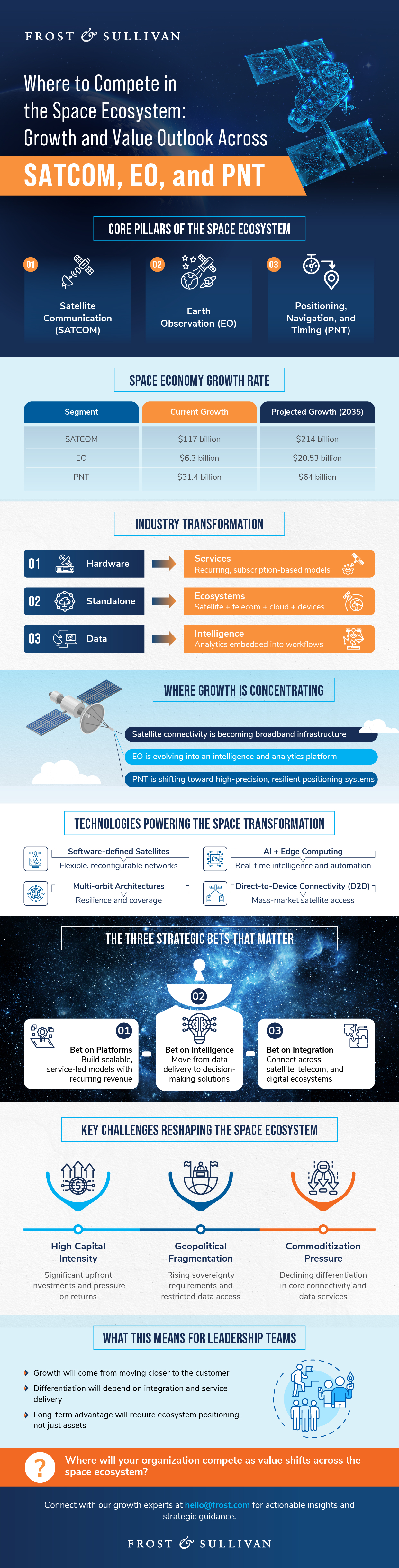
- The global Space Economy Market is entering a transformative growth phase, driven by rapid expansion across SATCOM, Earth Observation (EO), and Position, Navigation, and Timing (PNT) value chains.
- The SATCOM segment is projected to grow from USD 117.29 billion in 2024 to USD 214.38 billion by 2035, registering a CAGR of 5.6%.
- Low Earth Orbit (LEO) constellation deployment is reshaping satellite communications by improving coverage, reducing latency, and enabling new commercial applications.
- Revenue models across the space economy are increasingly shifting from hardware-centric sales to recurring service-based business models.
- Government and defense demand for resilient communications infrastructure remains one of the strongest long-term growth drivers.
- Earth Observation technologies are expanding beyond imagery into advanced analytics, climate intelligence, defense applications, and decision-support solutions.
- The PNT ecosystem is evolving through GNSS modernization, alternative navigation systems, and growing demand from autonomous mobility and critical infrastructure sectors.
- Software-defined architectures, satellite virtualization, and cloud-enabled ground infrastructure are accelerating innovation and scalability.
- Industry consolidation continues as vertically integrated players strengthen ecosystem control through acquisitions, partnerships, and multi-orbit strategies.
- Regulatory complexity, spectrum scarcity, and increasing competitive pressure from dominant LEO operators remain key market challenges.
Market Forecast (2024–2035)
| Metric | Details |
|---|---|
| 2024 SATCOM Market Size | USD 117.29 Billion |
| 2035 SATCOM Projected Size | USD 214.38 Billion |
| CAGR | 5.6% |
| Largest Growth Driver | LEO Constellation Expansion |
| Key Opportunity Areas | SATCOM, Earth Observation (EO), and PNT |
Report Summary: Space Economy Market
The global Space Economy Market is undergoing a structural transformation as satellite communications, Earth Observation (EO), and Position, Navigation, and Timing (PNT) technologies become increasingly critical to digital infrastructure, national security, enterprise operations, and connected mobility. The market is evolving beyond traditional satellite manufacturing and launch activities toward integrated ecosystems that generate recurring revenue through connectivity services, geospatial intelligence, navigation solutions, and data-driven applications. Increasing commercialization of space assets, combined with growing public and private sector investments, is creating substantial opportunities across the value chain.
A major shift within the space economy market is the rapid deployment of Low Earth Orbit (LEO) constellations and software-defined satellite architectures. These technologies are improving communication speed, coverage, scalability, and operational flexibility while enabling new applications across broadband connectivity, cellular backhaul, maritime communications, defense networks, and direct-to-device services. Simultaneously, Earth Observation providers are expanding beyond imagery collection into analytics-driven services supporting agriculture, climate monitoring, infrastructure management, insurance, energy, and defense sectors.
The broader market is also benefiting from increasing demand for resilient navigation and timing systems as industries adopt autonomous technologies, connected transportation platforms, and mission-critical digital infrastructure. Across SATCOM, Earth Observation, and PNT, industry participants are investing heavily in artificial intelligence, cloud integration, advanced analytics, and multi-orbit architectures to strengthen competitive positioning. As technology maturity improves and commercialization accelerates, the Space Economy Market is expected to witness sustained innovation, ecosystem consolidation, and long-term value creation through 2035.
Market Overview & Trends: Space Economy Market
The Space Economy Market is transitioning from a capital-intensive hardware industry into a technology-driven ecosystem focused on services, data monetization, and platform-based business models. Satellite operators, analytics providers, and navigation solution vendors are increasingly generating revenue from recurring subscriptions and managed services rather than one-time equipment sales.
One of the most significant trends shaping the market is the proliferation of LEO satellite constellations. These networks provide lower latency, broader coverage, and improved scalability compared to traditional geostationary systems. As deployment costs decline through reusable launch technologies and standardized satellite manufacturing, operators are expanding services across consumer broadband, enterprise connectivity, government communications, and mobility applications.
The SATCOM segment is also witnessing increased adoption of multi-orbit architectures that combine LEO, MEO, and GEO networks to enhance reliability and service continuity. Software-defined payloads, digital beamforming, and satellite virtualization are improving network flexibility while supporting evolving customer requirements.
Within Earth Observation, the market is shifting toward value-added analytics powered by artificial intelligence and machine learning. Organizations increasingly require actionable insights rather than raw imagery, creating opportunities for advanced geospatial intelligence platforms.
The PNT ecosystem is experiencing growing demand from autonomous vehicles, aviation, maritime operations, telecommunications, financial services, and critical infrastructure operators. Alternative navigation solutions and resilient timing systems are gaining importance as governments and enterprises seek to reduce dependence on traditional GNSS infrastructure.
Scope of Analysis: Space Economy Market
This study provides a comprehensive assessment of the global Space Economy Market, focusing on the technology evolution, commercial dynamics, competitive landscape, and growth opportunities across SATCOM, Earth Observation (EO), and Position, Navigation, and Timing (PNT) value chains.
The analysis evaluates each sector across its respective ecosystem, including infrastructure providers, service operators, analytics platforms, component manufacturers, system integrators, and downstream application providers. Particular emphasis is placed on technology readiness, commercialization maturity, value creation potential, and competitive intensity.
The SATCOM segment covers satellite television, consumer broadband, business broadband, cellular backhaul, in-flight and maritime communications, and direct-to-device connectivity. The Earth Observation segment includes optical, radar, and hyperspectral imaging technologies, along with analytics and geospatial intelligence services. The PNT segment encompasses GNSS systems, alternative navigation technologies, timing services, receivers, antennas, and integrated navigation platforms.
The study examines global market dynamics from 2024 through 2035 and evaluates technology innovation, ecosystem partnerships, mergers and acquisitions, competitive positioning, and emerging business models. Revenue forecasts are developed using a combination of industry benchmarks, technology adoption trends, commercialization trajectories, and market demand indicators.
Market Segmentation Analysis: Space Economy Market
The Space Economy Market is segmented into three core domains: Satellite Communications (SATCOM), Earth Observation (EO), and Position, Navigation, and Timing (PNT), each representing distinct but increasingly interconnected growth opportunities.
The SATCOM segment enables global connectivity through satellite networks supporting broadband internet, business communications, government and defense applications, cellular backhaul, maritime services, aviation connectivity, and direct-to-device communications. Increasing demand for low-latency broadband and resilient communications infrastructure continues to drive investment across the segment.
The Earth Observation segment provides geospatial intelligence through optical, radar, and hyperspectral satellite technologies. Applications include agriculture monitoring, environmental management, disaster response, defense intelligence, infrastructure planning, mining, energy, insurance, and climate analytics. The growing need for real-time actionable insights is accelerating demand for analytics-driven solutions.
The PNT segment supports precision positioning, navigation, and timing capabilities across transportation, logistics, telecommunications, financial services, defense operations, autonomous systems, and critical infrastructure. The market includes GNSS operators, alternative navigation providers, receiver manufacturers, timing solution providers, and integrated navigation platforms.
Increasing convergence among SATCOM, Earth Observation, and PNT technologies is creating opportunities for integrated solutions that combine connectivity, geospatial intelligence, and navigation capabilities within a unified ecosystem.
Revenue & Spending Forecast: Space Economy Market
The global Space Economy Market is expected to experience sustained investment growth as governments, enterprises, and consumers increase reliance on satellite-enabled services and infrastructure.
Within the SATCOM segment, market revenue is projected to increase from USD 117.29 billion in 2024 to USD 214.38 billion by 2035, reflecting a CAGR of approximately 5.6%. Growth is being driven by broadband expansion, mobility applications, government communications programs, and next-generation satellite deployments.

Investment activity across the broader market continues to accelerate as operators deploy LEO constellations, expand ground infrastructure, develop advanced payload technologies, and integrate cloud-based network architectures. Significant spending is also directed toward Earth Observation analytics platforms, alternative navigation systems, and AI-powered operational capabilities.
As commercialization expands and technology costs continue to decline, spending across SATCOM, Earth Observation, and PNT ecosystems is expected to increase substantially, supporting long-term market growth and value creation.
Growth Drivers: Space Economy Market
Government and defense demand for resilient communications infrastructure remains a major growth catalyst within the Space Economy Market. National security priorities, military modernization programs, and secure communication requirements are driving long-term investments across satellite networks.
The rapid expansion of LEO constellations is creating additional growth opportunities by improving broadband accessibility, reducing latency, and enabling new commercial applications. Advances in satellite manufacturing, launch services, and digital payload technologies are lowering deployment costs and accelerating innovation.
Increasing adoption of mobility applications, including connected vehicles, aviation connectivity, maritime communications, and direct-to-device services, is expanding addressable markets. Growing demand for geospatial intelligence and Earth Observation analytics is also supporting market expansion across agriculture, climate monitoring, infrastructure management, and defense sectors.
Rising reliance on navigation and timing services for autonomous systems, logistics operations, telecommunications networks, and financial infrastructure continues to strengthen demand across the PNT ecosystem.
Growth Restraints: Space Economy Market
Despite strong growth prospects, the Space Economy Market faces several structural challenges.
Complex regulatory frameworks and spectrum allocation requirements remain significant barriers to deployment. Operators must navigate national regulations, international coordination requirements, and spectrum scarcity challenges that can delay expansion efforts.
Increasing competition from dominant LEO operators is creating pricing pressure across broadband and connectivity markets. Smaller participants may face difficulties achieving the scale necessary to compete effectively.
Integration challenges associated with hybrid LEO-GEO architectures also present technical and operational obstacles. Differences in latency characteristics, routing requirements, and network management systems can complicate seamless service delivery.
Additional challenges include capital intensity, cybersecurity risks, orbital congestion concerns, and evolving regulatory requirements affecting long-term market dynamics.
Competitive Landscape: Space Economy Market
The Space Economy Market is characterized by increasing consolidation, ecosystem partnerships, and competition among large, vertically integrated operators.
The SATCOM competitive landscape includes approximately 45 major participants competing across satellite television, consumer broadband, enterprise connectivity, cellular backhaul, maritime communications, aviation connectivity, and direct-to-device services. The top five competitors collectively account for more than 53% of market revenue.
Leading companies include Starlink, Viasat, Eutelsat, SES, Dish Network, DirectTV, OneWeb, Iridium, Panasonic Avionics, Thales, Gogo, Marlink, and other regional and global service providers. Competition is increasingly focused on deployment speed, scalability, technology flexibility, service integration capabilities, spectrum access, and customer proximity.
Across SATCOM, Earth Observation, and PNT, strategic acquisitions, ecosystem partnerships, and multi-orbit strategies are becoming critical competitive differentiators. As the market matures, success will increasingly depend on technological innovation, operational scale, ecosystem integration, and the ability to monetize data-driven services across multiple end-user industries.
Scope of Analysis
Segmentation
Why Is It Increasingly Difficult to Grow?
The Strategic Imperative 8™
The Impact of the Top 3 Strategic Imperatives on the SATCOM Industry
SATCOM: Competitive Environment
SATCOM: Key Competitors
Growth Metrics
Growth Drivers
Growth Restraints
Forecast Considerations
Revenue Forecast
Revenue Forecast by Industry Vertical
Pricing Trends
Forecast Analysis
Revenue Share Analysis
Value Chain Analysis Overview
Value Chain Analysis
Satellite Operations
Why Is It Increasingly Difficult to Grow?
The Strategic Imperative 8™
The Impact of the Top 3 Strategic Imperatives on the EO Industry
EO: Competitive Environment
EO: Key Competitors
Growth Metrics
Growth Drivers
Growth Restraints
Forecast Considerations
Revenue Forecast
Revenue Forecast by Industry Vertical
Pricing Trends
Forecast Analysis
Revenue Share Analysis
Value Chain Analysis Overview
Value Chain Analysis
Satellite Operations
Why Is It Increasingly Difficult to Grow?
The Strategic Imperative 8™
The Impact of the Top 3 Strategic Imperatives on the PNT Industry
PNT: Competitive Environment
PNT: Key Competitors
Growth Metrics
Growth Drivers
Growth Restraints
Forecast Considerations
Revenue Forecast
Revenue Forecast by Industry Vertical
Pricing Trends
Forecast Analysis
Revenue Share Analysis
Value Chain Overview
Value Chain Analysis
Satellite Operations
Growth Opportunity 1: LEO-Based SATCOM Constellations and Network Densification
Growth Opportunity 2: Satellite Non-Terrestrial Networks (NTNs)
Growth Opportunity 3: Direct-to-Device (D2D) and Ubiquitous Connectivity
Growth Opportunity 4: Proliferation of High-Revisit, Multi-Sensor Constellations
Growth Opportunity 5: AI-Driven Analytics and Automation of the EO Value Chain
Growth Opportunity 6: Verticalized EO Platforms and Embedded Decision Workflows
Growth Opportunity 7: Multi-Constellation and Multi-Frequency PNT Architectures
Growth Opportunity 8: Alternative and Complementary PNT Technologies
Growth Opportunity 9: Emergence of LEO-Based PNT
Benefits and Impacts of Growth Opportunities
Next Steps
List of Exhibits
Legal Disclaimer
Frequently Asked Questions (FAQs) – Space Economy Market
1. What is the Space Economy Market?
The Space Economy Market encompasses commercial and government activities related to satellite communications (SATCOM), Earth Observation (EO), and Position, Navigation, and Timing (PNT). The market includes satellite infrastructure, connectivity services, geospatial intelligence solutions, navigation systems, ground infrastructure, and downstream applications that leverage space-based technologies.
2. How large is the Space Economy Market?
Within the Space Economy Market, the SATCOM segment is projected to grow from USD 117.29 billion in 2024 to USD 214.38 billion by 2035, registering a CAGR of 5.6%. Growth is being driven by expanding satellite connectivity services, LEO constellation deployments, and increasing demand for broadband and mobility applications.
3. What factors are driving growth in the Space Economy Market?
Key growth drivers include increasing government and defense investments, expansion of Low Earth Orbit (LEO) constellations, rising demand for broadband connectivity, growth in Earth Observation analytics, and increasing reliance on Position, Navigation, and Timing (PNT) solutions across critical industries.
4. What is SATCOM and why is it important?
Satellite Communication (SATCOM) enables global connectivity through satellite networks that support broadband internet, cellular backhaul, enterprise communications, government and defense applications, maritime connectivity, aviation services, and direct-to-device communications. SATCOM plays a critical role in expanding connectivity beyond terrestrial networks.
5. What is the role of Earth Observation (EO) in the Space Economy Market?
Earth Observation (EO) uses optical, radar, and hyperspectral satellites to collect and analyze geospatial data. Applications include agriculture monitoring, climate intelligence, environmental management, disaster response, infrastructure planning, defense operations, mining, and energy management.
6. What is the Position, Navigation, and Timing (PNT) market?
The Position, Navigation, and Timing (PNT) segment provides location, navigation, synchronization, and timing services that support transportation, logistics, telecommunications, defense systems, financial services, autonomous vehicles, and critical infrastructure operations worldwide.
7. What are the major trends shaping the Space Economy Market?
Major trends include the deployment of LEO satellite constellations, software-defined satellite architectures, AI-powered analytics, multi-orbit network integration, cloud-based ground infrastructure, recurring service-based business models, and increasing commercialization of space-enabled services.
8. What challenges affect the Space Economy Market?
Key challenges include spectrum scarcity, complex regulatory requirements, orbital congestion, cybersecurity risks, pricing pressure from dominant LEO operators, and integration challenges associated with hybrid LEO-GEO satellite architectures.
9. Who are the leading companies in the Space Economy Market?
Leading participants across the Space Economy Market include Starlink, Viasat, Eutelsat, SES, OneWeb, Iridium, Dish Network, DirectTV, Panasonic Avionics, Thales, Gogo, and other major operators serving SATCOM, Earth Observation, and PNT markets.
10. What is the future outlook for the Space Economy Market?
The future outlook for the Space Economy Market remains highly positive due to increasing commercialization of space technologies, expanding satellite connectivity demand, growing adoption of Earth Observation analytics, rising reliance on PNT services, and continued innovation across SATCOM, EO, and PNT ecosystems through 2035.
Speak directly with our analytics experts for tailored recommendations.
Recent related Space research
27 Jul 2026 | Global | Technology Research
Advancements in Wide-Bandgap Materials (GaN, SiC, Ga₂O₃) for Power and RF Electronics
This study examines the technology landscape, commercialization progress, and future growth opportunities of wide-bandgap (WBG) semiconductor materials, with a primary focus on silicon carbide (SiC), gallium nitride (GaN), and gallium oxide (Ga₂O₃) for power and RF electronics. It evaluates how thes...
25 Jun 2026 | Global | Technology Research
Quantum Sensors Transitioning from Lab to Industry: Ultra-Precision Measurement for Healthcare, Defense, and Manufacturing
Quantum sensing is transitioning from laboratory research to industrial deployment, driven by the need for ultra-precise, reliable measurement in high-impact sectors such as healthcare, defense, and advanced manufacturing. This shift reflects a broader move from controlled, research-grade environmen...
28 Nov 2025 | Global | Market Research
Growth Opportunities in the Asia-Pacific C4ISR Industry, 2023–2028
This research service analyzes the Asia-Pacific military command, control, communication, intelligence, surveillance, and reconnaissance (C4ISR) industry. It segments the industry into 5 categories: command and control, communication, computers, ISR, and electronic warfare. The assessment covers fou...
21 Nov 2025 | Global | Market Research
US Foreign Military Sales Growth Opportunities, 2025
This research provides a comprehensive overview of the US foreign military sales industry outlook. Based on major arms segmentation, it categorizes the industry into: • Missiles • Command, Control, Communications, Computers, Intelligence, Surveillance, and Reconnaissance • ...
28 Oct 2025 | Global | Technology Research
Growth Opportunities in Carbon Nanotubes for Improved Product Performances
Carbon nanotubes (CNTs) are emerging as a cornerstone material for next-generation industries, enabling breakthroughs in electric vehicles, aerospace, energy storage, and flexible electronics through their unique combination of lightweight structure, exceptional electrical conductivity, and superior...
Purchase includes:
- Report download
- Growth Dialog™ with our experts
Growth Dialog™
A tailored session with you where we identify the:- Strategic Imperatives
- Growth Opportunities
- Best Practices
- Companies to Action
Impacting your company's future growth potential.