 USD
USD GBP
GBP  CNY
CNY  EUR
EUR  INR
INR  JPY
JPY  MYR
MYR  ZAR
ZAR  KRW
KRW  THB
THB 


US Military Intelligence Analytics Industry Growth Opportunities, 2025–2028
Algorithm of Victory: AI’s Analytical Intelligence Revolution
25-Aug-2026
North America
Market Research
M1L5-01-00-00-00
AE_2026_34840
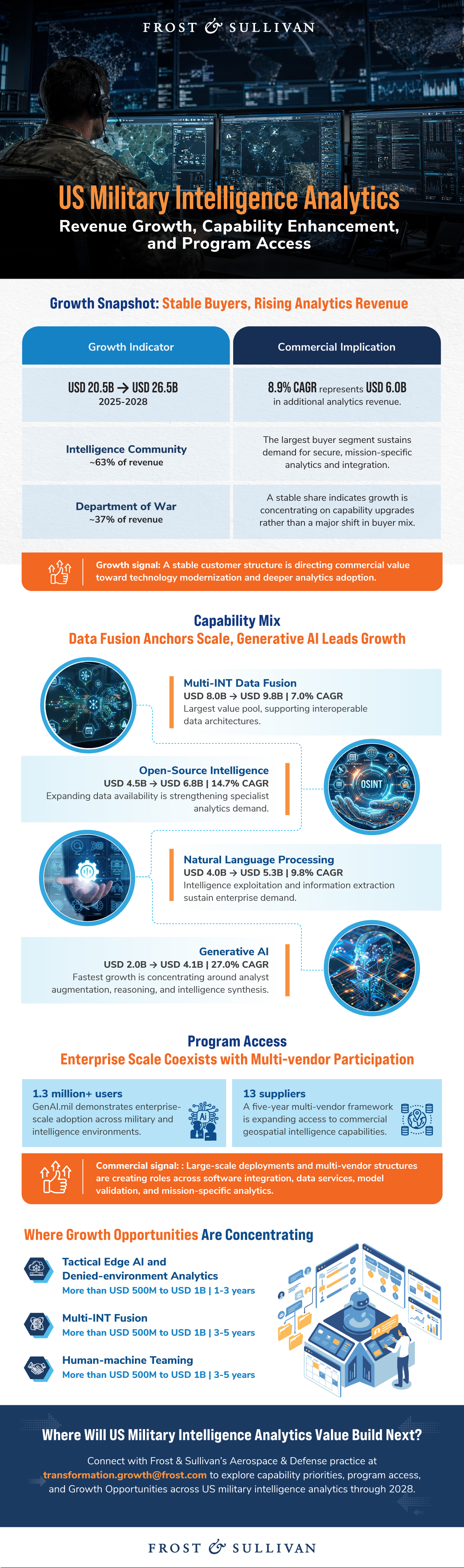
The US military intelligence (MILINT) analytics market is undergoing rapid transformation driven by the convergence of AI, big data analytics, and next-generation sensing. As the DoW and the wider intelligence community (IC) face increasingly complex multi-domain threats, the demand for scalable, real-time, and automated intelligence processing capabilities is accelerating.
This research examines the evolving market across key technology segments: natural language processing (NLP), open-source intelligence (OSINT), and Generative AI/large language models (LLMs), as well as the broader data fusion, analytics, and integration ecosystem supporting mission-critical intelligence workflows.
At its core, the market is transitioning from traditional, human-intensive intelligence analysis toward AI-augmented decision-making. NLP technologies are enabling automated extraction, classification, and translation of vast volumes of unstructured multilingual data, significantly enhancing analyst productivity and enabling deeper contextual understanding. Simultaneously, OSINT platforms are gaining strategic importance, allowing IC to collect, correlate, and exploit publicly available data sources—including social media, dark web, and commercial imagery—at scale.
The emergence of Generative AI and LLMs represents a paradigm shift in military intelligence operations. These technologies are increasingly being integrated into workflows for summarization, query-based intelligence retrieval, knowledge synthesis, and mission planning support. As a result, the MILINT ecosystem is evolving toward a layered architecture combining foundational AI models, domain-specific analytics platforms, and mission-focused applications.
The competitive landscape reflects this structural shift. Large technology providers such as Microsoft, Google, and emerging AI model developers are supplying foundational AI capabilities, while specialized analytics vendors and defense technology companies deliver intelligence-oriented platforms. Established defense integrators including Booz Allen Hamilton, Leidos, CACI, SAIC, and RTX play a critical role in operationalizing these technologies within secure, classified environments and mission systems.
The report provides a comprehensive assessment of the market, including key drivers and restraints, alongside analysis of budgets and contract activity. It further delivers market sizing, growth forecasts, and a clear view of the commercial potential and emerging opportunities shaping the market over the coming years.
Scope of Analysis
Industry Segmentation
Why is it Increasingly Difficult to Grow?
The Strategic Imperative 8™
The Impact of the Top 3 Strategic Imperatives on the US Military Intelligence (MILINT) Analytics Industry
Growth Opportunities Fuel the Growth Pipeline Engine™
Research Methodology
Scope of Research
Purpose and Overview
Growth Drivers
Growth Restraints
Forecast Assumptions
Revenue Forecast
Revenue Forecast by Segment
Market Share by Segment
Market Forecast Analysis
DoW 2026 MILINT Analytics Strategy
US IC MILINT Posture
Key US MILINT Analytics Vendors by Segment
MILINT Analytics Emerging Concepts of Operation
MILINT Analytics Prime Military US Programs, 2025–2028
MILINT Analytics Prime US Contracts, 2025–2028
Growth Opportunity 1: Operationalizing Tactical Edge AI and Denied-Environment Analytics
Growth Opportunity 2: Multi-INT Fusion
Growth Opportunity 3: Human-Machine Teaming (Augmented Analysts)
Benefits and Impacts of Growth Opportunities
Next Steps
List of Exhibits
Legal Disclaimer
Speak directly with our analytics experts for tailored recommendations.
Recent related Defense research
07 Oct 2026 | North America | Frost Radar
Frost Radar™: US Military Intelligence Analytics, 2026
The US military intelligence (MILINT) analytics industry is undergoing a structural transformation as defense and intelligence agencies transition from platform-centric architectures to AI-native, data-centric, and decision-driven operational models. Intelligence systems are no longer confined to po...
30 Sep 2026 | Global | Market Research
Total Airport Management (TAM) Market, Global, 2025–2034
Total airport management (TAM) represents a high-potential convergence market that integrates enterprise architecture, data management, resource and capacity planning, collaborative decision-making, passenger management, and airport simulation/digital twin into a unified operational framework. TAM r...
24 Sep 2026 | North America | Market Research
Military Aviation Maintenance, Repair, and Overhaul Industry, US, 2025–2030
This research service provides a comprehensive overview of the US military aviation maintenance, repair, and overhaul (MRO) industry. The study segments the industry into six platform categories: 1. Fighter, Attack, & Bomber 2. Rotorcraft 3. Transport & Tanker 4. Training & Utility 5. Intelligence, ...
03 Sep 2026 | Global | Technology Research
Photonic and Optical Computing Chips for AI and Data Center Acceleration
The study evaluates photonic and optical computing technologies as critical enablers of next-generation AI infrastructure, addressing growing bandwidth, latency, power consumption, and scalability constraints associated with copper-based interconnects. The analysis covers photonic integrated circuit...
31 Jul 2026 | Global | Market Research
UAV Navigation Systems and Solutions, Global, 2025–2035
This study provides a comprehensive assessment of the global UAV navigation systems and solutions market through a multidimensional framework encompassing geographies, technologies, and applications. The market sizing and competitive assessment use a triangulated methodology that combines demand-sid...
Purchase includes:
- Report download
- Growth Dialog™ with our experts
Growth Dialog™
A tailored session with you where we identify the:- Strategic Imperatives
- Growth Opportunities
- Best Practices
- Companies to Action
Impacting your company's future growth potential.