 USD
 GBP
 CNY
 EUR
 INR
 JPY
 MYR
 ZAR
 KRW
 THB


UAV Navigation Systems and Solutions, Global, 2025–2035
UAV Navigation Systems and Solutions is Driving Transformational Growth by 2035 due to SWaP-C Optimization, Swarming Solutions, and AI-Enabled Navigation Capabilities
31-Jul-2026
Global
Market Research
PLII-01-00-00-00
AE_2026_34789
Key Takeaways: UAV navigation systems market
- The global UAV navigation systems market is entering a late-growth phase, supported by rising demand for autonomous, resilient, and high-performance navigation across defense, commercial, agriculture, public safety, and consumer applications.
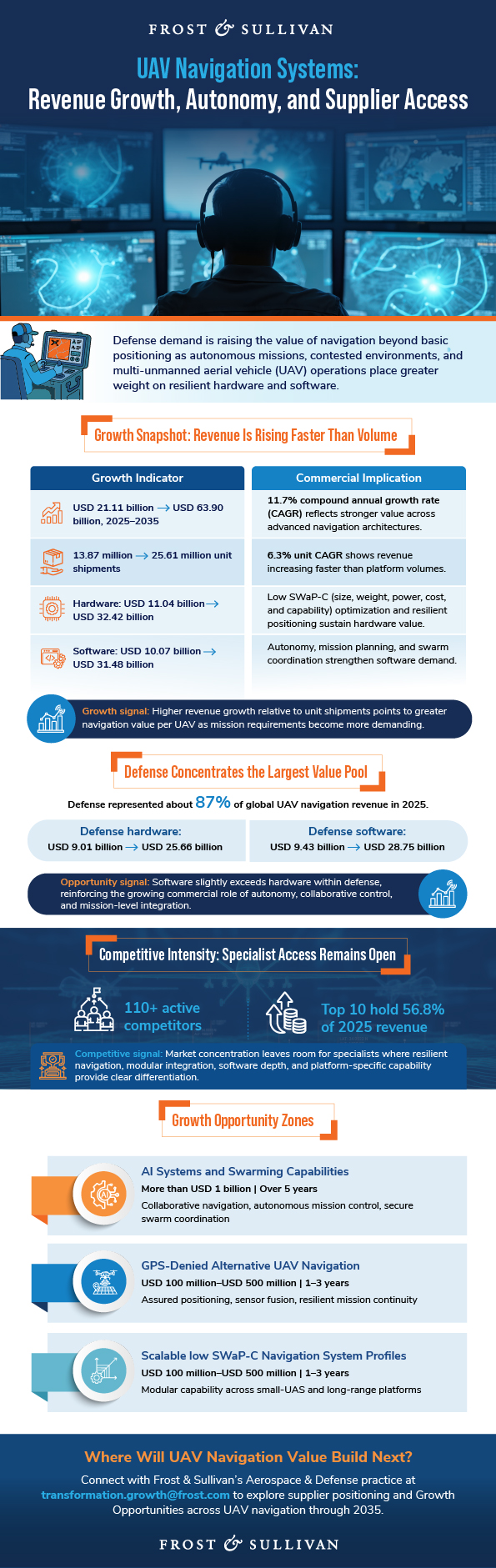
- The UAV navigation systems and solutions market is forecast to expand from approximately $21.1 billion in 2025 to $63.9 billion by 2035, representing an 11.7% revenue CAGR.
- Unit shipments are projected to increase from approximately 13.87 million units in 2025 to 25.61 million units by 2035, reflecting a 6.3% CAGR.
- Defense represents the dominant application segment, while commercial, public safety, agriculture, and consumer applications broaden the addressable opportunity for navigation technologies.
- AI-enabled navigation, vision-based navigation, swarm technologies, and SWaP-C optimization are emerging as important technology themes across the unmanned aerial vehicle (UAV) navigation systems market.
- The Americas currently represent the largest regional market, while Asia is identified in the research as an emerging high-growth region supported by modernization, indigenous capability development, and expanding commercial adoption.
- Modular Open Systems Architecture (MOSA) is contributing to component commoditization and margin pressure by improving interoperability, substitution flexibility, and multi-vendor participation.
- Counter-UAV technologies, including GNSS jamming and spoofing, are simultaneously increasing the need for resilient and redundant navigation architectures.
Report Summary: UAV navigation systems market
The global UAV navigation systems market is undergoing significant transformation as unmanned aerial vehicles become increasingly autonomous, mission-specific, and technologically sophisticated. The supplied research evaluates the market across technologies, applications, and geographies, using demand-side analysis of end-use adoption together with supply-side validation based on the revenue performance of major industry participants.
The UAV navigation systems and solutions market encompasses hardware and software capabilities supporting positioning, stabilization, flight control, mission planning, autonomy, and navigation in both GNSS-enabled and denied environments. The study identifies defense as the dominant demand-generating application, while commercial, agriculture, public safety and law enforcement, and consumer applications contribute to broader market expansion.
The research highlights increasing adoption of AI-enabled autonomous navigation, vision-based navigation, swarm technologies, and SWaP-C optimization. Navigation architectures are also evolving in response to counter-UAV technologies such as GNSS jamming and spoofing, increasing the importance of resilient, redundant, and multi-sensor navigation capabilities.
From a regional perspective, the Americas represent the largest market, supported by defense spending and technology leadership. Asia is emerging as an important growth region, supported by modernization initiatives, indigenous capability development, and increasing adoption across defense and commercial applications.
Market Overview & Trends: UAV navigation systems market
The global UAV navigation systems market is evolving from conventional positioning and inertial navigation toward integrated, software-enabled, and increasingly autonomous navigation architectures. The market combines technologies such as GNSS modules, inertial navigation systems, inertial measurement units, LiDAR, radar, ultrasonic sensors, vision-based systems, and supporting software platforms. These technologies collectively enable UAV positioning, stabilization, obstacle avoidance, flight management, and autonomous operations.
A major trend in the UAV navigation systems and solutions market is the increasing emphasis on SWaP-C optimization. UAV manufacturers and operators are seeking navigation systems that deliver greater functionality while reducing size, weight, power consumption, and cost. This requirement is particularly important for smaller platforms, where payload capacity and energy availability are constrained.
AI-enabled navigation is another significant development. AI and machine-learning capabilities can support autonomous decision-making, navigation in complex environments, and adaptive mission execution. Vision-based navigation is also becoming increasingly important where GNSS availability or reliability is limited.
Swarm-enabled UAV operations represent another emerging trend. As fleets of smaller UAVs become more capable of collaborative operations, navigation systems must support coordinated movement, adaptive control, and distributed decision-making.
The unmanned aerial vehicle (UAV) navigation systems market is also being affected by the development of counter-UAV technologies. GNSS jamming, spoofing, and other electronic warfare techniques can compromise conventional navigation signals, increasing demand for navigation architectures capable of operating with reduced dependence on external positioning signals.
Scope of Analysis: UAV navigation systems market
The study provides a global assessment of the UAV navigation systems market covering technology layers, application segments, and regional supply capabilities. The study period is 2025–2035, with 2025 as the base year and 2026–2035 as the forecast period. Monetary values are presented in US dollars.
At the technology level, the UAV navigation systems and solutions market includes two broad layers. Hardware systems include GNSS modules, inertial navigation systems, inertial measurement units, LiDAR, radar, ultrasonic sensors, and vision-based systems. Software includes navigation and control functions, mission planning, obstacle detection and avoidance, precision flight control, fleet management, and advanced capabilities such as AI-enabled navigation and swarm intelligence.
The application scope covers consumer, commercial, agriculture, public safety and law enforcement, and defense. Defense is specifically identified as a dedicated segment because of its significant market value and advanced navigation requirements.
The regional analysis considers major geographies including the Americas, Europe, and Asia-Pacific. The study also evaluates regional manufacturers and solution providers, their production capabilities, technology focus, revenue contribution, innovation strengths, and manufacturing scale.
Market Segmentation Analysis: UAV navigation systems market
The UAV navigation systems market is segmented primarily by application, technology, and region. Application segmentation provides insight into how different operational requirements influence navigation technology adoption.
The consumer segment includes navigation systems embedded in drones used for recreational and personal applications. These systems prioritize accessibility, ease of operation, stable positioning, automated return-to-home functionality, and user-friendly operation.
The commercial segment covers UAVs used for enterprise applications such as land surveying, infrastructure inspection, logistics, construction monitoring, and asset management. Commercial users require reliable navigation, structured mission planning, precision flight control, and integration with operational workflows. The expansion of enterprise UAV applications creates opportunities for the UAV navigation systems and solutions market beyond traditional defense programs.
The agriculture segment includes navigation systems used for crop spraying, field mapping, and crop-health monitoring. Navigation capabilities must support repeatable flight operations, field coverage, and precise movement across agricultural environments.
The public safety and law enforcement segment includes police, firefighting, disaster response, and other emergency applications. Navigation systems support operations in unpredictable environments where situational awareness, mission control, and reliable positioning are important.
The defense segment represents the dominant application in the supplied research. Defense UAVs require sophisticated navigation capabilities for intelligence gathering, reconnaissance, tactical support, and operations in challenging environments. These requirements support demand for resilient, high-performance systems.
At the technology level, the unmanned aerial vehicle (UAV) navigation systems market incorporates hardware and software. Hardware includes GNSS, INS, IMUs, LiDAR, radar, ultrasonic sensors, and vision-based systems. Software includes mission planning, obstacle avoidance, flight management, autonomous navigation, and swarm capabilities.
Regionally, the market is assessed across the Americas, Europe, and Asia-Pacific, with regional demand influenced by defense spending, modernization programs, indigenous manufacturing, technology development, and commercial UAV adoption.
Revenue & Spending Forecast: UAV navigation systems market
The supplied forecast indicates substantial expansion in the global UAV navigation systems market over the 2025–2035 period. Revenue is estimated at approximately $21.109 billion in 2025 and is projected to reach approximately $63.904 billion by 2035. This represents a 11.7% compound annual growth rate (CAGR).
The forecast suggests that revenue growth is substantially faster than unit shipment growth. This indicates increasing value per navigation system, supported by technology advancement, higher system sophistication, greater autonomy, and demand for mission-specific capabilities.
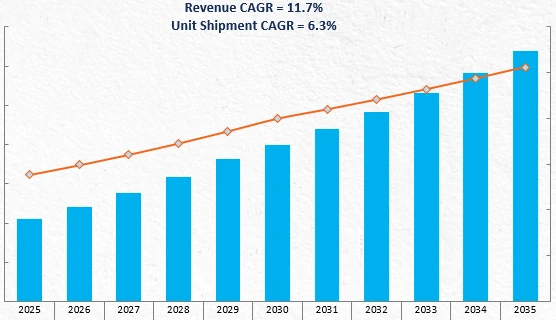
The supplied research also identifies the market as being in a late-growth lifecycle stage. The 2025 base-year growth rate is approximately 14.09%, while the overall revenue CAGR for 2025–2035 is 11.7%.
The market has more than 110 active competitors, while the top 10 companies collectively account for approximately 56.8% of revenue, indicating a competitive environment with meaningful concentration alongside a broad supplier base.
Growth Drivers: UAV navigation systems market
The UAV navigation systems market is supported by several structural growth drivers. One major driver is the expansion of defense drone warfare, which is creating demand for navigation systems capable of supporting both attritable ammunition-oriented UAVs and long-endurance platforms. These different mission profiles require scalable, cost-effective, and increasingly resilient navigation solutions.
Defense procurement strategies are also accelerating UAV adoption. The supplied research highlights increasing emphasis on sovereignty, indigenous capability development, localized supply chains, and mission-specific software. These trends are contributing to sustained demand for navigation systems across defense and commercial applications.
Another important driver is the adoption of swarm-enabled UAVs. As small drones become capable of coordinated operations, navigation systems must support collaborative mission planning, adaptive control, and distributed decision-making. This creates additional technology requirements for the UAV navigation systems and solutions market.
AI-enabled autonomy is also expanding the addressable market. AI can support autonomous navigation, obstacle avoidance, route optimization, and decision-making, allowing UAVs to perform increasingly complex missions with reduced operator intervention.
Commercialization represents another growth opportunity. UAV adoption in surveying, inspection, logistics, agriculture, construction, and asset management increases the need for reliable navigation technologies that can operate across diverse environments.
Finally, increasing deployment in GNSS-denied or degraded environments is driving demand for multi-sensor navigation architectures. The need for resilient navigation against jamming and spoofing supports continued technology development within the unmanned aerial vehicle (UAV) navigation systems market.
Growth Restraints: UAV navigation systems market
Despite strong expansion potential, the UAV navigation systems market faces several restraints. MOSA-driven commoditization is one important challenge. The adoption of modular open systems architecture allows greater interoperability and makes component substitution easier. This can reduce vendor differentiation, weaken proprietary advantages, and contribute to margin compression.
Counter-UAV technologies create another challenge. GNSS jamming, spoofing, and other electronic warfare techniques can compromise conventional navigation architectures. As these threats become more capable, navigation suppliers must invest in redundant, resilient, and alternative positioning technologies, increasing system complexity and development costs.
The increasing technological sophistication of navigation systems can also raise integration requirements. Combining GNSS, inertial sensors, vision, LiDAR, radar, AI, and software-based control capabilities requires strong system engineering and validation capabilities.
Cost pressure can be particularly significant for smaller and attritable UAV platforms. While operators require reliable navigation, they may also prioritize low-cost architectures, creating a difficult balance between performance, resilience, and affordability.
The UAV navigation systems and solutions market also faces competitive pressure from emerging technology companies. Open architectures can lower entry barriers and enable new suppliers to compete with established providers.
Finally, the increasing number of technologies incorporated into UAV navigation creates challenges around interoperability, system validation, cybersecurity, and operational reliability. These requirements can increase development timelines and investment requirements across the unmanned aerial vehicle (UAV)
Scope of Analysis
Segmentation by Applications
Landscape Mapping
Why is it Increasingly Difficult to Grow?
The Strategic Imperative 8™
The Impact of the Top 3 Strategic Imperatives on the UAV Navigation Systems and Solutions Industry
Growth Metrics
Growth Drivers
Growth Restraints
Revenue and Unit Shipment Forecast of UAV Navigation Systems
Revenue Forecast by Technology—UAV Navigation Systems
Revenue Forecast by Technology—Hardware UAV Navigation Systems
Revenue Forecast by Technology—Software UAV Navigation Systems
Revenue Forecast by Application—Consumer UAV Navigation Systems
Revenue Forecast by Application—Commercial UAV Navigation Systems
Revenue Forecast by Application—Agriculture UAV Navigation Systems
Revenue Forecast by Application—Public Safety UAV Navigation Systems
Revenue Forecast by Application—Defense UAV Navigation Systems
Revenue Forecast by Application—Technology Trends in Defense UAV Navigation Systems
Revenue Forecast by Region
Growth Opportunity 1: AI Systems and Swarming Capabilities
Growth Opportunity 2: GPS-Denied Alternative UAV Navigation
Growth Opportunity 3: Scalable SWaP-C Navigation System Profiles from Small-UAS to Long-Range Platforms
Benefits and Impacts of Growth Opportunities
Next Steps
List of Exhibits
Legal Disclaimer
Frequently Asked Questions: UAV Navigation Systems Market
1. What is the UAV navigation systems market?
The UAV navigation systems market comprises hardware and software technologies that enable unmanned aerial vehicles to determine position, maintain stability, plan missions, avoid obstacles, and perform autonomous or semi-autonomous operations. Technologies include GNSS, inertial navigation systems, IMUs, LiDAR, radar, ultrasonic sensors, and vision-based navigation.
2. What is driving the UAV navigation systems and solutions market?
The UAV navigation systems and solutions market is being driven by increasing defense UAV deployment, commercial drone adoption, AI-enabled autonomy, swarm operations, SWaP-C optimization, indigenous capability development, and the growing requirement for resilient navigation in challenging or GNSS-denied environments.
3. What technologies are included in the unmanned aerial vehicle (UAV) navigation systems market?
The unmanned aerial vehicle (UAV) navigation systems market includes GNSS modules, inertial navigation systems, inertial measurement units, LiDAR, radar, ultrasonic sensors, and vision-based systems. Software capabilities include mission planning, obstacle detection and avoidance, precision flight control, fleet management, AI-enabled navigation, and swarm intelligence.
4. Which application segment dominates the UAV navigation systems market?
According to the supplied research, defense is the dominant application segment in the UAV navigation systems market. Defense UAVs require sophisticated navigation capabilities for intelligence gathering, reconnaissance, tactical support, and operations in challenging environments. Other segments include commercial, agriculture, public safety and law enforcement, and consumer applications.
5. What is the forecast for the UAV navigation systems market?
The supplied research estimates that the global UAV navigation systems market will grow from approximately $21.1 billion in 2025 to approximately $63.9 billion by 2035. The market is forecast to expand at a revenue CAGR of approximately 11.7% during 2025–2035.
6. How fast are UAV navigation system unit shipments expected to grow?
UAV navigation system unit shipments are projected to increase from approximately 13.87 million units in 2025 to approximately 25.61 million units by 2035. This represents a unit shipment CAGR of about 6.3% over the forecast period, according to the supplied research.
7. What are the key growth opportunities in the UAV navigation systems and solutions market?
Key opportunities in the UAV navigation systems and solutions market include AI-enabled autonomous navigation, vision-based navigation, swarm-enabled systems, resilient navigation for GNSS-denied environments, SWaP-C optimization, defense modernization, commercial UAV deployment, and navigation solutions for agriculture, logistics, inspection, and public safety applications.
8. What are the major restraints affecting the UAV navigation systems market?
Major restraints include MOSA-driven commoditization, margin pressure, increasing system complexity, counter-UAV technologies such as GNSS jamming and spoofing, integration requirements, and the cost of developing resilient and redundant navigation architectures. These factors can increase development and deployment costs across the UAV navigation systems market.
9. Which regions are covered in the UAV navigation systems market analysis?
The global UAV navigation systems market analysis covers major regions including the Americas, Europe, and Asia-Pacific. The supplied research identifies the Americas as the largest market and Asia as an emerging growth region supported by modernization, indigenous capability development, and increasing adoption across defense and commercial applications.
10. What is the forecast period for the UAV navigation systems market?
The study covers the global UAV navigation systems market from 2025 to 2035, with 2025 serving as the base year and 2026–2035 representing the forecast period. The analysis evaluates technologies, UAV application segments, regional dynamics, revenue development, and competitive factors.
Speak directly with our analytics experts for tailored recommendations.
Recent related Aerospace Systems research
30 Sep 2026 | Global | Market Research
Total Airport Management (TAM) Market, Global, 2025–2034
Total airport management (TAM) represents a high-potential convergence market that integrates enterprise architecture, data management, resource and capacity planning, collaborative decision-making, passenger management, and airport simulation/digital twin into a unified operational framework. TAM r...
28 Sep 2026 | South Asia, Middle East & North Africa | Market Research
Aerospace Engineering Services, India, 2025–2030
India's aerospace engineering services market is evolving from cost-led engineering delivery to higher-value, strategic aerospace engineering participation. The market comprises outsourced engineering services delivered from India by third-party engineering and digital service providers that support...
24 Sep 2026 | North America | Market Research
Military Aviation Maintenance, Repair, and Overhaul Industry, US, 2025–2030
This research service provides a comprehensive overview of the US military aviation maintenance, repair, and overhaul (MRO) industry. The study segments the industry into six platform categories: 1. Fighter, Attack, & Bomber 2. Rotorcraft 3. Transport & Tanker 4. Training & Utility 5. Intelligence, ...
03 Sep 2026 | Global | Technology Research
Photonic and Optical Computing Chips for AI and Data Center Acceleration
The study evaluates photonic and optical computing technologies as critical enablers of next-generation AI infrastructure, addressing growing bandwidth, latency, power consumption, and scalability constraints associated with copper-based interconnects. The analysis covers photonic integrated circuit...
Purchase includes:
- Report download
- Growth Dialog™ with our experts
Growth Dialog™
A tailored session with you where we identify the:- Strategic Imperatives
- Growth Opportunities
- Best Practices
- Companies to Action
Impacting your company's future growth potential.