 USD
USD GBP
GBP  CNY
CNY  EUR
EUR  INR
INR  JPY
JPY  MYR
MYR  ZAR
ZAR  KRW
KRW  THB
THB 


Enterprise Risk Mitigation and Management (ERMM) Solutions, Global, 2025–2030
The ERMM Market is Experiencing Transformational Growth due to a Rapidly Expanding Risk Landscape
15-Jun-2026
Global
Market Research
KC3C-01-00-00-00
AE_2026_34658
Key Takeaways: External Risk Mitigation and Management (ERMM) Market
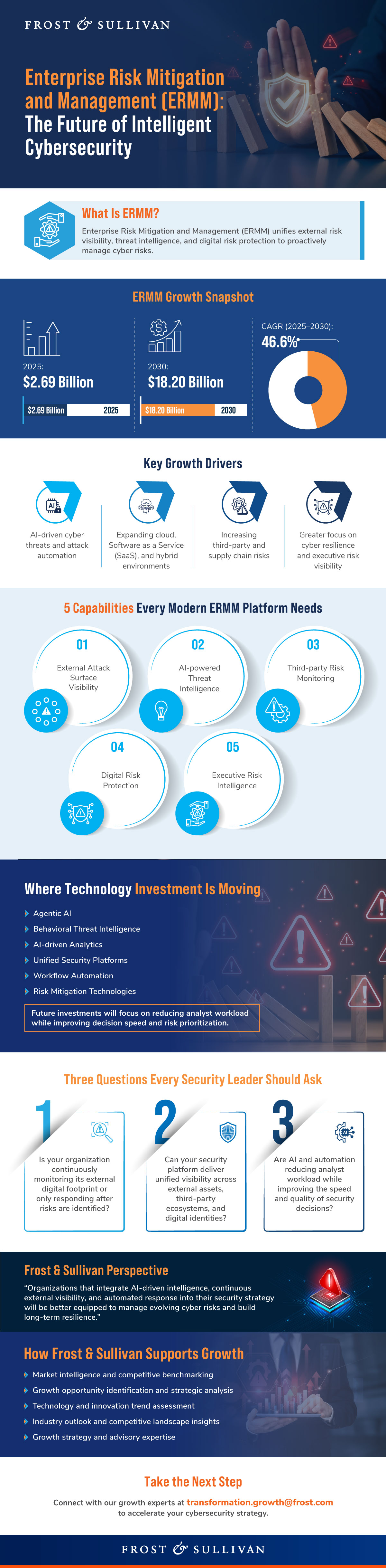
- The External Risk Mitigation and Management (ERMM) Market is projected to grow from USD 2.69 billion in 2025 to USD 18.20 billion by 2030, registering an exceptional CAGR of 46.6%.
- ERMM platforms unify External Attack Surface Management (EASM), Cyber Threat Intelligence (CTI), and Digital Risk Protection (DRP) into a single operational framework.
- Rising cyber threats, digital transformation, cloud adoption, IoT expansion, and growing third-party ecosystem exposure are accelerating market demand.
- North America currently leads the market, while Asia-Pacific is expected to witness the fastest growth during the forecast period.
- AI-powered threat intelligence, proactive risk management, and security platform consolidation are reshaping enterprise cybersecurity strategies.
- Banking, financial services, technology, government, healthcare, manufacturing, and retail sectors are among the largest adopters of ERMM solutions.
Report Summary: External Risk Mitigation and Management (ERMM) Market
The External Risk Mitigation and Management (ERMM) Market represents one of the fastest-growing segments within cybersecurity. ERMM platforms combine external attack surface management, cyber threat intelligence, and digital risk protection capabilities into a unified platform that helps organizations identify, monitor, prioritize, and remediate external cyber risks.
The growing complexity of digital ecosystems has significantly expanded organizational attack surfaces. Cloud adoption, remote work, IoT deployments, supply chain interconnectivity, and increased dependence on third-party vendors have created new vulnerabilities that traditional perimeter-based security models struggle to address. ERMM solutions provide continuous visibility into external-facing assets and emerging threats, enabling organizations to proactively manage cyber risk.
The market is experiencing rapid growth due to increasing cybercrime sophistication, regulatory pressures, executive-level security accountability, and growing demand for proactive threat intelligence. Organizations are increasingly seeking consolidated security platforms that reduce operational complexity while improving risk visibility and response effectiveness.
North America remains the largest regional market due to high cybersecurity maturity and strong enterprise adoption. However, Asia-Pacific and Latin America are emerging as high-growth regions as businesses accelerate digital transformation initiatives.
As cybersecurity shifts from reactive defense to proactive resilience, ERMM platforms are becoming a strategic requirement for organizations seeking to protect digital assets, maintain customer trust, and manage increasingly complex external risk environments.
Market Overview & Trends: External Risk Mitigation and Management (ERMM) Market
The global External Risk Mitigation and Management (ERMM) Market is transforming cybersecurity operations by consolidating multiple external security functions into a unified platform. Historically, organizations relied on separate tools for threat intelligence, attack surface monitoring, phishing detection, brand protection, and third-party risk assessment. ERMM platforms integrate these capabilities into a centralized framework that delivers comprehensive visibility into external threats.
One of the primary trends driving market growth is the rapid expansion of digital attack surfaces. Organizations increasingly operate across cloud environments, SaaS applications, remote workforces, IoT devices, and interconnected supply chains. These developments have expanded the number of internet-facing assets that attackers can target, making continuous external monitoring essential.
Another significant trend is the growing adoption of AI-powered cybersecurity capabilities. ERMM vendors are leveraging machine learning, behavioral analytics, and automated threat correlation to identify emerging threats more quickly and accurately. AI enables organizations to process large volumes of threat intelligence data and prioritize risks based on business impact.
The market is also witnessing a shift toward proactive cybersecurity strategies. Organizations are moving away from traditional reactive incident response approaches and investing in platforms that identify vulnerabilities and threats before exploitation occurs. This trend aligns with growing executive and board-level pressure to demonstrate measurable security outcomes and resilience.
Cybersecurity platform consolidation is becoming increasingly important. Security teams face tool sprawl, operational inefficiencies, and resource shortages. ERMM platforms address these challenges by unifying EASM, CTI, and DRP capabilities within a single solution, reducing complexity while improving operational effectiveness.
Regulatory requirements are further accelerating market adoption. Governments and industry regulators increasingly require organizations to demonstrate stronger risk management practices, third-party oversight, and cyber resilience. ERMM solutions provide the visibility and reporting capabilities needed to support compliance initiatives.
Geographically, North America remains the dominant market due to strong enterprise cybersecurity spending and regulatory maturity. Europe benefits from strict data protection and cybersecurity regulations such as GDPR. Asia-Pacific is experiencing accelerated growth due to rapid digitalization, increasing cyber threats, and growing cybersecurity investments across financial services, manufacturing, and technology sectors.
As cyber threats continue evolving, ERMM platforms are expected to become a foundational component of enterprise security architectures, supporting resilience, risk reduction, and strategic decision-making.
Scope of Analysis: External Risk Mitigation and Management (ERMM) Market
This study analyzes the global External Risk Mitigation and Management (ERMM) Market from 2025 through 2030, evaluating market size, growth opportunities, competitive dynamics, and technological developments.
The analysis focuses on solutions that combine External Attack Surface Management (EASM), Cyber Threat Intelligence (CTI), and Digital Risk Protection (DRP) into integrated cybersecurity platforms. These solutions provide organizations with visibility into external-facing assets, emerging threats, phishing campaigns, brand impersonation risks, data leaks, and third-party exposures.
The study covers key geographic regions including North America, Latin America, Europe, the Middle East & Africa (EMEA), and Asia-Pacific. It also examines adoption trends across large enterprises, mid-market organizations, and small-to-medium-sized businesses.
Industry verticals analyzed include banking and financial services, government, healthcare, technology, manufacturing, retail, utilities, media and entertainment, education, and professional services.
The research evaluates both technology capabilities and business drivers influencing adoption, including digital transformation, cybersecurity modernization, regulatory compliance, threat intelligence utilization, and risk management maturity.
The forecast period extends from 2026 to 2030, with 2025 serving as the base year for market estimation.
Market Segmentation Analysis: External Risk Mitigation and Management (ERMM) Market
The External Risk Mitigation and Management (ERMM) Market can be segmented by geography, organization size, industry vertical, and core solution capabilities.
Geographically, North America represents the largest market, driven by advanced cybersecurity programs, significant enterprise concentration, and high exposure to sophisticated cyber threats. Organizations in the region are among the earliest adopters of proactive risk management technologies.
EMEA constitutes the second-largest market. Strong regulatory frameworks, including GDPR and cybersecurity directives, continue to drive demand for comprehensive risk visibility and compliance-focused cybersecurity capabilities.
Asia-Pacific represents the fastest-growing region. Increasing digital transformation initiatives, expanding internet penetration, foreign direct investment, and rising cybercrime activity are accelerating ERMM adoption across financial services, technology, and manufacturing sectors.
Latin America remains an emerging market with growing opportunities. Increased phishing attacks, digital fraud, and regulatory developments are encouraging organizations to invest in external risk management solutions.
From a capability perspective, ERMM platforms typically integrate three major components:
- Digital Risk Protection (DRP): Brand protection, phishing detection, data leak identification, takedown services, and digital asset monitoring.
- External Attack Surface Management (EASM): Discovery and assessment of internet-facing assets, shadow IT, and third-party exposures.
- Cyber Threat Intelligence (CTI): Monitoring of dark web activity, threat actor behavior, emerging attack campaigns, and actionable intelligence reporting.
This integrated approach enables organizations to consolidate cybersecurity operations while improving visibility across increasingly complex digital ecosystems.
Revenue & Spending Forecast: External Risk Mitigation and Management (ERMM) Market
The External Risk Mitigation and Management (ERMM) Market is forecast to experience one of the highest growth rates across the cybersecurity industry during the forecast period.
Global market revenue is projected to increase from USD 2.69 billion in 2025 to USD 18.20 billion by 2030, representing a remarkable CAGR of 46.6%. Revenue growth is expected to accelerate as organizations transition from fragmented cybersecurity tools to integrated risk management platforms.
igure class="image">
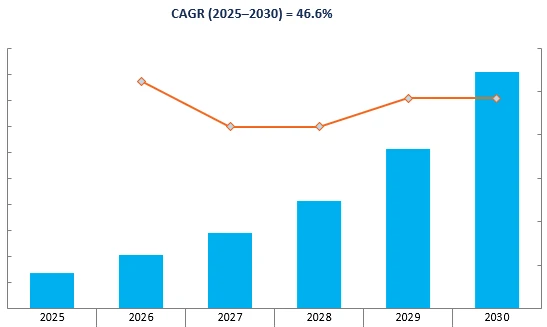
Market expansion will be driven by increasing investments in proactive threat detection, cyber resilience initiatives, external asset monitoring, and AI-powered security operations. Organizations are prioritizing visibility into internet-facing assets and external threat exposure as part of broader cybersecurity modernization strategies.
Spending is expected to remain strongest among large enterprises due to their complex digital footprints and extensive third-party ecosystems. However, mid-market organizations are increasingly adopting SaaS-based ERMM platforms due to lower deployment barriers and growing cybersecurity requirements.
North America will continue to account for the largest share of spending, while Asia-Pacific is expected to generate the fastest growth rates throughout the forecast period.
Increasing regulatory scrutiny, board-level cybersecurity oversight, and the rising financial impact of cyber incidents will further support investment growth. As organizations seek measurable security outcomes, spending on integrated ERMM solutions is expected to increase substantially across all major industry sectors.
Growth Drivers: External Risk Mitigation and Management (ERMM) Market
The rapid expansion of digital ecosystems is the primary growth driver for the External Risk Mitigation and Management (ERMM) Market. As organizations adopt cloud technologies, SaaS applications, remote work models, and IoT infrastructure, their external attack surfaces continue to expand significantly.
Cybercriminals are also becoming increasingly sophisticated. Modern threat actors utilize advanced attack methodologies, phishing campaigns, credential theft, ransomware operations, and supply chain attacks that require proactive monitoring and intelligence-driven defense strategies.
AI-powered cybersecurity capabilities are accelerating market growth. Organizations are adopting ERMM platforms that leverage machine learning and automated analytics to identify emerging risks and prioritize remediation efforts more effectively.
Another important driver is the shift toward integrated cybersecurity operations. Security teams are increasingly consolidating fragmented tools into unified platforms that improve efficiency, reduce operational complexity, and provide broader threat visibility.
Executive leadership and board-level stakeholders are placing greater emphasis on measurable cybersecurity outcomes. Organizations are under pressure to demonstrate resilience, manage regulatory obligations, and justify cybersecurity investments through quantifiable risk reduction.
These factors collectively position ERMM as a critical component of future enterprise security architectures.
Growth Restraints: External Risk Mitigation and Management (ERMM) Market
Despite strong growth prospects, several challenges may limit the pace of adoption within the External Risk Mitigation and Management (ERMM) Market.
Many organizations struggle to effectively scale and operationalize ERMM capabilities. While platforms generate extensive intelligence, translating technical findings into business-relevant actions remains difficult for many security teams.
Another challenge involves contextualization. Security professionals often produce highly detailed threat intelligence reports, but decision-makers may struggle to connect these findings to business priorities, revenue impact, or strategic objectives.
Budget constraints and procurement complexity can also slow adoption. Organizations frequently face challenges in demonstrating measurable returns on cybersecurity investments, making funding approvals more difficult.
Market awareness remains relatively limited compared with more established cybersecurity categories. Some organizations continue to rely on legacy security architectures and may not fully understand the benefits of integrated external risk management.
Finally, skepticism regarding platform effectiveness and concerns about overlapping functionality with existing security tools may delay purchasing decisions and broader market adoption.
Competitive Landscape: External Risk Mitigation and Management (ERMM) Market
The External Risk Mitigation and Management (ERMM) Market is moderately concentrated, with approximately 28 major competitors generating more than USD 1 million in annual revenue.
Competition is based on platform capabilities, breadth of use cases, intelligence coverage, remediation services, data contextualization, customer support, and overall operational effectiveness. Vendors increasingly differentiate themselves through AI-powered analytics, integrated workflows, and managed services.
Leading market participants include:
- Recorded Future
- ReliaQuest
- CrowdStrike
- Rapid7
- Palo Alto Networks
These companies collectively account for approximately 53.4% of market revenue among the top five competitors.
Other notable vendors include SecurityScorecard, BitSight, Flashpoint, Group-IB, Mandiant, and ZeroFox. These providers offer specialized capabilities ranging from threat intelligence and brand protection to attack surface monitoring and digital risk management.
The market continues to experience consolidation activity. Recent transactions include BitSight's acquisition of Cybersixgill, Check Point's acquisitions of Cyberint and Veriti, and Mastercard's acquisition of Recorded Future.
Distribution channels include direct sales, resellers, distributors, and managed security service providers (MSSPs). As demand grows, vendors are expected to pursue additional acquisitions, partnerships, and platform integrations to strengthen market positions.
Scope of Analysis
Segmentation
Why is it Increasingly Difficult to Grow?
The Strategic Imperative 8™
The Impact of the Top 3 Strategic Imperatives on the ERMM Industry
Overview: Today's Risk Management Landscape
ERMM: The Connective Tissue of an Organization
Making Heads and Tails of ERMM
Common ERMM Use Cases
From Risk to Reward: Benefits of ERMM Platform Integration
Competitive Environment
Key Competitors
Growth Metrics
Growth Drivers
Growth Driver Analysis
Growth Restraints
Growth Restraint Analysis
Forecast Considerations
Revenue Forecast
Revenue Forecast by Region
Revenue Forecast by Industry Vertical
Revenue Forecast by Business Type
Revenue Forecast Analysis
Pricing Trends and Forecast Analysis
Growth Metrics
Revenue and Growth Rate Forecast
Revenue Forecast by Industry Vertical
Revenue Forecast by Customer Size
Forecast Analysis
Growth Metrics
Revenue and Growth Forecast
Revenue Forecast by Industry Vertical
Revenue Forecast by Customer Size
Forecast Analysis
Growth Metrics
Revenue and Growth Forecast
Revenue Forecast by Industry Vertical
Revenue Forecast by Customer Size
Forecast Analysis
Growth Metrics
Revenue and Growth Forecast
Revenue Forecast by Industry Vertical
Revenue Forecast by Customer Size
Forecast Analysis
Growth Opportunity 1: Use Case Expansion for ERMM Platforms
Growth Opportunity 2: Convergence of Enterprise Risk and Fraud
Growth Opportunity 3: Threat Actor Behavioral Analysis
Growth Opportunity 4: Progressive Agentic Workflow Integration
Growth Opportunity 5: Executive-Level Reporting and Measurable Risk Reduction
Benefits and Impacts of Growth Opportunities
Next Steps
List of Exhibits
Legal Disclaimer
Frequently Asked Questions (FAQs) – External Risk Mitigation and Management (ERMM) Market
1. What is the External Risk Mitigation and Management (ERMM) Market?
The External Risk Mitigation and Management (ERMM) Market consists of cybersecurity platforms that integrate External Attack Surface Management (EASM), Cyber Threat Intelligence (CTI), and Digital Risk Protection (DRP) to help organizations identify, monitor, prioritize, and mitigate external cyber threats, brand risks, phishing campaigns, and third-party vulnerabilities.
2. What is driving growth in the External Risk Mitigation and Management (ERMM) Market?
Growth is driven by expanding digital attack surfaces, increasing cybercrime sophistication, cloud adoption, remote work environments, IoT proliferation, regulatory requirements, and growing demand for proactive cybersecurity and risk management solutions.
3. How large is the External Risk Mitigation and Management (ERMM) Market?
The global External Risk Mitigation and Management (ERMM) Market is projected to grow from USD 2.69 billion in 2025 to USD 18.20 billion by 2030, registering a compound annual growth rate (CAGR) of 46.6% during the forecast period.
4. What are the core components of ERMM platforms?
ERMM platforms typically combine External Attack Surface Management (EASM), Cyber Threat Intelligence (CTI), and Digital Risk Protection (DRP). These capabilities provide visibility into internet-facing assets, dark web threats, phishing campaigns, brand impersonation, data leaks, and third-party cyber risks.
5. Which industries are major users of External Risk Mitigation and Management (ERMM) solutions?
Major adopters include banking and financial services, technology, government, healthcare, manufacturing, retail, utilities, education, media and entertainment, and professional services organizations that require continuous monitoring of external cyber risks.
6. Which region leads the External Risk Mitigation and Management (ERMM) Market?
North America currently leads the market due to its high cybersecurity maturity, large enterprise presence, and significant investments in advanced threat intelligence and digital risk management solutions.
7. Which regions are expected to experience the fastest growth in the ERMM Market?
Asia-Pacific and Latin America are expected to witness the fastest growth due to rapid digital transformation, increasing cyber threats, expanding digital ecosystems, and rising awareness of external risk management strategies.
8. What challenges affect adoption of External Risk Mitigation and Management (ERMM) solutions?
Key challenges include limited market awareness, difficulty translating technical threat intelligence into business insights, budgeting constraints, platform effectiveness concerns, and the persistence of legacy cybersecurity infrastructures.
9. Who are the leading companies in the External Risk Mitigation and Management (ERMM) Market?
Leading market participants include Recorded Future, ReliaQuest, CrowdStrike, Rapid7, and Palo Alto Networks. Other notable companies include SecurityScorecard, BitSight, Flashpoint, Group-IB, Mandiant, and ZeroFox.
10. What is the future outlook for the External Risk Mitigation and Management (ERMM) Market?
The future outlook remains highly positive as organizations increasingly adopt AI-powered threat intelligence, proactive cybersecurity strategies, and unified risk management platforms. ERMM solutions are expected to become a core component of enterprise cyber resilience and security operations over the next decade.
Speak directly with our analytics experts for tailored recommendations.
Recent related Security research
16 Oct 2026 | Global | Market Research
Customer Transformation Journeys External Risk Mitigation and Management: BitSight
This report explores how organizations are accelerating cyber risk reduction and remediation through Bitsight’s intelligent External Risk Management and Mitigation (ERMM) solution. It examines customer transformation journeys, highlighting how continuous visibility, contextualized risk intelligence,...
15 Oct 2026 | Global | Market Research
Network Detection and Response (NDR) Sector, Global, 2026–2030
This study examines the global NDR market over the 2022–2030 forecast period. It finds that rising investment reflects NDR's evolution from a discretionary security enhancement into a foundational component of enterprise cyber defense, underscoring stronger buyer commitment and heightened vendor com...
09 Oct 2026 | Global | Technology Research
Growth Opportunities in SiC MOSFET, Photodiodes, RISC-Vs, and Advanced Memory
The Microelectronics Technology Opportunity Engine covers innovations pertaining to SiC MOSFET, Photodiodes, RISC-Vs, and Advanced Memory.The Microelectronics Technology Opportunity Engine captures global electronics-related innovations and developments on a weekly basis. Developments are centered o...
09 Oct 2026 | Global | Frost Radar
Frost Radar™: Workforce Identity and Access Management, 2026
Hybrid work and software as a service have shifted security enforcement from the network perimeter to identity, transforming it into a control plane. Workforce identity and access management (IAM) now determines whether every user, device, and session should retain access based on context, risk, and...
07 Oct 2026 | Global | Frost Radar
Frost Radar™: Network Detection and Response, 2026
The rapid evolution of enterprise IT environments, driven by cloud adoption, connected devices, and hybrid infrastructure, has rendered legacy perimeter defenses inadequate. Network detection and response (NDR) has become a strategic imperative, providing continuous visibility across network traffi...
Purchase includes:
- Report download
- Growth Dialog™ with our experts
Growth Dialog™
A tailored session with you where we identify the:- Strategic Imperatives
- Growth Opportunities
- Best Practices
- Companies to Action
Impacting your company's future growth potential.
ERMM solutions address these challenges by providing continuous visibility into an organization’s external digital footprint, enabling proactive identification and remediation of threats such as phishing, brand impersonation, and supply chain vulnerabilities. By consolidating fragmented security functions into a centralized framework, ERMM platforms enhance operational efficiency, reduce mean time to response (MTTR), and improve overall risk posture.
The global ERMM market is projected to grow significantly, from $2.69 billion in 2025 to $18.2 billion by 2030, reflecting a compound annual growth rate (CAGR) of 46.6%. Growth is fueled by the increasing sophistication of cyber threats, rising regulatory pressures, and a strategic shift from reactive security models to proactive, intelligence-driven risk management. While North America remains the largest market due to high cybersecurity maturity and enterprise concentration, regions such as Asia-Pacific and Latin America are expected to experience the fastest growth, supported by improving awareness and expanding digital ecosystems.
Despite strong growth potential, the market faces challenges including low awareness, inconsistent vendor messaging, and the persistence of legacy security architectures. Additionally, increasing competition and platform consolidation may drive commoditization over time. Nevertheless, ERMM is positioned as a critical enabler of enterprise resilience, serving as the connective tissue across security, risk, and business functions to protect digital assets, preserve brand integrity, and sustain customer trust in an increasingly externalized threat environment.
Authors: Danielle VanZandt and Dolores Aleman
| Deliverable Type | Market Research |
|---|---|
| Industries | Aerospace, Defence and Security |
| No Index | No |
| Is Prebook | No |
| Keyword 1 | External Risk Management Solutions |
| Keyword 2 | Third-Party Risk Management |
| Keyword 3 | Risk Mitigation Technologies |
| Podcast | No |
| Predecessor | KAD8-01-00-00-00 |
| WIP Number | KC3C-01-00-00-00 |