 USD
USD GBP
GBP  CNY
CNY  EUR
EUR  INR
INR  JPY
JPY  MYR
MYR  ZAR
ZAR  KRW
KRW  THB
THB 


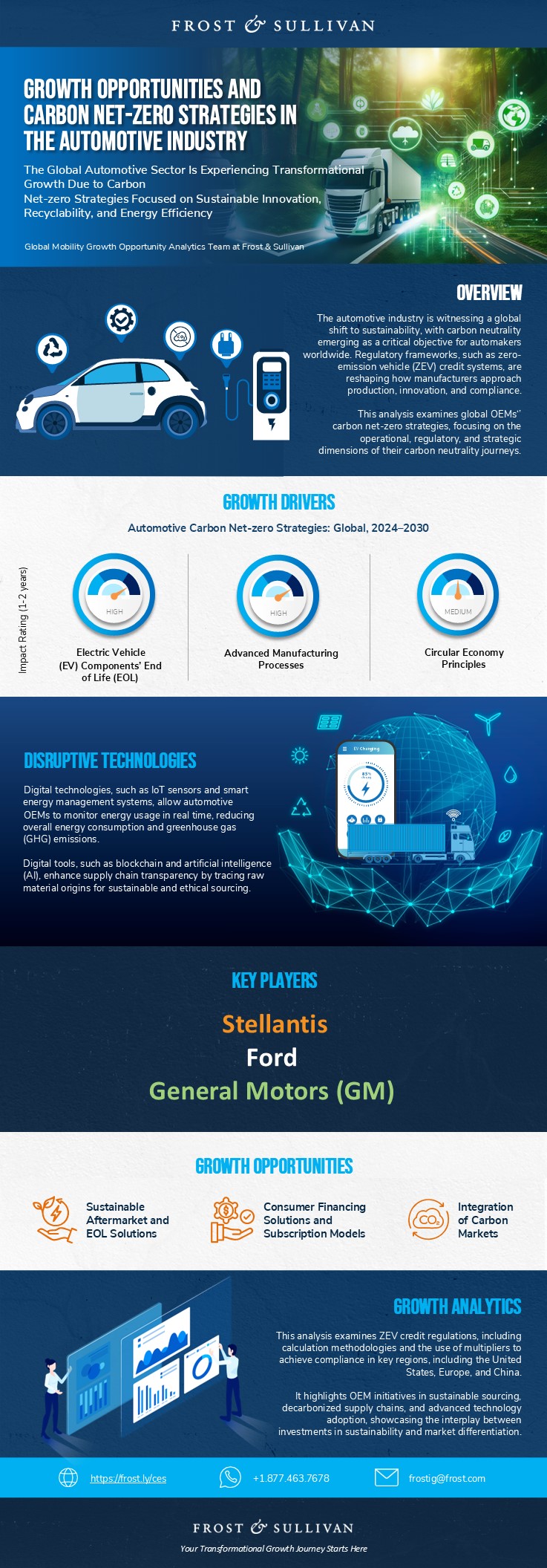
The Global Automotive Sector is Experiencing Transformational Growth due to Carbon Net-zero Strategies Focused on Sustainable Innovation, Recyclability, and Energy Efficiency
08-Apr-2025
Global
Market Research
MH5D-01-00-00-00
AU_2025_33432
The automotive industry is witnessing a global shift to sustainability, with carbon neutrality emerging as a critical objective for automakers worldwide. Regulatory frameworks, such as zero-emission vehicle (ZEV) credit systems, are reshaping how manufacturers approach production, innovation, and compliance. This study examines global OEMs' carbon net-zero strategies, focusing on the operational, regulatory, and strategic dimensions of their carbon neutrality journeys. It provides a detailed analysis of ZEV credit regulations, including calculation methodologies and the use of multipliers to achieve compliance in key markets, including the United States, Europe, and China. The study highlights OEM initiatives in sustainable sourcing, decarbonized supply chains, and advanced technology adoption, showcasing the interplay between investments in sustainability and market differentiation. By profiling leading automakers' carbon net-zero strategies, the study offers insight into how regional variations and technological advancements are shaping the automotive industry's decarbonization landscape.
Author: Thanigesh Arumugam Parthasarathi
The Impact of the Top 3 Strategic Imperatives on the Automotive Industry’s Carbon Net-zero Strategies
Transformative Megatrends
- Why:
- Carbon neutrality commitments drive the integration of renewable energy practices in automotive OEM manufacturing plants.
- Sustainable practices are becoming a strategic differentiator, influencing customer purchasing decisions.
- The emphasis on sustainability across the supply chain to reduce illegal mining and logistics emissions is evident.
- Frost Perspective:
- During the next 5 years, OEMs will adopt renewable energy, achieving a minimum 50% renewable energy mix in their factories.
- Within this decade, automotive OEMs will include their sustainability practices as strategic communication to attract environmentally conscious consumers.
- In the next 5 years, responsible sourcing and sustainable logistics practices will become mandatory for North American and EU automotive OEMs.
Geopolitical Chaos
- Why:
- Political unrest and geopolitical tensions may result in energy supply disruptions between countries, leading to shortages in manufacturing operations.
- Sustainability initiatives in the automotive industry contribute directly to Sustainable Development Goals (SDGs), such as Goal 7 (Affordable and Clean Energy) and Goal 13 (Climate Action).
- Frost Perspective:
- Owing to unfavorable political conditions after the COVID-19 pandemic, automotive OEMs are targeting self-sustaining energy production through renewable sources, such as solar, wind, and biogas, for their manufacturing facilities.
- During the next 5–10 years, automotive brands will try to integrate sustainable practices that directly contribute to specific SDGs and broader sustainability objectives to have a positive societal and environmental impact.
Disruptive Technologies
- Why:
- Digital technologies, such as IoT sensors and smart energy management systems, allow automotive OEMs to monitor energy usage in real time, reducing overall energy consumption and greenhouse gas (GHG) emissions.
- Digital tools, such as blockchain and artificial intelligence (AI), enhance supply chain transparency by tracing raw material origins for sustainable and ethical sourcing.
- Frost Perspective:
- The integration of energy-efficient technologies and predictive maintenance systems will become mandatory in automotive manufacturing during the next 5 years.
- Full-scale adoption of digital solutions, such as blockchain, digital twins, and generative AI, to enable monitoring and reduce carbon footprints, as well as position the automotive industry as a leader in sustainable manufacturing practices, will occur after 2030.
Scope of Analysis
- The study provides a comprehensive overview of regulatory carbon credits by examining zero-emission vehicle (ZEV) credit regulations, their calculation methodologies, and the influence of multipliers in driving compliance with carbon net-zero targets across the United States, the European Union (EU), and China.
- The study explores the operational and product development impacts of carbon net-zero strategies on OEMs, focusing on the sustainable sourcing of materials and components, as well as the role of technology vendors in enabling decarbonization initiatives.
- The study analyzes OEM initiatives in sustainable sourcing, supply chain decarbonization, and end-of-life (EOL) product management, highlighting the role of technology partnerships and vendor contributions. It examines investments in carbon net-zero strategies and their effects on organizational strategy, market differentiation, and regional variations.
- The study profiles select global OEMs’ carbon net-zero strategies, showcasing their organizational vision, strategic initiatives, and technological advancements tailored to regional market requirements.
Growth Drivers
Electric Vehicle (EV) Components’ End of Life (EOL):
OEMs will adopt business models that leverage opportunities in EV second-life applications and recycle raw materials from EVs, such as nickel and cobalt.
Advanced Manufacturing Processes:
Concepts such as digital twins, energy-efficient manufacturing systems, and micro-factories will reduce GHG emissions and waste generation in factories and ensure sustainability in vehicle assembly.
SDGs:
As a part of their SDG goals and commitment to sustainable development, UN member countries are increasingly imposing regulations on automotive OEMs to increase sustainable practices and reduce GHG emissions across the value chain.
Circular Economy Principles:
Vehicle manufacturing will adopt a sustainability-focused approach that includes EOL recycling and modular assembly practices from the concept stage to ensure sustainable practices in vehicle design in the coming years.
Lightweight Materials:
Automotive manufacturers are adopting lightweight materials to reduce overall vehicle weight, translating to improved fuel efficiency and reduced emissions.
Growth Restraints
Vehicle Life Cycle Monitoring:
Monitoring sold vehicles and retrieving them for proper EOL disposal is becoming an essential task for automakers. Stricter recycling and disposal standards are threatening automotive manufacturers.
High Implementation Costs to Achieve Sustainability:
Implementing sustainable practices in material usage and energy generation involves substantial investments, which burdens automotive OEMs, especially small- and medium-sized automakers.
Lack of Standards and Regulations:
Sustainability standards differ by region, with EU standards being much stricter than Asian ones. Implementing sustainability across an automaker’s manufacturing locations becomes challenging, as plants in different regions have divergent priorities.
Limited Consumer Awareness:
Consumers have limited awareness of and interest in buying green products, such as eco-friendly car interiors and modular vehicles, and the willingness to pay for such products is only picking up slowly, making automakers cautious about investing in these areas.
Limitations in Sustainable Material Usage:
Despite the encouragement to adopt sustainable materials, they have certain limitations; for example, using plant-based materials to replace plastics will improve renewable material usage but promote deforestation.
Key Competitors
- Stellantis
- Ford
- General Motors (GM)
- Hyundai & Kia
- Toyota
- Volkswagen (VW)
- BYD
- SAIC
- Geely
- GM
- Toyota
- VW
- BYD
- SAIC
- Geely
Why Is It Increasingly Difficult to Grow?
The Strategic Imperative 8
The Impact of the Top 3 Strategic Imperatives on the Automotive Industry’s Carbon Net-zero Strategies
Scope of Analysis
Key Competitors
Growth Drivers
Growth Restraints
Carbon Net-zero Strategies: Key Takeaways
Carbon Net-zero Strategies’ Scope
Regulatory Carbon Credits: Overview
ZEV Credit Regulations
ZEV Credit Calculation
Comparative Analysis
Impact of Carbon Net-zero Targets on Automakers: Overview
Challenges OEMs Face in Achieving Carbon Net Zero and Utilizing Carbon Credits
Regulatory Environment, US: Overview
US Regulatory Environment: Recent Developments
European Regulatory Environment: Overview
EU Regulatory Environment: Recent Developments
Chinese Regulatory Environment: Overview
Chinese Regulatory Environment: Recent Developments
Countries with Carbon Credit Markets and Trading Systems
Carbon Credits Market: Key Participants and Stakeholders
Carbon Credit Multipliers
Impact of Carbon Credits on Automakers: Overview
Operational Impact: Product Development and Design for Sustainability
Product Development and Design: OEM Initiatives and Technology Vendors
Sustainable Sourcing of Materials and Components
Sustainable Sourcing: OEM Initiatives and Technology Vendors
Manufacturing Process Optimization
Manufacturing Process Optimization: OEM Initiatives and Technology Vendors
Supply Chain Decarbonization
Supply Chain Decarbonization: OEM Initiatives and Technology Vendors
EOL Product Management and Recycling Strategies
EOL Product Management: OEM Initiatives
EOL Product Management: Enabling Technology Vendors
Impact of Carbon Net-zero Targets on Automakers: Overview
Financial Implications: Financial Incentives, Benefits
Investments in Carbon Net-zero Strategy: Impact on OEMs
Increasing Prices Due to the High Cost of Carbon Credits
Impact of Carbon Net-zero Targets on Automakers: Overview
Impact on Market Dynamics: OEM Differentiation Through Net-zero Strategies
OEM Differentiation Through Net-zero Strategies: OEM Initiatives
Impact of Carbon Net-zero Targets on Automakers: Overview
Impact on Organizational Strategy and Vision: Partnerships
Impact on Organizational Strategy and Vision: Acquisitions
Impact on Organizational Strategy and Vision: Joint Ventures
Regional Variations in OEM Net-zero Strategies
Automotive Brands and their Carbon Net-zero Roadmaps
Stellantis
Volkswagen
Ford
General Motors
Toyota
Hyundai
Growth Opportunity 1: Sustainable Aftermarket and EOL Solutions
Growth Opportunity 2: Consumer Financing Solutions and Subscription Models
Growth Opportunity 3: Integration of Carbon Markets
Benefits and Impacts of Growth Opportunities
Next Steps
List of Exhibits
Legal Disclaimer
Speak directly with our analytics experts for tailored recommendations.
Recent related Infotainment and Telematics research
25 Sep 2026 | Global | Technology Research
Growth Opportunities in Next-Gen Wireless EV charging, Automotive Grade IoT module, Autonomous driving, E-bike Platform, UAVs, and 4D Radars
The Mobility Technology Opportunity Engine (TOE) covers innovations pertaining to EV charging, Automotive Grade IoT module, Autonomous driving, E-bike Platform, UAVs, and 4D Radars.The purpose of the Mobility Technology TOE is to raise awareness of global technology innovations in self-propelled gro...
22 Sep 2026 | Global | Market Research
Growth Opportunities in the Global EV Power Electronics Market, 2025–2032
The rapid push toward e-mobility is accelerating adoption of advanced power electronics by major OEMs. Power electronics underpin electric vehicle reliability, efficiency, and performance. Core systems, including traction inverters, onboard chargers, and DC-DC converters, are gaining strategic impor...
10 Sep 2026 | Global | Market Research
Global Robobus Market, 2026–2032
The global robobus market is at an inflection point. Large autonomous buses are no longer a concept—they are running as paid public services in China, South Korea, Norway, Switzerland, Finland, and the Netherlands. Europe is in its first wave of real deployment, with active L4 commercial service acr...
03 Sep 2026 | Global | Technology Research
Photonic and Optical Computing Chips for AI and Data Center Acceleration
The study evaluates photonic and optical computing technologies as critical enablers of next-generation AI infrastructure, addressing growing bandwidth, latency, power consumption, and scalability constraints associated with copper-based interconnects. The analysis covers photonic integrated circuit...
02 Sep 2026 | Global | Frost Radar
Frost Radar™: In-Vehicle Audio Technology Stacks, 2026
The in-vehicle entertainment industry is going through a dynamic shift. Audio entertainment in the passenger vehicle is no longer limited to music playback through multiple sources. The rise of ADAS/AD and SDVs have made audio a critical part of the passenger vehicle. Audio developers must now cater...
Purchase includes:
- Report download
- Growth Dialog™ with our experts
Growth Dialog™
A tailored session with you where we identify the:- Strategic Imperatives
- Growth Opportunities
- Best Practices
- Companies to Action
Impacting your company's future growth potential.
Author: Thanigesh Arumugam Parthasarathi
| Deliverable Type | Market Research |
|---|---|
| Industries | Automotive |
| No Index | No |
| Is Prebook | No |
| Keyword 1 | Automotive sustainability strategies |
| Keyword 2 | Net-zero emissions roadmap |
| Keyword 3 | Automotive industry decarbonization |
| Podcast | No |
| Predecessor | PF98-01-00-00-00 |
| WIP Number | MH5D-01-00-00-00 |
Carbon Net-zero Strategies in the Automotive Sector, Global, 2024–2030
$4,950.00
Special Price $4,455.00 save 10 %