 USD
USD GBP
GBP  CNY
CNY  EUR
EUR  INR
INR  JPY
JPY  MYR
MYR  ZAR
ZAR  KRW
KRW  THB
THB 


Regulatory Support, Battery Innovations, Recycling Advancements, Renewable Integration, and Transparent Supply Chains are Driving Transformational Growth Toward a Carbon-neutral EV Ecosystem
06-Aug-2025
Global
Market Research
MH71-01-00-00-00
AU_2025_33730
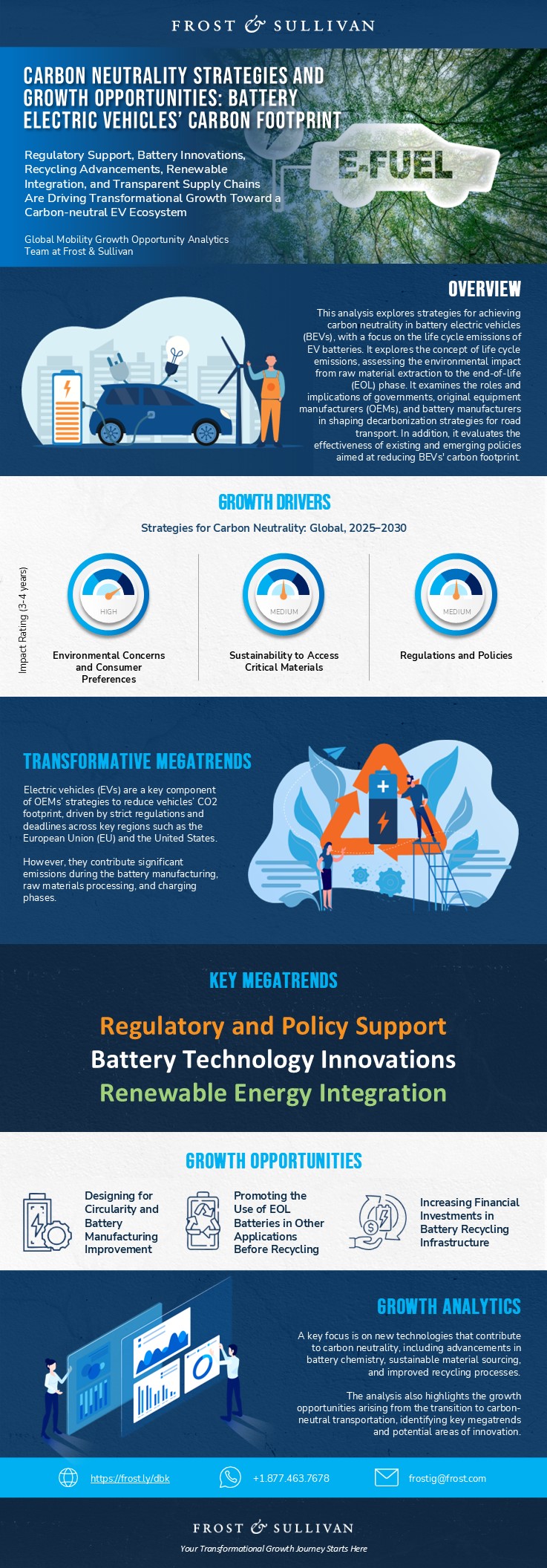
This study provides a comprehensive analysis of strategies for achieving carbon neutrality in battery electric vehicles (BEVs), with a focus on the life cycle emissions of EV batteries. It explores the concept of life cycle emissions, assessing the environmental impact from raw material extraction to the end-of-life (EOL) phase. The study examines the roles and implications of governments, original equipment manufacturers (OEMs), and battery manufacturers in shaping decarbonization strategies for road transport. In addition, it evaluates the effectiveness of existing and emerging policies aimed at reducing BEVs' carbon footprint.
A key focus is on new technologies that contribute to carbon neutrality, including advancements in battery chemistry, sustainable material sourcing, and improved recycling processes. The study also highlights the growth opportunities arising from the transition to carbon-neutral transportation, identifying key trends and potential areas of innovation. By analyzing these elements, the study provides valuable insights into the evolving landscape of BEV sustainability and the collaborative efforts required to achieve long-term carbon neutrality goals.
Author: Federico Biscini
The Impact of the Top 3 Strategic Imperatives on the Electric Vehicles Industry
Transformative Megatrends
- Why: Electric vehicles (EVs) are a key component of OEMs' strategies to reduce vehicles' CO2 footprint, driven by strict regulations and deadlines across key regions such as the European Union (EU) and the United States. However, they contribute significant emissions during the battery manufacturing, raw materials processing, and charging phases.
- Frost Perspective: OEMs must analyze the overall emissions of their EVs during the entire life cycle to be transparent and convince consumers of their true sustainability credentials.
Geopolitical Chaos
- Why: Growing concerns surround the ethical and environmental practices associated with raw material extraction for EV batteries in certain regions, including Africa, South America, and China.
- These concerns intensified during the COVID-19 pandemic, prompting the EU to address potential supply chain vulnerabilities, particularly their dependence on specific markets, including China.
- Frost Perspective: The EU is implementing stricter regulations on battery production and sourcing, aiming to reduce dependence on a single country, diversify raw material sources (push for recyclability), and develop a secure and sustainable supply chain.
- Moreover, the United States is prioritizing responsible practices and supply chain diversification to mitigate ethical concerns and curb critical materials availability.
Industry Convergence
- Why: Reducing EVs' carbon footprint requires collaboration across multiple industries. This includes the entire life cycle—from mining and refining to battery anode/cathode manufacturing, vehicle assembly, the electricity mix of the grid for charging infrastructure, and end-of-life (EOL) solutions for batteries.
- Frost Perspective: To achieve total life cycle CO2 neutrality, mandatory CO2 tracking plans must be implemented. This will empower all industry participants to understand their environmental impact and incentivize them to adopt cleaner processes and designs, ultimately accelerating the transition to a more sustainable future.
Scope of Analysis
| Base Year | 2024 |
| Study Period | 2023–2030 |
| Forecast Period | 2025–2030 |
| Market/Segment/Program Area | The study covers strategies for carbon neutrality for EV batteries with a focus on:
|
| Geographic Scope |
|
Growth Drivers
- Environmental Concerns and Consumer Preferences
- Sustainability to Access Critical Materials
- Regulations and Policies
Growth Restraints
- Technology Maturity
- Investment Slowdown
- Challenges in Battery Manufacturing and Supply Chains
Why is it Increasingly Difficult to Grow?
The Strategic Imperative 8™
The Impact of the Top 3 Strategic Imperatives on the Electric Vehicles Industry
Scope of Analysis
Introduction: Research Aims and Objectives
Key OEMs and Battery Manufacturers
Key Trends
Growth Drivers
Growth Restraints
Battery Electric Vehicles: Key Life Cycle Phases
Geographic Concentration of Lithium Reserves
Geographic Concentration of Cobalt Reserves
Geographic Concentration of Nickel Reserves
Geographic Concentration of Manganese Reserves
Raw Materials Mining Overview
Process and Energy Demand for Active Material Production
Share of Renewable Sources in Europe
Share of Clean Energy Sources Versus Number of Charging Stations
Batteries’ Second-Life Usage Depends on Their Capacity after the End of Their First Life
Battery Recycling SWOT Analysis
EV Battery Recycling Policies: EU, UK, and US
EV Battery Recycling Policies: Canada and China
EV Battery Recycling Policies: Japan and India
EU and China Have Developed Strong EV Battery Recycling Policies
Case Study: Volvo EX30 Life Cycle Assessment
Decarbonization Targets for Major OEMs
Major OEMs’ Performance Targets to Reduce Emissions
OEMs’ EV Sales Target by Region
European OEMs’ Strategies and Partnerships for EV Battery Recycling
Other OEMs’ Strategies and Partnerships for EV Battery Recycling
BMW Group—Leading Sustainability
Mercedes-Benz—Commitment to Sustainability We Move Green
Volkswagen Group—goTOzero
Volvo Cars—Sustainability is the Key to Future Success
Stellantis—Transforming into a Sustainable Mobility Technology Company Dare Forward 2030
Renault Group—The Future is NEUTRAL
GM—Actively Pursuing a Vision of a World with Zero Emissions
Ford Motor Company—Building a Better World
Hyundai Motor Group—Progress for Humanity
Toyota—On the Road to Carbon Neutrality
OEM Reliance on Carbon Offsets
Growth Opportunity 1: Designing for Circularity and Battery Manufacturing Improvement
Growth Opportunity 2: Promoting the Use of EOL Batteries in Other Applications Before Recycling
Growth Opportunity 3: Increasing Financial Investments in Battery Recycling Infrastructure
Benefits and Impacts of Growth Opportunities
Next Steps
List of Exhibits
Legal Disclaimer
Speak directly with our analytics experts for tailored recommendations.
Recent related Autonomous Vehicles research
25 Sep 2026 | Global | Technology Research
Growth Opportunities in Next-Gen Wireless EV charging, Automotive Grade IoT module, Autonomous driving, E-bike Platform, UAVs, and 4D Radars
The Mobility Technology Opportunity Engine (TOE) covers innovations pertaining to EV charging, Automotive Grade IoT module, Autonomous driving, E-bike Platform, UAVs, and 4D Radars.The purpose of the Mobility Technology TOE is to raise awareness of global technology innovations in self-propelled gro...
22 Sep 2026 | Global | Market Research
Growth Opportunities in the Global EV Power Electronics Market, 2025–2032
The rapid push toward e-mobility is accelerating adoption of advanced power electronics by major OEMs. Power electronics underpin electric vehicle reliability, efficiency, and performance. Core systems, including traction inverters, onboard chargers, and DC-DC converters, are gaining strategic impor...
31 Aug 2026 | Global | Market Outlook
Off-Highway Equipment Market Predictions and Growth Opportunities, Global, 2026
The global off-highway (OHW) equipment industry enters 2026 amid a complex and evolving macroeconomic environment characterized by geopolitical uncertainty, energy price volatility, and shifting trade dynamics. While the baseline outlook suggests moderate global GDP growth of about 3%, downside scen...
27 Aug 2026 | Global | Market Outlook
Global EV Charging Infrastructure, 2026: Growth Trajectory and Emerging Opportunities
The rapid rise of electric vehicles (EVs) is intensifying the need for a robust, accessible charging infrastructure. Enabled by IoT integration, EVs are becoming a smarter alternative to conventional ICE vehicles. Expanding fast-charging stations along highways and at key destinations is critical to...
21 Aug 2026 | South Asia, Middle East & North Africa | Market Research
High-Traffic Truck Charging Infrastructure Revenue Opportunities, India, 2026–2041
India’s electric truck charging ecosystem is entering a critical phase of commercialization, with revenue generation and investment returns emerging as key focus areas alongside infrastructure deployment. As medium- and heavy-duty electric trucks scale up, charging infrastructure development across ...
Purchase includes:
- Report download
- Growth Dialog™ with our experts
Growth Dialog™
A tailored session with you where we identify the:- Strategic Imperatives
- Growth Opportunities
- Best Practices
- Companies to Action
Impacting your company's future growth potential.
A key focus is on new technologies that contribute to carbon neutrality, including advancements in battery chemistry, sustainable material sourcing, and improved recycling processes. The study also highlights the growth opportunities arising from the transition to carbon-neutral transportation, identifying key trends and potential areas of innovation. By analyzing these elements, the study provides valuable insights into the evolving landscape of BEV sustainability and the collaborative efforts required to achieve long-term carbon neutrality goals.
Author: Federico Biscini
| Deliverable Type | Market Research |
|---|---|
| Industries | Automotive |
| No Index | No |
| Is Prebook | No |
| Keyword 1 | EV carbon footprint reduction |
| Keyword 2 | battery recycling solutions |
| Keyword 3 | EV lifecycle emissions, |
| Podcast | No |
| Predecessor | None |
| WIP Number | MH71-01-00-00-00 |