 USD
USD GBP
GBP  CNY
CNY  EUR
EUR  INR
INR  JPY
JPY  MYR
MYR  ZAR
ZAR  KRW
KRW  THB
THB 


Electric Vehicle Market, India, 2025–2032
Localization Policies Reduce Import Dependency, and the US-Iran Conflict Accelerates Consumer and Fleet Transition Toward Electric Mobility
17-Aug-2026
Asia Pacific
Market Research
M1L2-01-00-00-00
AU_2026_34827
Key Takeaways: Indian EV Market
- The Indian EV Market is projected to grow at a 36.2% CAGR from 2025 to 2032, making it one of the world's fastest-growing mobility markets.
- EV sales are expected to increase from 178,238 units in 2025 to approximately 1.55 million units by 2032.
- Tata Motors leads the India EV Market, while JSW MG Motor and Mahindra continue strengthening competition.
- Government localization policies, battery manufacturing investments, and charging infrastructure expansion are accelerating adoption.
- The India Electric Vehicle Market benefits from rising consumer demand, fleet electrification, and technology innovation across passenger vehicles.
- The Electric Vehicle Market India is evolving toward sustainable long-term growth supported by domestic manufacturing and digital mobility solutions.
Report Summary: Indian EV Market
The Indian EV Market is entering a transformative growth phase between 2025 and 2032, driven by supportive government policies, localization initiatives, and expanding charging infrastructure. The study examines passenger electric vehicle adoption across India while evaluating regional demand patterns, OEM performance, battery technology developments, and future investment opportunities.
The India Electric Vehicle Market is transitioning from policy-driven adoption toward commercially sustainable expansion. Production Linked Incentive (PLI) schemes, domestic battery manufacturing, and investments in charging infrastructure are reducing import dependence and strengthening the national EV ecosystem. Urban consumers increasingly favor electric passenger vehicles due to improving charging accessibility, declining battery costs, and broader model availability.
The report also highlights challenges such as charging gaps, battery material dependency, grid limitations, and resale uncertainty. Despite these obstacles, the India EV Market is expected to witness strong long-term momentum as manufacturers expand localized production, improve vehicle affordability, and introduce next-generation battery technologies. The Electric Vehicle Market India is positioned to become a strategic pillar of the country's clean mobility transition.
Analyst's Words: Indian EV Market
"The Indian EV Market has moved beyond early adoption and is entering a phase of accelerated commercialization. The next decade will be defined by scalable manufacturing, affordable technologies, and a broader portfolio of electric vehicles that make electrification accessible across every mobility segment."
Jagadeesh Chandran Industry Principal – Electric Vehicles & Powertrain, Mobility
India's electric mobility ecosystem is rapidly evolving as domestic manufacturing strengthens alongside charging infrastructure expansion. The India Electric Vehicle Market is witnessing a structural shift where policy support is increasingly complemented by consumer demand, private investment, and technological innovation.
Battery localization, fast-charging technologies, connected mobility, and software-defined vehicles will reshape competitive dynamics throughout the forecast period. As OEMs expand production capacity and diversify their portfolios, the India EV Market is expected to become more competitive while improving affordability and ownership convenience. The Electric Vehicle Market India will increasingly depend on ecosystem collaboration between automakers, battery manufacturers, charging providers, and financial institutions to sustain high growth through 2032.
Market Overview & Trends: Indian EV Market
The Indian EV Market is experiencing unprecedented transformation as government policies, localization strategies, and consumer demand collectively reshape the country's passenger vehicle landscape. With EV sales rising from 99,004 units in 2024 to 178,238 units in 2025, the market recorded approximately 80% year-over-year growth, demonstrating accelerating acceptance across urban centers.
Several megatrends are defining the India Electric Vehicle Market. Domestic manufacturing has become a national priority through PLI incentives, encouraging investments in batteries, motors, power electronics, and charging infrastructure. This localization strategy reduces import dependency while strengthening supply chain resilience.
Battery technology is advancing through lithium-ion optimization, sodium-ion research, and emerging solid-state developments. Meanwhile, charging infrastructure continues expanding across metropolitan cities, highways, commercial fleets, and residential communities, making EV ownership increasingly practical.
OEM competition is intensifying as Tata Motors, JSW MG Motor, Mahindra, Hyundai, and BYD introduce new models targeting multiple price segments. Consumer purchasing decisions increasingly prioritize charging convenience, driving range, affordability, and digital connectivity features.
Regional adoption patterns also continue evolving. Western and Southern India remain strong adoption centers, while Northern India demonstrates growing potential through improving infrastructure and purchasing power. The India EV Market increasingly benefits from fleet electrification across ride-hailing, corporate mobility, and commercial transport.
Looking ahead, the Electric Vehicle Market India is expected to transition from subsidy-led growth toward a more mature ecosystem driven by localized manufacturing, competitive pricing, and technology-led differentiation.
Scope of Analysis: Indian EV Market
The Indian EV Market study provides comprehensive coverage of India's passenger electric vehicle ecosystem across the 2023–2032 period. Using 2025 as the base year, the report delivers forecasts for 2026–2032, helping stakeholders evaluate future opportunities across manufacturing, infrastructure, and consumer adoption.
The analysis focuses on passenger EV sales performance across Indian states and regional clusters while examining OEM competitiveness, investment strategies, charging infrastructure development, and policy implementation. Geographic coverage spans the entire India Electric Vehicle Market, including Northern, Southern, Eastern, Western, Central, and Northeastern regions.
Key research areas include:
- Passenger EV adoption trends across India.
- Regional sales performance and state-level adoption patterns.
- OEM market share and competitive positioning.
- Localization investments and manufacturing expansion.
- Charging infrastructure deployment.
- Government incentives and regulatory developments.
- Battery technology and supply chain evolution.
The report combines primary interviews, secondary research, historical market data, and Frost & Sullivan industry analysis to evaluate current market dynamics and future growth potential. This approach provides actionable intelligence for automakers, battery manufacturers, investors, policymakers, and infrastructure providers participating in the rapidly expanding India EV Market.
Market Segmentation Analysis: Indian EV Market
The Indian EV Market is segmented across multiple dimensions, including geography, OEM performance, technology adoption, and vehicle ecosystem participation, reflecting the country's rapidly evolving electric mobility landscape.
Regional Segmentation
The India Electric Vehicle Market demonstrates distinct regional adoption patterns. Western and Southern India currently lead passenger EV adoption due to stronger charging infrastructure, higher urbanization, and greater consumer purchasing power. Northern India continues emerging as a high-growth region as infrastructure investments accelerate, while Eastern and Northeastern states gradually expand their EV ecosystems.
OEM Market Segmentation
The India EV Market remains concentrated among leading manufacturers. Tata Motors accounted for approximately 39.6% market share in 2025 with over 70,000 units sold, while JSW MG Motor captured roughly 29.1%, and Mahindra secured around 19.0%. Together, these three manufacturers controlled approximately 87.7% of passenger EV sales, although Hyundai, BYD, Kia, BMW, Mercedes-Benz, VinFast, and emerging brands continue expanding competition.
Technology Segmentation
Battery technology remains a defining differentiator within the Electric Vehicle Market India. Lithium-ion batteries continue dominating production, while manufacturers increasingly invest in sodium-ion research, advanced battery management systems, fast-charging capabilities, and software-defined vehicle architectures.
Ecosystem Segmentation
Beyond vehicle manufacturing, the Indian EV Market encompasses battery production, charging infrastructure, software platforms, connected mobility services, financing solutions, and fleet electrification. Ride-hailing companies, corporate fleets, charging providers, utilities, and financial institutions increasingly contribute to ecosystem expansion.
As charging accessibility improves and localized manufacturing reduces costs, every segment of the India Electric Vehicle Market is expected to become more competitive throughout the forecast period.
Revenue & Spending Forecast: Indian EV Market
The Indian EV Market is expected to maintain exceptional long-term momentum, with Frost & Sullivan forecasting a 36.2% CAGR between 2025 and 2032. Passenger EV sales are projected to increase from 178,238 units in 2025 to approximately 1,548,841 units by 2032, supported by localization initiatives, expanding charging infrastructure, and stronger consumer demand.
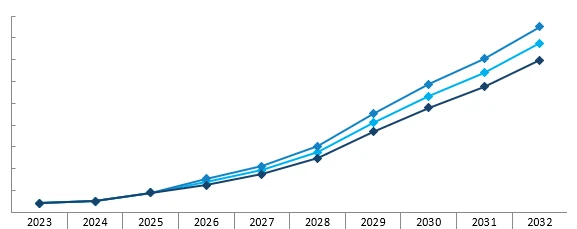
The report also presents optimistic and conservative scenarios extending beyond 1.7 million units and approximately 1.39 million units, respectively, by 2032, highlighting both upside potential and execution risks.
Spending across the India Electric Vehicle Market will increasingly shift toward localized battery manufacturing, charging infrastructure deployment, renewable energy integration, and software-enabled mobility services. Investments in fast-charging networks, domestic cell production, and OEM manufacturing facilities are expected to strengthen supply chain resilience while reducing long-term ownership costs.
The Electric Vehicle Market India will increasingly attract capital from automakers, battery producers, utilities, and financial institutions seeking long-term opportunities in India's rapidly expanding electric mobility ecosystem.
Growth Environment: Indian EV Market
The Indian EV Market operates within one of the world's most favorable electric mobility environments, where government support, industrial investments, and technological innovation collectively accelerate long-term adoption.
Manufacturing localization remains the strongest catalyst. Production Linked Incentive programs encourage domestic battery manufacturing, component production, and vehicle assembly, reducing import dependence while strengthening India's industrial competitiveness.
Charging infrastructure continues expanding rapidly across metropolitan cities, highways, residential communities, and commercial fleets. Improved charging accessibility significantly reduces consumer concerns regarding convenience and vehicle usability, making electric passenger vehicles increasingly attractive.
Battery technology innovation further strengthens the India Electric Vehicle Market. Improvements in battery efficiency, thermal management, software-defined vehicle architecture, and fast-charging systems enhance vehicle performance while reducing ownership costs over time.
Digital transformation is reshaping the India EV Market through connected mobility, AI-enabled fleet management, predictive maintenance, and intelligent charging solutions. These technologies improve customer experience while creating new revenue opportunities across the broader EV ecosystem.
However, several challenges remain. Limited public charging availability, battery material dependency, grid capacity constraints, charging duration, and resale uncertainty continue affecting consumer confidence. Geopolitical risks surrounding critical mineral supply chains may also influence manufacturing costs during the forecast period.
Despite these obstacles, collaboration between automakers, battery manufacturers, utilities, charging providers, and financial institutions continues strengthening the Electric Vehicle Market India. As infrastructure expands, localized production scales, and technology costs decline, India's electric mobility ecosystem is expected to transition from rapid adoption toward sustainable commercial maturity through 2032.
Scope of Analysis
Regional Segmentation
Why is it Increasingly Difficult to Grow?
The Strategic Imperative 8™
The Impact of the Top 3 Strategic Imperatives on the Indian EV Market
Research Methodology
Questions This Study Will Answer
Competitive Environment
Key Competitors
Factors Influencing EV OEMs
Predominant EV Distribution Channels
Key Trends in 2026
Battery Technology Outlook
Innovative Vehicle Architecture
Progressive Thermal Management
Advanced Charging Technology
Connectivity, Autonomy, and Digital Services
Electric Motor Technology
Primary Findings: Current and Outlook
Key Growth Metrics
Growth Environment
Growth Drivers
Growth Restraints
Potential Trends Influencing Market Growth
Supply Chain Localization
Interoperable Charging Network
Key Strategic Collaborations
Incentive Evolution In India
Timeline: Major Schemes and Incentives
Purchase Subsidies/Exemptions by Leading States
Expected Direction of EV and Charging Infrastructure Policies
Companies Building Battery Cell Gigafactories in India
Impact of Iran-US War on the Indian EV Industry
Forecast Considerations
Indian EV Market: 2025 and 2026e
EV Adoption by Region: 2025 Comparison Summary
EV Sales Forecast by Region
EV Unit Sales Share and Market Share by OEMs, 2025
Key Growth Metrics
Regional Overview: Northern Region
Key Growth Metrics
Regional Overview: Northeastern Region
Key Growth Metrics
Regional Overview: Eastern Region
Key Growth Metrics
Regional Overview: Central Region
Key Growth Metrics
Regional Overview: Western Region
Key Growth Metrics
Regional Overview: Southern Region
Operating OEMs’ Investments/Initiatives
Key EV Production Facilities in India: Summary
Tata Motors
JSW MG Motors India
Mahindra & Mahindra
Growth Opportunity 1: Localization/Manufacturing Domestication
Growth Opportunity 2: Fast-Charging Infrastructure & Fleet Electrification
Growth Opportunity 3: Expansion of Affordable Mass-Market EVs
Top 3 Conclusions
Benefits and Impacts of Growth Opportunities
Next Steps
List of Exhibits
Legal Disclaimer
Frequently Asked Questions (FAQs) – Indian EV Market
1. What is the Indian EV Market?
The Indian EV Market refers to India's passenger electric vehicle ecosystem, including EV sales, OEM competition, battery technologies, charging infrastructure, and government policies that support electric mobility adoption.
2. How fast is the India Electric Vehicle Market expected to grow?
The India Electric Vehicle Market is projected to grow at a CAGR of 36.2% between 2025 and 2032, driven by localization policies, expanding charging infrastructure, and rising consumer demand.
3. How many passenger EVs are expected to be sold in India by 2032?
The India EV Market is forecast to reach approximately 1.55 million passenger EV sales by 2032, reflecting strong long-term growth across urban and emerging regional markets.
4. Which companies lead the Electric Vehicle Market India?
Tata Motors leads the Electric Vehicle Market India, followed by JSW MG Motor and Mahindra. Other competitors such as Hyundai, BYD, BMW India, Kia India, Mercedes-Benz, and VinFast are expanding their presence.
5. What are the key growth drivers of the Indian EV Market?
Key growth drivers include domestic manufacturing localization, government incentive programs, battery technology advancements, expanding charging infrastructure, fleet electrification, and increasing consumer acceptance of electric vehicles.
6. Which regions are leading EV adoption in the India EV Market?
Western and Southern India currently lead passenger EV adoption, while Northern India is emerging as a high-growth region due to improving charging infrastructure and stronger purchasing power.
7. What challenges could affect the India Electric Vehicle Market?
The India Electric Vehicle Market faces challenges such as limited charging infrastructure, battery material dependency, grid capacity constraints, charging-time concerns, and uncertainty regarding EV resale values.
8. How important is battery localization in the Indian EV Market?
Battery localization is a critical growth factor because domestic manufacturing reduces import dependence, strengthens supply chain resilience, lowers production costs, and supports long-term competitiveness in the Indian EV Market.
9. How is charging infrastructure influencing the Electric Vehicle Market India?
The expansion of public charging stations, fast-charging corridors, residential charging solutions, and commercial charging networks is improving ownership convenience and accelerating EV adoption across the Electric Vehicle Market India.
10. What is the long-term outlook for the India EV Market?
The India EV Market is expected to evolve into a mature, technology-driven mobility ecosystem through 2032, supported by localized manufacturing, advanced battery technologies, stronger charging infrastructure, and growing investments across the EV value chain.
Speak directly with our analytics experts for tailored recommendations.
Recent related Autonomous Vehicles research
15 Oct 2026 | Asia Pacific | Market Outlook
Automotive Market Opportunities, South Korea, 2026
This Frost & Sullivan report analyzes South Korea’s automotive market, focusing on passenger vehicles and light commercial vehicles.South Korea has built a fully integrated supply chain, covering everything from manufacturing to sales and aftermarket services. The entire business cycle is continuous...
25 Sep 2026 | Global | Technology Research
Growth Opportunities in Next-Gen Wireless EV charging, Automotive Grade IoT module, Autonomous driving, E-bike Platform, UAVs, and 4D Radars
The Mobility Technology Opportunity Engine (TOE) covers innovations pertaining to EV charging, Automotive Grade IoT module, Autonomous driving, E-bike Platform, UAVs, and 4D Radars.The purpose of the Mobility Technology TOE is to raise awareness of global technology innovations in self-propelled gro...
22 Sep 2026 | Global | Market Research
Growth Opportunities in the Global EV Power Electronics Market, 2025–2032
The rapid push toward e-mobility is accelerating adoption of advanced power electronics by major OEMs. Power electronics underpin electric vehicle reliability, efficiency, and performance. Core systems, including traction inverters, onboard chargers, and DC-DC converters, are gaining strategic impor...
31 Aug 2026 | Global | Market Outlook
Off-Highway Equipment Market Predictions and Growth Opportunities, Global, 2026
The global off-highway (OHW) equipment industry enters 2026 amid a complex and evolving macroeconomic environment characterized by geopolitical uncertainty, energy price volatility, and shifting trade dynamics. While the baseline outlook suggests moderate global GDP growth of about 3%, downside scen...
27 Aug 2026 | Global | Market Outlook
Global EV Charging Infrastructure, 2026: Growth Trajectory and Emerging Opportunities
The rapid rise of electric vehicles (EVs) is intensifying the need for a robust, accessible charging infrastructure. Enabled by IoT integration, EVs are becoming a smarter alternative to conventional ICE vehicles. Expanding fast-charging stations along highways and at key destinations is critical to...
Purchase includes:
- Report download
- Growth Dialog™ with our experts
Growth Dialog™
A tailored session with you where we identify the:- Strategic Imperatives
- Growth Opportunities
- Best Practices
- Companies to Action
Impacting your company's future growth potential.
Urbanization, growing environmental awareness, rising fuel prices, and expanding charging networks in major metropolitan cities are accelerating EV adoption. Tier I cities are emerging as the primary growth centers due to better charging availability, stronger purchasing power, and a more mature EV ecosystem. At the same time, geopolitical uncertainties and energy security concerns are reinforcing the nation’s transition toward electrification as a means of reducing reliance on imported fossil fuels.
Several factors will influence OEM strategies over the forecast period. Emerging battery chemistries, such as sodium-ion and solid-state batteries, are expected to improve cost efficiency and performance, while dependence on imported critical minerals remains a challenge. Government policies, charging infrastructure expansion, and localization efforts will continue to shape market competitiveness and investment decisions.
Despite strong growth prospects, the market faces constraints including inadequate charging infrastructure, battery material dependency, grid limitations, charging-time concerns, and uncertainty regarding EV resale values. However, ongoing investments in charging networks, grid modernization, and domestic manufacturing are expected to mitigate these challenges over time.
Author: Jagadeesh Chandran
| Deliverable Type | Market Research |
|---|---|
| Industries | Automotive |
| No Index | No |
| Is Prebook | No |
| Keyword 1 | India Electric Vehicle Market |
| Keyword 2 | India EV Market Report |
| Keyword 3 | Electric Mobility Market Analysis |
| Podcast | No |
| Predecessor | PFV9-01-00-00-00 |
| WIP Number | M1L2-01-00-00-00 |