 USD
USD GBP
GBP  CNY
CNY  EUR
EUR  INR
INR  JPY
JPY  MYR
MYR  ZAR
ZAR  KRW
KRW  THB
THB 


Endpoint Security Industry, Global, 2024–2028
The Endpoint Security Industry is Driving Transformational Growth due to an Ever-complex Threat Landscape
02-May-2025
Global
Market Research
KAE4-01-00-00-00
AE_2025_33464
Report Summary: Endpoint Security Market
The global endpoint security market is experiencing strong and sustained growth, driven by the increasing complexity of cyber threats and the rapid expansion of connected devices across enterprise environments. The Endpoint Security Industry generated approximately USD 12,994.1 million in 2024 and is projected to reach around USD 22,310.9 million by 2028, growing at a CAGR of 14.5%. This growth is primarily supported by rising enterprise investments in cybersecurity and the need to secure distributed endpoints, including laptops, mobile devices, servers, and IoT systems.
Key Market Trends & Insights
- The endpoint security market is shifting from traditional antivirus solutions to integrated EPP and EDR platforms.
- AI and machine learning are increasingly being used for real-time threat detection and automated response.
- The rise of remote work and BYOD policies is expanding the enterprise attack surface.
- Cloud-based endpoint security solutions are gaining traction due to scalability and centralized management capabilities.
- Regulatory compliance and data protection requirements are driving adoption across industries.
Market Size & Forecast
- 2024 Market Size: USD 12,994.1 Million
- 2028 Projected Market Size: USD 22,310.9 Million
- CAGR (2024–2028): 14.5%
- North America: Largest market due to advanced cybersecurity infrastructure
- Asia-Pacific: Fastest-growing region driven by digital transformation
The increasing sophistication of cyberattacks and the growing number of endpoints are transforming the Endpoint Security Industry. Organizations are prioritizing advanced, AI-driven security solutions to protect sensitive data and ensure operational continuity. As enterprises continue to adopt cloud technologies and remote work models, the endpoint security market is expected to witness continuous innovation and expansion, reinforcing its critical role in modern cybersecurity strategies.
Market Overview & Trends: Endpoint Security Market
The global endpoint security market is undergoing a transition toward integrated, intelligence-driven security frameworks as enterprises respond to the growing complexity of cyber threats. The Endpoint Security Industry has shifted from reactive protection models to proactive and predictive security strategies, focusing on endpoint-level visibility and control.
A key development in the endpoint security market is the convergence of EPP and EDR capabilities into unified platforms. These solutions provide continuous monitoring, threat hunting, and automated remediation, reducing response times and improving operational efficiency. AI and machine learning technologies are central to this transformation, enabling detection of zero-day threats and anomalous behaviors.
The increasing adoption of remote work models has significantly expanded the attack surface within the Endpoint Security Industry. Employees accessing corporate networks from multiple devices and locations require robust endpoint protection solutions capable of securing diverse environments. The proliferation of IoT devices further adds to endpoint complexity, introducing additional vulnerabilities.
Cloud-based endpoint security solutions are becoming a standard deployment model in the endpoint security market. These solutions offer scalability, centralized control, and faster deployment compared to traditional on-premises systems. Organizations are leveraging cloud-native architectures to manage security across geographically dispersed endpoints.
Regulatory frameworks and data protection laws are influencing purchasing decisions in the Endpoint Security Industry. Compliance requirements are pushing enterprises to adopt advanced security solutions that ensure data integrity and privacy.
The competitive landscape is shaped by continuous innovation, with vendors focusing on enhancing platform capabilities, improving user experience, and integrating with broader cybersecurity ecosystems.
Scope of Analysis: Endpoint Security Market
This study analyzes the global endpoint security market across the period from 2021 to 2028, with 2024 as the base year. The Endpoint Security Industry is assessed across major regions including North America, Europe, Asia-Pacific, and Latin America.
The scope includes endpoint protection platforms (EPP) and endpoint detection and response (EDR) solutions, covering a wide range of endpoints such as desktops, laptops, servers, mobile devices, and IoT systems. The analysis focuses on enterprise-level endpoint security deployments.
The study evaluates the endpoint security market across industry verticals such as banking and finance, government, healthcare, manufacturing, and technology. It also considers adoption across organizations of different sizes, including small and medium enterprises and large enterprises.
Research methodology includes a combination of primary interviews with industry stakeholders and secondary data analysis. Market estimates are validated through data triangulation and cross-referencing of multiple sources.
Key areas of focus include technology evolution, deployment models, regulatory impact, and competitive dynamics within the Endpoint Security Industry.
Market Segmentation Analysis: Endpoint Security Market
The global endpoint security market is segmented based on solution type, deployment model, organization size, and industry verticals, reflecting the diverse requirements of the Endpoint Security Industry.
By solution type, the market includes endpoint protection platforms (EPP) and endpoint detection and response (EDR). EPP solutions provide preventive capabilities such as antivirus, anti-malware, and intrusion prevention, while EDR solutions offer advanced detection, investigation, and response functionalities. Increasingly, organizations are adopting unified platforms that combine both capabilities.
By deployment model, the endpoint security market is categorized into on-premises and cloud-based solutions. Cloud-based deployment is gaining significant adoption due to its scalability, flexibility, and centralized management features. Enterprises are transitioning toward cloud-native security architectures to manage distributed endpoints efficiently.
By organization size, the Endpoint Security Industry serves both small and medium enterprises and large enterprises. SMEs are increasingly adopting endpoint security solutions due to rising cyber threats and regulatory pressures, while large enterprises continue to invest in advanced, integrated platforms.
By industry vertical, the endpoint security market spans sectors such as BFSI, healthcare, government, manufacturing, and IT & telecommunications. These industries require robust endpoint security solutions to protect sensitive data and maintain compliance with regulatory standards.
Geographically, North America leads the Endpoint Security Industry, followed by Europe and Asia-Pacific, where digital transformation initiatives are driving increased adoption.
Revenue & Spending Forecast: Endpoint Security Market
The global endpoint security market is projected to grow significantly, supported by increasing enterprise spending on cybersecurity and the rising number of connected endpoints. The Endpoint Security Industry generated approximately USD 12,994.1 million in 2024 and is expected to reach USD 22,310.9 million by 2028, reflecting a CAGR of 14.5%.
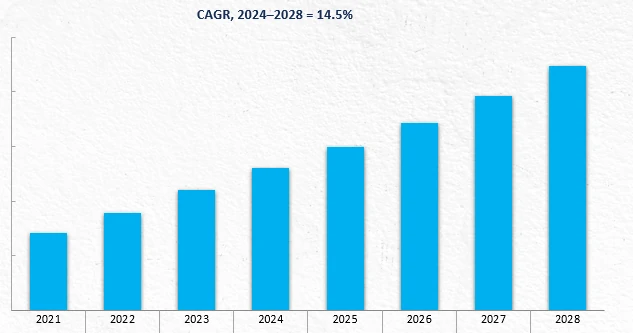
Revenue growth in the endpoint security market is driven by the adoption of advanced security solutions that integrate AI and automation. Enterprises are prioritizing investments in platforms that offer real-time threat detection, automated response, and centralized management.
Cloud-based endpoint security solutions are contributing to increased spending, as organizations seek scalable and cost-effective deployment models. Subscription-based pricing models are also supporting recurring revenue streams within the Endpoint Security Industry.
High-risk sectors such as BFSI, healthcare, and government are leading investments due to their exposure to cyber threats and regulatory requirements. Additionally, the expansion of remote work and IoT adoption is increasing demand for endpoint security solutions.
Growth Drivers: Endpoint Security Market
The global endpoint security market is driven by the increasing frequency and sophistication of cyberattacks targeting enterprise endpoints. As endpoints become primary entry points for attackers, organizations are investing in advanced security solutions.
The rise of remote work and BYOD policies is expanding the attack surface within the Endpoint Security Industry, driving demand for comprehensive endpoint protection. Employees accessing corporate networks from various devices require robust security measures.
Advancements in AI and machine learning are enhancing capabilities within the endpoint security market, enabling predictive threat detection and automated response. These technologies improve efficiency and reduce response times.
The proliferation of IoT devices is further increasing the need for endpoint security solutions, as these devices introduce new vulnerabilities. Regulatory compliance requirements are also driving adoption across industries.
Growth Restraints: Endpoint Security Market
The global endpoint security market faces challenges related to high implementation costs, particularly for small and medium enterprises. Advanced security solutions require significant investment in technology and expertise.
The complexity of integrating multiple security solutions is another challenge within the Endpoint Security Industry. Organizations often deploy layered security architectures, which can create operational inefficiencies.
A shortage of skilled cybersecurity professionals limits the effective deployment and management of endpoint security solutions. This skill gap impacts the ability of organizations to respond to evolving threats.
Additionally, the rapidly changing threat landscape requires continuous updates and improvements, increasing operational complexity and costs.
Competitive Landscape: Endpoint Security Market
The global endpoint security market is highly competitive, with more than 40 players operating within the Endpoint Security Industry. The market includes established cybersecurity vendors and emerging technology providers.
Key players include CrowdStrike, Microsoft, Trellix, SentinelOne, Trend Micro, ESET, Sophos, and Broadcom (Symantec). These companies focus on developing AI-powered security solutions that enhance threat detection and response capabilities.
Competition in the endpoint security market is based on technology performance, scalability, cost efficiency, and ease of implementation. Vendors are increasingly offering integrated platforms that combine EPP and EDR functionalities.
Strategic partnerships and acquisitions are shaping the Endpoint Security Industry, enabling companies to expand capabilities and market presence. Cloud-based solutions are a key area of focus, reflecting the shift toward scalable and flexible security architectures.
The distribution ecosystem includes channel partners, managed service providers (MSPs), and direct sales models, supporting widespread adoption across enterprises.

Why Is It Increasingly Difficult to Grow?
The Strategic Imperative 8
The Impact of the Top 3 Strategic Imperatives on the Endpoint Security Industry
Scope of Analysis
Segmentation
Competitive Environment
Key Competitors
Growth Metrics
Growth Drivers
Growth Driver Analysis
Growth Restraints
Growth Restraint Analysis
Trends
Forecast Considerations
Revenue Forecast
Revenue Forecast by Region
Revenue Forecast by Industry Vertical
Revenue Forecast by Business Size
Revenue Forecast Analysis
Pricing Trends and Forecast Analysis
Revenue Share
Revenue Share Analysis
Growth Opportunity 1: Incorporate AI Technology into Endpoint Solutions
Growth Opportunity 2: Implement Mobile Threat Defense MTD
Growth Opportunity 3: Prepare a Layered Cybersecurity Strategy
Insights for CISOs
Benefits and Impacts of Growth Opportunities
Next Steps
List of Exhibits
Legal Disclaimer
Frequently Asked Questions (FAQ) – Endpoint Security Market
1. What is the endpoint security market?
The endpoint security market refers to solutions designed to protect endpoints such as laptops, desktops, servers, mobile devices, and IoT systems from cyber threats, malware, and unauthorized access.
2. What is included in the Endpoint Security Industry?
The Endpoint Security Industry includes endpoint protection platforms (EPP), endpoint detection and response (EDR), threat intelligence solutions, and integrated security platforms that monitor and secure enterprise endpoints.
3. What is driving growth in the endpoint security market?
Growth is driven by increasing cyberattacks, expansion of remote work, rising adoption of IoT devices, regulatory compliance requirements, and advancements in AI-based security technologies.
4. What is the difference between EPP and EDR?
EPP focuses on prevention through antivirus and anti-malware tools, while EDR provides advanced detection, investigation, and response capabilities to address sophisticated and ongoing cyber threats.
5. Which industries use endpoint security solutions the most?
Industries such as banking and finance, healthcare, government, manufacturing, and IT & telecommunications are major adopters due to their high exposure to cyber threats and sensitive data.
6. What role does AI play in the Endpoint Security Industry?
AI enhances endpoint security by enabling real-time threat detection, behavioral analysis, predictive analytics, and automated response to cyber incidents.
7. What are the key challenges in the endpoint security market?
Key challenges include high implementation costs, integration complexity, shortage of skilled cybersecurity professionals, and the rapidly evolving threat landscape.
8. How is cloud technology impacting the endpoint security market?
Cloud-based endpoint security solutions offer scalability, centralized management, and cost efficiency, enabling organizations to secure distributed endpoints effectively.
9. Who are the leading players in the Endpoint Security Industry?
Leading players include CrowdStrike, Microsoft, SentinelOne, Trend Micro, Sophos, ESET, and Broadcom (Symantec), among others.
10. What is the future outlook for the endpoint security market?
The endpoint security market is expected to grow steadily, driven by increasing cyber threats, adoption of AI-driven security solutions, and expansion of remote and cloud-based environments.
Speak directly with our analytics experts for tailored recommendations.
Recent related Security research
21 Oct 2026 | Global | Market Research
Insights for CISOs: The Transition to Quantum-Safe
The emergence of post-quantum cryptography (PQC) reflects a significant problem: powerful quantum computers may soon compromise the cryptographic algorithms underpinning today’s digital economy, threatening the confidentiality and integrity of sensitive data and communications. Addressing this risk ...
16 Oct 2026 | Global | Market Research
Customer Transformation Journeys External Risk Mitigation and Management: BitSight
This report explores how organizations are accelerating cyber risk reduction and remediation through Bitsight’s intelligent External Risk Management and Mitigation (ERMM) solution. It examines customer transformation journeys, highlighting how continuous visibility, contextualized risk intelligence,...
15 Oct 2026 | Global | Market Research
Network Detection and Response (NDR) Sector, Global, 2026–2030
This study examines the global NDR market over the 2022–2030 forecast period. It finds that rising investment reflects NDR's evolution from a discretionary security enhancement into a foundational component of enterprise cyber defense, underscoring stronger buyer commitment and heightened vendor com...
09 Oct 2026 | Global | Technology Research
Growth Opportunities in SiC MOSFET, Photodiodes, RISC-Vs, and Advanced Memory
The Microelectronics Technology Opportunity Engine covers innovations pertaining to SiC MOSFET, Photodiodes, RISC-Vs, and Advanced Memory.The Microelectronics Technology Opportunity Engine captures global electronics-related innovations and developments on a weekly basis. Developments are centered o...
09 Oct 2026 | Global | Frost Radar
Frost Radar™: Workforce Identity and Access Management, 2026
Hybrid work and software as a service have shifted security enforcement from the network perimeter to identity, transforming it into a control plane. Workforce identity and access management (IAM) now determines whether every user, device, and session should retain access based on context, risk, and...
Purchase includes:
- Report download
- Growth Dialog™ with our experts
Growth Dialog™
A tailored session with you where we identify the:- Strategic Imperatives
- Growth Opportunities
- Best Practices
- Companies to Action
Impacting your company's future growth potential.