 USD
USD GBP
GBP  CNY
CNY  EUR
EUR  INR
INR  JPY
JPY  MYR
MYR  ZAR
ZAR  KRW
KRW  THB
THB 


Strategic Agility and Value-Driven Service Models Drive Transformational Growth in FM
20-May-2026
North America
Market Research
PL0A-01-00-00-00
EN_2026_34598
Report Summary: North America Facility Management Market
The North America facility management market size was valued at USD 307.32 billion in 2025 and is projected to reach USD 400.43 billion by 2032, expanding at a CAGR of 3.9% from 2025 to 2032. Growth is being supported by increasing outsourcing adoption, integrated facility management (IFM) contracts, digital building operations, sustainability mandates, and growing demand for operational efficiency across commercial and institutional infrastructure in the United States and Canada.
Key Market Trends & Insights
- The United States remains the dominant market due to large-scale commercial infrastructure and mature outsourcing adoption.
- Integrated facility management (IFM) contracts are gaining traction as enterprises consolidate multiple services under single providers.
- Hard FM services, including HVAC, electrical systems, plumbing, and building maintenance, continue to account for a major revenue share.
- Healthcare, government, education, industrial manufacturing, and financial services are among the leading end-user verticals.
- Digital FM technologies such as IoT sensors, predictive maintenance, analytics platforms, and AI-enabled monitoring are transforming service delivery.
- ESG initiatives and decarbonization goals are accelerating demand for energy management and sustainable building operations.
- Workplace transformation and hybrid work models are increasing demand for occupant-centric and productivity-focused FM solutions.
Market Size & Forecast
- 2025 Market Size: USD 307.32 Billion
- 2032 Forecast Market Size: USD 400.43 Billion
- CAGR (2025–2032): 3.9%
- United States: Largest Market
- Canada: Emerging High-Growth Market
The North American facility management industry is transitioning from labor-intensive service delivery models toward technology-enabled, integrated, and value-driven service ecosystems. Enterprises are increasingly outsourcing FM operations to improve operational consistency, optimize costs, enhance compliance management, and strengthen energy efficiency across large property portfolios. Aging building infrastructure, rising maintenance complexity, and expansion of mission-critical facilities such as data centers, healthcare campuses, and advanced manufacturing plants are further accelerating market demand.
Digital transformation continues to reshape the competitive landscape as FM providers integrate IoT-enabled building management systems, AI-driven predictive maintenance, cloud-based monitoring platforms, and energy analytics into their service portfolios. At the same time, sustainability regulations, carbon reduction targets, and occupant wellness initiatives are encouraging organizations to adopt comprehensive FM strategies that combine operational excellence with environmental performance. Market participants are also increasingly focusing on integrated FM contracts that bundle hard services, soft services, workplace experience management, and sustainability consulting under unified delivery frameworks.
Market Overview & Trends: North America Facility Management Market
The North American facility management (FM) market is witnessing a structural transformation driven by outsourcing expansion, workplace modernization, sustainability initiatives, and rapid digitalization of building operations. Organizations across public and private sectors are increasingly shifting from fragmented service contracts toward integrated facility management models that combine multiple operational services under centralized governance structures. This transition is helping enterprises improve accountability, operational efficiency, service consistency, and long-term cost optimization.
The growing complexity of commercial buildings, industrial facilities, healthcare campuses, educational institutions, and mission-critical infrastructure is increasing demand for specialized FM providers capable of delivering high-reliability operational support. Large organizations are prioritizing preventive maintenance, compliance management, energy optimization, and workplace experience enhancement to improve asset performance and employee productivity. As a result, integrated FM providers with nationwide service capabilities and advanced digital platforms are gaining a competitive advantage.
Technology adoption is becoming a major differentiator across the industry. IoT-enabled sensors, AI-powered predictive maintenance systems, digital twins, cloud-based facility monitoring platforms, and analytics-driven energy management tools are transforming traditional FM operations into data-centric service ecosystems. Predictive maintenance is reducing downtime and operational risks while enabling providers to deliver measurable performance outcomes. Smart building technologies are also helping organizations improve energy efficiency, reduce emissions, and support ESG reporting requirements.
The market is further benefiting from rising demand for sustainability-focused facility operations. Organizations across North America are implementing decarbonization strategies, green building certifications, and energy-efficiency initiatives to comply with environmental regulations and corporate sustainability targets. FM providers are increasingly offering energy management, environmental services, waste management, carbon reporting, and renewable integration solutions as part of broader integrated contracts.
Hybrid work models and workplace transformation strategies are also reshaping service demand. Companies are redesigning office spaces to improve employee experience, collaboration, flexibility, and space utilization. This trend is increasing demand for workplace management services, occupancy analytics, indoor environmental quality monitoring, and smart workspace solutions.
Despite strong growth opportunities, the market faces challenges including labor shortages, wage inflation, pricing pressures, fragmented competition, and increasing client expectations around sustainability and service quality. However, consolidation through mergers and acquisitions, expansion of digital FM capabilities, and growing adoption of performance-based service contracts are expected to support long-term market expansion through 2032.
Scope of Analysis: North America Facility Management Market
The North America facility management market study evaluates outsourced facility management services across the United States and Canada, covering both public and private sector customer segments. The analysis focuses on outsourced FM operations and excludes in-house FM activities performed internally by organizations.
The study period spans from 2019 to 2032, with 2025 considered as the base year and 2026–2032 serving as the forecast period. Revenue estimates are measured in US dollars and reflect manufacturer- and service-provider-level revenues generated through outsourced facility management contracts.
The market scope includes three primary service categories: hard FM services, soft FM services, and additional value-added services. Hard FM services include mechanical and electrical maintenance, HVAC systems, plumbing, fire protection systems, building controls, and infrastructure operations. Soft FM services include cleaning, security, catering, landscaping, laundry, pest control, and hospitality-related services. Additional services include property management, environmental management, energy management, waste management, IT support, and telecommunications services.
The report evaluates market demand across multiple customer sectors including healthcare, government, education, financial services, professional services, industrial manufacturing, logistics, hospitality, retail, and commercial real estate. The study also examines service delivery models such as single services, bundled services, and integrated facility management (IFM) contracts.
In addition to market sizing and forecasting, the analysis assesses industry trends related to outsourcing adoption, digital transformation, sustainability initiatives, workforce management, predictive maintenance technologies, smart buildings, ESG compliance, and integrated workplace management systems. Competitive benchmarking covers leading FM providers, M&A activity, service integration strategies, technology investments, and regional expansion initiatives.
Market Segmentation Analysis: North America Facility Management Market
The North America facility management market is segmented by service type, contract model, customer sector, and geography. Service-based segmentation includes hard FM services, soft FM services, and additional integrated operational services. Hard FM continues to account for a significant portion of market revenue due to the critical nature of infrastructure maintenance, HVAC systems, electrical systems, fire safety, and mechanical operations across commercial and industrial facilities.
Soft FM services remain essential for maintaining workplace functionality and occupant experience. Cleaning, security, catering, landscaping, and hospitality services are experiencing stable demand across healthcare facilities, educational institutions, government buildings, corporate offices, and retail environments. Growing emphasis on workplace wellness and sanitation standards continues to support soft FM demand.
Additional services such as energy management, environmental management, waste management, and IT infrastructure support are expanding rapidly as organizations pursue sustainability targets and digital workplace initiatives. Energy optimization and ESG-focused services are emerging as major revenue opportunities for FM providers.
Based on contract type, the market is segmented into single services, bundled services, and integrated facility management (IFM) contracts. IFM services are witnessing the fastest growth as enterprises increasingly consolidate multiple service functions under centralized operational frameworks. Integrated contracts improve operational visibility, accountability, and cost management while enabling providers to deliver scalable, technology-enabled services.
By customer sector, healthcare, government, education, industrial manufacturing, and financial services represent major demand segments. Healthcare facilities require highly specialized FM services focused on compliance, uptime, infection control, and patient safety. Industrial facilities and manufacturing plants are increasingly adopting predictive maintenance and energy optimization solutions to improve operational efficiency.
Geographically, the United States dominates the regional market due to its extensive commercial infrastructure, high outsourcing penetration, and large presence of enterprise-scale service contracts. Canada is emerging as a strong growth market supported by infrastructure modernization, sustainability initiatives, and increasing demand for integrated service delivery models.
Revenue & Spending Forecast: North America Facility Management Market
The North America facility management market generated approximately USD 307.32 billion in revenue in 2025 and is expected to reach USD 400.43 billion by 2032, growing at a CAGR of 3.9% during the forecast period. The market continues to demonstrate steady long-term expansion supported by increasing outsourcing penetration, integrated service adoption, and digital transformation initiatives across commercial and institutional facilities.
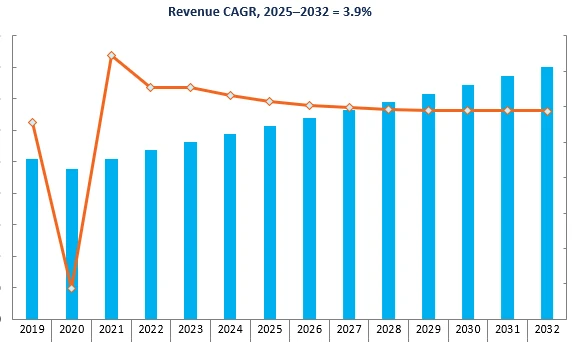
Revenue growth is expected to remain strongest within integrated facility management (IFM) contracts as enterprises seek unified service delivery frameworks that improve operational accountability and reduce administrative complexity. Large organizations are increasingly consolidating hard FM, soft FM, workplace services, and sustainability management into long-term integrated contracts.
Technology-driven FM services are expected to contribute significantly to spending growth. Investments in predictive maintenance platforms, IoT-enabled building systems, AI-powered analytics, occupancy monitoring, and cloud-based facility management solutions are accelerating across healthcare, data centers, manufacturing facilities, and commercial real estate portfolios.
Energy management and ESG-focused services are emerging as another major growth category. Organizations are increasing spending on carbon reduction initiatives, energy-efficiency upgrades, renewable integration, and sustainability reporting services to comply with environmental regulations and corporate ESG commitments.
From a regional perspective, the United States will continue to account for the largest share of revenue throughout the forecast period due to large-scale outsourcing contracts, aging infrastructure modernization, and rapid adoption of digital FM technologies. Canada is projected to witness strong growth driven by public infrastructure investments, commercial real estate modernization, and expanding sustainability initiatives.
While labor shortages, pricing pressure, and inflationary operating costs may impact profitability across certain service categories, long-term market fundamentals remain positive due to rising operational complexity, increasing compliance requirements, and growing reliance on outsourced facility management expertise.
Growth Drivers: North America Facility Management Market
Several structural and technological trends are accelerating growth across the North America facility management market.
Increasing FM Outsourcing Adoption
Organizations are increasingly outsourcing facility management services to reduce fixed operational costs, improve service quality, and focus on core business activities. Outsourcing also enables enterprises to access specialized expertise and scalable service delivery models.
Expansion of Integrated Facility Management (IFM)
Demand for integrated FM contracts is increasing as enterprises consolidate multiple operational services under unified governance structures. IFM models improve accountability, operational efficiency, and long-term cost optimization.
Aging Commercial and Institutional Infrastructure
Aging building stock across North America is driving demand for maintenance, retrofitting, compliance management, and infrastructure modernization services. This is particularly significant in healthcare, government, education, and industrial facilities.
Growth of Smart Buildings and Digital FM
Rapid adoption of IoT sensors, AI-powered predictive maintenance, digital twins, and centralized monitoring platforms is transforming FM operations. Smart building technologies improve energy efficiency, asset uptime, and operational transparency.
Sustainability and ESG Initiatives
Organizations are increasingly implementing energy management, carbon reduction, and sustainability strategies to meet regulatory and corporate ESG goals. FM providers are expanding environmental and energy optimization service portfolios to address this demand.
Expansion of Mission-Critical Facilities
Growth in data centers, healthcare campuses, life sciences facilities, and advanced manufacturing plants is creating demand for highly specialized FM services with stringent uptime, compliance, and operational reliability requirements.
Workplace Transformation and Occupant Experience
Hybrid work environments and evolving workplace strategies are increasing demand for workplace experience management, occupancy analytics, indoor environmental quality monitoring, and productivity-focused FM services.
Growth Restraints: North America Facility Management Market
Despite positive market fundamentals, several factors continue to challenge growth across the North America facility management industry.
Skilled Labor Shortages
The FM industry faces ongoing shortages of technical and semi-skilled labor across engineering, HVAC maintenance, electrical systems, and building operations. Labor constraints increase operational risk and limit scalability.
Wage Inflation and Rising Operating Costs
Labor inflation, higher insurance costs, and increasing employee benefit expenses continue to pressure FM provider profitability. Service providers often face difficulty fully passing rising costs to clients.
Pricing Pressure and Margin Compression
Highly competitive bidding environments, especially within soft FM services, continue to compress operating margins. Long-term fixed-price contracts signed before inflationary cycles have also created profitability challenges.
High Client Expectations
Customers increasingly expect enhanced sustainability performance, digital integration, service customization, and operational transparency without proportional increases in contract pricing, placing pressure on provider margins.
Fragmented Market Structure
The North American FM market remains highly fragmented, particularly among regional and mid-sized service providers. Fragmentation creates inconsistencies in service quality and limits standardization across the industry.
Digital Transformation Investment Challenges
Smaller and mid-tier FM providers may face difficulties investing in digital infrastructure, predictive maintenance platforms, and advanced analytics capabilities due to capital constraints and uncertain ROI timelines.
Operational Complexity in IFM Transition
Transitioning clients toward integrated FM models often requires complex operational restructuring, workforce integration, technology implementation, and change management, which may temporarily impact service performance.
Competitive Landscape: North America Facility Management Market
The North America facility management market is highly competitive and fragmented, with more than 600 market participants operating across hard FM, soft FM, integrated FM, and specialized workplace services. Large multinational providers compete alongside regional operators and niche technical service companies.
Leading companies in the market include Compass Group, Sodexo, Aramark, CBRE, ABM Industries, JLL, Allied Universal, Cushman & Wakefield, EMCOR, ISS, and GDI Integrated Facility Services. These providers compete based on operational scale, service quality, energy-efficiency capabilities, technology integration, nationwide coverage, and long-term customer relationships.
Integrated facility management providers are increasingly differentiating themselves through digital capabilities including predictive maintenance platforms, AI-driven building analytics, IoT-enabled monitoring systems, and cloud-based operational management solutions. Technology adoption is becoming a critical competitive factor as clients demand greater transparency, operational efficiency, and measurable sustainability outcomes.
Mergers and acquisitions continue to reshape the competitive landscape. Major providers are acquiring specialized technical service firms, energy management companies, and digital FM technology providers to expand service capabilities and strengthen regional presence. Strategic acquisitions are also enabling companies to enhance expertise in mission-critical infrastructure, sustainability consulting, and workplace experience management.
The market is also witnessing growing demand for performance-based and outcome-driven contracts where service providers are measured based on energy savings, operational uptime, ESG performance, occupant satisfaction, and cost optimization outcomes. This trend is encouraging providers to invest in advanced analytics, workforce training, and integrated digital service ecosystems.
Long-term competitive success will increasingly depend on providers’ ability to deliver integrated, technology-enabled, sustainability-focused, and scalable FM solutions tailored to evolving workplace and infrastructure requirements across North America.
Scope of Analysis
Segmentation by Service Type
Segmentation by Customer Sector
Segmentation by Contract Type
FM Service Spectrum by Contract Type
FM Market Analysis Methodology
Why is it Increasingly Difficult to Grow?
The Strategic Imperative 8™
The Impact of the Top 3 Strategic Imperatives on the North American Facility Management (FM) Industry
Key Findings and the CEO’s 360-Degree Perspective
North America FM Market in Numbers
North America FM Market Segmentation
North America FM Market Growth by Segment
North America FM Market Growth by Sub-Segment
North America FM Market Growth by Country
Competitive Environment
Key Competitors by Service Background
Key Competitors by HQ Location/Parent Group Nationality
Competitive Outlook for FM in North America
Revenue Market Share by Company
Revenue Market Share by Company Size and Number of Companies
Leading FM Suppliers by Service Type
Companies to Watch in 2025–2026
Summary of the North America FM Market Growth Outlook
North America FM Market Overview
Top 5 FM Developments, 2025–2032
Evolution of FM Trends, 2019–2032
FM Market Evolution
Top Transformational FM Trends, 2025–2032
High Impact FM Trends and Influencing Factors, 2025-2026
North America FM Universe: Total Addressable Market
North America FM Universe: Benchmarking Against Other Regions
Growth Metrics
Growth Drivers
Growth Restraints
Revenue Forecast
Revenue Forecast Analysis
Revenue Forecast by Contract Type
Revenue Forecast Analysis by Contract Type
Revenue by Service Type
Revenue Forecast by Service Type
Revenue by Service Sub-type
Revenue Forecast Analysis by Service Type
FM Market by Customer Type
Revenue Forecast by Customer Type
Revenue by Customer Sector
Revenue Forecast Analysis by Customer Sector
US Revenue Forecast by Contract Type
US Revenue Forecast by Service Type
US Revenue by Service Sub-type
US Revenue Forecast by Customer Type
US Revenue by Customer Sector
Canada FM Market Overview
Canada Growth Metrics
Canada FM Market Segmentation
Canada FM Market Growth by Segment
Canada FM Market Growth by Sub-Segment
Canada Revenue Forecast
Canada Revenue Forecast by Contract Type
Canada Revenue Forecast by Service Type
Canada Revenue by Service Sub-type
Canada Revenue Forecast by Customer Type
Canada Revenue by Customer Sector
Growth Opportunity 1: Energy Management, Sustainability, and ESG-Linked FM Services
Growth Opportunity 2: Digitally-Enabled FM and Smart Building Solutions
Growth Opportunity 3: Sector-Specific Capabilities
Growth Opportunity 4: Expansion of Integrated and Outcome-Based FM
Benefits and Impacts of Growth Opportunities
Next Steps
List of Exhibits
Frequently Asked Questions (FAQ) – North America Facility Management Market
1. What is the North America Facility Management Market?
The North America facility management market refers to outsourced services that support the operation, maintenance, safety, and efficiency of commercial, industrial, institutional, and public-sector buildings across the United States and Canada. These services include hard FM, soft FM, integrated FM, energy management, and workplace services.
2. How large is the North America facility management market?
The North America facility management market was valued at approximately USD 307.32 billion in 2025 and is projected to reach USD 400.43 billion by 2032, growing at a CAGR of 3.9% during the forecast period.
3. What are the major services included in facility management?
Facility management services include hard FM services such as HVAC, electrical systems, plumbing, fire safety, and building maintenance; soft FM services such as cleaning, security, catering, and landscaping; and additional services including energy management, waste management, property management, and workplace technology support.
4. What factors are driving growth in the North American facility management market?
Market growth is being driven by increasing outsourcing adoption, integrated facility management contracts, aging infrastructure, smart building technologies, sustainability initiatives, predictive maintenance adoption, and rising demand for energy-efficient building operations.
5. What is integrated facility management (IFM)?
Integrated facility management (IFM) is a service delivery model where multiple facility management services are consolidated under a single provider and centralized contract structure. IFM improves operational efficiency, accountability, cost optimization, and service consistency across facilities.
6. Which industries are major end users of facility management services?
Major end-user industries include healthcare, government, education, industrial manufacturing, financial services, retail, hospitality, commercial real estate, logistics, and data centers.
7. How is technology transforming the facility management market?
Technology is transforming the facility management market through IoT-enabled sensors, AI-driven analytics, predictive maintenance systems, cloud-based monitoring platforms, smart building technologies, and digital workplace management solutions that improve operational visibility and efficiency.
8. What are the key challenges in the North America facility management market?
Key challenges include skilled labor shortages, wage inflation, pricing pressure, fragmented competition, operational complexity in IFM implementation, and rising customer expectations related to sustainability, digital integration, and service performance.
9. Who are the leading companies in the North America facility management market?
Leading companies in the market include CBRE, ABM Industries, JLL, Compass Group, Sodexo, Aramark, Allied Universal, Cushman & Wakefield, EMCOR, ISS, and GDI Integrated Facility Services.
10. What is the future outlook for the North America facility management market?
The market outlook remains positive due to rising adoption of smart buildings, increasing demand for integrated service delivery, sustainability-focused operations, workplace transformation initiatives, and growing investments in digital facility management technologies across North America.
Speak directly with our analytics experts for tailored recommendations.
Recent related Homes and Buildings research
09 Oct 2026 | Global | Frost Radar
Frost Radar™: Smart Building Solutions in Healthcare, 2026
Healthcare facilities are some of the most complex and mission-critical environments in the smart buildings market, and investment priorities now extend beyond energy management to indoor environmental quality, critical infrastructure monitoring, asset visibility, and workflow optimization. Revenue ...
17 Sep 2026 | Asia Pacific | Frost Radar
Frost Radar™: Facility Management in Malaysia, 2026
Malaysia's facility management (FM) market is transitioning from labor-intensive, compliance-driven service delivery to technology-enabled, outcome-oriented, and sustainability-integrated operating models. Competitive differentiation increasingly depends on providers’ ability to combine integrated F...
27 Aug 2026 | Global | Market Research
Smart Building Solutions, Global, 2025–2031
Smart building solutions encompass the integrated suite of hardware, software, and digital services that enable the automation, optimization, and intelligent management of commercial, educational, healthcare, industrial, datacenters and other buildings.The scope includes: Hardware: Automation contro...
07 Aug 2026 | Asia Pacific | Frost Radar
Frost Radar™: Facility Management in Thailand, 2026
Thailand's facility management (FM) market is transitioning from labor-intensive, task-based service delivery to integrated, technology-enabled, and outcome-driven operating models. Customer expectations for operational efficiency, sustainability, resilience, digital visibility, and business outcome...
28 Jul 2026 | Global | Market Research
Building Construction Robotics, Global, 2025–2031
The global building construction robotics market is transitioning from proof of concept to selective deployment, shifting focus from technological feasibility to execution at the project and contractor level. Growth is influenced by the ability of firms to redesign workflows, manage human robot coor...
Purchase includes:
- Report download
- Growth Dialog™ with our experts
Growth Dialog™
A tailored session with you where we identify the:- Strategic Imperatives
- Growth Opportunities
- Best Practices
- Companies to Action
Impacting your company's future growth potential.
This Frost & Sullivan analysis offers a comprehensive examination of the shifts impacting the North America FM market. It highlights the factors driving and restraining growth and provides relevant market forecasts. The report also provides an overview of the competitive landscape and the trends emerging from the developments in this market. Service type and end-user segmentation analysis have also been provided, together with country chapters for the United States and Canada. Finally, the study identifies four growth opportunities emerging from the changes in this space that market players and stakeholders can leverage. This base year is 2025, and the forecast period is from 2026 to 2032.
Author: Janice Wung
| Deliverable Type | Market Research |
|---|---|
| Industries | Environment |
| No Index | No |
| Is Prebook | No |
| Keyword 1 | North America facility management |
| Keyword 2 | Integrated facility management (IFM) |
| Keyword 3 | Smart building solutions |
| Podcast | No |
| Predecessor | K897-01-00-00-00 |
| WIP Number | PL0A-01-00-00-00 |