 USD
USD GBP
GBP  CNY
CNY  EUR
EUR  INR
INR  JPY
JPY  MYR
MYR  ZAR
ZAR  KRW
KRW  THB
THB 


Sustainability Goals, Stringent Regulation, Industry Collaboration, Disruptive Technologies, and Digital Transformation to Drive Recycling and Resource Recovery Efficiency
10-Jul-2019
Global
Market Research
ME39-01-00-00-00
EN01130-EU-MR_23223
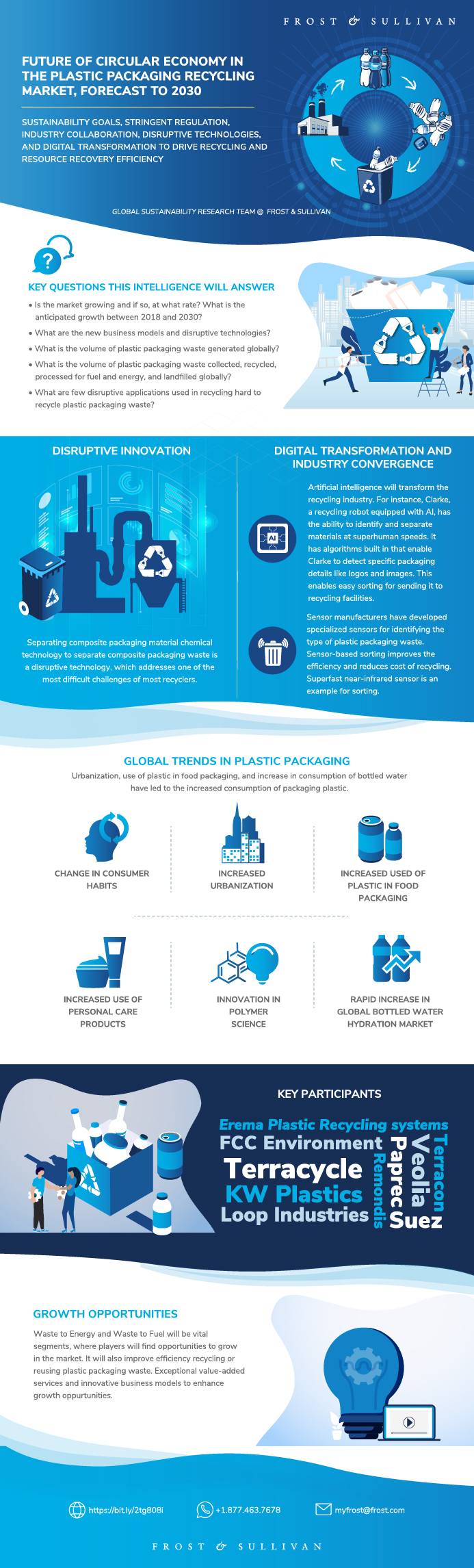
Innovative business models such as deposit return schemes, disruptive applications like augmented reality (AR), composite plastic separation, plastic to fuel etc., will drive the circular economy in the plastic packaging recycling market in the future. The market revenue is estimated at $13.1 billion and is expected to have a CAGR of 9.1% during the forecast period (2019 to 2030). This study includes the revenue forecast for plastic packaging waste management. The study also elaborates on the volume forecast of 5 different kinds of plastics—PET, HDPE, LDPE, PVC, and PP—at both the regional and global levels.
Research Scope
The study estimates the size of the global circular economy in the plastic packaging waste recycling market for 2018 and provides a forecast till 2030. The forecast includes revenue forecasts for plastic packaging waste management methods/segments: collection, recycling, and waste to energy/incineration, waste to fuel, and landfill. The study includes revenue forecasts for each region: Asia-Pacific, Europe, the Americas, and Middle-East & Africa. Few critical trends like changes in consumer habits, increase in urbanization, increased use of plastic in food packaging, increased use of personal care products, rapid increase in the global bottled water hydration market, etc., have had a significant impact on the plastic packaging waste market.
The global and regional plastic packaging waste recycling market trends include the global volume forecast of plastic packaging waste for the various segments. Landfill includes both organized and illegal dumping. The forecast consists of the volume of waste generated, collected and recycled, incinerated (waste to energy), landfilled, plastic to fuel, for all regions. There will be an increase in the number of countries introducing bans on single-use plastics due to various organizations stressing on the impacts of the same on marine life.
Followed by volume forecast, the study also provides valuable information on revenue forecast till 2030, with base year being 2018. Due to bigger recycling targets, especially in Europe, the recycling market is set to experience tremendous growth during the forecast period. As a result of stringent environmental regulations and a growing awareness of the environmental harm caused by the ocean dumping of plastic packaging waste, many corporates have vowed to make their plastic packaging recyclable in the coming years. This commitment will drive the recycling market as well. Waste to fuel is becoming increasingly popular and is set to gain traction during the forecast period. Waste to energy plants will also see significant growth during the forecast period, especially in the Asia-Pacific. Even though the Asia-Pacific is the largest generator of plastic packaging waste, it reports lower recycling rates than Europe and the Americas. Even though the per capita consumption is low compared to that of the developed regions, dense population contributes to volumes. When compared to other regions, the European Union (EU) will have the highest recycling rate during the forecast period due to stringent measures taken towards dealing with packaging plastic waste.
The study covers case studies on a few plastic packaging recycling concepts and provides the profiles of innovative recyclers across the world. The study also addresses key challenges present in the packaging plastic waste recycling market and includes discussions on how to tackle the same.
Key Issues Addressed
- Is the market growing and if so, at what rate?
- What is the anticipated growth between 2018 and 2030?
- What are the new business models and disruptive technologies?
- What is the volume of plastic packaging waste generated globally and across various regions?
- What is the volume of plastic packaging waste collected, recycled, processed for fuel and energy, and landfilled across various regions?
- What are some of the innovative plastic packaging waste management concepts?
- What are some of the disruptive applications being used in the recycling of hard-to-recycle plastic packaging waste?
Top 5 Key Messages of this Study
Future of Plastic Packaging Recycling Market—Total Volume Forecast
Future of Plastic Packaging Recycling Market Generation, Collection and Recycling
Future of Plastic Packaging Waste Recycling and Resource Recovery Market—Share of Volume Generation, and Collection by Region
Total Revenue Forecast
Global Trends in Plastic Packaging
Key Elements Critical for the Success of Plastic Packaging Waste Recycling
Research Scope
Research Methodology
Market Definition and Research Coverage
Value Chain of Packaging Plastic Recycling Market
Evolution of Plastic Recycling—Key Milestones
Rapid Rise of Plastics—Key Facts
Rapid Rise of Plastics—Key Facts (continued)
Plastic Packaging Waste Flows
Plastic Waste Exports Ban—Key Developments
Global Trends in Plastic Packaging
Global Trends in Plastic Packaging (continued)
Key Elements Critical for the Success of Plastic Packaging Waste Recycling
Key Elements Critical for the Success of Plastic Packaging Waste Recycling (continued)
Digital Transformation and Industry Convergence in Plastic Packaging Waste Management
Digital Transformation and Industry Convergence in Plastic Packaging Waste Management (continued)
Forecast Assumptions
Global—Total Volume Forecast for Plastic Packaging Waste Management by Type
Total Volume Forecast Discussion
Global PET Volume Forecast by Generated, Collected, and Recycled
PET Volume Forecast Discussion
Global HDPE Volume Forecast by Generated, Collected, and Recycled
HDPE Volume Forecast Discussion
Global LDPE Volume Forecast by Generated, Collected, and Recycled
LDPE Volume Forecast Discussion
Global PVC Volume Forecast by Generated, Collected, and Recycled
PVC Volume Forecast Discussion
Global PP Volume Forecast by Generated, Collected, and Recycled
PP Volume Forecast Discussion
Percent Volume Forecast by Treatment Methods
Percent Volume Forecast by Treatment Methods—Discussion
Forecast Assumption
Total Revenue Forecast
Total Revenue Forecast Discussion
APAC Volume Forecast for Plastic Packaging Waste Management by Type
Total Volume Forecast Discussion
Total Volume Forecast Discussion (continued)
Total Volume Forecast Discussion (continued)
APAC PET Volume Forecast by Generated, Collected, and Recycled
PET Volume Forecast Discussion
APAC HDPE Volume Forecast by Generated, Collected, and Recycled
HDPE Volume Forecast Discussion
APAC LDPE Volume Forecast by Generated, Collected, and Recycled
LDPE Volume Forecast Discussion
APAC PVC Volume Forecast by Generated, Collected, and Recycled
PVC Volume Forecast Discussion
APAC PP Volume Forecast by Generated, Collected, and Recycled
PP Volume Forecast Discussion
APAC Percent Volume Forecast by Treatment Methods
Percent Volume Forecast by Treatment Methods—Discussion
Volume Forecast Discussion
Treatment Methods—Discussion
Treatment Methods—Discussion (continued)
APAC Total Revenue Forecast
Total Revenue Forecast Discussion
Competitive Analysis
Ecosystem of Current Packaging Plastic Waste Recyclers—APAC
Europe Volume Forecast for Plastic Packaging Waste Management by Type
Total Volume Forecast Discussion
Total Volume Forecast Discussion (continued)
Europe PET Volume Forecast by Generated, Collected, and Recycled
PET Volume Forecast Discussion
Europe HDPE Volume Forecast by Generated, Collected, and Recycled
HDPE Volume Forecast Discussion
Europe LDPE Volume Forecast by Generated, Collected, and Recycled
LDPE Volume Forecast Discussion
Europe PVC Volume Forecast by Generated, Collected, and Recycled
PVC Volume Forecast Discussion
Europe PP Volume Forecast by Generated, Collected, and Recycled
PP Volume Forecast Discussion
Europe Percent Volume Forecast by Treatment Methods
Percent Volume Forecast by Treatment Methods—Discussion
Volume Forecast Discussion
Europe Total Revenue Forecast
Total Revenue Forecast Discussion
Competitive Analysis
The Ecosystem of Current Packaging Plastic Waste Recyclers—Europe
Key Legislations in Europe
Key Legislations in Europe (continued)
Circular Economy—Strategy for Plastics
Americas Volume Forecast for Plastic Packaging Waste Management by Type
Americas Volume Forecast for Plastic Packaging Waste Management by Type—Discussion
Americas PET Volume Forecast by Generated, Collected, and Recycled
PET Volume Forecast Discussion
Americas HDPE Volume Forecast by Generated, Collected, and Recycled
HDPE Volume Forecast Discussion
Americas LDPE Volume Forecast by Generated, Collected, and Recycled
LDPE Volume Forecast Discussion
Americas PVC Volume Forecast by Generated, Collected, and Recycled
PVC Volume Forecast Discussion
Americas PP Volume Forecast by Generated, Collected, and Recycled
PP Volume Forecast Discussion
Americas Percent Volume Forecast by Treatment Methods
Percent Volume Forecast by Treatment Methods—Discussion
Percent Volume Forecast by Treatment Methods—Discussion (continued)
The Americas Total Revenue Forecast
Total Revenue Forecast Discussion
Competitive Analysis
Ecosystem of Current Packaging Plastic Waste Recyclers—Americas
MEA Volume Forecast for Plastic Packaging Waste Management by Type
MEA Volume Forecast Discussion
MEA PET Volume Forecast by Generated, Collected, and Recycled
PET Volume Forecast Discussion
MEA HDPE Volume Forecast by Generated, Collected, and Recycled
HDPE Volume Forecast Discussion
MEA LDPE Volume Forecast by Generated, Collected, and Recycled
LDPE Volume Forecast Discussion
MEA PVC Volume Forecast by Generated, Collected, and Recycled
PVC Volume Forecast Discussion
MEA PP Volume Forecast by Generated, Collected, and Recycled
PP Volume Forecast Discussion
Percent Volume Forecast by Treatment Methods
Percent Volume Forecast by Treatment Methods—Discussion
Percent Volume Forecast by Treatment Methods—Discussion (continued)
Percent Volume Forecast by Treatment Methods—Discussion (continued)
MEA Total Revenue Forecast
Total Revenue Forecast Discussion
Competitive Analysis
Ecosystem of Current Packaging Plastic Waste Recyclers—MEA
Innovative Startups in Plastic Packaging Waste Recycling
Innovative Startups in Packaging Waste Recycling
Partnerships in the Plastic Packaging Waste Recycling
Partnerships in the Packaging Plastic Waste Recycling
Partnerships in the Packaging Plastic Waste Recycling (continued)
Partnerships in the Packaging Plastic Waste Recycling (continued)
Opportunities in Packaging Plastic Waste Management Market
Opportunities in Packaging Plastic Waste Management Market (continued)
Packaging Plastic Recycling Concepts, 2018
Packaging Plastic Recycling Concepts, 2018 (continued)
Packaging Plastic Recycling Concepts, 2018 (continued)
Packaging Plastic Recycling Concepts, 2018 (continued)
Packaging Plastic Recycling Concepts, 2018 (continued)
Packaging Plastic Recycling Concepts, 2018 (continued)
Packaging Plastic Recycling Concepts, 2018 (continued)
Packaging Plastic Recycling Concepts, 2018 (continued)
Packaging Plastic Recycling Concepts, 2018 (continued)
Packaging Plastic Recycling Concepts, 2018 (continued)
Packaging Plastic Recycling Concepts, 2018 (continued)
Profiles of Selected Recyclers with Innovative Technologies
Profiles of Selected Recyclers with Innovative Technologies (continued)
Profiles of Selected Recyclers with Innovative Technologies (continued)
Profiles of Selected Recyclers with Innovative Technologies (continued)
Profiles of Selected Recyclers with Innovative Technologies (continued)
Profiles of Selected Recyclers with Innovative Technologies (continued)
Profiles of Selected Recyclers with Innovative Technologies (continued)
Challenges for Existing and New Market Participants
Lack of Design and Innovation of Plastic Packaging Materials
Tackling Challenges in Plastic Packaging Waste Management
Tackling Challenges in Plastic Packaging Waste Management (continued)
Growth Opportunity 1—Effective Business Models
Growth Opportunity 2—Disruptive Application
Growth Opportunity 2—Disruptive Application (continued)
Growth Opportunity 3—Predictive Analytics
Strategic Imperatives for Success and Growth
The Last Word—3 Big Predictions
Legal Disclaimer
Market Engineering Methodology
List of Exhibits
List of Exhibits (continued)
List of Exhibits (continued)
List of Exhibits (continued)
List of Exhibits (continued)
List of Exhibits (continued)
List of Exhibits (continued)
List of Exhibits (continued)
Speak directly with our analytics experts for tailored recommendations.
Recent related Waste Management research
02 Oct 2026 | Global | Technology Research
Innovations in Carbon Capture, Waste Conversion, Wastewater Treatment, Bioreactors, Artificial Protein and Plastic Recycling
This edition of the Industrial Bioprocessing TOE features information on carbon capture, waste conversion, wastewater treatment, bioreactors, artificial protein and plastic recycling among others.The Industrial Bioprocessing TOE provides intelligence on technologies, processes and strategic insights...
25 Sep 2026 | South Asia, Middle East & North Africa | Market Research
Circular Economy for Used Electrical and Electronic Equipment (Used EEE) and ITAD Services Market, India, 2025–2032
The circular economy for used electrical and electronic equipment (used EEE) in India is experiencing transformational growth as an expanding domestic electronics manufacturing industry, rapid digitalization, and shorter electronics replacement cycles intersect with a stricter policy environment and...
22 Sep 2026 | Europe | Strategic Imperatives
Top 8 Strategic Imperatives for the Membrane-Based Water & Wastewater Treatment Systems Market, Europe, 2026
Europe has been faced with unprecedented heatwaves and droughts triggered by climate change. This has affected surface and groundwater availability across regions, leading to water use restrictions and investment in water reuse infrastructure.Southern European countries such as Spain, Cyprus, Malta,...
16 Sep 2026 | Europe | Frost Radar
Frost Radar™: European Membrane-Based Water and Wastewater Treatment Systems, 2026
Most parts of Europe face recurring droughts as below-average rainfall combined with heatwaves exacerbate water stress. The latest revision of European Union wastewater directives has driven nations to invest in tertiary treatment of wastewater and proactively encouraged water reuse to meet agricult...
04 Sep 2026 | Global | Technology Research
Innovations in Carbon Capture, Battery & Plastic Recycling, Wastewater Treatment, Bioreactors, and Plastic Recycling
This edition of the Industrial Bioprocessing TOE features information on advanced carbon capture technology, plastic recycling, biogas treatment, reverse osmosis, wastewater treatment, cell culture, clean sustainable aviation fuel production and direct air capture, among others.The Industrial Biopro...
Purchase includes:
- Report download
- Growth Dialog™ with our experts
Growth Dialog™
A tailored session with you where we identify the:- Strategic Imperatives
- Growth Opportunities
- Best Practices
- Companies to Action
Impacting your company's future growth potential.
Research Scope
The study estimates the size of the global circular economy in the plastic packaging waste recycling market for 2018 and provides a forecast till 2030. The forecast includes revenue forecasts for plastic packaging waste management methods/segments: collection, recycling, and waste to energy/incineration, waste to fuel, and landfill. The study includes revenue forecasts for each region: Asia-Pacific, Europe, the Americas, and Middle-East & Africa. Few critical trends like changes in consumer habits, increase in urbanization, increased use of plastic in food packaging, increased use of personal care products, rapid increase in the global bottled water hydration market, etc., have had a significant impact on the plastic packaging waste market.
The global and regional plastic packaging waste recycling market trends include the global volume forecast of plastic packaging waste for the various segments. Landfill includes both organized and illegal dumping. The forecast consists of the volume of waste generated, collected and recycled, incinerated (waste to energy), landfilled, plastic to fuel, for all regions. There will be an increase in the number of countries introducing bans on single-use plastics due to various organizations stressing on the impacts of the same on marine life.
Followed by volume forecast, the study also provides valuable information on revenue forecast till 2030, with base year being 2018. Due to bigger recycling targets, especially in Europe, the recycling market is set to experience tremendous growth during the forecast period. As a result of stringent environmental regulations and a growing awareness of the environmental harm caused by the ocean dumping of plastic packaging waste, many corporates have vowed to make their plastic packaging recyclable in the coming years. This commitment will drive the recycling market as well. Waste to fuel is becoming increasingly popular and is set to gain traction during the forecast period. Waste to energy plants will also see significant growth during the forecast period, especially in the Asia-Pacific. Even though the Asia-Pacific is the largest generator of plastic packaging waste, it reports lower recycling rates than Europe and the Americas. Even though the per capita consumption is low compared to that of the developed regions, dense population contributes to volumes. When compared to other regions, the European Union (EU) will have the highest recycling rate during the forecast period due to stringent measures taken towards dealing with packaging plastic waste.
The study covers case studies on a few plastic packaging recycling concepts and provides the profiles of innovative recyclers across the world. The study also addresses key challenges present in the packaging plastic waste recycling market and includes discussions on how to tackle the same.
Key Issues Addressed
- Is the market growing and if so, at what rate?
- What is the anticipated growth between 2018 and 2030?
- What are the new business models and disruptive technologies?
- What is the volume of plastic packaging waste generated globally and across various regions?
- What is the volume of plastic packaging waste collected, recycled, processed for
| Deliverable Type | Market Research |
|---|---|
| No Index | No |
| Podcast | No |
| Author | Deepthi Kumar Sugumar |
| Industries | Environment |
| WIP Number | ME39-01-00-00-00 |
| Is Prebook | No |
| GPS Codes | 9307-A4 |
Future of Circular Economy in the Plastic Packaging Recycling Market, Forecast to 2030
$4,950.00
Special Price $3,712.50 save 25 %