 USD
USD GBP
GBP  CNY
CNY  EUR
EUR  INR
INR  JPY
JPY  MYR
MYR  ZAR
ZAR  KRW
KRW  THB
THB 


Extended Producer Responsibility and Plastic Waste Neutrality in Companies Propel Future Growth Potential of Circularity
22-Oct-2021
South Asia, Middle East & North Africa
Market Research
PBA3-01-00-00-00
EN01279-SA-MT_25876
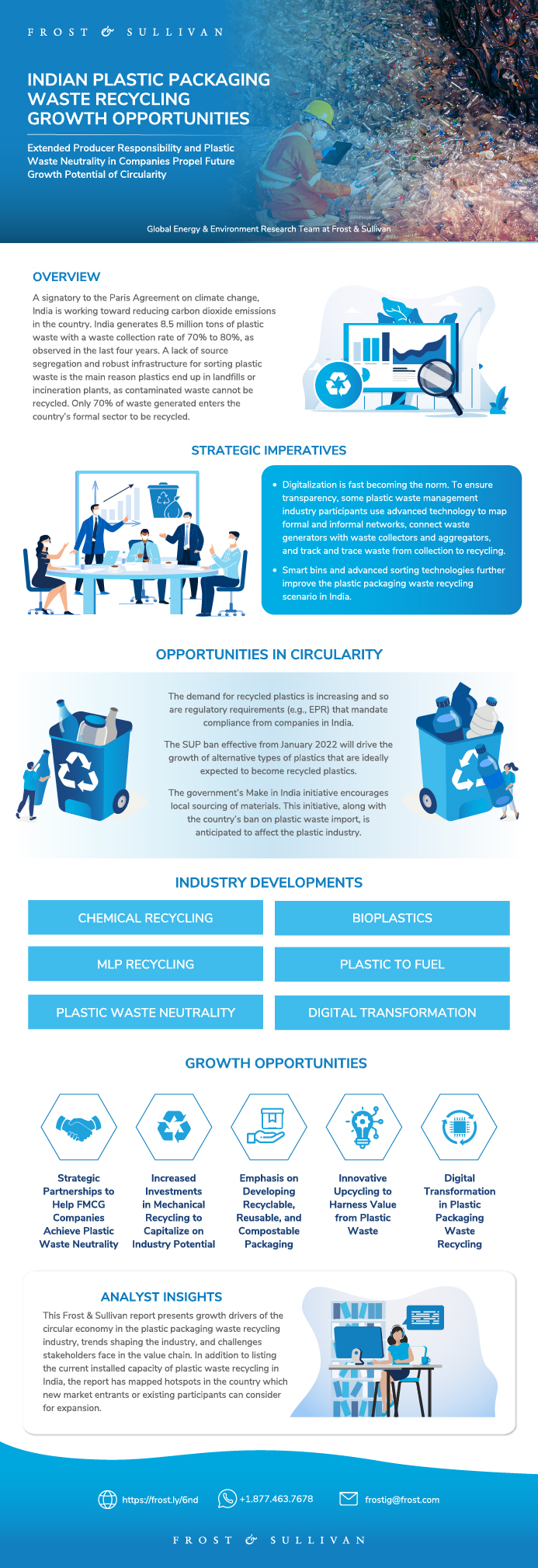
A signatory to the Paris Agreement on climate change, India is working toward reducing carbon dioxide emissions in the country. India generates 8.5 million tons of plastic waste with a waste collection rate of 70% to 80% as observed in the last four years. A lack of source segregation and robust infrastructure for sorting plastic waste is the main reason plastics end up in landfills or incineration plants as contaminated waste cannot be recycled. Only 70% of waste generated enters the country’s formal sector to be recycled. Waste generators have shown considerable improvement in waste management awareness, but to achieve required outcomes and transition into a circular economy, the government needs to provide incentives in the form of policy support and subsidies.
Both flexible and rigid packaging accounted for an estimated 59% of plastics produced in India in 2021. India’s regulations on extended producer responsibility (EPR) reflect the government’s strict approach in putting the responsibility of post-consumer plastic waste management on the producers, importers, and brand owners that introduce plastics into the economy. The government’s ban on single-use plastics taking effect in January 2022 is another step to promote circularity in the plastic packaging waste recycling ecosystem.
This Frost & Sullivan report presents growth drivers of the circular economy in the plastic packaging waste recycling market, trends shaping the market, and challenges stakeholders face in the value chain. In addition to listing the current installed capacity of plastic waste recycling in India, the report has mapped hotspots in the country which new market entrants or existing participants can consider for expansion. The report discusses the market’s competitive environment, revenue potential, and growth opportunities for market participants. The value propositions of key participants that have contributed to the market’s transformation are also profiled in the report.
Key Issues Addressed
- What is the current status of the plastic packaging waste recycling market in India?
- What are the growth drivers and restraints affecting the market? What are the competitive factors in this market?
- Is the market growing? How long and fast will it grow?
- What are the primary regulations affecting the market?
- Which growth regions are suitable for plastic waste recyclers to achieve logistical cost advantages?
- How competitive is the market? Who are the main participants and what are their innovative business models or solutions?
- How are revenues expected to change from 2022 to 2030?
- What avenues are available for strategic investments in the plastic packaging waste recycling value chain? How can key stakeholders contribute to circularity?
Why Is It Increasingly Difficult to Grow?
The Strategic Imperative 8™
The Impact of the Top Three Strategic Imperatives on the Indian Plastic Packaging Waste Recycling Market
Growth Opportunities Fuel the Growth Pipeline Engine™
Scope of Analysis
Key Growth Metrics
Overview of India and its Plastic Waste Management
Plastic Packaging Waste Recycling in India
Circularity in Plastic Packaging Waste Recycling
Circularity in Plastic Packaging Waste Recycling (continued)
Opportunities and Challenges in Circularity
Impact Mapping of Opportunities and Challenges in Circularity
Demand for Plastics by End-user Sector/Application
Packaging Polymer Types and Their Recycling Status
Recycling Types and Their Circularity Potential
Regulatory Frameworks for Plastic Waste
EPR Promotes Formal Waste Management and Circularity
EPR Scheme Explained
Trends in the Plastic Packaging Waste Recycling Market
Regional Initiatives in Plastic Packaging Waste Recycling
Market for Recycled Plastics
Generated and Collected Plastic Waste Volume Forecast
Plastic Waste Volume Forecast by Process
Recyclable Waste Volume Forecast
Recyclable Waste Revenue Forecast
Key Stakeholders and Their Influence in the Future Value Chain
Companies to Watch Out For
Companies to Watch Out For (continued)
Companies to Watch Out For (continued)
Companies to Watch Out For (continued)
Growth Opportunity 1—Strategic Partnerships to Help FMCG Companies Achieve Plastic Waste Neutrality
Growth Opportunity 1—Strategic Partnerships to Help FMCG Companies Achieve Plastic Waste Neutrality (continued)
Growth Opportunity 2—Increased Investments in Mechanical Recycling to Capitalize on Market Potential
Growth Opportunity 2—Increased Investments in Mechanical Recycling to Capitalize on Market Potential (continued)
Growth Opportunity 3—Emphasis on Developing Recyclable, Reusable, and Compostable Packaging
Growth Opportunity 3—Emphasis on Developing Recyclable, Reusable, and Compostable Packaging (continued)
Growth Opportunity 4—Innovative Upcycling to Harness Value from Plastic Waste
Growth Opportunity 4—Innovative Upcycling to Harness Value from Plastic Waste (continued)
Growth Opportunity 5—Digital Transformation in Plastic Packaging Waste Recycling
Growth Opportunity 5—Digital Transformation in Plastic Packaging Waste Recycling (continued)
Regional Hotspots for Recycling
Regional Installed Base of Plastics Manufacturers
Regional Installed Base of Plastics Manufacturers (continued)
Plastic Packaging Waste Recycling Value Chain—Key Participants
Plastic Packaging Waste Recycling Value Chain—Key Participants (continued)
List of Exhibits
List of Exhibits (continued)
Legal Disclaimer
Speak directly with our analytics experts for tailored recommendations.
Recent related Environment research
02 Oct 2026 | Global | Technology Research
Innovations in Carbon Capture, Waste Conversion, Wastewater Treatment, Bioreactors, Artificial Protein and Plastic Recycling
This edition of the Industrial Bioprocessing TOE features information on carbon capture, waste conversion, wastewater treatment, bioreactors, artificial protein and plastic recycling among others.The Industrial Bioprocessing TOE provides intelligence on technologies, processes and strategic insights...
25 Sep 2026 | South Asia, Middle East & North Africa | Market Research
Circular Economy for Used Electrical and Electronic Equipment (Used EEE) and ITAD Services Market, India, 2025–2032
The circular economy for used electrical and electronic equipment (used EEE) in India is experiencing transformational growth as an expanding domestic electronics manufacturing industry, rapid digitalization, and shorter electronics replacement cycles intersect with a stricter policy environment and...
22 Sep 2026 | Europe | Strategic Imperatives
Top 8 Strategic Imperatives for the Membrane-Based Water & Wastewater Treatment Systems Market, Europe, 2026
Europe has been faced with unprecedented heatwaves and droughts triggered by climate change. This has affected surface and groundwater availability across regions, leading to water use restrictions and investment in water reuse infrastructure.Southern European countries such as Spain, Cyprus, Malta,...
17 Sep 2026 | Asia Pacific | Frost Radar
Frost Radar™: Facility Management in Malaysia, 2026
Malaysia's facility management (FM) market is transitioning from labor-intensive, compliance-driven service delivery to technology-enabled, outcome-oriented, and sustainability-integrated operating models. Competitive differentiation increasingly depends on providers’ ability to combine integrated F...
16 Sep 2026 | Europe | Frost Radar
Frost Radar™: European Membrane-Based Water and Wastewater Treatment Systems, 2026
Most parts of Europe face recurring droughts as below-average rainfall combined with heatwaves exacerbate water stress. The latest revision of European Union wastewater directives has driven nations to invest in tertiary treatment of wastewater and proactively encouraged water reuse to meet agricult...
Purchase includes:
- Report download
- Growth Dialog™ with our experts
Growth Dialog™
A tailored session with you where we identify the:- Strategic Imperatives
- Growth Opportunities
- Best Practices
- Companies to Action
Impacting your company's future growth potential.
Key Issues Addressed
- What is the current status of the plastic packaging waste recycling market in India
- What are the growth drivers and restraints affecting the market What are the competitive factors in this market
- Is the market growing How long and fast will it grow
- What are the primary regulations affecting the market
- Which growth regions are suitable for plastic waste recyclers to achieve logistical cost advantages
- How competitive is the market Who are the main participants and what are their innovative business models or solutions
- How are revenues expected to change from 2022 to 2030
- What avenues are available for strategic investments in the plastic packaging waste recycling value chain How can key stakeholders contribute to circularity
| Deliverable Type | Market Research |
|---|---|
| Author | Saraswathi Venkatesan |
| GPS Codes | 9307-A4 |
| Industries | Environment |
| No Index | No |
| Is Prebook | No |
| Podcast | No |
| WIP Number | PBA3-01-00-00-00 |
Indian Plastic Packaging Waste Recycling Growth Opportunities
$2,450.00
Special Price $1,837.50 save 25 %