 USD
 GBP
 CNY
 EUR
 INR
 JPY
 MYR
 ZAR
 KRW
 THB


Global Healthcare Data Interoperability Growth Opportunities Forecast to 2028
Systems to Move Beyond Integration Toward Semantic Interoperability
21-Dec-2023
North America
Market Research
K94E-01-00-00-00
HC_2023_484
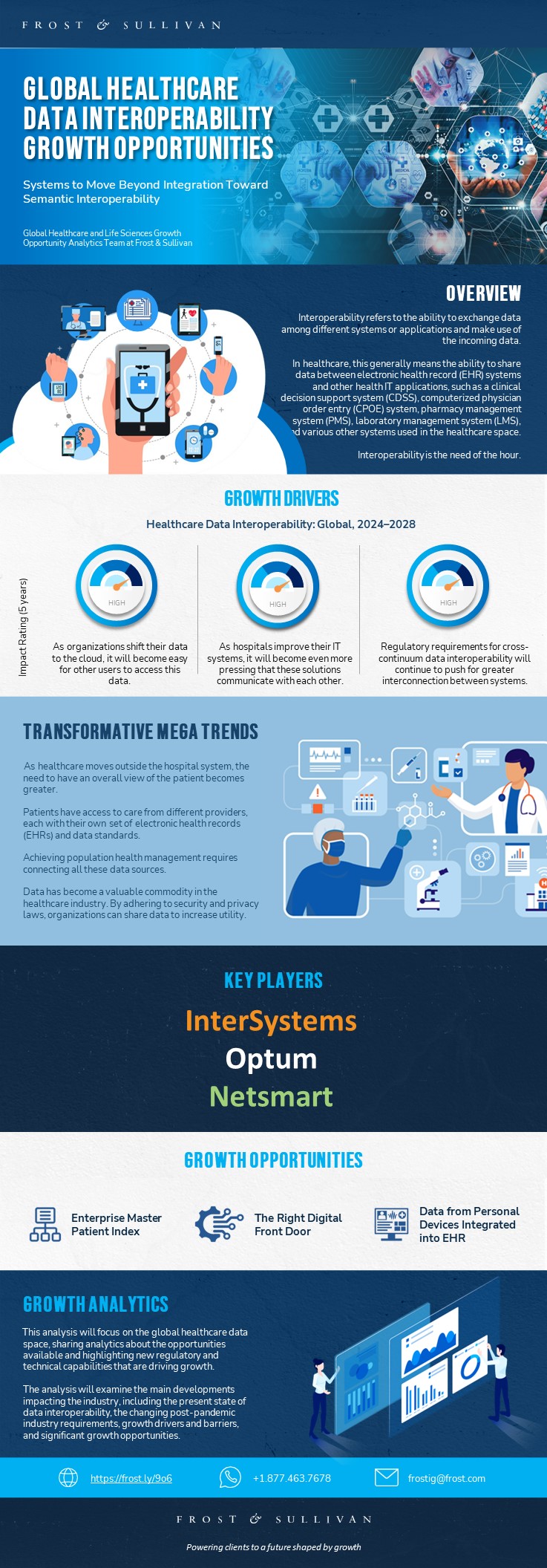
Interoperability refers to the ability to exchange data among different systems or applications and make use of the incoming data. In healthcare, this generally means the ability to share data between electronic health record (EHR) systems and other health IT applications, such as a clinical decision support system (CDSS), computerized physician order entry (CPOE) system, pharmacy management system (PMS), laboratory management system (LMS), and various other systems used in the healthcare space.
While the ultimate need is to develop semantic systems, interoperability is currently most efficiently achieved through application program interfaces (APIs). APIs can be defined to provide access to basic data sets all the way to complete program processes. These codes can be developed and provided by application vendors or developed by third parties. Meanwhile, to achieve semantic interoperability, there is increased emphasis on sharing data in a standard format. The Fast Healthcare Interoperability Resources (FHIR) standard has received new rules and promotion by the US government's Department of Health and Human Services. Developed by the Health Level 7 organization, FHIR provides a framework for data exchange that, while currently limited in its ability to handle unstructured data, still provides a foundation on which to build more robust data exchanges.
Interoperability is the need of the hour. As the data generated by different health IT applications grows exponentially, there is a need to make systems understand the data and provide actionable insights to end users. To achieve interoperability, major healthcare stakeholders acknowledge the need to invest in digital infrastructure capabilities that facilitate cross-continuum patient information exchange and support evidence-based care. Regulatory agencies are also embracing policies that advocate for major health IT vendors to become fully interoperable with one another. The objective is to drive a progressive digital healthcare approach, one that is standardized, collaborative, and multi-disciplinary yet modular and API-based. To achieve the desired future state and adhere to the policies/rules developed by the US Centers for Medicare and Medicaid Services (CMS) and Office of the National Coordinator for Health Information Technology (ONC), the healthcare ecosystem needs to overcome financial and technological challenges.
The market is driven by strong growth in the data integration and enterprise data exchange segments. The newer segment, the enterprise master patient index, is gradually gaining pace and will witness the fastest growth during the forecast period (2024–2028). Regionally, the United States and Europe will command the largest revenue share, with Asia-Pacific gradually catching up with Europe. Technology vendors and ICT companies support government and industry players to improve patient data accessibility globally.
Interoperability will lead to accessing data from wearables and establishing two-way communication with patients, orchestrated by digital front doors. Further, technological evolution, especially the use of dynamic AI (machine learning, natural language processing, conversational AI, and generative AI), will accelerate the process of data conversion between different standards and decipher meaning from the incoming data. Interoperability market growth will be driven by joint efforts among policy-makers and all decision-making stakeholders involved in technology development, procurement, and utilization.
This study will focus on the global healthcare data market, sharing insights about the opportunities available and highlighting new regulatory and technical capabilities that are driving growth. The report will analyze the main trends impacting the market, including the present state of data interoperability, the changing post-pandemic market requirements, growth drivers and barriers, and significant growth opportunities. In addition, the report will profile leading vendors and new entrants that are making headway in this space.
Author: Nitin Manocha
Why is it Increasingly Difficult to Grow?
The Strategic Imperative 8™
The Impact of the Top 3 Strategic Imperatives on the Healthcare Data Interoperability Market
Growth Opportunities Fuel the Growth Pipeline Engine™
Scope of Analysis
Different Views of the Market
Market Segmentation by Modular Applications
Interoperability Overview—Introduction
Interoperability Overview—Industry Convergence Leads to New Growth Opportunities
Stakeholder Interplay in Patient Data Exchange
Efficiency Gains with Interoperability
Measures to Achieve Interoperability
Measures to Achieve Interoperability (continued)
Primary Challenges Pulling the Interoperability Behind
Main Factors Driving Data Interoperability Initiatives
Evolving Regulatory Mandates
Regulatory Mandates—2020
Regulatory Mandates—2022
Regulatory Mandates—2022 (continued)
Regulatory Mandates—2023
Evolving Regulatory Mandates
Global Regulation for Interoperability
Growth Metrics
Growth Drivers
Growth Restraints
Forecast Assumptions
Revenue Forecast
Revenue Forecast Discussion
Revenue Forecast by Segment
Revenue Forecast Discussion by Segment
Revenue Forecast by Region
Revenue Forecast Discussion by Region
Competitive Environment
Key Competitors
Revenue Share
Market Share Analysis
Companies to Action—Optum
Companies to Action—Salesforce
Companies to Action—InterSystems
Companies to Action—Oracle
Role of Big Tech Companies in Advancing Interoperability
Growth Metrics
Revenue Forecast
Revenue Forecast by Region
Revenue Forecast Discussion
Growth Metrics
Revenue Forecast
Revenue Forecast by Subsegment
Revenue Forecast by Region
Revenue Forecast Discussion
Growth Metrics
Revenue Forecast
Revenue Forecast by Region
Revenue Forecast Discussion
Growth Opportunity 1: Enterprise Master Patient Index
Growth Opportunity 1: Enterprise Master Patient Index (continued)
Growth Opportunity 2: Generative AI-based Solutions to Speed Interoperability Initiatives
Growth Opportunity 2: Generative AI-based Solutions to Speed Interoperability Initiatives (continued)
Growth Opportunity 3: The Right Digital Front Door
Growth Opportunity 3: The Right Digital Front Door (continued)
Growth Opportunity 4: Data from Personal Devices Integrated into EHR
Growth Opportunity 4: Data from Personal Devices Integrated into EHR (continued)
Your Next Steps
Why Frost, Why Now?
List of Exhibits
Legal Disclaimer
Speak directly with our analytics experts for tailored recommendations.
Recent related Healthcare research
19 Nov 2026 | Global | Technology Research
Programmable Vaccines: AI-Designed Antigens and Next-Generation Rapid Platforms
Traditional vaccine development is an empirical, time-consuming process that often leads to a high failure rate. With the proven clinical success of RNA vaccines, there has been a focus on accelerating the development of vaccines to address the growing incidence of infectious diseases and emerging p...
17 Nov 2026 | Global | Frost Radar
Frost Radar™: Quantum-Grade Sensor Technology Ecosystem for Healthcare Applications, 2026
Quantum-grade sensors are advancing healthcare by leveraging quantum phenomena to enable highly sensitive, precise, and non-invasive measurements of biological signals and physiological parameters. These innovations enhance diagnostic accuracy, disease monitoring, brain activity measurement, and ear...
16 Nov 2026 | North America | Frost Radar
Frost Radar™: Healthcare Data Interoperability Platforms and Integration Engines in North America, 2026
This Frost Radar™ analyzes the healthcare data platform and integration engine vendors that enable healthcare organization to improve the exchange, utilization, contextualization, and management of clinical, operational, financial, and administrative data. Data issues, AI adoption, and solution gove...
03 Nov 2026 | North America | Market Research
Enterprise Imaging Market, United States, 2025–2030
Enterprise imaging is no longer a technology upgrade. It is becoming the operating model for imaging across the provider organization, and the next investment cycle will decide which vendors lead it. This study gives vendors, ecosystem partners, and provider leaders a 360-degree view of that shift, ...
02 Nov 2026 | Global | Market Research
Continuous Glucose Monitoring Market, Global, 2026
The global continuous glucose monitoring (CGM) market is undergoing a fundamental transformation as the technology evolves from a prescription-led glucose monitoring device into an AI-connected metabolic intelligence ecosystem. Market expansion is increasingly driven by the emergence of over-the-cou...
Purchase includes:
- Report download
- Growth Dialog™ with our experts
Growth Dialog™
A tailored session with you where we identify the:- Strategic Imperatives
- Growth Opportunities
- Best Practices
- Companies to Action
Impacting your company's future growth potential.