 USD
 GBP
 CNY
 EUR
 INR
 JPY
 MYR
 ZAR
 KRW
 THB


Growth Opportunities in Real-Time Location Systems in the Healthcare Industry, Forecast to 2031
Operational Efficiency, Connected Healthcare Ecosystems, and AI-Enabled Intelligence Are Driving Transformational Growth in Healthcare RTLS
24-Aug-2026
Global
Market Research
KCD9-01-00-00-00
HC_2026_34836
Key Takeaways: Real-Time Location Systems (RTLS) Market in Healthcare
- The real-time location systems (RTLS) market in healthcare is evolving from basic asset tracking toward integrated platforms that support workflow optimization, patient safety, workforce productivity, and operational intelligence.
- The global Real-Time Location Systems Market is forecast to grow from $2,381.5 million in 2025 to $5,937.0 million by 2031, representing a 16.4% revenue CAGR.
- Healthcare providers are increasingly adopting RTLS as an enterprise-wide technology integrated with electronic health records (EHR), nurse call systems, computerized maintenance management systems (CMMS), and other healthcare applications.
- The market covers Wi-Fi, UWB, ultrasound, infrared, and BLE technologies, along with hardware, software, and services.
- Key applications include staff location and workflow optimization, asset tracking and management, safety and security, and infection control and hygiene monitoring.
- AI-enabled analytics, cloud platforms, and hybrid RTLS architectures are expanding the value proposition from location visibility to predictive and operational intelligence.
- North America remains the largest regional market, while Asia-Pacific is identified as an emerging growth region due to healthcare digitization and infrastructure investment.
- Major growth drivers include improving patient-care delivery, healthcare modernization, hybrid RTLS architectures, managed services, workforce challenges, and increased demand for operational efficiency.
- Market restraints include integration complexity, uncertain ROI, cybersecurity and privacy requirements, high initial costs, and staff adoption challenges.
- The competitive environment includes more than 50 companies with revenue above $1 million, with the top five accounting for 26.1% of 2025 revenue.
Report Summary: Real-Time Location Systems (RTLS) Market in Healthcare
The real-time location systems (RTLS) market in healthcare is evolving beyond traditional asset tracking toward intelligent location platforms that enable real-time visibility, workflow optimization, and operational decision-making across healthcare environments. Healthcare providers are increasingly deploying RTLS as an enterprise-wide technology supporting patient flow, workforce productivity, asset utilization, and safety applications.
A defining market shift is the transition from isolated RTLS deployments toward integrated healthcare platforms combining high-precision location technologies, interoperable software, and AI-enabled analytics. Healthcare organizations are prioritizing hybrid location architectures, cloud-enabled platforms, and integrations with electronic health records, nurse call systems, computerized maintenance management systems, and other healthcare applications.
The Real-Time Location Systems Market covers Wi-Fi, UWB, ultrasound, infrared, and BLE technologies, together with hardware, software, and services. Applications include staff location and workflow optimization, asset tracking and management, safety and security, and infection control and hygiene monitoring.
The global market is forecast to increase from $2,381.5 million in 2025 to $5,937.0 million by 2031, representing a 16.4% CAGR. North America remains the largest market, while Asia-Pacific is emerging as a growth region. Revenue growth is increasingly supported by software platforms, AI-enabled applications, managed services, and enterprise-wide RTLS strategies.
Analyst's Words: Real-Time Location Systems (RTLS) Market in Healthcare
Tanuja Sahay, Project Manager, Global RTLS Market in Healthcare Industry
“The Healthcare RTLS industry is evolving from infrastructure-centric deployments toward integrated, cloud-enabled platforms that combine hardware, software, analytics, and recurring services. Advances in AI, interoperability, and evolving healthcare compliance requirements are expanding RTLS beyond traditional tracking into a strategic platform for workflow optimization, patient safety, and data-driven hospital operations.”
Top 3 Growth Perspectives
- AI-Driven Operational Intelligence Will Become the Next Value Pool: Traditional location tracking is increasingly becoming a baseline capability. Future opportunities are expected to center on AI-enabled workflow optimization, predictive analytics, and decision support that transform RTLS data into measurable operational outcomes.
- Platform Ecosystems Will Outperform Product-Centric Strategies: The market is moving toward interoperable healthcare platforms, strategic partnerships, and AI-enabled applications rather than standalone hardware offerings.
- Healthcare Workforce Challenges Will Sustain Long-Term RTLS Demand: Clinician shortages, increasing patient volumes, and pressure to improve productivity are supporting demand for solutions that automate workflows, optimize staff utilization, and reduce operational inefficiencies.
Market Overview & Trends: Real-Time Location Systems (RTLS) Market in Healthcare
The real-time location systems (RTLS) market in healthcare is undergoing a structural transition from standalone location tracking toward integrated healthcare intelligence platforms. Traditionally, RTLS deployments focused primarily on identifying the location of medical equipment, staff, patients, or other assets. The market is now expanding toward workflow optimization, operational visibility, safety, and measurable productivity improvements.
One of the strongest trends in the Real-Time Location Systems Market is the integration of location intelligence with healthcare IT infrastructure. Healthcare providers are increasingly connecting RTLS platforms with EHR systems, nurse call platforms, CMMS solutions, and other enterprise applications. These integrations allow location information to become part of broader operational workflows rather than remaining within a separate tracking environment.
Another important trend is the adoption of hybrid RTLS architectures. Healthcare facilities have different requirements for accuracy, coverage, infrastructure, and application use cases. Wi-Fi, UWB, BLE, ultrasound, and infrared technologies can therefore be deployed according to specific facility and application requirements. The source indicates that hybrid architectures can improve the accuracy-cost trade-off and accelerate ROI.
Cloud-enabled platforms and managed services are also becoming increasingly important. Rather than relying exclusively on self-managed infrastructure, healthcare organizations are moving toward scalable platforms and service-based deployment models.
AI and analytics are further changing the market. Location data can support predictive analytics, workflow optimization, staff utilization, asset management, and operational decision-making. This evolution is shifting the market value proposition from “where is the asset?” toward “what should the healthcare organization do with the location intelligence?”
Regional development is another important market trend. North America remains the largest market, supported by mature healthcare IT infrastructure and smart-hospital investments. Europe, the Middle East, and Africa are emphasizing patient safety, compliance, and healthcare modernization, while Asia-Pacific is emerging through hospital digitization and expanding healthcare infrastructure.
Scope of Analysis: Real-Time Location Systems (RTLS) Market in Healthcare
The real-time location systems (RTLS) market in healthcare covers technologies, components, applications, facility types, and regions associated with real-time tracking and location intelligence within healthcare environments.
RTLS uses IoT sensors, tags, and specialized software to track the real-time location of medical equipment, patients, and staff within hospitals and clinics. The study covers hardware, software, and services, reflecting the evolution of the market from self-managed deployments toward RTLS-as-a-Service models.
The technology scope includes:
- Wi-Fi
- Ultra-Wideband (UWB)
- Ultrasound
- Infrared
- Bluetooth Low Energy (BLE)
The application scope includes:
- Staff Location & Workflow Optimization
- Asset Tracking & Management
- Safety & Security
- Infection Control & Hygiene Monitoring
The facility segmentation includes large hospitals, medium hospitals, and small hospitals.
The geographic scope is global and includes:
- North America
- Asia-Pacific
- Europe, Middle East & Africa
- Latin America
The study period covers 2025–2031, with 2025 as the base year and the forecast extending through 2031. The monetary unit is US dollars.
The source also notes that RTLS requirements vary according to facility type, with some specialist healthcare environments requiring sub-room-level precision while other applications can operate effectively with zonal-level tracking.
Market Segmentation Analysis: Real-Time Location Systems (RTLS) Market in Healthcare
The Real-Time Location Systems Market in healthcare is segmented across technology, components, applications, facility type, and region. This structure reflects the diverse technical and operational requirements of hospitals and healthcare facilities.
By Technology
Wi-Fi is an important RTLS technology because it can leverage existing wireless infrastructure within healthcare facilities. It can support location applications where integration with existing connectivity infrastructure is important.
UWB supports high-precision tracking and is particularly relevant for applications requiring detailed location information. High accuracy makes UWB suitable for specialized healthcare environments and workflow applications.
Ultrasound provides another location technology for environments where precise positioning is required. It can support specific room-level and asset-tracking applications.
Infrared can be used for location identification in controlled indoor environments and specialized tracking scenarios.
BLE provides a flexible option for connected healthcare devices and location tags. Its applicability across connected-device environments supports its role in hybrid RTLS architectures.
By Components
The market includes hardware, software, and services. Hardware encompasses the physical infrastructure required for tracking and location capture. Software provides the platforms and applications used to process location information. Services support deployment, integration, management, and ongoing operation.
The increasing adoption of managed services is changing the commercial structure of the real-time location systems (RTLS) market in healthcare, as providers seek customizable and scalable solutions.
By Application
Staff Location & Workflow Optimization is becoming increasingly important as healthcare organizations seek to improve workforce utilization and reduce operational inefficiencies.
Asset Tracking & Management enables hospitals to improve visibility and utilization of medical equipment and other assets.
Safety & Security applications use location information to support healthcare personnel, patients, and facility security.
Infection Control & Hygiene Monitoring provides location intelligence that can support healthcare safety and infection-management processes.
By Facility Type
The market includes large hospitals, medium hospitals, and small hospitals. Requirements vary by facility size, infrastructure, operational complexity, and desired location precision.
By Region
The study covers North America, APAC, EMEA, and LATAM. North America remains the largest market, while APAC is identified as an emerging growth region. EMEA continues to emphasize modernization, safety, compliance, and digital healthcare infrastructure, while LATAM provides longer-term opportunities as healthcare providers progressively modernize their operations.
Revenue & Spending Forecast: Real-Time Location Systems (RTLS) Market in Healthcare
The global real-time location systems (RTLS) market in healthcare is forecast to expand substantially during 2025–2031. According to the supplied Frost & Sullivan data, global revenue was approximately $2,381.5 million in 2025 and is projected to reach $5,937.0 million by 2031.
The forecast represents a 16.4% revenue CAGR over the 2025–2031 period.
Revenue expansion is being supported by increasing adoption of RTLS for operational efficiency, workflow optimization, asset utilization, patient safety, and workforce productivity. The source also highlights the growing contribution of software platforms, AI-enabled applications, recurring managed services, and enterprise-wide deployments.
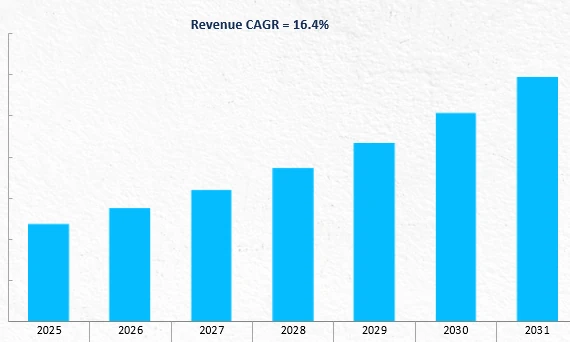
The movement toward integrated platforms can increase the addressable value of the Real-Time Location Systems Market, as healthcare organizations increasingly seek solutions that connect location intelligence with existing digital infrastructure.
Growth Drivers: Real-Time Location Systems (RTLS) Market in Healthcare
Improving Patient-Care Delivery and Operational Efficiency
Healthcare providers are increasingly seeking technologies that can improve patient flow, reduce asset-search costs, optimize workforce utilization, and improve operational efficiency. RTLS can provide real-time visibility into people and assets, supporting more coordinated healthcare workflows.
Healthcare Modernization and Digital Health Programs
The growth of healthcare modernization expenditure and nationwide digital-health initiatives is creating an enabling environment for RTLS. As hospitals expand their digital infrastructure, location intelligence can become integrated into broader healthcare technology ecosystems.
Hybrid RTLS Architectures
Hybrid architectures combining BLE, UWB, Wi-Fi, and RFID can help healthcare organizations balance accuracy, coverage, infrastructure requirements, and cost. This flexibility can support broader deployment across different hospital environments.
Shift Toward Managed Services
The movement from self-managed deployments toward fully managed services can reduce the need for healthcare organizations to maintain specialized internal resources. Managed models can also provide customization and ongoing support.
Workforce Challenges
Clinician shortages, increasing patient volumes, and workforce productivity pressures are supporting demand for technologies that can automate workflows and improve staff utilization. The real-time location systems (RTLS) market in healthcare can address these requirements by providing visibility into workforce movement and operational processes.
Aging Population and Patient Safety
The growing and aging population, together with the increasing prevalence of dementia, can increase demand for RTLS-enabled fall prevention, wander management, and patient-safety applications.
Patient Satisfaction and Reimbursement
The source identifies improved reimbursements linked to patient satisfaction scores as another demand factor. RTLS applications that reduce wait times and improve care coordination can support operational initiatives associated with patient experience.
Growth Restraints: Real-Time Location Systems (RTLS) Market in Healthcare
Integration Complexity
Integration remains a major challenge for the Real-Time Location Systems Market. Fully leveraging RTLS may require integration with EHR, CMMS, nurse call, and other healthcare systems. Legacy environments can increase implementation complexity.
ROI Uncertainty
Some healthcare organizations remain cautious about RTLS investments because the technology can operate as a separate integration layer. Inadequate vendor support after deployment and system interference can further affect perceived ROI.
Compliance, Privacy, and Cybersecurity
RTLS deployments generate real-time information about patients, staff, assets, and facility operations. Healthcare organizations therefore need to address regulatory compliance, labor laws, data privacy, cybersecurity, and other requirements to ensure appropriate system operation.
High Initial Investment
The source indicates that RTLS services are predominantly high-Capex-based, particularly affecting smaller healthcare providers. High initial deployment costs can delay adoption where budgets are constrained.
Staff Adoption and Implementation Burden
RTLS deployment can increase the operational burden on healthcare staff during implementation. Training, workflow changes, system adoption, and vendor support requirements can affect deployment success.
Vendor Lock-In
Dependence on specific technology platforms or vendors can create long-term integration challenges. Healthcare organizations may need to evaluate interoperability and flexibility when building enterprise-wide RTLS strategies.
Competitor Landscape: Real-Time Location Systems (RTLS) Market in Healthcare
The competitive environment of the real-time location systems (RTLS) market in healthcare is characterized by more than 50 companies with revenue greater than $1 million, according to the provided Frost & Sullivan research. Competition is shaped by cost, performance, technical support, technology capabilities, reliability, contractor relationships, and customer relationships.
The leading competitors identified in the research include Zebra Technologies, CenTrak (Halma), HID Global, Securitas Healthcare (Stanley Healthcare), Kontakt.io, and TeleTracking Technologies. Other notable participants include Midmark Corporation, Litum Technologies, AiRISTA Flow, and Sonitor Technologies.
The market serves large hospitals with more than 300 beds, medium hospitals with 100–300 beds, and small hospitals with 10–100 beds. Different facility types can require different levels of location accuracy, infrastructure coverage, integration, and deployment support.
The distribution structure includes full-stack integrators, value-added resellers, system integrators, local resellers, direct sales, hospitals, and healthcare systems. This diversified structure reflects the technical complexity of deploying RTLS across healthcare environments and the importance of implementation and integration capabilities.
The research identifies several notable corporate transactions. Halma plc acquired CenTrak, while Securitas acquired Stanley Healthcare and Zulafly. Such transactions illustrate continued activity around healthcare technology portfolios and connected-location capabilities.
Competitive differentiation is increasingly extending beyond hardware. Providers are emphasizing software functionality, interoperability, analytics, cloud platforms, managed services, AI-enabled workflows, and healthcare application integration. This reflects the broader transition of the Real-time Location Systems Market from point tracking toward enterprise location intelligence.
The analyst perspective indicates that platform ecosystems may become increasingly important as healthcare organizations seek interoperable solutions rather than isolated tracking products. Strategic partnerships and integration with existing healthcare systems can therefore influence competitive positioning.
The competitive environment is also shaped by the ability to address healthcare-specific requirements, including patient safety, asset utilization, workflow optimization, infection control, cybersecurity, privacy, and regulatory compliance. As RTLS adoption expands, suppliers capable of combining location technology with software, analytics, services, and enterprise integration can participate across a broader portion of the healthcare technology value chain.
Scope of Analysis
Segmentation
Market Segment Definitions
Why is it Increasingly Difficult to Grow?
The Strategic Imperative 8™
The Impact of the Top 3 Strategic Imperatives on the RTLS in Healthcare Industry
Growth Metrics
Growth Environment—Market Transformation & Adoption Drivers
Growth Environment—Competitive Dynamics & Strategic Implications
RTLS in Healthcare Industry—Investment Dilemma
RTLS in Healthcare Industry—Proof of Value Chain
Revenue Forecast by Facility Type
Facility Type Forecast Analysis
Revenue Forecast by Component
Revenue Forecast by Component Analysis
Revenue Forecast by Technology Type
RTLS in Healthcare Industry—Technology Type
Technology-Type Forecast Analysis
Revenue Forecast by Application Area
Application Area Forecast Analysis
Pricing Trends and Forecast Analysis
Revenue Share
Revenue Share Analysis
Healthcare RTLS Shift Towards Outcome-Based Services is Significantly Reducing Complexity, Aligning Costs with Realized Outcomes
Global RTLS in Healthcare Pricing Models
Competitive Heatmap by Application Areas
Competitive Heatmap by Technology Type
Competitive Heatmap Analysis
Companies to Watch—Leaders
Companies to Watch—Challengers
Growth Metrics
Revenue and Growth Forecast
Revenue Forecast by Region
Global RTLS in the Healthcare Industry Hardware Revenue Forecast Analysis
Growth Metrics
Revenue and Growth Forecast
Revenue Forecast by Region
Global RTLS in the Healthcare Industry Software Revenue Forecast Analysis
Growth Metrics
Revenue and Growth Forecast
Revenue Forecast by Region
Global RTLS in Healthcare Industry Services Revenue Forecast Analysis
Growth Opportunity 1: Shift from Basic Tracking to AI-Driven Intelligence
Growth Opportunity 2: Industry Consolidation and Ecosystem Expansion
Growth Opportunity 3: Rise of Hybrid Location Architectures
Growth Opportunity 4: Digital Twins for Hospital Operations
Growth Opportunity 5: Rise of Cloud-Hosted RTLS-as-a-Service (RTLSaaS) Platforms
Benefits and Impacts of Growth Opportunities
Next Steps
List of Exhibits
Legal Disclaimer
Frequently Asked Questions: Real-Time Location Systems (RTLS) Market in Healthcare
1. What is the real-time location systems (RTLS) market in healthcare?
The real-time location systems (RTLS) market in healthcare covers hardware, software, and services that use sensors, tags, and specialized platforms to track the real-time location of medical equipment, patients, and staff within hospitals and clinics. Applications include workflow optimization, asset tracking, safety and security, and infection control.
2. What was the size of the RTLS market in healthcare in 2025?
According to the provided Frost & Sullivan research, the global real-time location systems (RTLS) market in healthcare generated approximately $2.38 billion in revenue in 2025.
3. What is the forecast for the RTLS market in healthcare by 2031?
The global Real-time Location Systems Market in healthcare is forecast to reach approximately $5.94 billion by 2031, increasing from approximately $2.38 billion in 2025.
4. What is the CAGR of the real-time location systems market in healthcare?
The global real-time location systems (RTLS) market in healthcare is projected to grow at a compound annual growth rate of approximately 16.4% from 2025 to 2031, according to the provided research.
5. What technologies are covered in the Real-time Location Systems Market?
The Real-time Location Systems Market in healthcare includes Wi-Fi, ultra-wideband (UWB), ultrasound, infrared, and Bluetooth Low Energy (BLE). Hybrid architectures can combine multiple technologies to meet different requirements for precision, coverage, deployment complexity, and cost.
6. What are the major applications of RTLS in healthcare?
Major applications in the real-time location systems (RTLS) market in healthcare include staff location and workflow optimization, asset tracking and management, safety and security, and infection control and hygiene monitoring. These applications support operational efficiency, asset utilization, workforce productivity, and patient safety.
7. Which regions are covered by the healthcare RTLS market?
The global Real-time Location Systems Market in healthcare is segmented into North America, Asia-Pacific, Europe, Middle East & Africa, and Latin America. North America is identified as the largest market, while Asia-Pacific is an emerging growth region supported by healthcare infrastructure expansion and hospital digitization.
8. What are the key growth drivers for the real-time location systems (RTLS) market in healthcare?
Key growth drivers include improving healthcare operational efficiency, smart-hospital infrastructure investments, healthcare digitization, hybrid RTLS architectures, managed services, workforce productivity requirements, patient-safety applications, and the increasing need for better asset utilization and workflow visibility.
9. What are the major restraints affecting the healthcare RTLS market?
Major restraints include integration complexity with EHR and CMMS systems, ROI uncertainty, interference and deployment challenges, cybersecurity and compliance requirements, high initial capital expenditure, and staff burden associated with implementation and technology adoption.
10. How is AI affecting the Real-time Location Systems Market?
AI is expanding the role of RTLS from basic location visibility toward operational intelligence. AI-enabled analytics can support workflow optimization, predictive insights, and decision support, helping healthcare organizations convert location data into measurable operational outcomes. This is contributing to the evolution of the Real-time Location Systems Market toward integrated healthcare intelligence platforms.
Speak directly with our analytics experts for tailored recommendations.
Recent related Digital Health research
16 Nov 2026 | North America | Frost Radar
Frost Radar™: Healthcare Data Interoperability Platforms and Integration Engines in North America, 2026
This Frost Radar™ analyzes the healthcare data platform and integration engine vendors that enable healthcare organization to improve the exchange, utilization, contextualization, and management of clinical, operational, financial, and administrative data. Data issues, AI adoption, and solution gove...
16 Oct 2026 | Global | Technology Research
Innovations and Growth Opportunities in Precision Therapeutics, AI-Enabled Discovery and Bioengineering, Regenerative Medicine, and Next-Generation Vaccine Platforms
This edition of the Life Science, Health & Wellness Technology Opportunity Engine (TOE) provides a comprehensive overview of breakthrough innovations transforming precision therapeutics, regenerative medicine, AI-enabled discovery, laboratory automation, targeted delivery, vaccines, and biomanufactu...
16 Oct 2026 | Global | Market Research
Public Sector Healthcare Cloud Market, North America and Europe, 2026
Public healthcare organizations across North America and Europe are using cloud technologies to support modernization efforts that extend beyond infrastructure replacement. Cloud is increasingly being adopted to improve interoperability, enable secure data sharing, support analytics and AI initiativ...
06 Oct 2026 | Global | Technology Research
Trends in Laboratory Automation, Global, 2021–2025
This research study provides a comprehensive assessment of the recent trends, technological advancements, and strategic developments shaping the global laboratory automation industry. The analysis traces the evolution of laboratory automation from task-specific automation systems to integrated, inte...
25 Sep 2026 | North America | Frost Radar
Frost Radar™: Conversational AI in Patient Engagement in North America, 2026
This Frost Radar™ analyzes conversational AI vendors in the patient engagement space that enable healthcare organizations to improve their efficiency, efficacy, and engagement of one of their significant cost centers. The market is evolving from focal performance capability either in administrative ...
Purchase includes:
- Report download
- Growth Dialog™ with our experts
Growth Dialog™
A tailored session with you where we identify the:- Strategic Imperatives
- Growth Opportunities
- Best Practices
- Companies to Action
Impacting your company's future growth potential.