 USD
USD GBP
GBP  CNY
CNY  EUR
EUR  INR
INR  JPY
JPY  MYR
MYR  ZAR
ZAR  KRW
KRW  THB
THB 


Geopolitical Flashpoints and Trade Fragmentation Risks Heighten the Strategic Imperative for Regionalization and Scenario Planning to Thrive
07-May-2026
Global
Market Research
PLRQ-01-00-00-00
CI_2026_34549
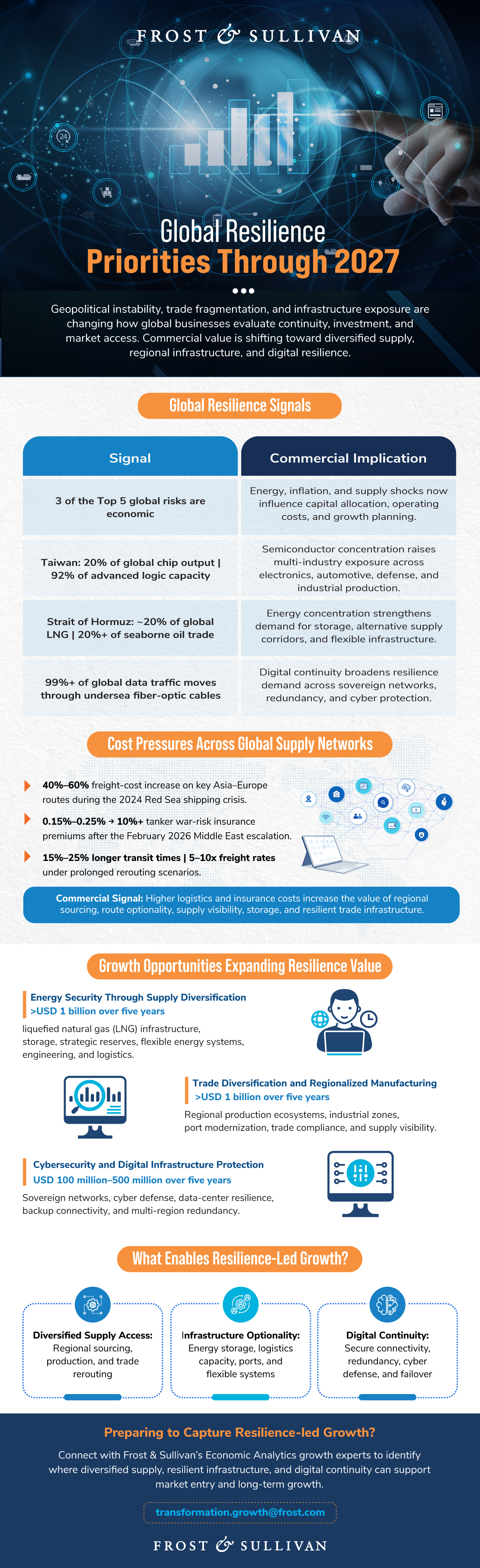
This macroeconomic thought leadership examines the most critical global risks shaping business performance in 2026–2027, with particular focus on the ongoing Middle East conflict and its cascading impacts on energy markets, shipping routes, inflation, and global supply chains. As geopolitical instability, trade fragmentation, and technology regulation intensify, the analysis helps business leaders interpret how conflict-driven shocks, especially across critical chokepoints such as the Strait of Hormuz and Red Sea, are transmitting into higher input costs, policy uncertainty, and operational volatility across regions and industries.
The approach combines structured risk mapping with quantitative and qualitative scoring across economic impact, likelihood, and duration, allowing organizations to compare risks on a common scale and prioritize action. It evaluates macroeconomic, geopolitical, trade, technology, cyber, labor, and energy risks, while embedding industry-level impact assessments for sectors such as semiconductors, automotive, LNG, critical minerals, and global logistics. The analysis highlights where exposure is concentrated, how second-order effects unfold from the Middle East conflict into inflation, energy availability, trade flows, and capital investment, and what mitigation actions can reduce vulnerability.
Beyond risk identification, the analysis demonstrates how disruption is reshaping investment patterns and competitive advantage, revealing growth pathways linked to energy security infrastructure, regional manufacturing realignment, trade rerouting, cybersecurity, and digital infrastructure protection. By aligning global risk intelligence with actionable mitigation and growth strategies, it enables organizations to protect supply continuity, manage cost volatility, and position capital toward resilient, long-term growth in an environment defined by persistent geopolitical stress.
Scope of Analysis
Why is it Increasingly Difficult to Grow?
The Strategic Imperative 8™
The Impact of the Top 3 Strategic Imperatives on the Global Business Environment
Growth Drivers and Restraints
Universal Risk Mapping
Macroeconomic Risks—Drivers
Geopolitical Risks; Trade and Supply Chain Risks—Drivers
Infrastructure, Technology, and Labor Risks—Drivers
Risk Impact, Probability, and Timeline Summary
Risk Scoring
Risk Ranking and Score Summary
Semiconductors
Automotive
Liquefied Natural Gas (LNG)
Critical Minerals
Supply Chain and Logistics
Growth Opportunity 1: Energy Security Through Supply Diversification
Growth Opportunity 2: Trade Diversification and Regionalized Manufacturing
Growth Opportunity 3: Cybersecurity and Digital Infrastructure Protection
Benefits and Impacts of Growth Opportunities
Next Steps
List of Exhibits
Legal Disclaimer
Speak directly with our analytics experts for tailored recommendations.
Recent related Macroeconomics research
07 Oct 2026 | Global | Market Research
Artificial Intelligence and the Transformation of the Global Economic and Business Order, 2035
Artificial intelligence (AI) is emerging as a foundational driver of global economic growth, with private AI investment shifting from experimentation to industrial-scale deployment. Beyond R&D, investment is increasingly directed toward expanding data center capacity, strengthening semiconductor sup...
30 Sep 2026 | Global | Market Research
Global Economic Transformations for 2026 (Q3 Update)
Prolonged geopolitical uncertainty, elevated energy costs, and persistent supply chain and trade disruptions define global economic conditions in Q3 2026. The US-Iran conflict has materially weakened the global growth trajectory, shaving 0.6 percentage points from the 2026 outlook (vs 3.5% in 2025) ...
28 Sep 2026 | Europe | Market Research
Europe Economic Prospects, Macroeconomic Transformations, and Industry Opportunities, 2025–2030
Europe is entering a period of moderate but increasingly strategic growth as governments, businesses, and investors navigate geopolitical uncertainty, evolving trade dynamics, energy transition priorities, and rapid technological advancement. While structural challenges, including demographic pressu...
22 Sep 2026 | Global | Market Research
Global Trade Bloc Transformations, 2040
Accelerating geopolitical fragmentation, industrial policy intervention, and the emergence of regionally aligned trade ecosystems will structurally transform global trade by 2040. As the multilateral trading system weakens and geopolitical alignment increasingly dictates trade flows, resilience-led ...
15 Sep 2026 | South Asia, Middle East & North Africa | Market Research
Future of Growth and Emerging Opportunities in the Gulf Cooperation Council, 2025–2030
The GCC has entered a period of strategic economic transformation as governments accelerate diversification efforts, strengthen economic resilience, and reduce dependence on hydrocarbon revenue amid heightened geopolitical uncertainty and evolving global trade dynamics. While the implications of the...
Purchase includes:
- Report download
- Growth Dialog™ with our experts
Growth Dialog™
A tailored session with you where we identify the:- Strategic Imperatives
- Growth Opportunities
- Best Practices
- Companies to Action
Impacting your company's future growth potential.
The approach combines structured risk mapping with quantitative and qualitative scoring across economic impact, likelihood, and duration, allowing organizations to compare risks on a common scale and prioritize action. It evaluates macroeconomic, geopolitical, trade, technology, cyber, labor, and energy risks, while embedding industry-level impact assessments for sectors such as semiconductors, automotive, LNG, critical minerals, and global logistics. The analysis highlights where exposure is concentrated, how second-order effects unfold from the Middle East conflict into inflation, energy availability, trade flows, and capital investment, and what mitigation actions can reduce vulnerability.
Beyond risk identification, the analysis demonstrates how disruption is reshaping investment patterns and competitive advantage, revealing growth pathways linked to energy security infrastructure, regional manufacturing realignment, trade rerouting, cybersecurity, and digital infrastructure protection. By aligning global risk intelligence with actionable mitigation and growth strategies, it enables organizations to protect supply continuity, manage cost volatility, and position capital toward resilient, long-term growth in an environment defined by persistent geopolitical stress.
| Deliverable Type | Market Research |
|---|---|
| Industries | Cross Industries |
| No Index | No |
| Is Prebook | No |
| Keyword 1 | Global risk mapping |
| Keyword 2 | Enterprise resilience strategies |
| Keyword 3 | Supply chain risk management |
| Podcast | No |
| Predecessor | PFLD-01-00-00-00 |
| WIP Number | PLRQ-01-00-00-00 |