 USD
USD GBP
GBP  CNY
CNY  EUR
EUR  INR
INR  JPY
JPY  MYR
MYR  ZAR
ZAR  KRW
KRW  THB
THB 


Global Smart Water Meter Market, Forecast to 2026
Revenue Incentives and High Demand for Smart Control & Management Drive the Market
29-Jan-2018
Global
Market Research
MD8C-01-00-00-00
EN01030-GL-MR_21297
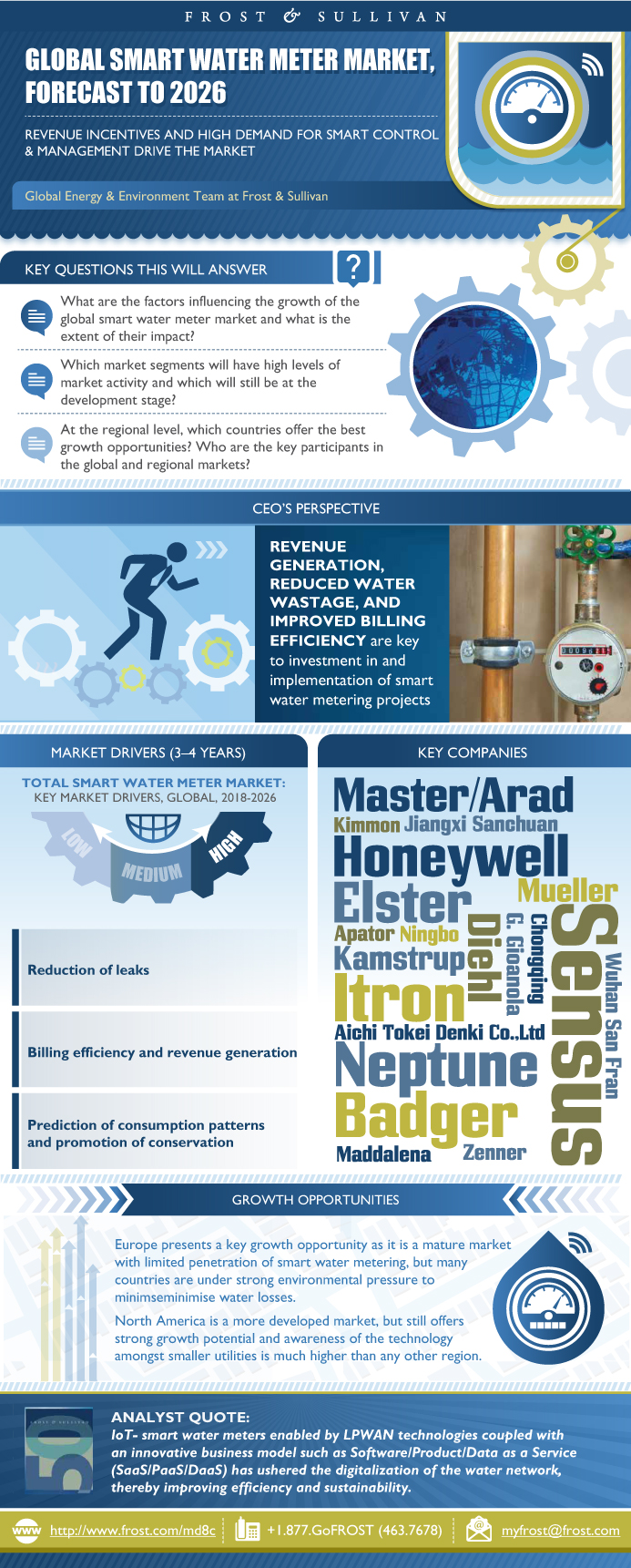
Water stress is a major cause of concern across the globe. Optimal water resource management, reducing leaks, and achieving lower non-revenue water (NRW) are the key challenges faced by utilities or entities managing water allocation. One of the key initiatives to promote water conservation across the globe is the installation of smart water meters. Smart water meters conserve water by monitoring usage and detecting leaks. Additionally, its billing transparency and efficiency helps to effectively address NRW.
Research Scope
The global smart water meter study estimates the revenue in 2017 to be $1.1 billion and the unit shipment, 12.5 million. Frost & Sullivan has presented a breakdown of unit shipment and revenue forecasts for the following regions: North America, South America, EMEA, Asia-Pacific (ex. China), and China. The study also analyses regional hotspots, drivers, restraints, and prominent players, along with their market share in each region. Further, it presents the details of upcoming LPWAN technologies and its impact across regions, and the new business models being aggressively pursued by leading players to enhance their prominence in a highly fragmented and price-sensitive market.
Research Highlights
The key component of the smart water meter is the communication module. Automated meter reading (AMR) and automated metering infrastructure (AMI) are the main technology segments. IoT-enabled AMI smart water meters powered by cellular or non-cellular low power wide area network (LPWAN) technologies are gaining market share due to their efficiency and added advantages like real-time usage data visualization, improved billing efficiency, leak detection, machine to machine communication, and resource optimization.
This global smart water market study provides a detailed analysis of market trends, regional hotspots, and forecasts of unit shipment and revenue trends for the forecast period between 2016 and 2026.
Key Issues Addressed
- What is the current market situation and the forecast market growth rate?
- What are the factors influencing the growth of the global smart water meter market and what is the extent of their impact?
- Which market segments will have high levels of market activity and which will still be at the development stage?
- At the regional level, which countries offer the best growth opportunities?
- Who are the key participants in the global and regional markets?
Executive Summary
Market Engineering Measurements
Market Engineering Measurements (continued)
CEO’s Perspective
Associated Research and Multimedia on Energy & Environment
Market Definitions
Key Questions this Study will Answer
Market Segmentation
Market Drivers
Drivers Explained
Market Restraints
Restraints Explained
Restraints Explained (continued)
Market Engineering Measurements
Market Engineering Measurements (continued)
Unit Shipment and Revenue Forecast
Unit Shipment Forecast by Region
Revenue Forecast by Region
Unit Shipment and Revenue Forecast Discussion
Market Share
Competitive Environment
Growth Opportunity 1—Innovative Business Models
Growth Opportunity 1—IoT-enabled Smart Water Meters
Strategic Imperatives for Success and Growth
LPWAN
Sample of Cellular IoT-based Smart Water MeterProjects, 2016–2017
LPWAN
LPWAN (continued)
Market Engineering Measurements
Market Engineering Measurements (continued)
Unit Shipment and Revenue Forecast
Unit Shipment Forecast by Region
Unit Shipment and Revenue Forecast Discussion
North America—Market Share
Market Engineering Measurements
Market Engineering Measurements (continued)
Unit Shipment and Revenue Forecast
Unit Shipment Forecast by Region
Unit Shipment and Revenue Forecast Discussion
South America—Market Share
Market Engineering Measurements
Market Engineering Measurements (continued)
Unit Shipment and Revenue Forecast
Unit Shipment Forecast by Region
Unit Shipment Forecast by Key European Countries
Unit Shipment and Revenue Forecast Discussion
Unit Shipment and Revenue Forecast Discussion (continued)
Unit Shipment and Revenue Forecast Discussion (continued)
EMEA—Market Share
Market Engineering Measurements
Market Engineering Measurements (continued)
Unit Shipment and Revenue Forecast
Unit Shipment Forecast by Region
Unit Shipment and Revenue Forecast Discussion
Asia-Pacific (Except China) Market Share
Market Engineering Measurements
Market Engineering Measurements (continued)
Unit Shipment and Revenue Forecast
Unit Shipment and Revenue Forecast Discussion
Unit Shipment and Revenue Forecast Discussion
China Market Share
The Last Word—3 Big Predictions
Legal Disclaimer
List of Exhibits
List of Exhibits (continued)
List of Exhibits (continued)
Market Engineering Methodology
Learn More—Next Steps
Speak directly with our analytics experts for tailored recommendations.
Recent related Water research
12 Oct 2026 | Europe | Strategic Imperatives
Top 10 Strategic Imperatives in the European Circular Economy for Used Electrical and Electronic Equipment (EEE) and ITAD Services Sector, 2026
This report examines the key transformations shaping Europe’s circular economy for used electrical and electronic equipment (EEE) and assesses the growth opportunities emerging from these shifts. It analyzes how evolving legal and regulatory frameworks, data security expectations, global supply chai...
02 Oct 2026 | Global | Technology Research
Innovations in Carbon Capture, Waste Conversion, Wastewater Treatment, Bioreactors, Artificial Protein and Plastic Recycling
This edition of the Industrial Bioprocessing TOE features information on carbon capture, waste conversion, wastewater treatment, bioreactors, artificial protein and plastic recycling among others.The Industrial Bioprocessing TOE provides intelligence on technologies, processes and strategic insights...
25 Sep 2026 | South Asia, Middle East & North Africa | Market Research
Circular Economy for Used Electrical and Electronic Equipment (Used EEE) and ITAD Services Market, India, 2025–2032
The circular economy for used electrical and electronic equipment (used EEE) in India is experiencing transformational growth as an expanding domestic electronics manufacturing industry, rapid digitalization, and shorter electronics replacement cycles intersect with a stricter policy environment and...
22 Sep 2026 | Europe | Strategic Imperatives
Top 8 Strategic Imperatives for the Membrane-Based Water & Wastewater Treatment Systems Market, Europe, 2026
Europe has been faced with unprecedented heatwaves and droughts triggered by climate change. This has affected surface and groundwater availability across regions, leading to water use restrictions and investment in water reuse infrastructure.Southern European countries such as Spain, Cyprus, Malta,...
16 Sep 2026 | Europe | Frost Radar
Frost Radar™: European Membrane-Based Water and Wastewater Treatment Systems, 2026
Most parts of Europe face recurring droughts as below-average rainfall combined with heatwaves exacerbate water stress. The latest revision of European Union wastewater directives has driven nations to invest in tertiary treatment of wastewater and proactively encouraged water reuse to meet agricult...
Purchase includes:
- Report download
- Growth Dialog™ with our experts
Growth Dialog™
A tailored session with you where we identify the:- Strategic Imperatives
- Growth Opportunities
- Best Practices
- Companies to Action
Impacting your company's future growth potential.
Research Scope
The global smart water meter study estimates the revenue in 2017 to be $1.1 billion and the unit shipment, 12.5 million. Frost & Sullivan has presented a breakdown of unit shipment and revenue forecasts for the following regions: North America, South America, EMEA, Asia-Pacific (ex. China), and China. The study also analyses regional hotspots, drivers, restraints, and prominent players, along with their market share in each region. Further, it presents the details of upcoming LPWAN technologies and its impact across regions, and the new business models being aggressively pursued by leading players to enhance their prominence in a highly fragmented and price-sensitive market.
Research Highlights
The key component of the smart water meter is the communication module. Automated meter reading (AMR) and automated metering infrastructure (AMI) are the main technology segments. IoT-enabled AMI smart water meters powered by cellular or non-cellular low power wide area network (LPWAN) technologies are gaining market share due to their efficiency and added advantages like real-time usage data visualization, improved billing efficiency, leak detection, machine to machine communication, and resource optimization.
This global smart water market study provides a detailed analysis of market trends, regional hotspots, and forecasts of unit shipment and revenue trends fo
| Deliverable Type | Market Research |
|---|---|
| No Index | No |
| Podcast | No |
| Author | Paul Hudson |
| Industries | Environment |
| WIP Number | MD8C-01-00-00-00 |
| Is Prebook | No |
| GPS Codes | 9307-A4,9596,9B07-C1 |
Global Smart Water Meter Market, Forecast to 2026
$4,950.00
Special Price $3,712.50 save 25 %